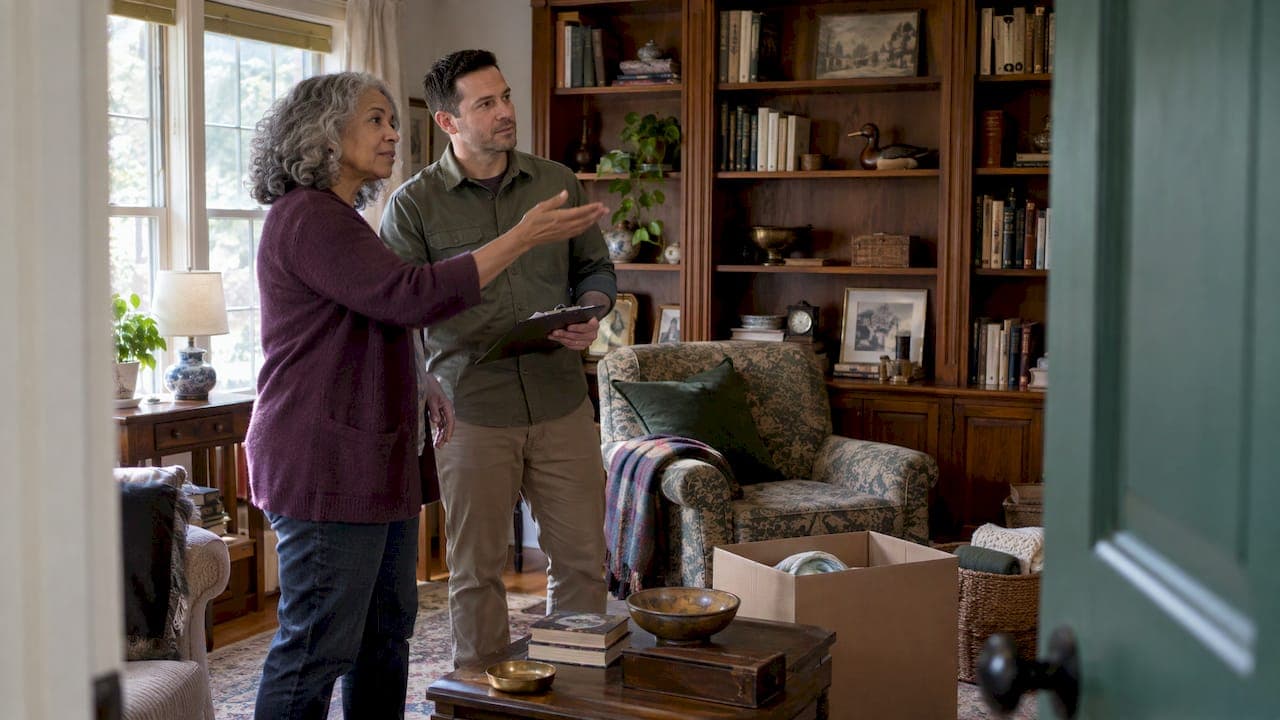
An estate cleanout moves in a fixed order: confirm who has legal authority, secure the home and find key documents, walk through and plan, sort every item into keep, sell, donate or discard, remove what is left, then clean and hand over the property. Most families do the sorting first and the hauling last. The fastest, calmest cleanouts are the ones where the order is respected.
If you are reading this after a loss, you do not have to do it all at once, and you do not have to do it alone. Below is the full process as we run it across New Jersey, with realistic timing, published starting prices and the points where families most often get stuck.
TL;DR
- Confirm your authority as executor or administrator before anything leaves the house. Items are part of the estate until the estate says otherwise.
- Plan first: walk the home, photograph each room, and mark high-volume areas such as the garage, basement and attic.
- Sort into four groups (keep, sell, donate, discard), one room or category at a time, and keep records of what went where.
- Most cleanouts take from a single day to a few days of on-site work; the legal side of an estate usually runs far longer than the cleanout itself.
- Finish with a broom-clean handoff so the property is ready to list, rent or show.
Table of Contents
- Step 1: Confirm who has authority to clear the home
- Step 2: Secure the property and find the documents
- Step 3: Walk through, set goals and build a plan
- Step 4: Sort into keep, sell, donate and discard
- Step 5: Remove what remains
- Step 6: Clean and hand over the property
- How long does an estate cleanout take?
- What does an estate cleanout cost in New Jersey?
- Special situations
- Perspective: why we sort donation first
- Getting help with your estate cleanout
- FAQ
- Sources
Step 1: Confirm who has authority to clear the home
Before you move or donate anything, make sure the right person is making the decisions. In most cases that is the executor named in the will, or an administrator appointed by the court if there is no will. Authority to sell or dispose of estate property comes from the will, from law, or from a court order, and an official county guide on personal representative duties lays out those routes, which vary by state (Houston County, Georgia). New Jersey has its own rules, so confirm yours with the county Surrogate's Office or an estate attorney.
Why it matters: a donation or sale made too early can cause disputes between heirs. If you are an executor and unsure when to start, our guide to probate house cleanouts and authority before donations explains what is safe to do now and what should wait. Our donation-first estate cleanout checklist also marks the point to wait for probate.
Step 2: Secure the property and find the documents
The first visit is about protection, not clearing. Typical tasks:
- Change or rekey the locks and tell the family who holds keys.
- Forward mail so bills, tax notices and account statements are not lost.
- Look for the will, deeds, insurance policies, vehicle titles, bank statements, tax returns and safe deposit keys.
- Remove obvious valuables such as cash, jewelry and firearms paperwork to a safe place, with a written note of who took what.
- Photograph the rooms as they stand.
Papers hide in unexpected places: coat pockets, books, freezers, kitchen drawers. This is why we ask families not to rush a bulk haul before the documents are found. For more on preparing, see finding the will and donating first.
Step 3: Walk through, set goals and build a plan
Planning guidance for estate and probate cleanouts from the National Association of Realtors recommends setting goals, a timeline and decision-makers, then walking the home to identify clear-out zones and safety concerns and documenting what you see with photos or notes (NAR). The same guide suggests treating the house like a project site and flagging high-volume spaces: garages, basements, attics, sheds and storage units.
A useful planning sheet answers five questions:
- Who decides? Name one point person and agree how siblings or heirs will weigh in.
- What is the deadline? A closing date, a lease end, a month of rent being paid, or no deadline at all.
- Which rooms are heaviest? Storage areas usually take longer than bedrooms.
- Are there safety concerns? Pests, mold, blocked exits, medications, chemicals, weak floors.
- Which items matter most to the family? Name them first so they are protected.
Our team does this walkthrough on site and follows it with a firm quote, so you know the number before work begins.
Step 4: Sort into keep, sell, donate and discard
The cleanest method is four categories, worked one floor, room or category at a time (ASEL). Start with the easiest room, usually a bathroom or hall closet, to build momentum, and leave photos, letters and the bedroom for when everyone is ready.
| Category | What goes here | Practical notes |
|---|---|---|
| Keep | Family keepsakes, photos, letters, heirlooms, documents | Label by heir and photograph before moving |
| Sell | Furniture, collectibles, jewelry, tools, art | Use an estate sale, online listing or consignment |
| Donate | Usable clothing, housewares, furniture, books | Get a written receipt for each load |
| Discard | Broken, soiled or unusable items, expired products | Separate hazardous items for proper disposal |
Keepsakes and the "when in doubt" rule
ASEL advises not throwing things out when in doubt, and asking an estate sale professional, appraiser or other qualified person to review unfamiliar items, because things that look insignificant can be sellable or important to the estate (ASEL). Old coins, sheet music, watches, military items and small paintings are common surprises. If you are downsizing a living parent rather than clearing an estate, this room-by-room keep list can help.
Selling what has value
For a home with furniture, art or collections, an on-site estate sale or online consignment recovers value that would otherwise be hauled away. Our estate sale commission is 15% to 35% and online listings and consignment run 20% to 40%. The rate depends on what is being sold and how much work is involved. For how these fees work in general, read estate sale fees explained. Our estate photography and online inventory service is $75 per hour, which also gives the family a documented record of what the home contained.
Donating with a paper trail
We sort donation first: usable items go to local charities rather than the landfill, and the family gets receipts. For tax purposes, the IRS says the value of donated property is its fair market value, meaning the price it would sell for between a willing buyer and a willing seller, and for used clothing that is usually far less than the original price (IRS Publication 561). Large or high-value gifts have extra requirements. SmartAsset notes that combined noncash donations above $500 are reported on Form 8283, and items valued above $5,000 generally need a qualified appraisal (SmartAsset). Ask the estate's accountant how this applies. Our guides on donation receipt rules and donating estate items with probate-ready receipts cover the paperwork in more detail.

Discarding safely
Household hazardous waste, including paints, cleaners, oils, batteries and pesticides, needs special care in disposal, and many electronics contain heavy metals (EPA). Do not bag these with regular trash. Check your county's household hazardous waste program for drop-off days and accepted items. Medications, sharps and anything biologically contaminated also need careful handling, and these are jobs for trained crews.
Step 5: Remove what remains
After keepsakes are claimed, valuables sold and usable items donated, what is left is hauled away. A planned approach to donation and disposal can cut the volume that has to be hauled, which also lowers disposal cost. Most families are surprised how little ends up as trash when sorting is done well. Our guide to leftover estate sale items shows how we split what remains after a sale into five buckets.
At this stage you have two options: rent a dumpster and do the loading yourself, or hire a crew that loads, hauls, donates and disposes in one visit. The second option matters most when there are stairs, heavy furniture, a basement full of boxes, or a deadline.
Step 6: Clean and hand over the property
For a sale or rental, NAR's guide says to clear remaining clutter, deep clean, make minor repairs, track receipts, and confirm readiness and the listing timeline before handoff (NAR). Our standard finish is broom-clean: every room empty, swept and free of debris, so the realtor, buyer or landlord can take over. If the home needs odor or waste cleaning beyond that, we handle specialty cleaning as a separate scope.
Keep a handoff folder with receipts, donation records, disposal records and your before-and-after photos. The same guide advises tracking receipts for donations and services and confirming what was removed, donated or kept. Our documentation guide for executors explains what to keep and why.
How long does an estate cleanout take?
There are two clocks running, and they should not be confused.
The cleanout itself. A single room, garage or basement is often a one-day job. An apartment or condo may take one or two days. A full house typically takes a few days, and a large estate with multiple outbuildings or a sale can run longer. Hoarding situations take the longest because every pile must be sorted for papers, valuables and safety. Your walkthrough quote will include a timeline for your property.

The estate settlement. There is generally no single legal deadline for clearing a house after someone dies, but practical ones exist: rent, a mortgage, taxes, insurance and utilities all keep running. A New Jersey law firm explains that there is no set deadline for finalizing an estate, that creditor claims run nine months, and that most estates settle within a year, with complex ones taking longer (Cytryn Law). Confirm timing for your situation with the Surrogate's Office or an estate attorney. If the home is rented, check the lease, because landlords set their own move-out terms.
A reasonable approach: begin the legal steps immediately, start the cleanout once you have authority and the documents are found, and aim to have the property empty before the next major carrying cost or listing date.
What does an estate cleanout cost in New Jersey?
Price depends on volume, access, how much is donated or sold, and whether hazardous or biohazard items are present. Our published starting prices:
| Service | Starting price |
|---|---|
| Single item or small pickup | From $150 |
| Single room, garage or basement | From $295 |
| Apartment or condo cleanout | From $650 |
| Foreclosure or eviction cleanout | From $950 |
| Full house cleanout | From $1,200 |
| Hoarding cleanup | From $1,500 |
| Large estate cleanout | From $2,200 |
| Packing service | $55 per hour per packer |
| Estate photography and online inventory | $75 per hour |
Estate sales are commission-based at 15% to 35%, and online listings and consignment at 20% to 40%. Specialty odor and waste cleaning and aftercare are quoted after a walkthrough. Starting prices are not final quotes: your firm number comes after we see the property.
Special situations
Hoarded or heavily cluttered homes
A hoarded home needs a slower, safer process: clear paths first, find documents and valuables, then remove in layers. Do not hurry the person who lived there if they are still alive, and do not assume the piles are worthless. If the house will be sold afterward, understanding the options for selling a hoarder house can shape how much cleanout is needed before listing.
Storage units
Units are often forgotten until a monthly bill arrives. Find the lease, the access code and the payment status first. Our storage unit cleanout plan for executors walks through it.
Foreclosure, eviction and landlord turnovers
Speed and documentation matter most here. Rules for personal property left behind differ by state and situation, so follow the notice and court requirements that apply before anything is removed.
Perspective: why we sort donation first
Most families come to us believing a cleanout means a dumpster. In our experience, it should mean a decision for every room, made with care, and only then a haul.
We start with keepsakes, because those cannot be replaced. Then we look for items with value to sell, and we send usable things to local charities. What is left goes out responsibly. We believe this order protects the family's memories, reduces what goes to disposal, and leaves a paper trail an executor can show a court, an accountant or a sibling.
We also think discretion is part of the work. Our crews are fully insured, we keep your family's business private, and we respond quickly when a deadline is close. If a room is too much to face, you can leave it to us and still decide what matters most.
Derek
Getting help with your estate cleanout
If the process feels like too much, we can take it from the walkthrough to the broom-clean handoff. Our services include full house, apartment and condo cleanouts, hoarding cleanup, foreclosure and eviction cleanouts, donation runs, packing, estate photography and estate sales across New Jersey, with documented work and fully insured crews.

See our cleanout services and starting prices or check the New Jersey areas we serve to request a walkthrough and a firm quote.
FAQ
How does an estate cleanout work?
You confirm legal authority, secure the home and find the documents, then walk through and plan. Next, belongings are sorted into keep, sell, donate and discard, the remainder is removed, and the property is cleaned for handoff. A professional crew can handle the sorting, hauling, donation and disposal in one coordinated visit.
How long do you have to clear a house after someone dies?
There is usually no single legal deadline, but rent, mortgage, insurance, taxes and any sale plans create practical ones. In New Jersey, most estates settle within about a year, though timing depends on the estate. Check with the Surrogate's Office or an estate attorney for your case.
How long does it take to clean out an estate?
The physical cleanout ranges from one day for a room or garage to several days for a full house. Hoarding and large estates take longer. We give a timeline with the firm quote after the walkthrough.
Should I clean out the house before probate is finished?
You can usually begin secure, low-risk steps such as finding documents and photographing rooms. Hold off on selling or donating estate property until you have the authority to do so, and confirm with the court or an attorney.
Sources
- Managing an Estate or Probate Cleanout: A Practical Guide for Realtors (NAR)
- The Top 15 Tips for Dealing With Personal Property in Estates (ASEL)
- IRS Publication 561 (Rev. December 2024)
- Form 8283: How to File for Noncash Charitable Contributions (SmartAsset)
- Household Hazardous Waste Guide (EPA)
- Duties and Responsibilities of Personal Representatives (Houston County, Georgia)
- How Long Does an Executor Have to Settle an Estate in New Jersey?