
A contemporaneous written acknowledgment naming the charity, the date, the amount or property description, and a statement about goods or services is required for any single gift of $250 or more [250 threshold]. Donors cannot claim that deduction without it. Related thresholds matter too: a $75 threshold for quid pro quo disclosures, a $500 threshold for Form 8283 filing, and a $5,000 threshold for qualified appraisals.
TL;DR:
- A written acknowledgment is required for donations of $250 or more, listing the charity, date, amount or description, and goods or services received.
- The acknowledgment must reach the donor by the earlier of their tax return filing date or the return's due date, including extensions.
- Property donations over $5,000 require a qualified appraisal and proper documentation; simple descriptions suffice for lower values.
- Quid pro quo disclosures are mandatory for donations over $75 if the donor receives goods or services in return, stating the deductible amount.
- For vehicle donations, charities must provide Form 1098-C or a written statement within 30 days of sale or contribution, including the vehicle's VIN and sale details.
Table of Contents
- Donation Receipt Rules for Contemporaneous Written Acknowledgments
- When a Donation Receipt Is Required and How Timing Works
- Noncash Donations, Form 8283, and When an Appraisal Kicks In
- Quid Pro Quo Contributions: When You Owe a Disclosure
- Vehicle Donation Rules: Form 1098-C and the 30-Day Window
- Recordkeeping Examples Every Donor and Charity Should Know
- Sample Language for Cash, Noncash, Quid Pro Quo, and Vehicle Receipts
- Common Mistakes That Cost Donors Their Deduction
- How Donation-First Estate Cleanouts Get the Documentation Right
- A Donation-First Partner for Estate Cleanout Documentation
- Where to Verify These Rules Directly
- Sources
Donation Receipt Rules for Contemporaneous Written Acknowledgments
The IRS calls this document a "contemporaneous written acknowledgment," and Publication 1771 spells out exactly what it needs. If you get any of these wrong, the donor's deduction is at risk, not yours.
Every acknowledgment for a gift of $250 or more needs:
- The organization's legal name
- The date of the contribution
- The dollar amount for cash gifts, or a description (never a dollar value) for property
- A statement about whether the donor received goods or services in exchange
- A good-faith estimate of the value of any goods or services provided, when applicable
Pro Tip: If a donor gave cash and got nothing back, write exactly this: "No goods or services were provided in exchange for this contribution." That single sentence is the phrase auditors look for first, and its absence is one of the most common reasons a deduction gets challenged.
For property donations, describe the item. A used sofa, three boxes of hardcover books, a working refrigerator. Never write a dollar figure next to it. Assigning fair market value is the donor's job, not the charity's, and a receipt that states "$400 sofa" can undercut the donor's own valuation later.
Format flexibility is generous here. A mailed letter, an email, or a printed receipt handed over at drop-off all satisfy the rule, as long as the required elements are present. What matters is substance, not paper stock.
When a Donation Receipt Is Required and How Timing Works
"Contemporaneous" has a specific legal meaning, and it trips up more organizations than any other part of these rules. The acknowledgment must reach the donor by the earlier of two dates: the date the donor files their tax return claiming the deduction, or the due date (including extensions) for that return.
Most charities sidestep the guesswork entirely by sending acknowledgments before January 31 of the following year, well ahead of any plausible filing date.
A few operational notes worth building into your process:
- Gifts under $250 don't require this formal acknowledgment, but donors still need proof, typically a bank record.
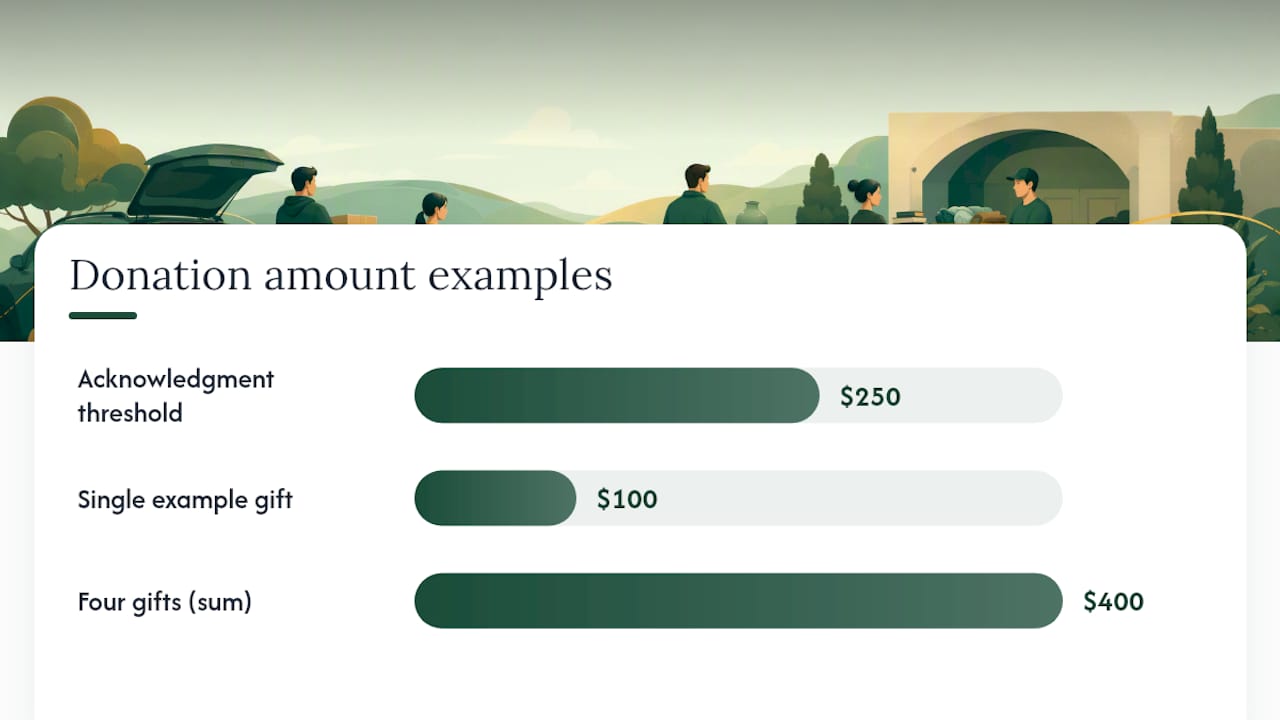
- The $250 threshold applies per contribution, not per year. A donor who gives $100 four times in one year doesn't need a written acknowledgment for any single gift, even though the annual total clears $250. This non-aggregation rule surprises a lot of first-time donation coordinators.
- Late acknowledgments aren't just an inconvenience. If a donor files before your letter arrives, the deduction may already be lost.
Noncash Donations, Form 8283, and When an Appraisal Kicks In
Property donations carry more paperwork than cash, and the rules shift again once value climbs past certain marks. Form 8283 governs the process, and it splits into two sections depending on dollar amount.
- Under $500. No special IRS form. The standard written acknowledgment covers it.
- Over $500. The donor must file Form 8283 Section A with their return, describing each item or group of similar items.
- Over $5,000. The donor generally needs a qualified appraisal and must complete Section B, which requires the charity's signature acknowledging receipt of the property, per the Form 8283 instructions.
Clothing and household items carry an extra wrinkle: they generally must be in "good used condition or better" to qualify for a deduction at all, unless the item is worth more than $500 and comes with a qualified appraisal.
Your job as the receiving organization stays narrow and specific: describe what came in the door, not what it's worth. Group similar items together in your notes (say, "assorted kitchenware, 12 items") rather than listing a vague dollar estimate. When a donor tells you they're filing Section B, the practical move is to request their appraisal documentation upfront and have someone authorized to sign ready to countersign the donee acknowledgment before the donor's filing deadline arrives.
Pro Tip: Never write "excellent condition" on a receipt in a way that reads like a value certification. Describe condition factually, "gently used, no visible damage," and let the donor's appraiser or their own judgment handle valuation.
Quid Pro Quo Contributions: When You Owe a Disclosure
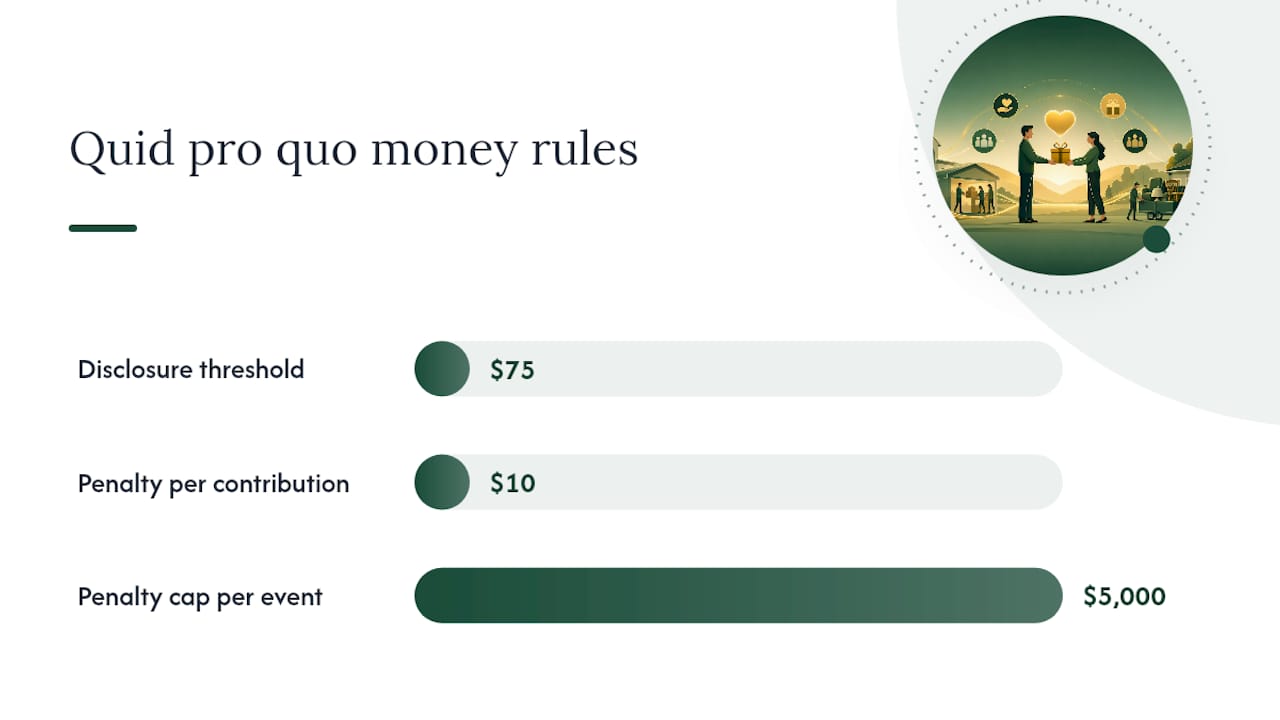
A quid pro quo contribution happens whenever a donor pays your organization and gets something of value back, a gala dinner, a raffle ticket, a tote bag worth more than a token amount. Once that payment exceeds $75, disclosure becomes mandatory, not optional.
The disclosure must include:
- A clear statement that the deductible amount is limited to whatever the donor paid above the fair market value of what they received
- A good-faith estimate of that fair market value
Deliver this either at the time of solicitation (on the event invitation, for instance) or on the receipt itself. Skip it, and the penalty is real: $10 per contribution, capped at $5,000 per event or mailing, unless reasonable cause can be shown.
Vehicle Donation Rules: Form 1098-C and the 30-Day Window
Cars, boats, and airplanes follow their own documentation path, separate from ordinary property rules. The Form 1098-C guidance requires charities to furnish either the form itself or a written statement carrying equivalent information.
- Charities generally must provide this statement within 30 days of the sale (if the vehicle is sold) or within 30 days of the contribution date if it's kept and used by the organization.
- Donors typically must attach Copy B of Form 1098-C to their tax return when the deduction exceeds $500.
- The statement needs the vehicle identification number, a description, and either the sale price or a statement of intended use.
- Keep a copy in your own files matched to the donor's name and the vehicle's VIN, since this is one of the more frequently audited donation categories.
Recordkeeping Examples Every Donor and Charity Should Know
Proof requirements scale with the size and type of gift, and donors ask about this constantly. Acceptable bank records for cash gifts include canceled checks, bank statements, or credit card statements, as long as they show the date, the charity's name, and the amount.
For payroll deductions, a pay stub paired with a pledge card from the charity satisfies the requirement. No separate written acknowledgment is needed in that case.
A few practical notes for your files:
- Electronic delivery (email, PDF, donor portal download) is fine as long as the five required elements are present.
- Retain copies of every acknowledgment issued for $250-plus gifts for at least seven years, matching typical audit windows.
- Name files consistently, something like "LastName_Date_Amount," so a donor's request for a duplicate receipt doesn't turn into a records search.
Donors who lose their acknowledgment often assume the charity keeps no backup. A simple naming convention proves otherwise in seconds. More detail on documenting donated estate contents specifically lives in this guide to donation tax deductions.
Sample Language for Cash, Noncash, Quid Pro Quo, and Vehicle Receipts
Ready-to-adapt wording saves time and keeps every acknowledgment consistent with IRS expectations.
- Cash gift under $250. "Thank you for your generous gift of $[amount] received on [date]. [Organization Name] is a qualified 501(c)(3) organization."
- Contemporaneous acknowledgment for $250+. "This letter confirms your contribution of $[amount] on [date] to [Organization Name], EIN [number]. No goods or services were provided in exchange for this contribution."
- Noncash donation. "[Organization Name] received the following item(s) from you on [date]: [description, e.g., 'sofa, gently used, no visible damage']. No goods or services were provided in exchange. [Organization Name] did not determine or assign a fair market value to this donation."
- Quid pro quo disclosure. "In exchange for your payment of $[amount], you received [description of goods/services] with an estimated fair market value of $[estimate]. Your deductible contribution is limited to the amount by which your payment exceeds that value."
A vehicle donation statement needs the same discipline: vehicle description, VIN, sale date or intended use, and sale price if sold, delivered within 30 days, with Copy B attached to the donor's return when the claimed deduction tops $500.
Common Mistakes That Cost Donors Their Deduction
Most disqualified deductions trace back to a handful of repeat errors. Charities that assign fair market value on a receipt (writing "$500 worth of clothing" instead of a plain description) create ammunition for an audit denial, not protection for the donor.
- Late acknowledgments for $250+ gifts, sent after the donor already filed
- Missing quid pro quo disclosure language on event receipts over $75
- Blank donee signature lines on Form 8283 Section B
- Vague property descriptions that read like a garage-sale flyer instead of a receipt
Pro Tip: If you catch an error after the fact, don't ignore it. Issue a corrected acknowledgment immediately and note the correction date. Donors with a disallowed deduction sometimes need to file an amended return, and a prompt, clearly dated correction from your organization is exactly what that process requires.
How Donation-First Estate Cleanouts Get the Documentation Right
Households full of estate items create a documentation challenge at scale: dozens of donations, one afternoon, and no time for guesswork. A donation-first approach to estate cleanouts solves this by photographing and briefly describing each donated item before it ever leaves the property, condition noted, no valuation language attached. That habit hands the receiving charity exactly what it needs to issue a compliant acknowledgment, and it protects the family from an inflated or unsupported claim later.
— Derek
A Donation-First Partner for Estate Cleanout Documentation
A donation-first partner can be the practical alternative to sorting an entire estate alone while worrying whether the paperwork will hold up later. When an estate cleanout is handled, sorting donation-ready items from what needs to be sold or hauled away often happens on-site, with photos and short condition descriptions attached to each donated batch before drop-off.

That documentation goes straight to the receiving charity, which means the family gets a contemporaneous acknowledgment tied to items they can actually describe, not a vague memory of "some furniture we gave away." For families coordinating a donation of furniture in New Jersey, that record can matter months later during probate or tax season. Visit the Bereavement Cleanout Services site to request a walkthrough quote and ask about a donation documentation checklist for your family's cleanout.
Where to Verify These Rules Directly
Every rule in this article traces back to primary IRS guidance, and it's worth bookmarking the source documents directly.
- Topic 506: broader deduction and contribution rules
- Form 8283 and instructions: noncash filing thresholds and appraisal rules
- Form 1098-C: vehicle donation statement requirements
This article is general information, not a substitute for advice from a qualified financial advisor. Consult a qualified financial professional about your own circumstances before acting on anything here.