
Yes, many charitable donations are tax deductible — but only when given to a qualified organization and claimed correctly. Three rules determine whether you can benefit this year: you must give to an organization the IRS recognizes under Section 170(c), you must generally itemize deductions on Schedule A, although recent law changes created a limited benefit for non-itemizers starting in 2026, and you must keep contemporaneous documentation from the moment of the gift.
The forms and publications that govern this process are:
- Publication 526 — the primary IRS guide covering deductible types, AGI limits, and required forms
- Schedule A (Form 1040) — where itemized charitable deductions are reported
- Form 8283 — required for noncash contributions over $500
- Form 1098-C — required for donated vehicles, boats, and airplanes
Your first decision is straightforward: compare your total itemized deductions against the standard deduction for your filing status. If your itemized total exceeds the standard deduction, itemizing wins. If not, the new OBBBA non-itemizer deduction allows single filers to deduct up to $1,000, and married couples filing jointly up to $2,000, for cash gifts to qualified organizations starting in 2026.
Table of Contents
- What kinds of gifts are deductible and how is their value determined?
- How much can you deduct? AGI limits and carryover rules explained
- How do you report charitable deductions on your federal return?
- Estate cleanout donations: how to document them so they actually count
- Key Takeaways
- Why the paperwork burden on donors is the real story here
- Bereavementcleanoutservices makes donation documentation part of every cleanout
- Authoritative sources to consult next
What kinds of gifts are deductible and how is their value determined?
The type of property you donate determines both the deduction amount and the paperwork required.
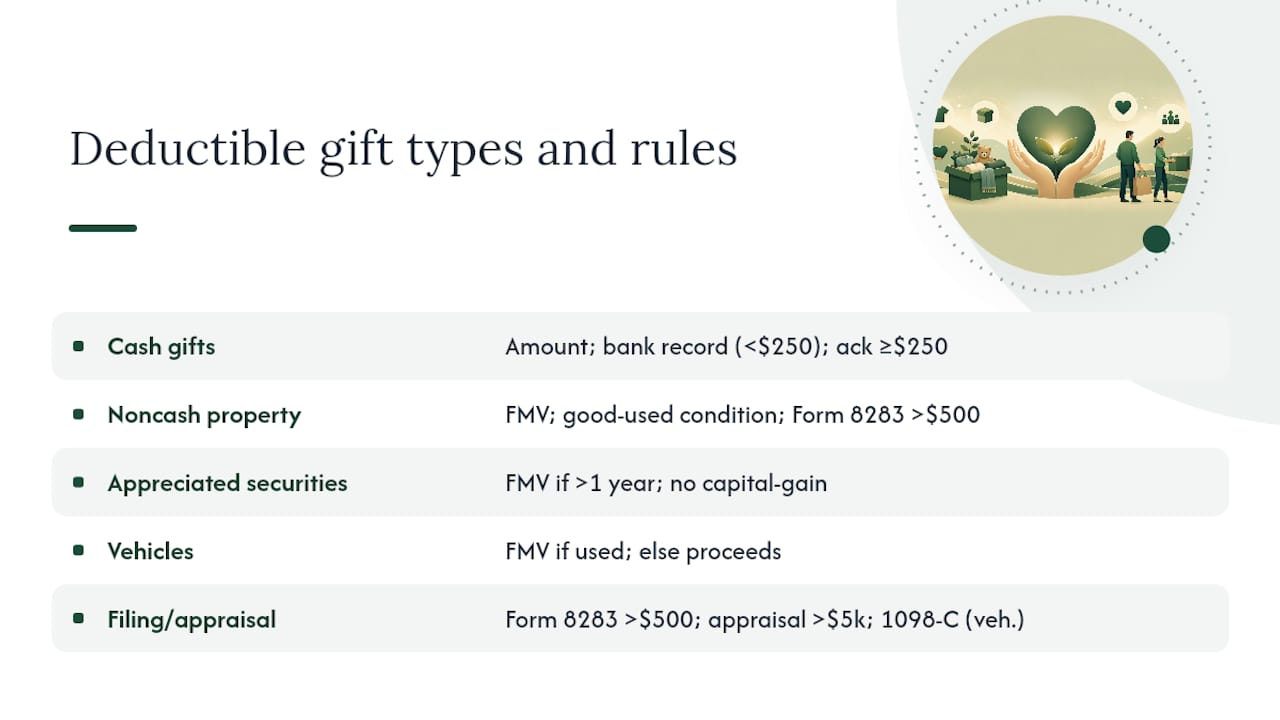
Cash and monetary gifts are the simplest. A bank record, canceled check, or written communication from the charity showing the organization's name, date, and amount is sufficient for gifts under $250. For gifts of $250 or more, you need a contemporaneous written acknowledgment from the charity — a bank statement alone is not enough.
Noncash property is deductible at fair market value (FMV) at the time of the contribution, per IRS guidance. FMV is what a willing buyer would pay a willing seller — not what you originally paid. A couch that cost $800 five years ago may have an FMV of $75 today. Clothing and household items must be in good used condition or better to qualify at all; items in poor condition are generally not deductible unless a qualified appraisal establishes a value above $500. Goodwill's online valuation guide is a widely used reference for common household goods, though the IRS does not endorse any single guide.
Appreciated securities and real estate held long-term (more than one year) can be donated at full FMV without triggering capital gains tax — one of the most tax-efficient giving strategies available. If you donate property you've held short-term, the deduction is limited to your cost basis.
Vehicles, boats, and airplanes follow special rules. If the charity sells the vehicle without significant use, your deduction is limited to the gross proceeds from that sale, and the charity must provide Form 1098-C within 30 days. If the charity uses the vehicle directly in its mission, you may deduct FMV. The Form 1098-C is your substantiation — without it, the deduction does not hold.
Pro Tip: For noncash donations over $500, you must file Form 8283 with your return. For items valued above $5,000 (most categories), a qualified appraisal is required and must be attached via Section B of Form 8283. Get the appraisal before you file, not after.
How much can you deduct? AGI limits and carryover rules explained
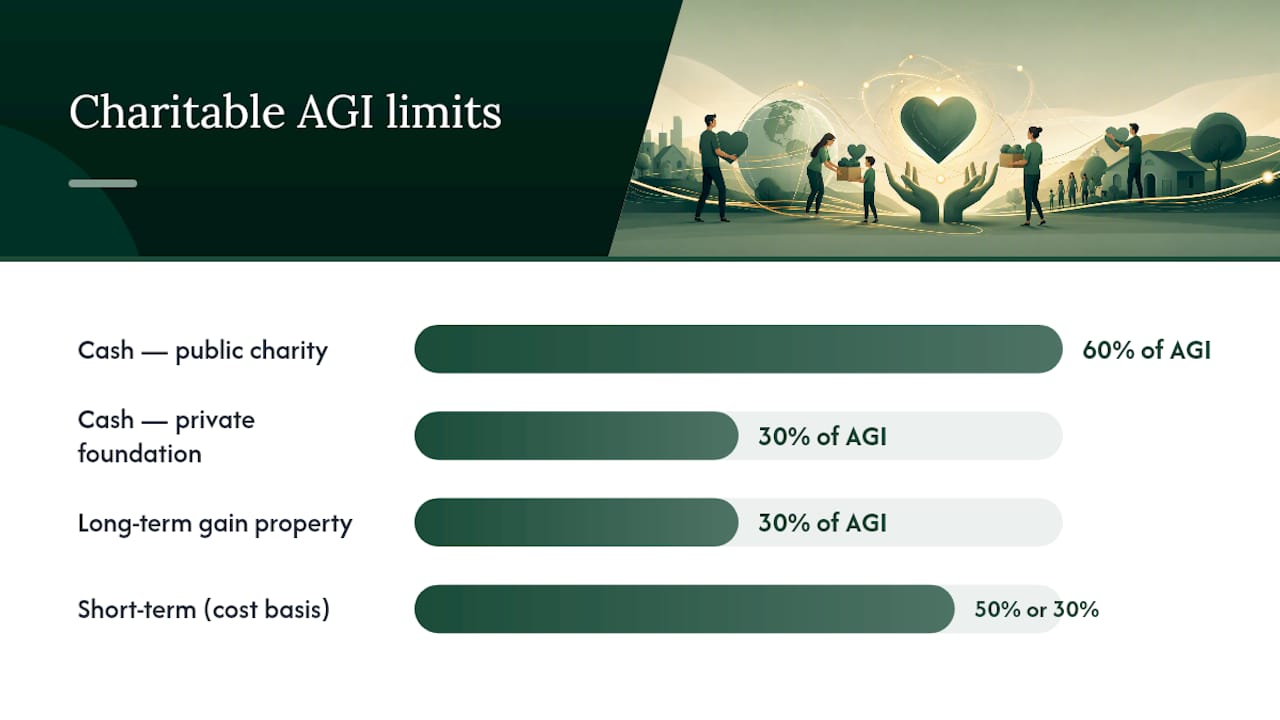
The IRS caps charitable deductions as a percentage of your adjusted gross income (AGI), and the applicable limit depends on the type of property donated and the type of organization receiving it. Publication 526 and the IRS charitable deductions page set out the full framework.
| Contribution Type | Organization Type | AGI Limit |
|---|---|---|
| Cash | Public charity / 60% limit org | 60% of AGI |
| Cash | Private foundation (non-operating) | 30% of AGI |
| Long-term capital gain property | Public charity | 30% of AGI |
| Long-term capital gain property | Private foundation | 30% of AGI |
| Short-term gain / ordinary income property | Public or private | Limited to cost basis; 50% or 30% of AGI |
A few practical points on how these limits interact:
- The 60% limit applies to most cash gifts to public charities and is the ceiling most taxpayers encounter.
- The 30% limit on appreciated property to public charities catches many donors by surprise, particularly those donating real estate or stock.
- If your total contributions exceed the applicable limit in a given year, the excess carries forward for up to five years and can be deducted in those future years, subject to the same percentage limits.
Example: Suppose your AGI is $100,000. You donate $50,000 cash to a public charity (60% limit = $60,000, so fully deductible) and $40,000 worth of long-term appreciated stock to the same charity (30% limit = $30,000). You can deduct $30,000 of the stock donation this year and carry the remaining $10,000 forward to 2027.
Bunching strategy: If your annual donations fall just below the standard deduction threshold, consider concentrating two or three years of giving into a single tax year. That spike in itemized deductions can push you over the standard deduction in the bunching year, then you take the standard deduction in the off years. Donor-advised funds work well here — you contribute a lump sum to the DAF, take the full deduction in year one, and distribute grants to charities over several years.
How do you report charitable deductions on your federal return?
Filing correctly comes down to three decisions: whether to itemize, which forms to attach, and whether the OBBBA non-itemizer deduction applies to you.
Step 1 — Itemize or take the standard deduction. The Tax Cuts and Jobs Act of 2017 roughly doubled the standard deduction, which means most taxpayers now benefit more from the standard deduction than from itemizing. For 2026, compare your total potential itemized deductions (mortgage interest, state and local taxes up to the SALT cap, medical expenses above the threshold, and charitable contributions) against your standard deduction. If itemized deductions exceed the standard deduction, use Schedule A.
Step 2 — Complete Schedule A. Report cash contributions on the appropriate line and noncash contributions separately. Attach Form 8283 for noncash gifts over $500 and Form 1098-C for vehicle donations.
Step 3 — The OBBBA non-itemizer deduction. Under the One Big Beautiful Bill Act, taxpayers who take the standard deduction can now claim an above-the-line deduction for cash gifts to qualified organizations: up to $1,000 for single filers and up to $2,000 for married filing jointly starting in 2026. This applies only to cash contributions, not noncash property. Before the OBBBA, most non-itemizers had no direct federal tax incentive for charitable giving; this change restores a modest benefit for smaller cash gifts, as the Tax Policy Center has noted in its analysis of the law's policy impact.
When to consult a tax professional: Large noncash gifts, donations of closely held stock, complex appraisals, or situations where state tax credits reduce your federal deduction all warrant professional guidance. State-level charitable tax credits can reduce your federal deduction dollar-for-dollar in some cases — a detail Publication 526 addresses but that many taxpayers overlook.
This article provides general information, not tax or legal advice. Confirm current rules with the IRS or a qualified tax professional before filing.
Estate cleanout donations: how to document them so they actually count
Estate and home cleanouts routinely produce large volumes of noncash donations — furniture, clothing, kitchenware, books, tools — where the fair market value is often a fraction of the original purchase price. Overclaiming FMV on bulk household goods is a common audit trigger. Getting the documentation right from the start protects the estate and the family.
A practical checklist for cleanout donations:
- Photograph items before removal. Condition photos support FMV estimates and satisfy the "good used condition or better" requirement.
- Create a written inventory. List each donated item with a brief description, approximate FMV, and the charity receiving it.
- Obtain a signed pickup receipt at the time of collection. The receipt should include the charity's name, address, EIN, the date, and a description of items received.
- Request a contemporaneous written acknowledgment for any single item or group of items valued at $250 or more.
- Separate keepsakes from donations before the charity arrives. Once items leave the property, recovering them for the family is difficult.
- Tag donated boxes with brief descriptions. This makes inventory reconciliation faster and supports the written acknowledgment.
For items that may exceed $5,000 in value (antiques, artwork, jewelry, collectibles), arrange a qualified appraisal before the cleanout date. The appraiser must inspect the item in person; a photo-based estimate does not meet the IRS standard for a qualified appraisal.
Bereavementcleanoutservices follows a donation-first approach on every New Jersey estate cleanout: usable items are sorted, inventoried, and directed to local charities before anything goes to disposal. The team obtains pickup receipts and logs donated items into the estate inventory, which also serves probate documentation. That paper trail is exactly what the IRS requires.
Pro Tip: Ask the cleanout crew to request a written acknowledgment from the charity at the time of pickup and to include it in the estate file. A receipt collected on the day of donation is far stronger substantiation than one requested weeks later.
Key Takeaways
Charitable deductions require a qualified organization, proper documentation, and a deliberate choice between itemizing and the standard deduction — the OBBBA non-itemizer deduction now offers a limited benefit for cash gifts even when you don't itemize.
| Point | Details |
|---|---|
| Verify charity status first | Use the IRS Tax Exempt Organization Search to confirm 501(c)(3) status before giving. |
| Itemize vs. standard deduction | Compare Schedule A totals against your standard deduction; most taxpayers benefit from the standard deduction post-TCJA. |
| OBBBA non-itemizer benefit | Non-itemizers can deduct up to $1,000 (single) or $2,000 (married filing jointly) in cash gifts above the line starting in 2026. |
| Form 8283 thresholds | Noncash gifts over $500 require Form 8283; gifts over $5,000 require a qualified appraisal and Section B. |
| Bereavementcleanoutservices documentation | The donation-first estate cleanout process includes item inventories, condition photos, and pickup receipts that directly support IRS substantiation requirements. |
Why the paperwork burden on donors is the real story here
Most articles on charitable deductions focus on the percentage limits and gloss over the documentation rules. That's backwards. The AGI limits rarely affect the average taxpayer — most people give well within the 60% ceiling. What actually costs people their deductions is missing or inadequate paperwork: no written acknowledgment for a $300 cash gift, no Form 8283 for a donated car, a bag of clothing with no receipt.
The OBBBA non-itemizer deduction is genuinely useful for people who give modest cash amounts and don't itemize, but it won't help anyone who can't show a bank record or written acknowledgment. The law creates the benefit; the documentation unlocks it.
For families handling an estate, the documentation challenge is compounded by grief, time pressure, and the sheer volume of items leaving the property. A donation-first cleanout process that builds documentation into the workflow — receipts at pickup, photos before removal, a written inventory — removes that burden from the family entirely. The tax benefit follows naturally from the process, rather than requiring a separate administrative effort after the fact. That's the practical value of working with a service that treats documentation as part of the job, not an afterthought.
Bereavementcleanoutservices makes donation documentation part of every cleanout
When a family is managing an estate in New Jersey, the last thing they need is to reconstruct donation records weeks after the cleanout. Bereavementcleanoutservices builds the documentation into the process from day one: items are sorted with a donation-first approach, inventoried with descriptions and approximate fair market values, photographed for condition, and directed to qualified local charities with pickup receipts collected on-site. That file goes directly into the estate record and supports both probate and any charitable deduction claims on the family's tax return.
If you're preparing for an estate cleanout and want a process that supports your deduction claims from the start, contact Bereavementcleanoutservices for an on-site estimate. The team will walk through the property with you, identify donation-eligible items, and explain exactly what documentation you'll receive.
Authoritative sources to consult next
- Publication 526 (2025), Charitable Contributions | Internal Revenue Service
- Topic no. 506, Charitable contributions | Internal Revenue Service
- Charitable contribution deductions | Internal Revenue Service
- What is the tax treatment of charitable contributions? | Tax Policy Center
- 26 USC 170: Charitable, etc., contributions and gifts
- https://www.irs.gov/pub/irs-pdf/f8283.pdf
- irs.gov
- https://www.irs.gov/forms-pubs/about-schedule-a-form-1040