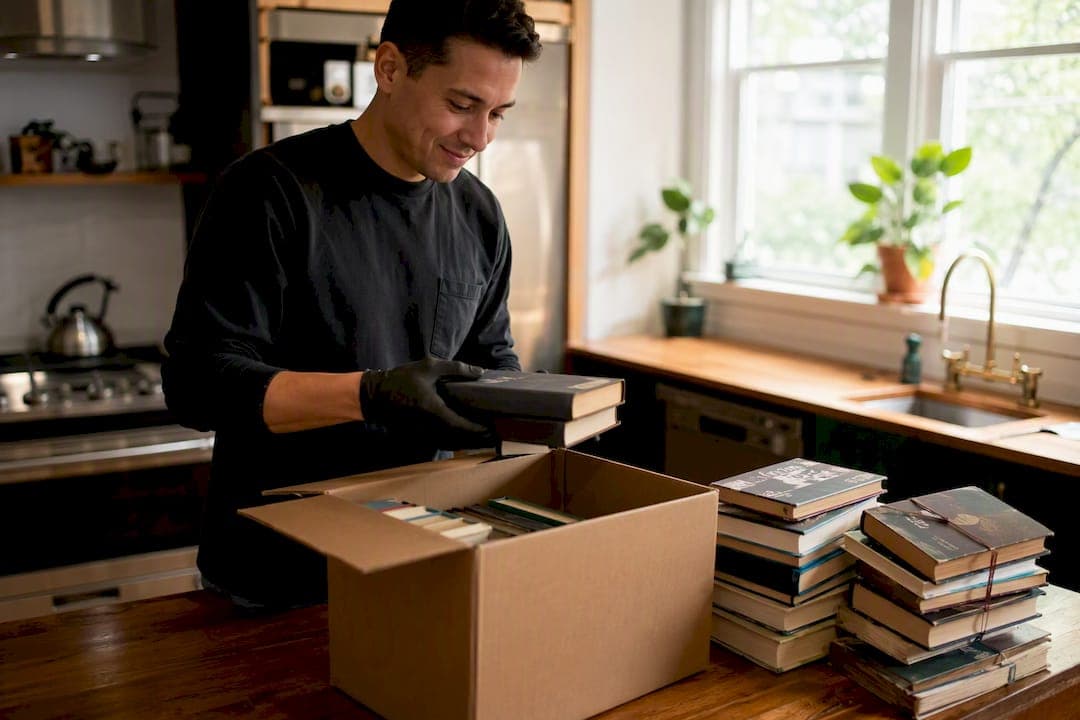
Yes, a cleanout company can sort, box, and deliver books to donation partners on your behalf as part of a paid estate or apartment cleanout in New York. The catch is logistics: not every partner accepts every title, and buildings with freight elevators or loading-dock rules add scheduling steps. Bereavementcleanoutservices runs donation-first cleanouts across New Jersey and handles those constraints with probate-friendly documentation, so families and executors get an itemized record without chasing paperwork later.
TL;DR:
- Most donation partners accept only books in good condition, and large collections require special scheduling, trucks, and building approvals.
- Booking early, ideally three to five days in advance, is vital during peak periods to secure elevator access and avoid service delays.
- Providing detailed inventories, photographs of valuable items, and notifying about archival or academic collections streamlines donation routing and compliance.
- Donation receipts should specify items and quantities, with a certificate of insurance necessary for building access and liability requirements.
- A vetted donation-first cleanout service must have proof of insurance, clear donation policies, reliable scheduling, and a transparent process for families during sensitive times.
Table of Contents
- Five steps to arrange a professional book donation run
- How book donation runs actually work in New York
- What lead times and costs to expect
- How to prepare books and keepsakes before the crew arrives
- Documentation you need for probate and taxes
- Questions to ask before hiring a donation-first cleanout company
- Why donation-first cleanouts matter more than people realize
- Get a New York book donation run scheduled
- Sources
Five steps to arrange a professional book donation run
Getting a donation run scheduled correctly takes less than an hour of prep, but the order matters. Skip a step and you risk a stalled pickup or a partner that refuses the load at the door.
- Flag donation as the priority and set aside keepsakes, legal documents, and anything the family wants to keep before the crew arrives.
- Estimate volume in boxes or truck-fill space, and note building access details like elevator size or stairwell-only entry.
- Ask the cleanout company directly whether they route to donation partners and whether they issue donation receipts.
- Book the pickup one to three weeks ahead, longer during peak season, and confirm freight elevator or loading-dock windows with the building.
- Photograph and inventory any high-value or rare volumes before removal, since that record matters for probate accounting.
Executors juggling a co-op board's move-in rules alongside a family's timeline usually find that booking early solves more problems than any other single decision.
How book donation runs actually work in New York
Crews doing this work daily follow a simple triage: keep, donate, or dispose. Keepsakes and anything a family flags get set aside first, before a single box of paperbacks moves. Everything else gets sorted by condition and category, since damaged or moldy books rarely qualify for any donation program regardless of partner.
New York's donation landscape runs through a mix of local nonprofits and the city's own donateNYC brochure, which lists accepted donation categories and notes that pickup service is handled case by case, often with fees depending on the partner. Housing Works and Better World Books both accept book donations in the city, though acceptance criteria shift by condition, genre, and current inventory needs, so confirmation before scheduling avoids a wasted trip.
Volume changes the workflow. A handful of boxes might go out with a regular donation stop, but larger collections, generally 30 or more boxes, usually trigger a specialized bulk pickup with its own scheduling and vehicle requirements. Buildings add their own layer: freight elevator reservations, a certificate of insurance for the management company, and a loading zone window that a superintendent has to approve in advance.
- Sorting happens on-site, keepsakes first, before any donation boxing begins.
- Condition and category determine which partner, if any, will take a given batch.
- Bulk collections often need a dedicated pickup vehicle and a longer building-access window.
Pro Tip: If a book collection includes academic texts or archival material, flag it at booking so the crew can arrange separate packing or a direct introduction to a library or archive program instead of routing it through general donation.
Realistically, estate cleanouts that prioritize donation tend to divert 20 to 40 percent of contents to reuse partners on Manhattan jobs. That number depends heavily on condition and category, so a library of well-kept hardcovers routes far more easily than a damp basement collection of paperbacks.

What lead times and costs to expect
Manhattan buildings typically need three to five business days to coordinate freight elevator access for a cleanout crew. That window shrinks the flexibility on last-minute jobs, so booking as soon as a move-out date is confirmed avoids a scramble.
Bulk book pickups get busiest during predictable stretches: campus move-out season from May through June, another wave in August and September, and a smaller surge around December. During those windows, lead times can stretch to two or three weeks, so building in extra buffer matters if a cleanout falls in one of those months.
Pricing depends on a handful of factors rather than a flat rate:
- Total volume, measured in boxes or truck-fill space.
- Crew hours needed for sorting keepsakes from donation-eligible material.
- Building access complexity, including elevator bookings and doorman coordination.
- Whether a specialized bulk-book partner charges a separate pickup fee.
Truck-fill pricing on comparable NYC estate jobs runs roughly $325 to $985 for smaller loads, scaling up with volume and access difficulty. Donation-first sorting can lower disposal costs by keeping usable items out of the landfill stream, but it adds handling time upfront since crews sort more carefully than they would for a straight haul-away.
How to prepare books and keepsakes before the crew arrives
A little prep on the family's end speeds up the entire process and protects what matters most.
- Set aside legal documents, family heirlooms, and any priority books in a clearly marked area before the crew starts.
- Pack remaining books in manageable box sizes, since overloaded boxes get rejected by donation partners for weight limits and palletizing 30 or more boxes makes bulk pickup far more efficient.
- Tell the crew which collections need special routing, such as academic sets or archival material that shouldn't go into general donation bins.
- Photograph and log valuable items before anything leaves the apartment, creating a record that supports both probate accounting and insurance purposes if something is ever disputed.
Pro Tip: Standard-size moving boxes, not oversized bins, are what most donation partners prefer. A box that's too heavy to lift with one hand usually gets flagged for repacking, which slows the whole pickup down.
Documentation you need for probate and taxes
Donation receipts from a professional cleanout typically list the general category and estimated quantity of items donated, along with the partner organization's name and date of pickup. For larger donations, some partners provide impact reporting that shows where books ultimately landed, whether a school, shelter, or resale program.
Buildings almost always require a certificate of insurance before letting a cleanout crew use a freight elevator or loading dock. Managing agents typically want additional insured language naming the building, which is why confirming COI availability before booking saves a wasted trip when moving day arrives.
For probate accounting, keep these on file:
- An itemized donation list matching the receipt to specific categories or box counts.
- Photographs taken before removal, especially for anything with potential resale or sentimental value.
- The donation receipt itself, dated and signed by the partner organization when possible.
For estates involving substantial donation volume, a tax advisor can confirm what documentation the IRS expects to support a deduction, since IRS donation receipt requirements generally scale with the claimed value of the donated goods.
Questions to ask before hiring a donation-first cleanout company
Vetting a cleanout company for a book donation run comes down to five things: a documented donation-first policy, proof of insurance, a track record with New York City buildings, receipts you can actually use, and discretion during a sensitive time.
- Can you route books directly to donation partners, or do they go straight into general disposal?
- Will you provide a donation receipt and an itemized list for probate or tax purposes?
- What lead time do you need for a building with a freight elevator or a doorman sign-off process?
- Do you accept 30 or more boxes for a free bulk pickup, or does that trigger a separate fee?
- Can you supply a certificate of insurance for the building's management company before the job date?
Pro Tip: Ask for the COI in writing before the walkthrough is even scheduled. A company that hesitates on that request usually isn't set up for regular building work.
Red flags are just as telling as good answers. Walk away from any company that refuses to provide a COI, can't describe how donation routing actually works, or pressures a family to remove items without a clear sign-off process. Bereavementcleanoutservices was built around exactly these vetting points: a donation-first policy, fully insured operations, documented receipts, and a broom-clean handoff that leaves nothing in question for the executor or the family.
Why donation-first cleanouts matter more than people realize
Most families hiring a cleanout crew focus on speed and cost, and donation gets treated as an afterthought. That's backward. A donation-first approach protects the emotional weight of a book collection, whether it's a parent's cookbook shelf or a grandparent's academic library, by making sure those items go somewhere useful instead of straight into a dumpster.
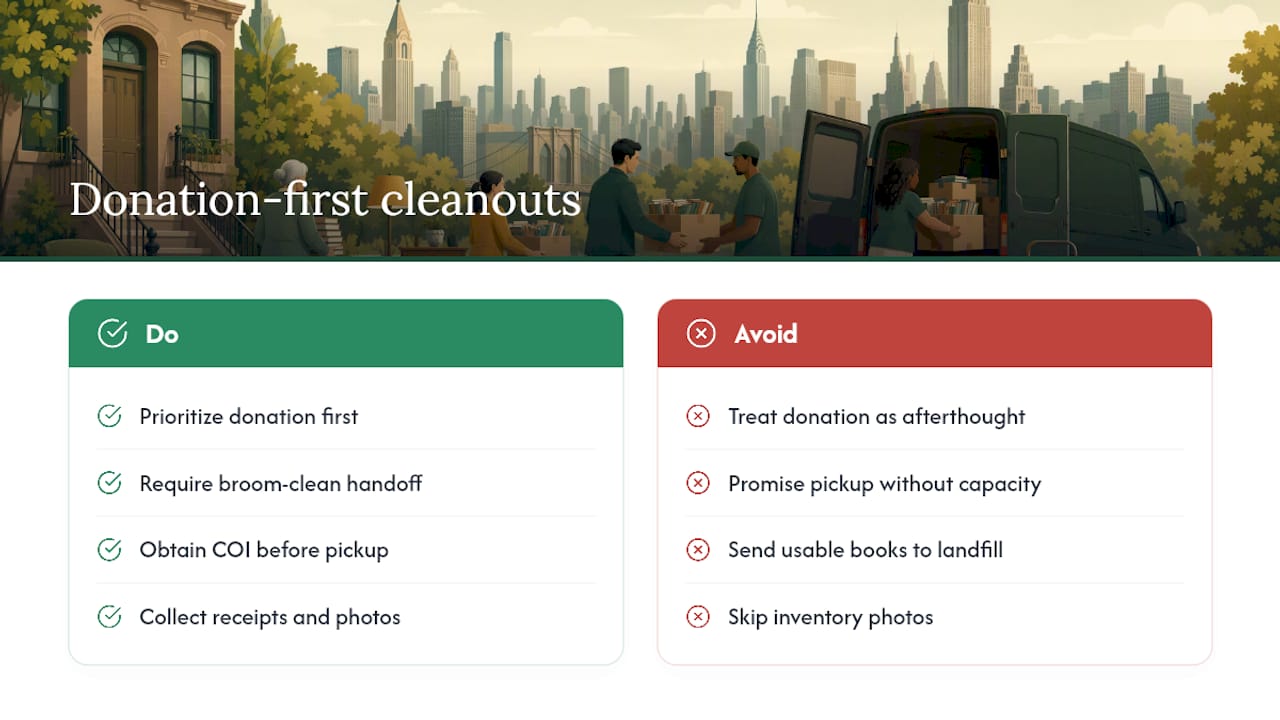
Broom-clean handoffs and COI availability aren't just operational checkboxes. They're what let an executor close out probate without a second round of questions from an accountant or a surrogate's court. Every donation receipt and photographed inventory item is one less thing a family has to reconstruct months later from memory.
The honest limitation is partner capacity. Not every book qualifies for donation, and not every partner has room for a large collection on short notice. Scheduling constraints are real, especially during peak moving months, and a responsible company will tell a family that upfront rather than promising a pickup window it can't keep.
— Derek
Get a New York book donation run scheduled
Bereavementcleanoutservices handles donation-first cleanouts the same way whether the job is a full estate or a single apartment full of books. That means a certificate of insurance ready for building management, an itemized donation list for probate, and a broom-clean finish when the crew leaves, without a family having to manage separate vendors for sorting, hauling, and donation.
Booking starts with a walkthrough, either in person or over photos and video for families coordinating from out of state. From there, you get a firm quote, a suggested timeline based on building access and volume, and a donation routing plan built around what the estate actually contains. Families managing New York properties who need documented, compassionate handling of a loved one's book collection can request an estimate through Bereavementcleanoutservices to get a timeline started.
Sources
Check the donateNYC brochure for accepted categories and partner contacts, and confirm current acceptance policies directly with Housing Works or Better World Books before a pickup. Partner rules shift, so always verify windows and volume limits ahead of scheduling.
- donateNYC brochure (DSNY)
- Estate cleanout Manhattan — JunkRabbit
- Book donations New York | ZoomBooks (bulk pickup service)