The executor or estate administrator holds legal authority over what happens to a deceased person's belongings, but family members can immediately secure the apartment, photograph every room, and remove trash and perishables without waiting for probate paperwork. If you're facing a deadline or feel too overwhelmed to sort through decades of memories, a compassionate cleanout crew can step in for the physical work while you handle the emotional side.
TL;DR:
- Securing the property, photographing rooms, and collecting documents are critical initial steps that help protect the estate and prevent disputes.
- Family members should remove trash and perishables, set up sorting stations, and work in short, paced sessions to minimize emotional and physical exhaustion.
- Only the executor or court-appointed administrator has legal authority to sell or dispose of estate property, with families limited to securing and documenting the property before probate.
- Professional cleanout services are recommended for hoarded spaces, hazardous materials, or when families lack the capacity, especially with tight landlord deadlines or complex conditions.
- A donation-first approach ensures usable items are routed to charities, promoting space and emotional healing while supporting estate and tax documentation.
Table of Contents
- What Do You Do First When Cleaning Out an Apartment After Death?
- Who Has the Legal Right to Clear Out the Apartment?
- How Long Does It Take and What Does It Cost?
- What Hazards Should You Watch For Before You Start?
- How Do You Sort Keepsakes and Documents Without Family Conflict?
- Where Should Belongings Go: Donate, Sell, Recycle, or Discard?
- Should You Hire a Professional Cleanout Service?
- What Sets a Donation-First Cleanout Apart?
- A Few Honest Words on Pacing and Letting Go
- How Bereavement Cleanout Services Can Take This Off Your Plate
- Where to Find More Help
- Sources
What Do You Do First When Cleaning Out an Apartment After Death?
The first 48 hours matter more than most families realize. An apartment cleanout after death starts with three actions that protect both the estate and your own peace of mind, and none of them require a lawyer or a court order.
Change or verify the locks, collect mail daily, and shut off anything that could cause damage if left running, like a stove or a leaking faucet. Photograph every room before you touch anything. This creates a documented inventory that protects against disputes later and gives the executor a clear record for probate. Executors are commonly advised to secure the property and document its condition before any formal paperwork is filed, precisely because damage or loss in those early days is hard to reconstruct later.
Once the property is secure, work through the space in this order:
- Remove trash and perishables first. Spoiled food and obvious garbage create urgency and safety concerns; clearing them also frees up physical space to work in.
- Set up sorting stations. Use separate zones or labeled boxes for keep, donate, discard, and undecided. A folding table in the living room works fine.
- Locate documents and valuables. Wills, insurance policies, deeds, and financial statements go into one secured folder or box immediately.
- Work in short sessions. Two to three hours at a time, then stop. Experts recommend pacing the work this way rather than pushing through in one exhausting weekend.
- Rotate helpers. Siblings, adult children, or close friends can trade off so no one person carries the entire emotional weight.
- Label everything you're keeping. A simple description and photo, logged in a spreadsheet or even a notebook, becomes your inventory for probate.
Pro Tip: Start with the bathroom or kitchen pantry, not the bedroom closet. Low-emotion spaces build momentum before you reach the items that carry real sentimental weight.
Who Has the Legal Right to Clear Out the Apartment?
The executor or court-appointed administrator is the only party with legal authority to sell, donate, or permanently dispose of estate property. Until letters testamentary are issued, family members occupy a gray zone: you can protect the property, but you generally shouldn't sell valuables or make irreversible decisions about high-value items.
Here's what typically falls within safe bounds before probate is finalized:
- Securing doors, windows, and mailboxes
- Photographing rooms and contents for the record
- Removing trash, spoiled food, and obvious hazards
- Collecting documents for safekeeping, without discarding anything
Landlords complicate the timeline. Most leases give families a limited window to clear a unit before storage or disposal fees kick in, so confirming that window early prevents a painful surprise on top of an already difficult month.
The practical contact order looks like this: notify the executor or probate attorney first, then the landlord or property manager, then extended family who may want access before anything moves. Skipping that sequence is where most family conflicts start.
How Long Does It Take and What Does It Cost?
A studio or one-bedroom apartment with light belongings often clears in two to four days once someone commits to the work. A cluttered three-bedroom home, or one involving hoarding, frequently stretches to two or three weeks, and that's before factoring in probate delays that can pause final disposition for months.
Costs swing widely based on a handful of variables:
- Unit size and volume of belongings — a studio costs a fraction of a hoarded three-bedroom house
- Hazardous material remediation — biohazard or mold cleanup adds specialized labor
- Labor and disposal fees — hauling and dump fees scale with truckloads, not square footage
- Estate sale or appraisal offsets — selling valuable furniture or collectibles can reduce your net cost significantly
Ballpark ranges for standard apartment cleanouts in New Jersey typically run from a few hundred dollars for a light studio to several thousand for a heavily furnished or hoarded unit. Getting firm, itemized quotes from at least two providers, rather than a vague estimate over the phone, is the single best way to avoid surprise charges once the truck is already loaded.
What Hazards Should You Watch For Before You Start?
Not every cleanout is a straightforward sorting job. Visible mold, strong chemical odors, bodily fluids, needles, or expired medications signal a job that goes beyond family labor and calls for certified remediation instead of trash bags and gloves.
Biohazard cleanup, in particular, requires licensed handling. If the death occurred in the apartment or the person lived with untreated medical conditions, ask any remediation company for proof of certification and insurance before they start, and keep that documentation with your other probate records.
For volunteers doing the general sorting, a few precautions go a long way:
- Wear gloves and a mask when handling dusty, moldy, or long-undisturbed items
- Keep windows open and take breaks if the air quality feels off
- Never handle sharps or needles alone; use a puncture-proof container and dispose of them through proper channels
- Photograph any hazard you find before cleanup, both for insurance claims and as part of the estate record
Pro Tip: If you spot anything that gives you pause, mold, an odor, unmarked chemical containers, stop and call a specialist rather than pushing through. The cost of remediation is almost always lower than the cost of exposure.
How Do You Sort Keepsakes and Documents Without Family Conflict?
Documents disappear fastest in a rushed cleanout, so they need to come out first, before boxes start moving toward donation trucks or dumpsters.
- Secure critical paperwork immediately: wills, life insurance policies, property titles, recent bank and credit card statements, and any safe deposit box keys.
- Build a simple inventory: photograph each keepsake or valuable item, label the box it goes in, and note a brief description in a shared spreadsheet.
- Set a claim window for family members: give everyone a specific date to identify items they want, and use written receipts for anything distributed before the estate formally closes.
- Bring in a neutral party if tension rises: a mediator, or simply the executor acting as tiebreaker, prevents disputes over sentimental items from becoming lasting rifts.
- Get professional appraisals for anything of uncertain value: jewelry, art, and collectibles should be valued before distribution, since guessing wrong can shortchange one heir or trigger tax issues.
This system protects relationships as much as it protects the estate's accounting. For a room-by-room reference on what families most often choose to keep, this downsizing checklist covers the categories people regret discarding too quickly.
Where Should Belongings Go: Donate, Sell, Recycle, or Discard?
Most of what's left after keepsakes and documents are pulled falls into four buckets, and getting the sorting right saves both landfill space and money.
- Donate first. Furniture, clothing, and books in usable condition can go to organizations like Habitat ReStore or through pickup services listed on Donation Town; always request a receipt, since donation records support both tax filings and probate accounting.
- Resell higher-value items. An estate sale, online consignment, or a local resale shop can recover meaningful money from furniture, art, or collectibles that aren't sentimental to the family.
- Recycle what you can. EPA guidance on household recyclables explains what belongs in standard recycling versus what needs a hazardous-waste facility, electronics and certain chemicals do not belong at the curb.
- Discard what's left. Damaged, expired, or unusable items go to standard disposal, ideally after everything donatable has already been pulled out.
The quick triage rule: if it's usable and someone else could benefit, donate it. If it's broken, contaminated, or unsafe, it goes to disposal, not the donation pile.
Should You Hire a Professional Cleanout Service?
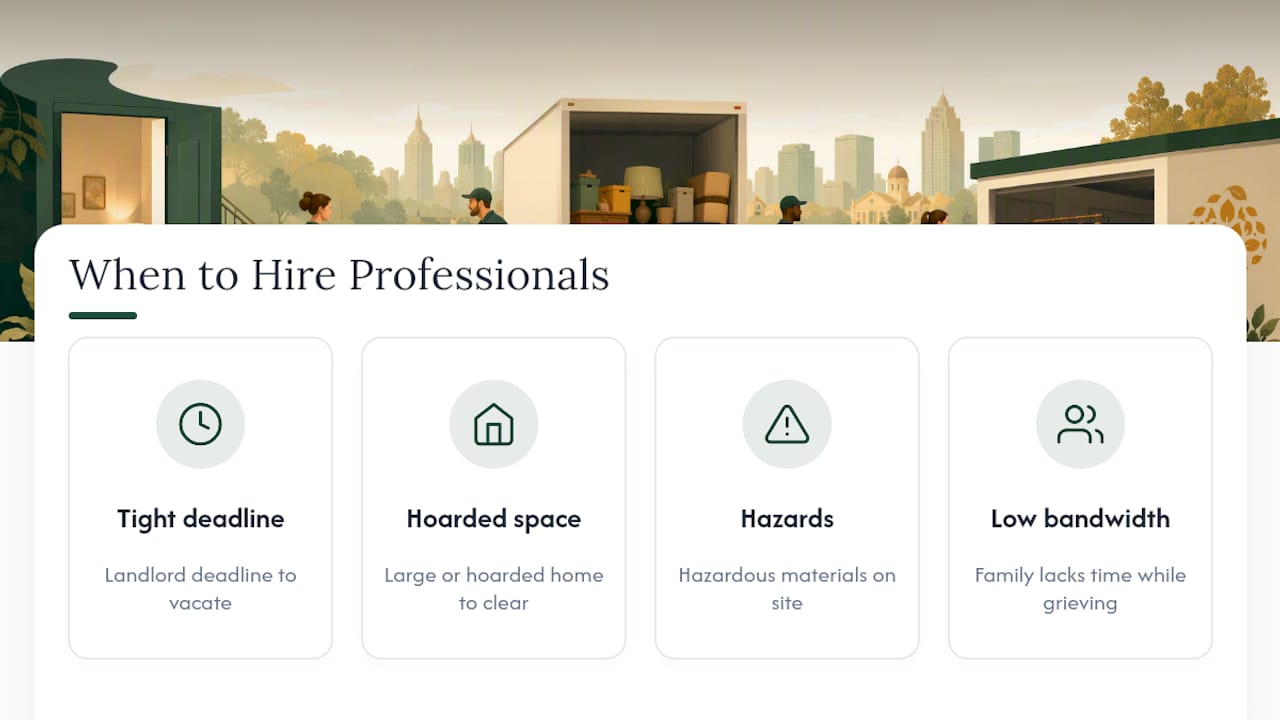
Hiring help makes sense when any of four conditions apply: a tight landlord deadline, a large or hoarded space, hazardous materials on site, or a family that simply doesn't have the bandwidth to do this work themselves while grieving.
A reputable, compassionate vendor should deliver more than just hauling. Look for a documented inventory, donation receipts, a thorough clean finish, and proper insurance for the crew working in the home.
Before signing anything, ask vendors how they document donations, whether they carry liability insurance, and how they handle items still pending a family decision. Comparing a professional crew against a DIY dumpster rental usually makes the tradeoff clear: professionals cost more upfront but save weeks of exhausting labor and reduce the risk of family burnout partway through.
What Sets a Donation-First Cleanout Apart?
A donation-first approach isn't just a marketing phrase, it changes what actually happens to a family's belongings. Instead of defaulting to a dumpster, a compassionate crew sorts for usable furniture, clothing, and household goods, routes them to local charities, and hands the family a receipt for every load donated.
That documentation matters twice over. It supports probate accounting when the executor needs a clear record of estate disposition, and it can support tax filings when donations qualify. Pair that with photo inventories completed before anything leaves the apartment, insured and bonded crews, and a broom-clean handoff at the end, and the process becomes something families can trust rather than dread. Reframing disposal as making space for healing, rather than discarding memories, is a shift that experienced cleanout teams bring to every job, not just the easy ones.

A Few Honest Words on Pacing and Letting Go
Grief doesn't run on a checklist's schedule, and that's fine. You don't owe anyone a fast cleanout, and slowing down when a room full of memories stops you cold isn't a failure of organization.
What actually helps is structure, not speed: use the checklist, hand off tasks to people you trust, and don't assume you have to touch every item yourself. Delegation isn't giving up on the memory, it's protecting your own capacity to grieve while the practical work still gets done. If the scale of the job outweighs what your family can manage right now, getting a quote from a cleanout service costs you nothing but ten minutes, and it might be the thing that lets you breathe again.
— Derek
How Bereavement Cleanout Services Can Take This Off Your Plate
Bereavement Cleanout Services is the alternative to piecing together dumpster rentals, donation drop-offs, and probate paperwork on your own, one compassionate crew handles the hauling, the donation runs, and the documentation together, so you're not managing five separate vendors during the hardest month of the year.

Every project starts with a walkthrough, so have the address, an estimate of square footage or room count, and any known hazards (mold, hoarding, biohazard concerns) ready when you call. For guidance on executor responsibilities and quick-sale considerations, see our probate-related planning and executor responsibilities blog. From there, the crew works donation-first, meaning usable furniture and household goods go to local charities rather than a landfill, with itemized receipts handed back for tax and probate records. Crews are fully insured, and every job ends broom-clean, with a photographed inventory documenting what left the property. If you're coordinating an estate cleanout, hoarding situation, or a landlord-driven deadline anywhere across New Jersey, request a free walkthrough estimate and get a firm quote before you commit to anything.
Where to Find More Help
For hazardous-waste and recycling rules, check the EPA's recycling guidance. For donation logistics, Donation Town and Habitat ReStore list pickup options and drop-off locations near you. For probate and executor duties, consult your state's probate court or an estate cleanout cost guide for planning help.
Sources
- How do I recycle common recyclables? — EPA
- Cleaning Out a Deceased Person's House: Who's Responsible?