
A full-service apartment estate cleanout in New Jersey typically runs several hundred dollars for a studio or one-bedroom, up to a few thousand dollars for a three-bedroom, according to national cost data. Hoarding situations or apartments with extreme clutter can reach significantly higher costs. Angi reports a national average around the mid-thousands, with a typical range covering small to large projects. Those figures cover full-service work: room-by-room sorting, donation-first removal, hauling and disposal, and a broom-clean handoff with basic documentation for probate. The single most reliable next step is scheduling an on-site walkthrough so a provider can give you a firm written quote.
Pro Tip: Before calling any provider, photograph every room and note any heavy or hazardous items (pianos, oxygen tanks, old paint cans). Providers who see photos in advance give faster, more accurate estimates.
Key Takeaways
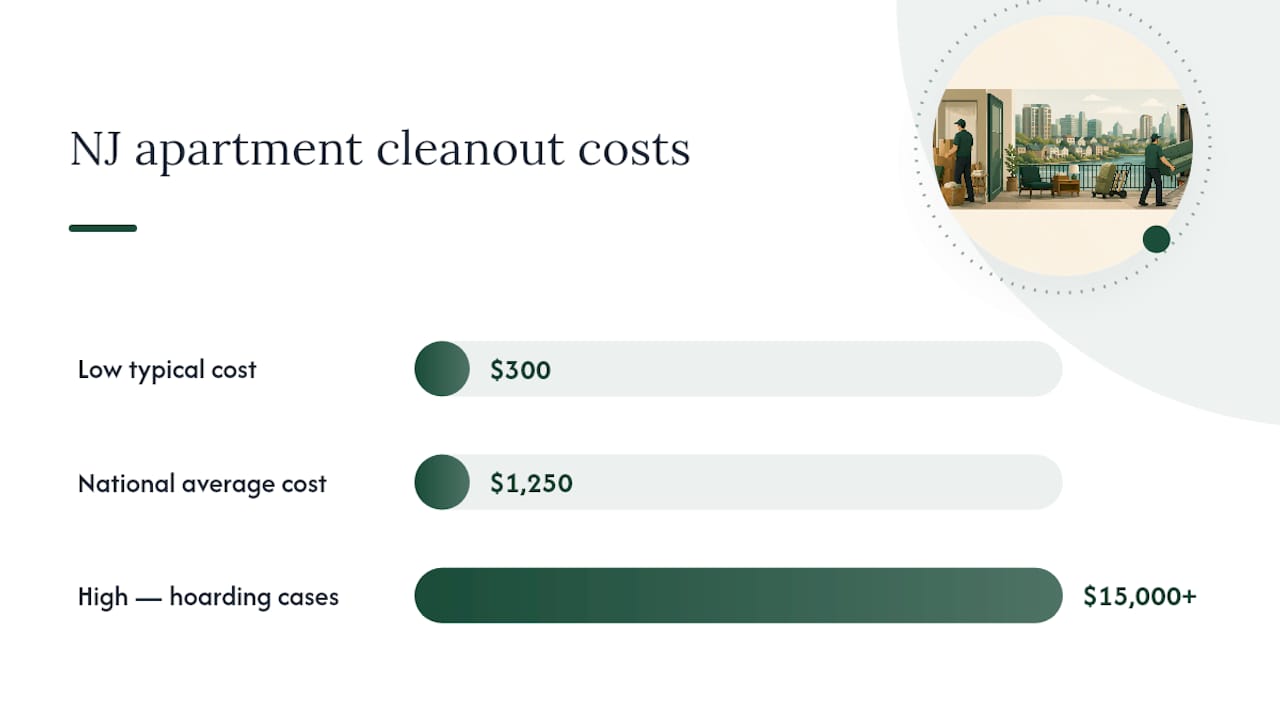
A full-service apartment estate cleanout in New Jersey costs $300–$15,000+ depending on size, clutter level, and access, with the national average near $1,250 and hoarding cases requiring specialized crews and significantly higher budgets.
| Point | Details |
|---|---|
| Cost by apartment size | Studio/1BR: several hundred dollars; 2BR: up to a few thousand dollars; 3BR+: up to a few thousand dollars; hoarding: significantly higher costs. |
| Top cost drivers | Volume (truck loads), stair carries ($40–$100/flight), hazardous materials, and rush timelines push totals up. |
| Full-service scope | Includes sorting, donation-first removal, hauling, broom-clean handoff, and estate photography for probate. |
| Provider checks | Require written itemized quote, proof of general liability and workers' comp, and references from estate jobs. |
| Bereavementcleanoutservices | Offers insured, donation-first estate cleanouts across New Jersey with written quotes and probate documentation. |
Table of Contents
- What does apartment cleanout cost by size and clutter level?
- What does a full-service estate cleanout actually include?
- How do cleanout companies price their services?
- What factors push your cleanout price up or down?
- How do you get an accurate quote for an apartment cleanout?
- What questions should you ask, and what are the red flags?
- How do donation-first cleanouts work, and what about tax receipts?
- What insurance, permits, and hazardous waste handling should you expect?
- How long does an apartment cleanout take?
- Practical ways to reduce your cleanout cost
- What families often underestimate about this process
- Bereavementcleanoutservices: New Jersey estate cleanouts, done right
- Sources
What does apartment cleanout cost by size and clutter level?
| Apartment Type | Typical Range | Notes |
|---|---|---|
| Studio / 1-bedroom | several hundred dollars | Light to moderate clutter; single-crew day job |
| 2-bedroom | up to a few thousand dollars | Standard furnishings; 1–2 crew days |
| 3-bedroom+ | up to a few thousand dollars | Multiple truck loads; larger crew |
| Hoarding / extreme clutter | significantly higher costs | Specialized crew, safety gear, extended timeline |
Ranges shift based on truck loads required, crew size, local disposal fees, and access. A lightly furnished one-bedroom with elevator access sits near the low end. A two-bedroom hoarding case with narrow stairs and biohazard materials can exceed the three-bedroom standard range entirely.
- Truck loads drive cost more than square footage. Two truck loads at a one-bedroom can cost more than a lightly packed two-bedroom.
- Stair carries add time and labor. Stair-related surcharges of roughly $40–$100 per flight are common.
- Disposal fees vary by county in New Jersey. Transfer station tipping fees are set locally and can add meaningfully to the total.
- Hoarding cases require specialized crews and safety equipment, longer timelines, and often hazardous-material handling, which is why pricing jumps sharply.
What does a full-service estate cleanout actually include?
A full-service estate cleanout is not junk removal. Estate cleanouts involve methodical sorting, flagging valuables, donation coordination, and documentation, whereas standard junk removal hauls whatever is set out, often straight to a landfill.
Professional crews follow a room-by-room process: identifying keepsakes and valuables, separating donations and recyclables, and isolating hazardous or specialty items for proper disposal. What that looks like in practice:
- Sorting and identification: Every room is worked through systematically. Keepsakes, documents, and items of potential value are flagged before anything is moved.
- Donation-first diversion: Usable items go to local charities, not the landfill. Providers coordinate pickups or drop-offs and document what was donated.
- Hauling and disposal: Remaining items are loaded, transported, and disposed of responsibly. Specialty items (electronics, appliances, chemicals) are handled separately.
- Broom-clean handoff: The unit is left swept and clear, ready for a landlord inspection, estate sale, or listing.
- Estate photography and inventory: Items of value are photographed and cataloged, which supports probate filings and helps executors account for the estate.
Pro Tip: Ask specifically whether the provider photographs items before removal. That documentation can be critical if a beneficiary later questions what was in the apartment.
How do cleanout companies price their services?
Three pricing models are common, and knowing which one a provider uses helps you compare quotes accurately.
- Flat fee (walkthrough-based): The provider tours the apartment, assesses volume and access, and quotes a single price. This is the most predictable model for families and executors.
- Hourly crew rate: You pay per person per hour, typically with a minimum. This works for small, straightforward jobs but can escalate quickly in hoarding situations.
- Per-cubic-yard or per-truck-load plus disposal: Volume is estimated or measured, then multiplied by a rate. Disposal fees are added separately. This model is transparent but requires you to understand what a "truck load" means for your situation.
A sample line-item estimate for a standard two-bedroom cleanout might look like this:
- Labor (3-person crew, 6 hours): $450–$750
- Truck/hauling: $150–$300
- Landfill/disposal fees: $75–$200
- Sorting paperwork: $50–$500 depending on volume
- Estate photography: $100–$250 (often bundled)
- Hazardous-material disposal (if applicable): $50–$300+
Add an estate sale and the commission structure changes the math. Estate-sale commissions typically run 35–40% of proceeds, which can offset cleanout costs significantly when there are items of real value.
Pro Tip: A buy-out cleanout, where the company keeps items of value in exchange for reduced fees, can be faster but usually yields less than a properly run estate sale. Get an independent opinion on item values before agreeing to a buy-out.
What factors push your cleanout price up or down?
Volume is the biggest lever. More items mean more labor hours and more truck loads. But several other variables can shift the total by hundreds of dollars:
- Access difficulty: Stair carries, narrow hallways, no elevator, and limited parking all add time. In New Jersey buildings, parking permits for a moving truck may be required and can take days to arrange.
- Heavy specialty items: Pianos, gun safes, and large appliances require additional crew members or equipment and typically carry a surcharge.
- Hazardous or biohazard materials: Old paint, chemicals, sharps, or biological waste require licensed disposal and add to both time and cost.
- Rush timelines: Probate deadlines, lease expirations, or landlord pressure can require expedited scheduling, which often carries a premium.
- Location within New Jersey: Travel time and local disposal fees vary. Urban areas with parking restrictions add logistical complexity.
A note on hoarding cases: Hoarding cleanouts are a category apart. They require crews trained in safe navigation of compromised spaces, often personal protective equipment, and significantly more time per square foot than a standard cleanout. Budget accordingly and ask specifically about hoarding experience before hiring.
How do you get an accurate quote for an apartment cleanout?
The most reliable quotes come from in-person walkthroughs. For hoarding situations, unclear access, or suspected hazardous materials, photos alone are not enough.
- Schedule a walkthrough. Walk every room with the provider. Point out items you want kept, donated, or disposed of.
- Send photos in advance. For a preliminary estimate, clear photos of each room, closets, and storage areas help providers gauge volume before they arrive.
- List known heavy or specialty items. Note pianos, safes, large appliances, or anything requiring special handling.
- Document access conditions. Stairs, elevator availability, parking restrictions, and building management requirements all affect the quote.
- Clarify your timeline. A firm move-out date or probate deadline changes scheduling options and may affect price.
A firm written quote should show: itemized charges, disposal fees listed separately, deposit amount and terms, cancellation and rescheduling policy, proof of insurance, and a clear timeline for completion.
- Insist on a written quote, not a verbal estimate.
- Confirm disposal fees are included, not estimated separately after the fact.
- Ask whether the quote covers a broom-clean finish or whether cleaning is an add-on.
What questions should you ask, and what are the red flags?
Every provider you call should be able to answer these without hesitation:
- Do you carry general liability insurance and workers' compensation? Can you provide proof?
- Do you have experience with hoarding cleanouts and estate situations specifically?
- Which charities do you partner with for donations, and do you provide itemized receipts?
- Is your quote written and itemized, with disposal fees included?
- What is your cancellation and rescheduling policy?
- Can you provide references from similar estate or hoarding jobs?
Red flags that warrant walking away:
- Demands for full cash payment upfront before any work begins.
- Vague or verbal-only estimates with no written breakdown.
- No proof of insurance or a refusal to provide it.
- Unclear disposal practices ("we take care of it" with no specifics).
- Refusal to provide references from estate or hoarding jobs.
"A provider who cannot tell you where your items are going or who is liable if something goes wrong during removal is a provider who should not be in your apartment." If an estate involves significant assets or legal complexity, loop in your estate attorney before signing any cleanout contract.
How do donation-first cleanouts work, and what about tax receipts?
A donation-first cleanout prioritizes diverting usable items to local charities before anything goes to a landfill. The process works like this:
- The crew sorts items during the cleanout and sets aside anything in donatable condition.
- The provider coordinates pickup with charity partners or delivers items directly.
- You receive an itemized donation receipt documenting what was given and to whom.
Those receipts matter beyond the charitable intent. Cleanout expenses may be deductible as estate administration expenses on Form 706, and donation receipts support charitable deduction claims, though you should confirm specifics with an estate attorney or CPA.
When items have significant resale value, an estate sale or consignment listing typically nets more than a buy-out arrangement.
Pro Tip: Keep all donation receipts in the estate file alongside the cleanout invoice. Executors filing a final estate return will need both.
What insurance, permits, and hazardous waste handling should you expect?
- General liability insurance: Covers damage to the property during the cleanout. Ask for a certificate of insurance naming the property address.
- Workers' compensation: Protects you if a crew member is injured on-site. Without it, you may be liable.
- Business license: Verify the provider is registered to operate in New Jersey.
- Building permits and management approvals: Many New Jersey apartment buildings require advance notice and a certificate of insurance from any contractor. Confirm with building management before scheduling.
- Parking permits: In denser New Jersey municipalities, a truck permit may be required. A good provider handles this, but confirm it is their responsibility.
Hazardous materials that typically carry extra disposal fees include old paint and solvents, asbestos-containing materials (common in pre-1980 New Jersey buildings), sharps and medical waste, and chemicals or pesticides. Biohazard situations, including cases involving a death in the unit, require licensed biohazard remediation, which is a separate service from standard cleanout work.
How long does an apartment cleanout take?
Timeline scales directly with size and condition:
- Studio or one-bedroom, light clutter: Often completed in a single day with a crew of two or three.
- Two-bedroom, standard clutter: Typically one to two days.
- Three-bedroom or larger: A crew of three to four people usually needs one to three days.
- Hoarding or extreme clutter: One week or more is realistic, depending on volume and hazardous-material scheduling.
Scheduling windows vary. Simple jobs can often be booked within the same week. Standard estate cleanouts typically require one to two weeks of lead time. Estate-sale coordination, charity pickups, and hazardous-waste scheduling can each add days to the timeline, so build in buffer if you are working against a probate or lease deadline.
Practical ways to reduce your cleanout cost
Cutting cost does not mean cutting corners on documentation or donation diversion. These steps reduce labor time without compromising the process:
- Pre-sort and label keep boxes. Anything you want saved should be clearly labeled and moved to one area before the crew arrives. Every hour they spend sorting your keep items is an hour you pay for.
- Identify heavy items in advance. Tell the provider about pianos, safes, or large appliances before the walkthrough so they can bring the right equipment and crew.
- Remove small, easy items yourself. Bagging and removing clothing, books, or small household goods before the crew arrives reduces truck volume and labor hours.
- Schedule the estate sale before the cleanout. Items sold at an estate sale reduce the volume the cleanout crew handles and can offset the cleanout fee.
- Avoid rush scheduling. If your timeline allows, standard scheduling is almost always less expensive than expedited service.
Pro Tip: A partial DIY approach works well for small, accessible items. For anything heavy, hazardous, or requiring documentation, hire professionals. The liability and documentation risks of DIY removal in an estate context are rarely worth the savings.
What families often underestimate about this process
Most families come to us focused on the price per truck load. That is understandable, but it is rarely where the real complexity lives. What actually takes time, and what actually protects you, is the sorting. Identifying a document that turns out to be a deed, or a piece of furniture with genuine value, or a medication that requires proper disposal — that is the work that matters.

The proof points that should reassure you: a written quote after an in-person walkthrough, a certificate of insurance you can hand to building management, itemized donation receipts you can file with the estate, estate photography that gives beneficiaries a record, and a broom-clean handoff the landlord can sign off on. Those are not extras. They are the baseline for a professional estate cleanout.
Bereavementcleanoutservices: New Jersey estate cleanouts, done right
When a lease deadline, a probate filing, or a family's grief cannot wait, you need a provider who has handled this before, in New Jersey, with the documentation to prove it.

Bereavementcleanoutservices offers full-service apartment and estate cleanouts across New Jersey with a donation-first process, written firm quotes after every on-site walkthrough, and fully insured operations. Every job includes itemized donation receipts, estate photography for probate, and a broom-clean handoff your landlord or realtor can verify. There are no vague verbal estimates and no surprise disposal fees added after the fact.
To request a firm written quote, visit Bereavementcleanoutservices or call to schedule your on-site walkthrough. Ask for proof of insurance at the time of booking.
Sources
- Estate Cleanout Services: Costs, Process & How to Find One
- How Much Do Estate Cleanout Services Cost? | Angi
- What Does an Estate Cleanout Involve? Step-by-Step Guide
This article provides general pricing guidance and is not a substitute for advice from an estate attorney or CPA. Consult a qualified professional for tax deductibility questions and probate-specific requirements in your jurisdiction.