
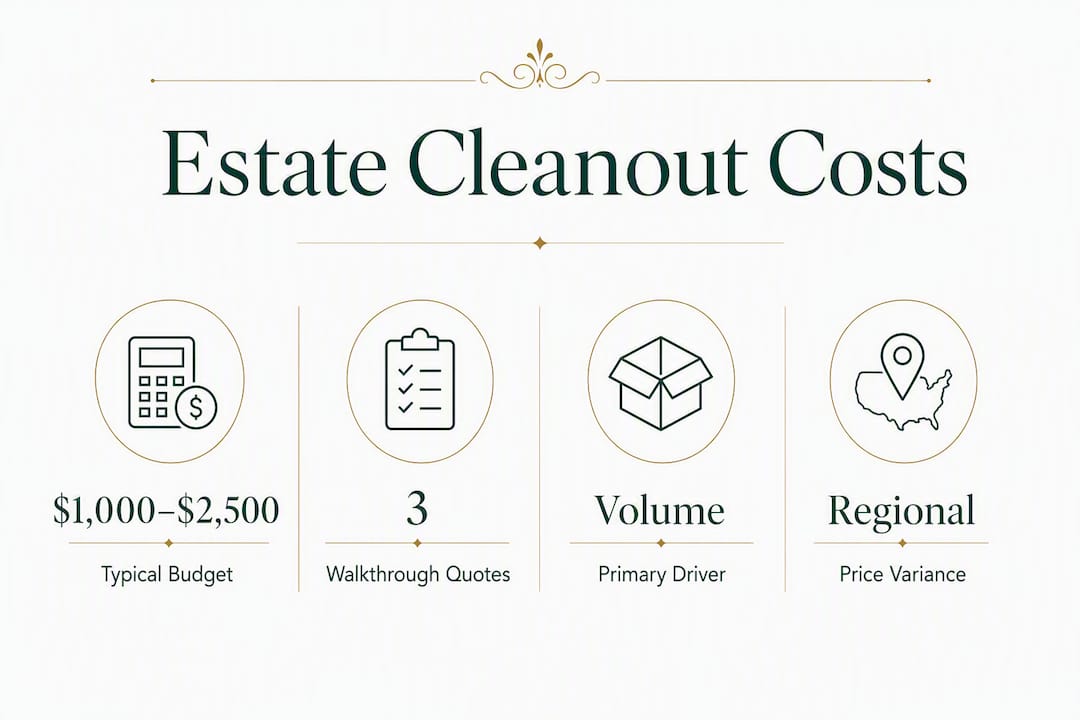
A typical estate cleanout costs an average of around $1,250 nationally, with most homes falling between $1,000 and $2,500, depending on volume and location. Small apartments can run as low as $300, while large or densely packed homes regularly reach $4,000 or more. The range is wide because volume, crew hours, access, and location all pull the final number in different directions. Before you call anyone, photograph every room and write down what stays, what gets donated, and what gets hauled. That preparation alone will get you a firm, itemized quote instead of a vague ballpark.
- National average: approximately $1,250
- Typical standard home (2–3 bedrooms): $1,000–$2,500
- Small apartments or lightly furnished homes: typically $300–$800
- Large estates or heavily packed homes: $2,500–$6,000 or more
- Hoarding or biohazard cases: $4,000–$8,000 or higher
Pro Tip: Request at least three walkthrough-based quotes before committing. A provider who quotes over the phone without seeing the property is guessing, and that guess rarely holds.
Table of Contents
- What does an estate cleanout actually cost by home size?
- What drives estate cleanout prices up or down?
- How to get an accurate quote and choose the right provider
- Ways to lower your estate cleanout bill without risking probate
- What a full-service estate cleanout typically includes
- Bereavementcleanoutservices brings compassion and documentation to New Jersey estate cleanouts
- Key Takeaways
- Why price alone is the wrong lens for an estate cleanout
What does an estate cleanout actually cost by home size?
Estate cleanout prices vary most by the volume of items a crew must sort, carry, and haul, not strictly by square footage. A sparsely furnished 2,000-square-foot home can cost less than a packed 900-square-foot apartment.
| Home Type | Typical Price Range | Notes |
|---|---|---|
| Studio / 1-bedroom apartment | $300–$800 | Light volume, single-floor access |
| 2–3 bedroom home | $1,000–$2,500 | Most common scenario |
| 4+ bedroom home | $2,500–$6,000 | Multiple truckloads, longer crew hours |
| Large estate or high-volume home | $4,000–$8,000+ | Extended timeline, possible multi-day |
| Hoarding / biohazard property | $4,000–$8,000+ | Specialist protocols required |
Three short scenarios:
- Scenario A: A 1-bedroom New Jersey apartment, lightly furnished, one truckload, two-person crew, four hours. Final cost: approximately several hundred dollars.
- Scenario B: A 3-bedroom suburban home, moderate contents, two truckloads, three-person crew, one full day. Final cost: approximately low thousands of dollars, depending on volume.
- Scenario C: A 4-bedroom home with decades of accumulated belongings, three-plus truckloads, four-person crew, two days, donation coordination included. Final cost: approximately several thousand dollars, depending on complexity and volume.
Regional pricing matters considerably. Large metro markets like New York City have higher costs compared to national averages. If you are budgeting for an estate cleanout in New York or northern New Jersey, add that buffer before your first call.
Pro Tip: Ask each provider how many truckloads they estimate and what their per-load rate is. That single question reveals more about the final bill than any per-square-foot figure.
What drives estate cleanout prices up or down?
Labor is typically the largest single line item, with crews charging an hourly rate varying by location and workload. A two-person crew on a small job and a five-person crew on a large one produce very different totals before a single truckload leaves the driveway.
The main cost drivers, with typical impact ranges:
- Volume and density: More items mean more crew hours and more truckloads. This is the dominant pricing variable.
- Labor hours and crew size: Labor charges scale with crew size and hours worked, significantly impacting overall cost.
- Stair and access surcharges: Flights of stairs usually incur additional surcharges due to extra effort. Narrow hallways, long carry distances to the truck, or multi-level homes multiply this quickly.
- Truckloads and dumpster costs: Dumpster rentals and landfill fees add to total cost, varying by size and location.
- Hazardous waste and appliances: Refrigerant-containing appliances require certified handling. Piano removal or crane hoists can add up to $2,000 to a job.
- Hoarding and biohazard protocols: Protective gear, safety procedures, and sometimes contracted remediation teams push costs to $4,000–$8,000 or more.
- Specialty cleaning: Post-cleanout deep cleaning, odor remediation, or trauma cleanup are typically priced as add-ons.
Pro Tip: Volume almost always matters more than floor plan. Send photos of closets, the garage, the basement, and any storage areas when requesting quotes. Crews price to truck-and-labor capacity, not to blueprints.
How to get an accurate quote and choose the right provider
Industry analysts consistently advise relying on walkthrough-based, itemized quotes because complexity governs final price, not square footage alone. Here is a practical sequence:
- Photograph every room before you call, including closets, the garage, attic, and basement.
- Create a scope list: identify keepsakes to protect, items to sell or consign, items to donate, and items to dispose of.
- Request in-person or live video walkthroughs from at least three providers. Decline phone-only quotes.
- Insist on written, itemized estimates that break out labor, truck or dumpster fees, disposal and tipping fees, special handling charges, and timeline.
A trustworthy written estimate should include:
- Itemized labor costs (crew size, estimated hours, hourly rate)
- Truck or container fees and estimated truckload count
- Disposal and landfill tipping fees
- Special handling charges (stairs, appliances, hazardous materials)
- Proof of liability insurance
- Option for donation receipts and documented disposition
- Payment terms and deposit amount
"Full-service professionals add value beyond labor: insurance, probate-ready documentation, donation receipts, and coordination of estate sales — services families often undervalue when judging price alone." — HomeAdvisor
Red flags to avoid:
- Large upfront deposits with no proof of insurance
- Vague line items like "miscellaneous fees" with no breakdown
- Refusal to document donated items or provide receipts
- No written liability coverage on file
- Pressure to sign before a walkthrough
Ways to lower your estate cleanout bill without risking probate
Families can meaningfully reduce costs with a few deliberate steps taken before the crew arrives.
- Coordinate donation pickups first. Documented charity pickups remove volume from the job before hauling fees apply. Many organizations will schedule free pickups for furniture, clothing, and household goods. Keep every receipt for probate records.
- Pre-sort keepsakes and valuables. Box and label items the family wants to keep. Leave anything with unclear value for the professionals to assess. Sorting what you know saves crew time; sorting what you do not know risks losing estate assets.
- Consider a hybrid approach for lightly packed homes. DIY dumpster rental typically runs $540–$1,400 for the container plus family labor. Full-service professional work often costs 20–40% more but shifts the physical and logistical burden entirely to the crew. For a heavily packed or emotionally difficult property, the premium is usually worth it.
Additional steps that reduce cost:
- Sell high-value items through consignment or an estate sale before the cleanout date.
- Consolidate items to one floor or one area if mobility allows, reducing carry distances.
- Confirm with your provider whether donated volume reduces your hauling estimate.
Pro Tip: Always get donation receipts in writing, even for small loads. Executors and probate courts frequently require documented proof of disposition for estate assets.
What a full-service estate cleanout typically includes
Full-service professionals handle far more than hauling. Understanding standard inclusions helps you compare quotes line-by-line and spot hidden fees.
Standard inclusions with most full-service providers:
- On-site sorting and keepsake protection
- Donation coordination with written receipts
- Hauling and responsible disposal
- Broom-clean finish of all cleared spaces
- Basic inventory or photo documentation for probate
- Estate-sale or consignment coordination (typically commission-based)
Common add-ons that cost extra:
| Add-On Service | Typical Cost Impact |
|---|---|
| Hoarding remediation | Significant premium; often $4,000–$8,000+ total |
| Biohazard or trauma cleanup | Specialist pricing; varies by severity |
| Crane or hoist removal | Up to $2,000 additional |
| Appliance freon handling | Per-unit fee; varies by provider |
| Deep cleaning post-cleanout | Typically quoted separately |
| Estate photography / online inventory | Often included or low add-on fee |
Timeline expectations: A studio or 1-bedroom job usually completes in a single day. A 3-bedroom home with moderate contents runs one full day. Large estates, hoarding properties, or homes requiring biohazard protocols extend to two or more days. What most often stretches a schedule is undisclosed volume in storage areas, so disclose everything during the walkthrough.
Bereavementcleanoutservices brings compassion and documentation to New Jersey estate cleanouts
When a family in New Jersey needs a cleanout handled with care, Bereavementcleanoutservices offers a donation-first approach that prioritizes what matters: protecting keepsakes, documenting every donated and disposed item, and delivering a broom-clean finish with probate-ready paperwork.

Every job starts with a walkthrough-based written quote, itemized by labor, hauling, disposal, and any specialty services. Operations are fully insured, and the team coordinates directly with estate attorneys and probate executors when needed. Donation receipts are provided as standard, not as an afterthought.
Request a walkthrough quote from Bereavementcleanoutservices and get a firm, written estimate for your New Jersey estate cleanout.
Key Takeaways
A standard estate cleanout costs $1,000–$2,500 for most homes, with the national average near $1,250, but volume, access, and location can push that figure significantly higher or lower.
| Point | Details |
|---|---|
| National average cost | Most homes fall between $1,000–$2,500; the national average is approximately $1,250. |
| Main cost drivers | Labor, truckload volume, stair surcharges, and disposal fees move the number most. |
| Get walkthrough quotes | Photograph every room and request written, itemized quotes from at least three providers. |
| Budget a buffer | Add 25–30% above your initial estimate to cover undisclosed volume or specialty items. |
| Local New Jersey option | Bereavementcleanoutservices provides donation-first, probate-ready estate cleanouts with walkthrough-based written quotes. |
Why price alone is the wrong lens for an estate cleanout
The families I see underserved most are the ones who chose the lowest bid. Not because low-cost providers are dishonest, but because an estate cleanout is not a commodity job. The difference between a crew that documents every donated item and one that does not is the difference between a clean probate process and months of follow-up questions from an executor or attorney.
Donation receipts, written inventories, and liability insurance are not premium upgrades. They are the baseline any reputable provider should offer without being asked. When a company refuses to document what left the property, or cannot show proof of insurance before work begins, the risk shifts entirely to the family.
Price matters. But a firm, walkthrough-based quote from an insured, documentation-first provider will almost always cost less in the long run than a cheap job that leaves gaps in the estate record. The families who come out of this process with the least stress are the ones who asked the right questions before signing anything.