
Most U.S. estate sale companies charge a commission of 30%–50% of gross sale proceeds, and that percentage typically covers everything from pricing and staging to staffing, marketing, transaction handling, and basic post-sale cleanup. The exact rate depends on the size of the estate, the complexity of the inventory, and regional labor costs. A smaller, labor-intensive sale often lands at the higher end; a large, well-organized estate with high-value items can sometimes negotiate closer to 30%. According to EstateSales.net, the average gross estate sale runs around mid-teens in thousands of dollars, with commissions typically falling in a mid-30s percentage range. State sales tax may also apply to buyer purchases, and the IRS has specific guidance on how inherited-property proceeds are treated for income tax purposes. Bereavementcleanoutservices bundles estate sales with donation coordination and broom-clean handoffs so that the commission covers more than the sale itself.
At a glance: A 35% commission on an $18,000 gross sale leaves the estate with roughly $11,700 before any additional fees. Knowing what those extras are, and which ones are negotiable, is where the real budgeting work happens.
Table of Contents
- How are estate sale fees typically structured?
- What extra charges appear beyond the commission?
- Onsite vs. online estate sales: how do the fees and payouts differ?
- What should you check in the estate sale contract?
- How to estimate your net proceeds before hiring anyone
- What are the U.S. tax basics for estate sale proceeds?
- How do you choose the right estate sale company?
- How Bereavementcleanoutservices handles estate sale fees
- Key Takeaways
- What most families get wrong about estate sale pricing
- Ready to get a clear, written estimate for your estate?
- Useful sources
How are estate sale fees typically structured?
Estate sale commissions follow three basic models, and knowing which one a company uses changes how you compare bids.
Flat percentage is the most common: the company takes a fixed cut of total gross proceeds regardless of how the sale performs. It is simple to understand and easy to verify on the settlement statement.
Sliding scale commissions adjust the rate based on how much the sale grosses. This model is common among experienced liquidators because it accounts for the reality that a $4,000 sale requires nearly as much labor as a $15,000 one. A typical sliding-scale structure looks like this:

| Gross Sale Amount | Commission Rate |
|---|---|
| — | 50% |
| — | 40% |
| — | 35% |
| — | 30% |
Source: EstateSales.net — illustrative brackets used across multiple industry writeups.
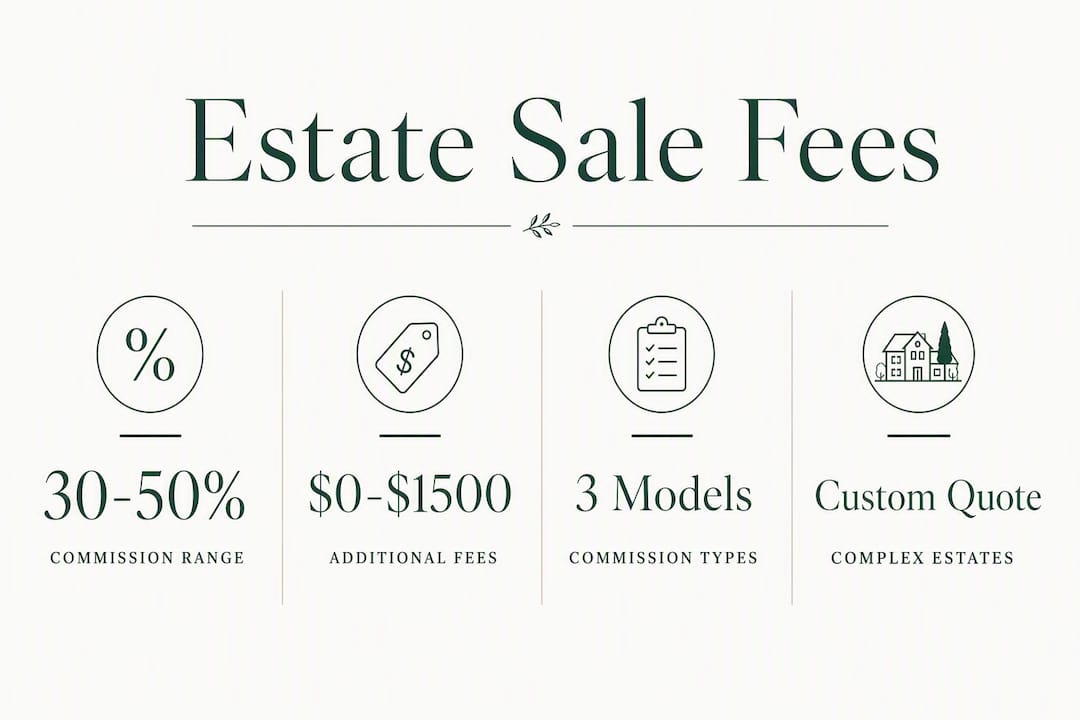
Custom quotes after an in-person walkthrough are standard for larger or more complex estates. The company assesses item mix, square footage, hoarding conditions, and regional demand before naming a rate. This is actually the most accurate model for unusual situations, even if it feels less transparent upfront.
Several factors push rates up or down. A hoarder-condition home with thousands of unsorted items commands a higher rate than a staged, well-organized property. High-value items like jewelry, art, or antiques attract more competitive bids from companies because the gross potential is higher, which can work in your favor during negotiation. Regional labor costs matter too: a New Jersey estate sale company faces different overhead than one operating in rural Tennessee.
One insight worth holding onto: a lower commission rate does not automatically mean a better deal. A more experienced company charging 40% may generate $6,000 more in gross proceeds through superior pricing and buyer outreach than a 30% firm with weaker marketing.
Pro Tip: Ask every company you interview for a sample settlement statement from a recent comparable sale. That single document tells you more about their actual fee structure than any verbal description.
What extra charges appear beyond the commission?
The commission covers the core service, but several line items can appear on top of it. Some are standard; others are negotiable. Here is what to watch for:
- Advertising and marketing: Costs for online listings, signage, and social media promotion typically run $100–$500. Many companies bundle basic advertising into the commission; confirm this in writing before signing.
- Credit card processing: Buyers increasingly pay by card. Processing fees run approximately 2.9% plus $0.30 per transaction, and some companies pass this cost to the seller rather than absorbing it.
- Haul-away and trash removal: Unsold items and debris removal can cost $50–$150 per load, billed separately unless the contract specifies otherwise.
- Post-sale cleanout: A full broom-clean finish after the sale is a distinct service. Some companies charge a flat cleanout fee or hourly rate; others offer it as a bundled option at a reduced cost.
- Appraisal fees: High-value items like fine art, jewelry, or collectibles may require a certified appraisal before pricing. This is usually billed separately and can range from a flat fee to an hourly rate depending on the appraiser.
- Security and staffing: Large sales with high foot traffic sometimes require additional staff or security personnel. Ask whether this is included in the commission or billed as an add-on.
- Shipping and handling: If the company lists items for online buyers or auction bidders outside the local area, packing and shipping costs are typically passed to the buyer or deducted from proceeds.
The fees most worth negotiating are advertising and post-sale cleanout. Basic signage and online listing are table stakes for any reputable company and should be included in the commission. Dumpster rental and haul-away are legitimate separate costs, but you should know the exact amount before signing, not after the sale closes.
Always request an itemized written estimate that distinguishes what is bundled from what is billed separately. A company that cannot produce one before the walkthrough is a company worth reconsidering.

Onsite vs. online estate sales: how do the fees and payouts differ?
The format of the sale changes the fee structure in ways that are easy to underestimate.
Onsite sales use the percentage commission model described above. Buyers come to the property over one to three days, and the company manages pricing, staffing, and transaction handling on-site. The reach is local, which works well for furniture, household goods, and everyday collectibles. Payout is straightforward: gross proceeds minus commission minus any documented extras.
Online auctions and consignment platforms add layers. Platform or auction house fees, lotting fees, and shipping or packing costs change the net payout profile compared with a local onsite sale. A buyer's premium charged to the bidder may reduce what buyers are willing to bid, indirectly affecting your gross. Listing fees and photography costs may also appear.
The real advantage of online formats is reach. A rare piece of furniture or a signed first edition that might sell for $200 at a local estate sale could attract national bidders and fetch $800 at auction. For the right items, the additional fees are worth it.
The hybrid approach is often the most practical for mid-to-large estates. High-value, easily shipped items go to an online auction or consignment platform for maximum exposure. Everything else moves through an onsite sale. The company manages both channels, and the fee structures are documented separately on the settlement statement.
When evaluating a hybrid proposal, ask the company to estimate gross proceeds for each channel separately, then calculate your net after all fees for each. That comparison tells you whether the online premium is actually worth the added complexity.
What should you check in the estate sale contract?
A signed contract is your only protection if something goes wrong. Read every line before the walkthrough ends.
Contract checklist:
- Commission structure: flat rate or sliding scale, with specific brackets documented
- Minimum guarantee: some companies require a minimum payout to themselves regardless of gross proceeds
- What is included vs. excluded: advertising, staffing, cleanout, donation coordination
- Payment timing: reputable companies typically issue an itemized settlement and payout within 7–14 days after the sale, but confirm the exact timeline in writing
- Itemized expenses: every add-on fee listed with a dollar amount or rate, not vague language like "additional costs as incurred"
- Unsold items policy: who handles removal, at what cost, and by what date
- Insurance and liability: the company should carry liability insurance covering damage to the property and theft during the sale
- Cancellation terms: what happens if you cancel after setup begins, and whether you owe a fee
- Dispute resolution: how disagreements about the settlement statement are handled
Negotiation tactics worth using:
- If your estate has high-value items, use that as leverage to negotiate a lower rate or a sliding scale.
- Ask for written itemized fees before signing, not after.
- Request two or three recent client references and call them. Ask specifically about the settlement statement accuracy and payout timing.
- Compare bids by expected net proceeds after all documented fees, not by commission percentage alone.
Red flags to watch for: vague contract language about "additional costs," no written payout timeline, or a company that cannot provide proof of insurance. Walk away from any bid that does not include a written itemized estimate.
Pro Tip: If a company resists putting specific fee amounts in writing before the sale, that resistance is the answer. Transparent companies document everything upfront.
How to estimate your net proceeds before hiring anyone
The math is straightforward once you know what to plug in.
Net proceeds = Gross sale total − Commission − Documented additional fees
Here are three worked examples using common commission and fee scenarios:
| Scenario | Gross Sale | Commission Rate | Commission Amount | Additional Fees (est.) | Net to Estate |
|---|---|---|---|---|---|
| Small sale | — | 50% | — | — | — |
| Mid-size sale | — | 40% | — | — | — |
| Large sale | — | 30% | — | $1,200 | — |
Additional fees in these examples include estimated advertising and basic haul-away. Credit card processing and post-sale cleanout are not included and would reduce net proceeds further if billed separately.
For context, SmartAsset reports that an $18,565 gross sale at 35% commission leaves the estate with roughly $12,000 after commission, before any extras.
Before you run your own numbers, confirm these assumptions with the company:
- Does the commission percentage apply to gross proceeds or net proceeds after expenses?
- Who pays state sales tax: the buyer at the register, or is it deducted from proceeds?
- Are credit card processing fees absorbed by the company or passed to the seller?
- Is haul-away of unsold items included, or billed separately per load?
- Is post-sale cleanout bundled, or is it a separate line item?
Getting clear answers to all five questions before signing lets you build an accurate budget rather than discovering surprises on the settlement statement.
What are the U.S. tax basics for estate sale proceeds?
Tax treatment for estate sale proceeds is one area where general guidance has real limits, because the specifics depend on the estate's structure, the decedent's cost basis, and state law.
The short answer on income tax: inherited personal property typically receives a stepped-up basis equal to the fair market value at the date of death. If items sell at or below that value, there is generally no taxable gain. If the sale price exceeds the date-of-death fair market value, or if items have appreciated since inheritance, there may be tax consequences. A tax professional familiar with estate situations can determine whether proceeds need to be reported and on which form.
Sales tax is a separate matter. Most estate sale companies collect and remit state sales tax on buyer purchases, as required by state law. Confirm that the company you hire handles this, and ask for documentation that it was remitted. If the company does not handle sales tax, you may have an obligation to do so yourself.
For federal guidance, the IRS publishes resources on inherited property and basis rules at IRS.gov. Your state's revenue department is the right source for state sales tax requirements.
This article provides general information only, not tax or legal advice. Consult a qualified tax professional for guidance specific to your estate.
How do you choose the right estate sale company?
Start by getting clear on what the estate actually needs, because the right company for a broom-clean handoff with donation coordination is not necessarily the same as the right company for a high-value art and jewelry sale.
Decision checklist:
- Maximum net proceeds: prioritize companies with strong buyer networks, pricing expertise, and verifiable references from comparable sales
- Broom-clean handoff: confirm that post-sale cleanout and unsold-item removal are bundled or clearly priced
- Timeline: ask how many days setup requires, how long the sale runs, and when the settlement check arrives
- Donation of usable items: if this matters to the family, confirm the company's policy and whether donation coordination is included or billed separately
Exact questions to ask at the walkthrough:
- What is your commission structure, and do you use a sliding scale?
- What does your commission include: advertising, staffing, cleanup?
- Can you provide a sample settlement statement from a recent comparable sale?
- What is your proof of liability insurance?
- Can you provide two or three references from estates similar in size and type?
- What is your estimated gross for this estate, and how did you arrive at that number?
- What happens to unsold items, and what does removal cost?
- What is your payout timeline after the sale closes?
The one-sentence heuristic: compare bids by expected net proceeds after all documented fees, and by service scope — specifically whether donation coordination and removal are included or billed separately.
How Bereavementcleanoutservices handles estate sale fees
Bereavementcleanoutservices approaches estate sale pricing with the same transparency it brings to every cleanout: everything is documented, nothing is vague, and the family knows exactly what to expect before work begins.
The company's model is built around a donation-first philosophy. Usable items go to local charities before anything goes to a dumpster, which reduces haul-away costs and honors the family's wishes. Estate sales, online consignment listings, and broom-clean handoffs are all part of the service offering, and bundling the sale with cleanout and donation coordination typically costs less than contracting separate companies for each piece.
What bundled service means in practice: when the estate sale commission covers pricing, staging, staffing, and post-sale cleanup in a single documented agreement, families avoid the common scenario of paying a sale company, then separately hiring a hauler, then separately arranging donations — three invoices, three timelines, and three sets of coordination.
Illustrative packages (not a formal quote — contact for a walkthrough estimate):
- Bundled estate sale + cleanout: commission-based sale with post-sale broom-clean finish, donation coordination, and itemized settlement statement included
- Estate sale only: commission-based sale with standard advertising and staffing; cleanout and donation runs quoted separately
- Online consignment + photography: inventory photography, online listing management, and commission-based consignment for higher-value items
Settlement documentation includes an itemized statement showing gross proceeds, commission, and any separately billed expenses. Payout timing is confirmed in the contract before work begins. All crews are fully insured, which matters for probate documentation and for the family's peace of mind.
To get an accurate estimate for your estate, request an in-home walkthrough. The walkthrough is the only reliable way to produce a real gross estimate and a written fee breakdown.
Key Takeaways
Estate sale commissions in the U.S. typically run 30%–50% of gross proceeds, covering pricing, staging, staffing, and marketing — but what those fees include beyond the commission varies significantly by company.
| Point | Details |
|---|---|
| Typical commission range | U.S. estate sale fees run 30%–50% of gross proceeds; smaller sales often land at 50%, large estates can negotiate to 30%. |
| Compare net proceeds, not just rates | A higher-commission company with better pricing and buyer reach often delivers more money to the estate than a lower-rate competitor. |
| Contract red flag | Vague language about "additional costs" and no written payout timeline are the two clearest signs of a contract worth rejecting. |
| Tax consultation required | Proceeds from inherited property may have tax implications if items sell above date-of-death fair market value; consult a tax professional and IRS.gov. |
| Bereavementcleanoutservices approach | Bundles estate sales with donation coordination and broom-clean handoffs in New Jersey, with itemized settlement statements and insured crews. |
What most families get wrong about estate sale pricing
The conventional wisdom says: get three bids, pick the lowest commission, and you've done your job. That logic works when you're buying a commodity. Estate sale services are not a commodity.
The commission percentage is the least informative number on the bid sheet. What actually determines how much money the estate keeps is the company's ability to price items correctly, attract qualified buyers, and close transactions at full value. A firm charging 45% that prices a mid-century dining set at $1,200 instead of $400 has already paid for its premium. The family nets more even after the higher cut.
The second thing families underestimate is the cost of fragmented services. Hiring a sale company, then separately arranging haul-away, then separately coordinating donations creates three invoices, three timelines, and real gaps in probate documentation. Bundling these services under one contract is not just convenient — it reduces the total cost and the administrative burden on whoever is managing the estate.
The third overlooked factor is the settlement statement. Most families never ask to see one from a comparable sale before signing. That document shows you exactly how the company accounts for gross proceeds, deductions, and net payout. A company that produces a clean, itemized statement for a past client will produce one for you. A company that hedges on that request is telling you something.
Ready to get a clear, written estimate for your estate?
When you're managing a loved one's estate in New Jersey, the last thing you need is a fee structure that surprises you after the sale closes. Bereavementcleanoutservices offers a straightforward alternative: a bundled estate sale and cleanout service with a donation-first approach, fully insured crews, and an itemized settlement statement so you know exactly where every dollar went.

What to expect from a walkthrough consultation:
- A room-by-room assessment of the estate's contents and estimated gross sale value
- A written fee breakdown distinguishing commission from any separately billed services
- A clear timeline covering setup, sale days, post-sale cleanup, and settlement payout
- Confirmation of donation coordination and unsold-item removal policy
Request a walkthrough to get a written estimate and a draft contract before you commit to anything. No vague verbal quotes, no surprises on the settlement statement.
Useful sources
- SmartAsset — How Much Does the Average Estate Sale Make? — net-proceeds baseline and average gross sale data
- IRS.gov — federal guidance on inherited property basis rules and reporting
- Bereavementcleanoutservices — Estate Cleanouts and Estate Sales in New Jersey — bundled estate sale, cleanout, and donation coordination services; request a walkthrough estimate here
For estate-specific tax questions, consult a qualified tax professional and your state's revenue department for current sales tax requirements.