
Start with five things, in order: confirm you have legal authority to act, gather the will and death certificates, secure the property and photograph every room, sort belongings into keep, sell, donate, and dispose piles, and get appraisals on anything valuable before selling it. Documents and photos can happen right away. Distributing or selling valuables should wait until you have proper authority and, where needed, a formal appraisal. Professional estate cleanout services often offer donation-first options if you'd rather hand the physical work to experts.
TL;DR:
- Confirm legal authority through probate court documents, such as Letters Testamentary or appointment of an administrator, before selling or distributing valuables.
- Obtain detailed inventories, photographs, and valuations of high-value items like art, jewelry, and vehicles before any sale or significant disposal.
- Secure the property by changing locks, maintaining utilities, and documenting everything, including room photographs, before handling belongings.
- Prioritize donation of usable items after confirming acceptance policies and obtaining receipts, and properly dispose of hazardous materials with proper documentation.
- Hire a reputable, insured estate cleanout service when the volume, distance, or emotional weight makes DIY unmanageable, ensuring clear scope, timeline, and proper documentation.
Table of Contents
- The Complete Estate Cleanout Checklist, Step by Step
- Who Has Legal Authority, and What Documents Protect You?
- How Do You Inventory and Sort a House Full of Belongings?
- What's the Safest Way to Donate, Recycle, or Dispose of Items?
- When Do You Need an Appraisal Before Selling Anything?
- When Should You Hire a Professional Cleanout Service?
- What Compassionate Cleanouts Get Right That Rushed Ones Miss
- How Bereavement Cleanout Services Handles the Work for You
- Sources
- FAQ
The Complete Estate Cleanout Checklist, Step by Step
An estate cleanout checklist only works if the steps happen in the right order. Clear a house too fast, and you risk giving away something that needed an appraisal, or worse, distributing property before you had the legal right to touch it. Here's the sequence that protects you and the estate.
1. Confirm your authority and notify key parties (Week 1). Before you touch anything of value, know your legal standing. If the deceased left a will naming an executor, that person typically needs Letters Testamentary from the probate court before acting on major decisions. No will? A court appoints an administrator instead, and that process, called intestate succession, takes longer. Notify the probate attorney handling the estate immediately, and if you're not yet formally appointed, avoid distributing or selling anything until you are.
2. Gather documents and records (Week 1). Locate the will, multiple certified copies of the death certificate, property deeds, vehicle titles, bank and retirement statements, insurance policies, and recent tax returns. Check a home office, safe deposit box, or a fireproof lockbox first.
3. Secure the property (Week 1). Change the locks if multiple people had keys, forward or hold mail, and confirm homeowners insurance is still active, since many policies lapse coverage on vacant homes after 30 to 60 days. Keep utilities on until the cleanout finishes.
4. Inventory and photograph every room (Weeks 1 to 2). Walk through methodically, documenting furniture, collectibles, and anything that looks valuable before moving a single box. This step alone prevents most family disputes down the line.
5. Triage into disposition categories (Weeks 2 to 3). Sort into keep and distribute, sell, donate, recycle, and dispose. Keepsakes can move immediately once claimed by family. Items worth real money wait for valuation.
6. Arrange valuations (Weeks 2 to 4). Get professional appraisals on art, jewelry, antiques, coins, and vehicles before choosing a sale method.
7. Execute staged clearance (Weeks 3 to 5). Schedule donation pickups, haul disposal loads, and finish with a broom-clean handoff for the buyer, landlord, or next occupant.
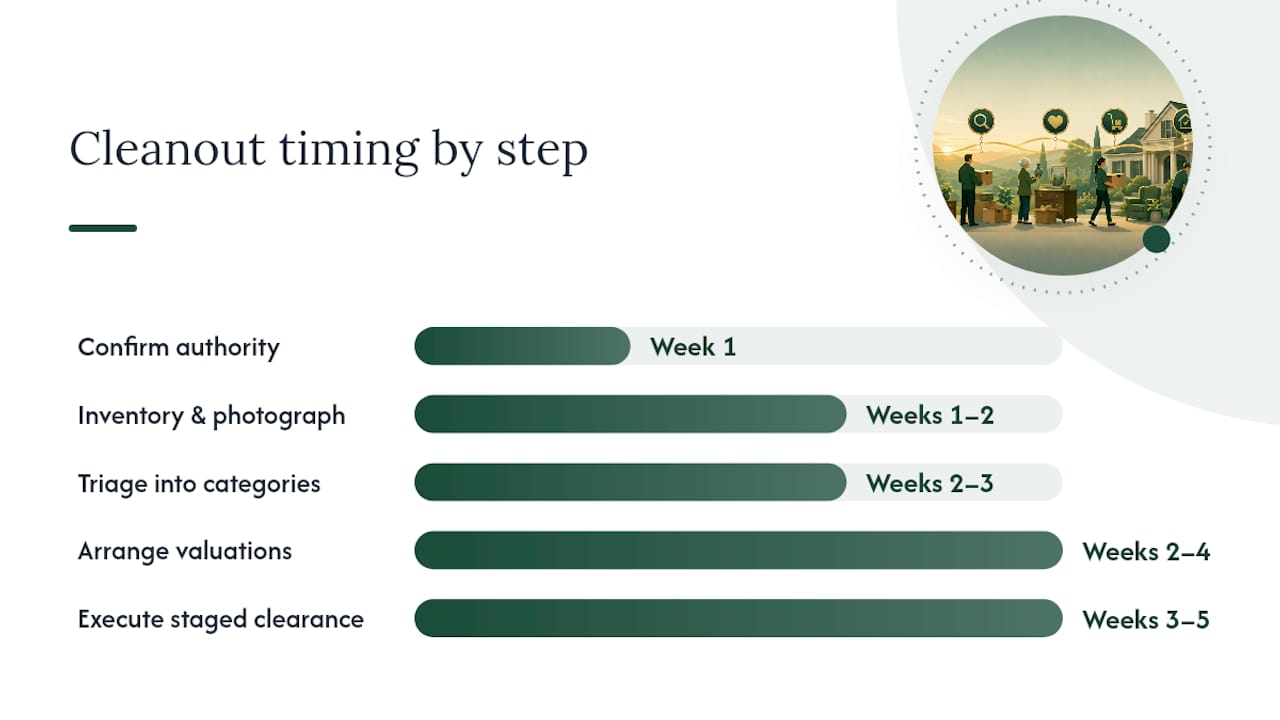
Realistically, a single-family home takes two to five weeks from first walkthrough to broom-clean, depending on volume and how many decision-makers need to weigh in.
Common friction points that slow this down:
- Siblings disagreeing over who gets sentimental items with no monetary value
- Discovering hazardous materials or old medications mid-sort
- Waiting on appraisal appointments that push the timeline back a week or more
- Realizing too late that something was already donated or discarded
Pro Tip: Create a shared spreadsheet or photo album the moment you start. Every family member with a stake in the estate should see the same inventory in real time, which cuts down on "who took that?" conversations later.
Who Has Legal Authority, and What Documents Protect You?
The single biggest mistake in any house cleanout guide is skipping the authority question. A will naming you as executor is a strong starting point, but many states still require Letters Testamentary from probate court before you can legally sell property, close accounts, or transfer titles. Without a will, a court appoints an administrator, and that appointment, not family consensus, is what gives you legal standing.
Executor guides consistently warn against clearing a property before authority and valuation are settled, since doing so can create legal liability or reduce what the estate is worth to heirs and creditors. That's the core discipline behind any solid estate liquidation checklist: document first, distribute last.
Before you touch anything with resale value, track down:
- The original will and any codicils
- Five to ten certified copies of the death certificate (banks and title companies each want their own)
- Property deeds and mortgage statements
- Vehicle titles and registrations
- Bank, brokerage, and retirement account statements
- Life insurance policies and beneficiary designation forms
- The last three years of tax returns
- A list of digital accounts, passwords, and two-factor recovery methods
Securing the property, retrieving these documents, and photographing rooms are all safe to do before probate finalizes. Selling the car, distributing jewelry, or emptying a bank account is not, at least not until you have formal authority in hand.
Keep a written log of every action you take. Note dates, who was present, and what left the house. Photograph before and after each room clears. This paper trail becomes your estate accounting, and it's what protects you if a beneficiary later questions where something went.
How Do You Inventory and Sort a House Full of Belongings?
Grief makes people skip corners, literally. Executors miss cash in coat pockets, jewelry tucked behind picture frames, and important papers filed inside books. A thorough search means checking closets, under furniture, inside dresser drawers, the attic, the garage, and any off-site storage units before you sort a single box.
Build your inventory around a simple template: photo, brief description, maker's mark or brand if visible, room location, condition, and proposed disposition. This becomes your record for tips for organizing estate belongings and doubles as documentation if disputes arise later.
Sort everything into five buckets:
- Keep or distribute to family members with agreed-upon claims
- Sell through auction, consignment, or estate sale
- Donate to a local charity or thrift organization
- Recycle electronics, metal, and building materials
- Dispose of anything with no resale or donation value
Add a sixth, unofficial bucket: "still deciding." Give it a hard deadline, two weeks is reasonable, so indecision doesn't stall the whole property cleanout plan.
Sentimental items deserve their own process. Label anything a family member has claimed with their name and the date, store it in a locked room or off-site until pickup, and get a signed receipt when it leaves the house. That receipt matters more than people expect, since it's often the only record that prevents a "you took that without asking" argument six months later.
Pro Tip: Photograph the inside of drawers and closets before emptying them. It sounds excessive until someone asks whether Grandma's ring was ever actually in the jewelry box.
What's the Safest Way to Donate, Recycle, or Dispose of Items?
Donation should be your default for anything usable, but call ahead first. Acceptance rules vary by location and by item condition, so check with your local Goodwill donation center before loading a truck full of furniture they might turn away. Habitat for Humanity ReStores take furniture, appliances, and building materials too, and both organizations issue donation receipts you'll want for estate accounting.

Medications need special handling. The FDA's guidance on drug disposal recommends take-back programs first, and flushing only specific medicines the agency has explicitly cleared for that method. Never toss loose pills in the regular trash.
Hazardous household materials require their own disposal path entirely. Paint, solvents, old batteries, propane tanks, and pesticides all fall under categories the EPA tracks as hazardous, and most municipalities run dedicated transfer stations or collection events for them rather than allowing curbside pickup.
Practical disposal steps:
- Call donation centers before hauling items, and confirm they're accepting that day
- Keep every donation and waste transfer receipt in your estate file
- Bring old electronics to an e-waste recycler rather than the curb
- Locate a medication take-back event near the property before the cleanout begins
- Set aside hazardous items in a ventilated area until you can transport them properly
Skipping the receipt step is the most common mistake families make here. Without documented proof of donation or disposal, you have no record for the estate's final accounting.
When Do You Need an Appraisal Before Selling Anything?
Not everything needs a professional appraiser, but certain categories almost always do: fine art, jewelry, antiques, coin and stamp collections, and vehicles. These carry enough value that an informal guess can cost the estate real money, either through underselling or through tax exposure if a beneficiary later disputes the reported value.
Valuations should reflect the date of death, not today's market, since that figure is what estate accounting and any tax filings rely on. Keep the appraiser's written report on file alongside your inventory photos.
Your sale method depends on what you're moving:
- Auction houses work well for high-value single items but take weeks to schedule and typically charge a seller's commission
- Estate sale companies clear a full house in a weekend and usually keep 15% to 35% of proceeds
- Consignment shops hold items longer for a better per-piece price, often 20% to 40% commission
- Online marketplaces net more per item but demand your time listing, photographing, and shipping
- Bulk buyout companies move fastest but pay the least
Deposit every sale's proceeds directly into the estate account and document the transaction. If the property is also headed to market, staging after cleanout is worth planning before the last item leaves.
When Should You Hire a Professional Cleanout Service?
Hire help when the volume, the distance, or the emotional weight is more than you can manage alone. Signs it's time: the property is hours from where you live, the home involves hoarding-level clutter, probate deadlines are tight, or family members simply can't agree on who does the physical labor.
Before signing anything, vet the company:
- Confirm they carry liability insurance and ask for proof
- Request references from past estate or probate clients
- Get a written contract with an itemized scope of work
- Ask whether donation receipts and waste transfer documentation are included
- Clarify the timeline and get payment terms in writing before work starts
A donation-first provider handles keepsake sorting separately from bulk removal, coordinates directly with local charities, and documents every donation with a receipt for your estate file. That combination, sensitivity paired with paperwork, is what separates a professional cleanout crew from a DIY dumpster rental when the estate involves both sentimental value and probate scrutiny.
Pro Tip: Ask any cleanout company how they handle an item the family hasn't decided on yet. A company with a real process for "still deciding" boxes is far more trustworthy than one who just wants everything gone by Friday.
What Compassionate Cleanouts Get Right That Rushed Ones Miss
Families almost always underestimate how much the donation-first decision matters, not just emotionally, but financially. A house cleared with donation as the default, rather than the dumpster, tends to cost less in hauling fees and produces documentation that makes the executor's final accounting far cleaner.
The lesson that surprises most people: sentimental items rarely have monetary value, but they cause the most conflict. Labeling and photographing them early, before anyone's exhausted from three straight weekends of sorting, prevents most of the disputes that otherwise end up dragging out probate. Grief and logistics collide in these projects, and organizations like GriefShare exist precisely because managing both at once is genuinely hard, not a sign you're doing it wrong.
— Derek
How Bereavement Cleanout Services Handles the Work for You
Bereavement Cleanout Services exists for the moment this checklist starts to feel like too much to carry alone, especially when you're grieving and managing probate paperwork at the same time. Unlike a general junk hauler, the donation-first approach means usable items go to local charities first, keepsakes get sorted separately with documentation for probate, and every donation and disposal run comes with a paper trail your estate accounting will need.

Services can include full house cleanouts, apartment and condo cleanouts, hoarding cleanup, and single-room jobs, often completed with a broom-clean finish by insured crews. Typically, the first call includes a walkthrough, a written quote, a timeline estimate, and confirmation of insurance coverage before work begins. If keepsakes need extra care, ideas from protecting sentimental clutter with proper documentation show how that process works in practice.
Request a walkthrough and quote directly through Bereavement Cleanout Services to get a clear timeline and price before you commit to anything.
Sources
- Drug disposal: Drug take-back options | FDA
- Goodwill locator
- Habitat for Humanity ReStores
- Geneseo
- GriefShare
FAQ
What Should Be the First Step in an Estate Cleanout Checklist?
Confirm your legal authority to act, either as the named executor or a court-appointed administrator, before touching anything of value. Gathering documents and photographing the property can start immediately, but selling or distributing valuables should wait until authority is formally established.
How Long Does a Typical Estate Cleanout Take?
Most single-family homes take two to five weeks from the first walkthrough to a broom-clean finish, depending on volume and how many family members are involved in decisions. Hoarding situations or homes with high-value collections often run longer.
What Documents Do I Need Before Clearing an Estate?
You'll need the will, several certified copies of the death certificate, property deeds, vehicle titles, bank and retirement statements, insurance policies, and recent tax returns. Locate these before scheduling any major disposal or sale.
Should I Donate or Sell Items During an Estate Cleanout?
Donate anything usable that doesn't require a professional appraisal, and sell higher-value items like jewelry, art, or antiques only after getting them valued. Always request a donation receipt for your estate accounting, whether you donate through Goodwill or a service like Bereavement Cleanout Services.
How Much Does It Cost to Hire an Estate Cleanout Service?
Pricing depends on the property size and condition. Bereavement Cleanout Services lists full house cleanouts from 1200 USD, apartment cleanouts from 650 USD, and hoarding cleanup from 1500 USD, with exact quotes available after a walkthrough at Bereavementcleanoutservices.