
Give yourself about three months if the calendar allows it. That window covers inventory, family decisions on keepsakes, appraisals, and staging without rushing anyone. If circumstances force a faster pace, a focused two to four week schedule can still work, with a sale running one to three days and advertising starting 10 to 14 days out. Beyond that minimum, you're gambling with pricing accuracy and turnout.
TL;DR:
- Starting estate sale preparations at least three months in advance allows ample time for inventory sorting, family decisions, and appraisals, reducing stress and friction.
- A two- to four-week schedule is possible but limits research, advertising stages, and appraisal accuracy, potentially reducing sale turnout.
- Weekends are optimal for sale days, with early planning for staffing, signage, security, and payment systems crucial to ensure smooth operation.
- For high-value items, scheduling appraisals early is essential, and certified documentation helps confirm item value for probate purposes.
- Fees for professional estate sale services typically range from 25% to 40% of gross sales, justifying hiring when time or emotional capacity is limited.
Table of Contents
- How Far Ahead Should You Start Planning an Estate Sale?
- What Does an Estate Sale Schedule Actually Look Like Week by Week?
- Should You Hire a Professional or Run the Sale Yourself?
- What Should Happen on Sale Day Itself?
- What Do You Do With Everything That Doesn't Sell?
- What If Something Delays Your Estate Sale?
- Do You Need a Permit to Hold an Estate Sale?
- A Few Honest Words on Timing and Value
- How Bereavement Cleanout Services Fits Into Your Schedule
- A Few More Places to Look
- Sources
- FAQ
How Far Ahead Should You Start Planning an Estate Sale?
The gap between an ideal timeline and a rushed one comes down to decision quality, not effort. An eight to twelve week runway gives you room to sort inventory carefully, let family members weigh in on keepsakes, get valuables appraised, and handle small repairs that affect what buyers will pay. Downsizing Insights recommends starting planning at least three months before your target sale date, and that lead time also tends to reduce family friction over who gets what, since nobody feels cornered into a fast decision.
A two to four week minimum can work, but you sacrifice something at every step. You'll skip deeper research on comparable pricing, compress advertising into a single push instead of a staged campaign, and likely forgo formal appraisals on higher-value pieces.
Weekends are the standard for sale days; Saturday and Sunday draw the deepest pool of buyers who have time to browse. Avoid major holiday travel weekends. Buyers are on the road, not shopping.
A few things stretch any estate sale timeline past the minimum:
- A large home with a full basement, attic, or garage adds sorting time that's easy to underestimate.
- High-value items like jewelry, art, or collectibles need appraisal lead time before you can price them confidently.
- Selling the house at the same time means coordinating showings, staging, and the sale itself without one interfering with the other.
What Does an Estate Sale Schedule Actually Look Like Week by Week?
A phased approach turns a vague goal into a calendar you can actually follow. Here's how the work breaks down when you have the full runway.
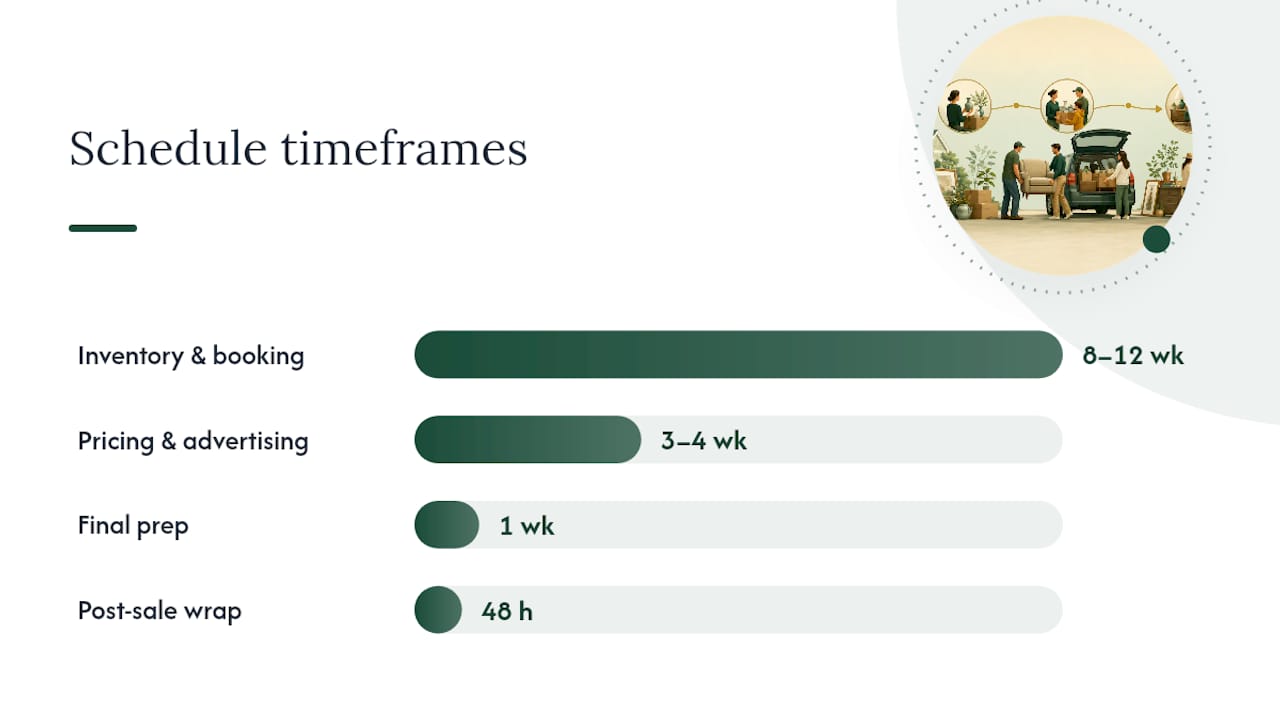
- Eight to twelve weeks out. Walk every room and build a full inventory. Let family members flag keepsakes before anything gets priced for sale. Schedule appraisals for jewelry, art, or collectibles. If you're hiring help, this is when to book them, since good crews get reserved weeks in advance.
- Three to four weeks out. Lock in your pricing plan and start advertising. Move, with professional photos and top-ticket items highlighted early to build a following before doors open. This is also when to line up donation and disposal logistics for whatever doesn't sell.
- One week out. Finish staging, print or order signage, and confirm your staffing schedule for sale days. Test your payment systems and count your starting cash drawer so there are no surprises on morning one.
Sale weekend runs on its own logic. Control the door so the space doesn't flood at opening. Keep checkout centralized and staffed. Pricing typically holds firm on day one, drops modestly on day two, and takes steeper cuts in the final hours as you clear remaining inventory. Afternoon Estate Sales outlines this staging and pricing rhythm as the norm across most sales, and it's worth following rather than reinventing.
Within 48 hours after the sale, document what sold, schedule your donation pickup, and plan the final broom-clean handoff if the property needs to go back to a landlord, buyer, or the estate.
Pro Tip: Photograph high-value items against a plain background before the sale starts. If a piece sells for a price that later gets questioned during probate, you'll have documentation showing exactly what it looked like and when.
Should You Hire a Professional or Run the Sale Yourself?
Commission is the number most families fixate on, and it's a fair place to start. Estate sale companies commonly charge 25% to 40% of gross sales, a range that typically covers pricing, advertising, staffing, and cleanup. A rate on the low end of that range can be a signal the service is stripped down, so it's worth asking what's actually included before you sign.
DIY makes sense under specific conditions:
- The estate's total property value is modest, often cited as under around ten to fifteen thousand dollars, where commission costs would eat a large share of proceeds.
- You have willing helpers for staffing, pricing, and cleanup across a full sale weekend.
- Nobody in the family is emotionally stretched thin by handling the items themselves.
If you're leaning toward hiring, ask a few direct questions before committing: Is the company insured? Can they provide references? What exactly does the commission cover? What happens to unsold items, and how fast do you get paid out after the sale closes?
This is also where a donation-first, documented approach pays off in ways a commission percentage doesn't capture. A service built around sorting for charity first, providing a broom-clean handoff, and generating paperwork for probate solves for time and emotional load, not just proceeds. For families managing an inherited home from a distance or under a tight timeline, that combination often matters more than shaving a few points off commission. You can compare typical estate sale fee structures against your own priorities before deciding.
What Should Happen on Sale Day Itself?
A sale runs smoothly when roles are assigned before the first buyer walks in. Plan for a floater who restocks and answers questions, someone watching pricing and markdowns, a dedicated checkout person, and a greeter managing the door if you expect a crowd.
Checkout needs to be simple and fast: a cash box, a card reader, receipts, and plenty of small bills and coins for change. Downsizing Insights recommends testing your payment setup and having a clear checkout station near the exit before doors open, not after the first buyer is already waiting.
Security matters more than most first-time sellers expect. Lock any rooms not part of the sale, tag high-value items so they're easy to track, and station someone near exits during busy stretches.
Signage does real work here too:
- Directional signs at the nearest intersections point buyers in from the street.
- Parking guidance keeps neighbors from filing complaints on sale morning.
- A controlled entry point, even something as simple as a sign-in sheet, keeps crowds from bottlenecking inside.
Pro Tip: Keep a sealed envelope of small bills specifically for the first hour. Early buyers moving fast on big-ticket items are the ones most likely to need change you don't have yet.
What Do You Do With Everything That Doesn't Sell?
Leftover inventory needs a plan before the sale even starts, not a scramble after. Schedule your donation pickup in advance and request receipts. Those documents matter for probate and estate tax accounting, and getting them on the spot beats chasing them down weeks later.

Electronics and hazardous materials need separate handling. Most municipalities have specific drop-off rules for these categories, and a general donation truck typically won't take them.
If the remaining volume is heavy, a cleanout crew can compress what would otherwise be days of hauling into a single broom-clean handoff, which matters if the home needs to go back to a landlord or hit the real estate market fast.
Keep a running record throughout:
- Log what sold and for how much.
- Note what was donated and to which organization.
- Record what was disposed of and how.
Keeping an estate accounting spreadsheet as you go saves hours of reconstruction later, especially if an executor needs to report totals to the court.
What If Something Delays Your Estate Sale?
Weather, a family emergency, or a slow appraisal can knock even a well-built schedule off track. Build a buffer into your plan rather than treating the calendar as fixed. If your ideal date lands during a stretch of severe weather or a competing local event, having a backup weekend already identified saves you from a last-minute scramble to find one.
Advertising delays are the most common snag. If your online listing or photos aren't ready by the 10 to 14 day mark that draws the strongest turnout, consider pushing the sale date rather than opening with a thin advertising push. A sale that opens to a small crowd because promotion started late is harder to recover from than one that simply starts a week later.
Appraisals for valuable items sometimes take longer than expected, particularly for art, jewelry, or antiques that need a specialist rather than a general appraiser. If a key item isn't appraised yet, you can either hold the sale and price that piece conservatively, or pull it aside for separate listing later. Rushing a guess on a high-value piece usually costs more than the delay would have.
Family disagreements over keepsakes are the delay nobody plans for but almost everyone encounters. Building in even a week of buffer at the front of your schedule, before pricing decisions lock in, gives relatives room to work through disagreements without pressure to decide on the spot.
Do You Need a Permit to Hold an Estate Sale?
Rules vary by municipality, and this is one area where it pays to check before you plan your dates, not after signage is printed. Some towns require a permit or a temporary sales license for estate sales, particularly if you're expecting heavy traffic or posting signs on public property. Others have no requirement at all for a private residential sale.
Homeowner association rules add another layer many families forget. If the property sits in an HOA, check the bylaws for restrictions on signage, parking, or the number of sale days allowed. Violating an HOA rule mid-sale can force an early shutdown, which is a far worse outcome than a five-minute phone call beforehand.
If you're hiring a professional company, ask directly whether permits are something they handle as part of their service or something you need to secure yourself. This is exactly the kind of detail that belongs on your list of questions before signing a contract, since permit responsibility that falls through the cracks can delay your sale date entirely.
Zoning matters too if you're in a mixed-use area or a neighborhood with unusually strict codes. A quick call to your local clerk's office or municipal website, made during that eight to twelve week planning window, is enough to confirm what applies to your specific address and avoid a surprise the week of the sale.
A Few Honest Words on Timing and Value
Rushed estate sales lose money in ways families don't see coming. Planning time isn't a luxury. It's what protects both the value of the items and the people making decisions about them.
Hiring help is worth the commission when time or emotional capacity is limited, and there's no shame in recognizing that limit early. Whatever you decide, keep the family informed at every step and write decisions down. Documentation settles disputes before they start.
— Derek
How Bereavement Cleanout Services Fits Into Your Schedule
If reading through all of this has you leaning toward professional help, a donation-first approach ensures usable items go to local charities before anything else, respecting what a family wants preserved while cutting down the volume left for disposal.

The process starts with a walkthrough and a firm quote, so you know your costs before committing to a date. From there, scheduling gets coordinated around your actual timeline, whether that's a full estate sale, a straight cleanout, or both back to back. Every service includes documentation for keepsakes and sales, which matters when an executor needs records for probate, and every job ends with a broom-clean handoff so there's nothing left for you to manage afterward. Operations are fully insured, and response times are fast for families working against a closing date or a lease deadline. If you're ready to put a real date on the calendar, reach out to Bereavement Cleanout Services for a walkthrough and a scheduling quote.
A Few More Places to Look
For deeper detail on specific tasks, Bereavement Cleanout Services' guide to estate sale advertising covers timing and photography, and the estate sale pricing breakdown walks through markdown strategy in more depth.
Sources
- Downsizing Insights | How to Host an Estate Sale: Step-by-Step Guide
- Move
- ProbatePedia — How to run an estate sale: personal property liquidation
- Afternoon Estate Sales — How long does the estate sale process really take?
FAQ
How Far in Advance Should You Schedule an Estate Sale?
Aim for about three months if your timeline allows it, since that covers inventory, family decisions, and appraisals without rushing. A minimum of two to four weeks can work, but expect compressed advertising and less research on pricing.
What Is the Best Time of Year or Week for an Estate Sale?
Weekends draw the strongest buyer turnout, and it's best to avoid major holiday travel weekends when shoppers are traveling instead of browsing sales.
How Much Do Estate Sale Companies Typically Charge?
Most estate sale companies charge 25% to 40% of gross sales, a range that generally covers pricing, advertising, staffing, and cleanup.
Is DIY Realistic for a Small Estate?
DIY tends to work when total property value falls under roughly $10,000 to $15,000 and you have helpers available for staffing and pricing across a full sale weekend.
What Happens to Items That Don't Sell?
Unsold items typically go to a scheduled charity donation pickup, with receipts kept for probate documentation, while electronics and hazardous materials usually require separate drop-off handling. A donation-first step built into the process ensures families aren't left coordinating disposal on their own after the sale ends.