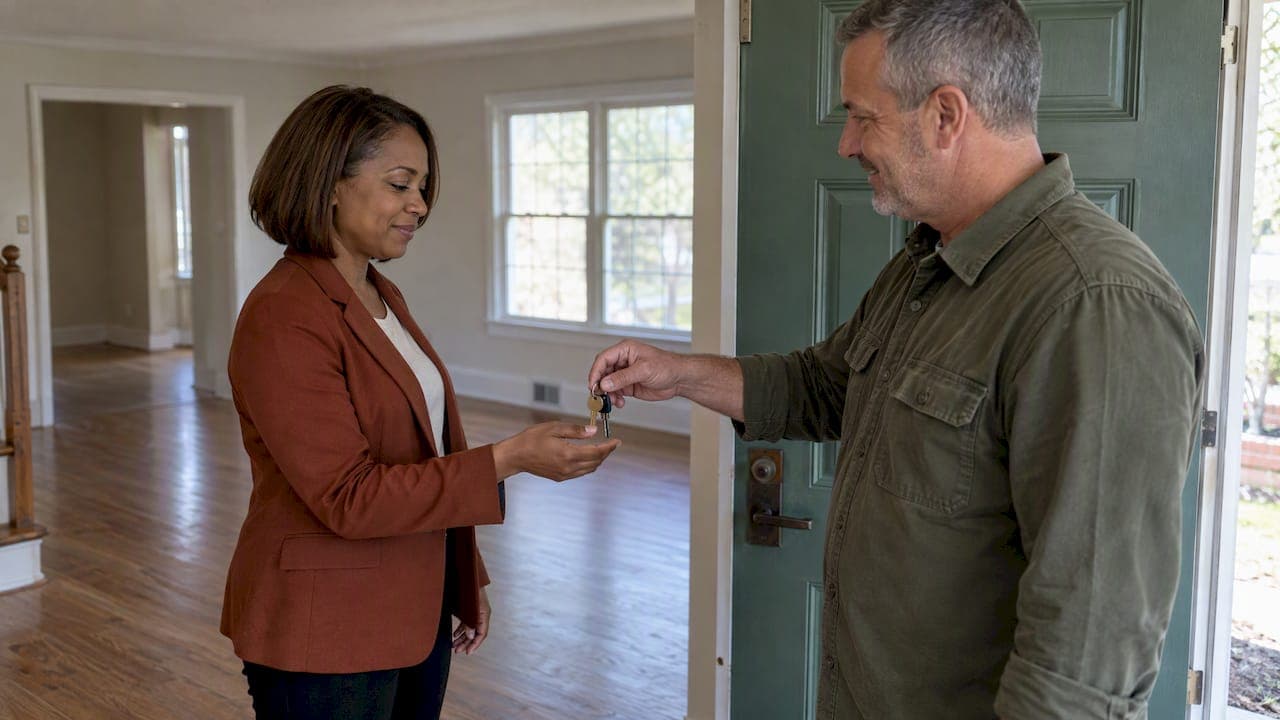
A good realtor cleanout checklist runs in a fixed order: confirm who can authorize the work, set the listing date, sort and document everything, remove hazardous items properly, finish broom-clean, and walk the property one last time. Skip the first step and the rest can stall. This guide gives you that order, with the specifics that tend to slow estate, probate, foreclosure and tenant-turnover listings.
It is written for agents who inherit a house full of belongings along with the listing. The family is grieving, the executor may live out of state, and the buyer's closing date does not move. We do cleanouts across New Jersey every week, and the same handful of decisions decide whether a turnover takes days or drags into weeks.
TL;DR
- Confirm in writing who has legal authority (executor, power of attorney or owner) before anyone removes a single item.
- Agree on the listing date and work backward: sort, remove, donate, clean, then photograph.
- Separate documents, valuables, medications and hazardous materials from general contents on day one.
- Keep donation receipts and photos, and finish broom-clean so the final walkthrough does not become a delay.
- For a fast turnover, hire a fully insured cleanout team with a firm quote after a walkthrough.
Table of Contents
- Step 1: Confirm authority before you touch anything
- Step 2: Build the timeline backward from the listing date
- Step 3: Do a walkthrough and set the sorting rules
- Step 4: Secure documents, valuables and sentimental items first
- Step 5: Handle medications and hazardous items safely
- Step 6: Donate, and keep the paperwork
- Step 7: Choose your cleanout approach
- Step 8: Clean to the standard the contract requires
- Step 9: Run the final walkthrough and handoff
- What we have learned doing this work
- Need the property cleared before you list?
- FAQ
- Sources
Step 1: Confirm authority before you touch anything
The National Association of REALTORS® advises realtors to confirm who has legal authority to authorize entry and removal, such as an executor, a power of attorney or the property owner. The same guidance points to three things to settle at the start: who makes decisions, the listing-date target and milestones, and what must be kept for legal, sentimental or financial reasons.
In practice, that means:
- Get a copy of the letters testamentary or letters of administration if the owner has died, or the power of attorney document if the owner is living but unable to act.
- Write down the name, phone number and email of the one person who gives final approval. If three siblings share the decision, ask them to name a single point of contact.
- Ask whether the estate is in probate and whether the court or an attorney has asked that contents stay in place. Our guide for executors on authority before donations explains why this order matters.
- Confirm who holds the keys, the alarm code and any lockbox access, and who is allowed in the house.
If the heirs disagree about anything, pause removal of that item and note it. A disputed rocking chair is a small problem. A disputed rocking chair that was donated last Tuesday is not.
For a deeper executor-side view, see our probate-ready checklist on when to wait.
Step 2: Build the timeline backward from the listing date
Most cleanout delays come from a timeline that starts at the front. Start from the date photos need to be taken and count back.
| Milestone | What has to be finished |
|---|---|
| Photos and showings | Rooms empty or staged, floors visible, odors addressed |
| Two to three days before | Final cleaning and touch-up |
| Before cleaning | All hauling, donation pickups and disposal complete |
| Before hauling | Keepsakes, documents and valuables removed and handed over |
| Before sorting | Authority confirmed, walkthrough done, quote approved |
Two practical notes. First, allow extra time when the property is packed to the ceilings. Heavy clutter slows every later step, which is why hoarding cleanups are quoted separately. Second, if a closing date is already fixed, tell the cleanout team that day. Our article on cleanout before closing covers the final 48 to 72 hours in detail.
Step 3: Do a walkthrough and set the sorting rules
The NAR guidance suggests that deciding early what is kept and what is removed prevents a project from stalling. A walkthrough with the decision-maker, ideally with you present, is where you do that.
Use four categories and label them physically with tape or colored tags:
- Keep: family keepsakes, photos, heirlooms, anything a relative asked for.
- Sell: furniture, art, jewelry, collectibles, tools and anything with resale value.
- Donate: usable furniture, housewares, clothing and linens in good condition.
- Dispose or recycle: everything else, including broken items and household hazardous waste.
One retail-side guide recommends handling items to be sold first because they are the most time-sensitive, then donating, gifting and discarding the rest (Saveor). On an estate listing, that order also protects value: a good dining set that sits in a dumpster pile is money lost for the heirs.
We sort with a donation-first approach, so usable items go to local charities rather than the landfill. Our guide to the five buckets for estate sale leftovers shows how that sorting works after a sale.
Step 4: Secure documents, valuables and sentimental items first
Before bulk removal, pull out what cannot be replaced. Agents get into trouble here more than anywhere else, because a box labeled "junk" can hold a deed, a will or a ring.
- Documents: FEMA's guidance on safeguarding critical documents and valuables recommends keeping paper copies in a fireproof, waterproof box or safe, a bank safe-deposit box, or with a trusted friend or relative. For an estate, hand them to the executor or attorney and record that you did.
- Small valuables: jewelry, cash, coins and keys go to the executor the same day, ideally with a photo and a signed note.
- Sentimental items: photo albums, letters, military items, religious objects. When in doubt, set aside. Our page on protecting sentimental clutter explains how we document these.
- Digital items: laptops, phones, hard drives and external storage may hold financial records. Keep them for the executor.
Check pockets, coat linings, books, freezers, the back of drawers and the tops of closets. People hide things in ordinary places.
Step 5: Handle medications and hazardous items safely
A house that has been lived in for decades usually holds more hazardous material than the family expects.
Medications
The DEA says unused or unwanted controlled substances may be transferred to authorized collectors or disposed of at law-enforcement take-back events (DEA). Liquid medications should be sealed in their original containers when brought to a take-back site, and syringes and sharps are generally not accepted through these programs (DEA). Do not let loose pills go into a donation box or a trash bag. If you find sharps, ask the local health department or pharmacy where they can be taken.
Paint, chemicals and batteries
The EPA describes household hazardous waste as leftover products with corrosive, toxic, ignitable or reactive ingredients, such as paints, cleaners, oils, batteries and pesticides, and says to use local collection events or permanent centers. Lithium-ion, lead-acid and other rechargeable batteries should not go in household trash or recycling bins; the EPA points to specialty drop-offs or household hazardous waste collection points.

Collection rules are local. Somerset County, New Jersey, for example, runs hazardous waste days for residents only and asks for proof of county residency, and businesses are not allowed. That matters when a cleanout company, not a resident, is doing the hauling, so ask the county or municipal recycling office what applies before you promise the seller a drop-off.
If the garage floor or driveway shows old oil or fuel stains, a short read on oil stains on asphalt explains quick first actions for the surface once the containers are gone.
Biohazard and specialty conditions
Pest droppings, mold, sewage, unattended-death conditions and heavy odors are not a job for a general cleanup crew or the family. Raise it early so the right team is scheduled. We offer specialty odor and waste cleaning for these situations.
Step 6: Donate, and keep the paperwork
Donation is where a cleanout can help the heirs financially if records are kept. The IRS notes that donors need a written acknowledgment for household items worth $250 or more, and that clothing and household items must be in good or better condition to be deductible (IRS). An item or group of similar items valued above $5,000 requires Section B of Form 8283, which generally calls for a qualified appraisal. The IRS also stresses that good records are key to claiming charitable gifts.
What to do on site:
- Photograph the donation load before it leaves.
- Get a dated receipt from the charity listing the items in general terms.
- Give the receipt and photos to the executor or the estate's accountant, and keep a copy in the listing file.
- Leave valuation to the donor or a tax professional. You and the cleanout team should not assign dollar values.
Our guide on donation receipt rules walks through what the receipt should show, and estate cleanout documentation explains the proof an executor may need.
Step 7: Choose your cleanout approach
Not every property needs the same service. Match the job to the situation.
| Situation | Typical approach | Published starting price |
|---|---|---|
| Single room, garage or basement | Targeted cleanout | from $295 |
| Apartment or condo | Full unit cleanout | from $650 |
| Foreclosure or eviction | Fast turnover, broom-clean | from $950 |
| Full house | Whole-house cleanout | from $1,200 |
| Heavy clutter or hoarding | Staged cleanup with sorting | from $1,500 |
| Large estate | Multi-room, large-volume cleanout | from $2,200 |
These are our published starting prices. The final price depends on volume, access, stairs, disposal needs and the condition of the property, which is why we give a firm quote after a walkthrough. For contents with resale value, estate sales run on a commission of 15% to 35%, and online consignment on 20% to 40%. Estate photography and online inventory is $75 per hour, and packing is $55 per hour per packer.
A useful rule when you advise sellers: if the heirs want to recover value, sell first, then clear. If the clock is tight, a donation-first cleanout with a short window for family keepsakes is usually the faster path.
Step 8: Clean to the standard the contract requires
Most purchase contracts require the seller to leave the property in broom-clean condition at closing. A New Jersey brokerage guide on the final walkthrough lists broom-clean condition as an expectation, alongside checking that agreed repairs are done. Read your own contract for the exact wording, as the standard can differ.
A broom-clean handoff generally means:
- No furniture, trash or personal belongings left in rooms, closets, attic, basement or garage
- Floors swept, with debris removed from corners and stairs
- Shelves, cabinets and drawers emptied
- Light bulbs working where the contract requires it
- Nothing left behind on the exterior, such as bins, debris piles or old appliances
For a stronger presentation, schedule a deeper clean after the cleanout and before photographs. Windows, kitchen, bathrooms, floors and odor control make the biggest difference in listing photos.
Also look at what the buyer's inspector will see outside. If the home is older, a quick look at roof rejuvenation before selling can help you think through what to fix before listing rather than after an inspection.
Step 9: Run the final walkthrough and handoff
The final walkthrough is where a nearly finished job can become a delayed closing. Do yours a day or two before the buyer's, so any problem can be fixed in time.
- Every room, top to bottom. Open closets, cabinets, the oven, the dishwasher and the washer and dryer.
- Attic, basement, garage, shed. These are the most common places for forgotten items.
- Exterior. Check porches, yard, sheds, curb and any bulk-item piles.
- Utilities and access. Confirm lights, water and heat work for the buyer's walkthrough, if the contract requires it.
- Keys and remotes. Gather garage remotes, mailbox keys and any codes in one labeled envelope.
- Photo record. Take dated photos of each room empty. They protect everyone if a question arises later.
- Paperwork to the executor and file. Donation receipts, disposal records, the list of items released to family, and the final photos.
If the cleanout team will do a final pass with you, schedule it for the same visit. We finish with a broom-clean handoff and provide documentation for probate.
What we have learned doing this work
Realtors usually come to us when time is already short. The pattern is the same: the house is full, the family is overwhelmed, and nobody is sure who can sign off on what.
Our advice is to settle authority and the sorting rules in the first walkthrough. After that, everything moves. We sort with a donation-first approach, set aside keepsakes with care, and document each step so the executor has records for probate and the realtor has a clean timeline.
We are fully insured, we work discreetly, and we respond quickly, because a listing date and a family's grief both deserve respect. A well-run cleanout does not feel rushed to the family, even when it is fast.
Derek
Need the property cleared before you list?
We handle estate, apartment, foreclosure, eviction and hoarding cleanouts across New Jersey, with donation-first sorting, documentation and a broom-clean finish. Share the address and your target listing date, and we will schedule a walkthrough and give you a firm quote. Start at our main page or check our New Jersey service areas.

For local pages, see Jersey City, Elizabeth and Freehold.
If you are guiding an executor who wants the family-side version, send them our real estate cleanout checklist for executors and our guide to preparing for an estate cleanout. If the contents are in storage, our storage unit cleanout plan applies.
FAQ
Who can authorize a cleanout on an estate property?
The person with legal authority, such as an executor, a power of attorney or the property owner. NAR guidance tells realtors to confirm this before entry and removal. Ask for the court letters or the power of attorney document and keep a copy in the file.
What should I do with medications found in the house?
Do not donate or trash them. Take unused medicines to an authorized collection site or a take-back event, with liquids sealed in their original containers. Sharps are generally not accepted at these programs, so ask your local health department or pharmacy where to take them.
How long before closing should the cleanout be finished?
Aim to finish hauling and cleaning well before the buyer's final walkthrough, with a few days of buffer for touch-ups and photographs. The exact window depends on the property and the contract. If closing is close, tell the cleanout team at the first call.
What does broom-clean mean?
It means the property is emptied of belongings and debris and the floors are swept. Contracts can word the standard differently, so check the one you are working under. A cleanout company can match that standard and document it with photos.
Do donation receipts matter for an estate?
Yes. The IRS requires a written acknowledgment for household items worth $250 or more, and clothing and household goods must be in good condition to be deductible. Give receipts and photos to the executor or the estate's tax professional.
Sources
- Managing an Estate or Probate Cleanout: A Practical Guide for Realtors (NAR)
- How to Get Rid of Unwanted Stuff (Saveor)
- Safeguard Critical Documents and Valuables (FEMA)
- DEA: new rules for prescription drug disposal
- DEA: National Prescription Drug Take Back Day
- EPA: Household Hazardous Waste guide
- EPA: How Do I Recycle Common Recyclables
- Somerset County, NJ: Household Hazardous Waste Days
- IRS: Tax Preparedness Series, #GivingTuesday
- IRS: Charitable contributions may help lower your tax bill
- IRS: Good Records Key to Claiming Gifts to Charity
- The Complete Final Walkthrough Checklist