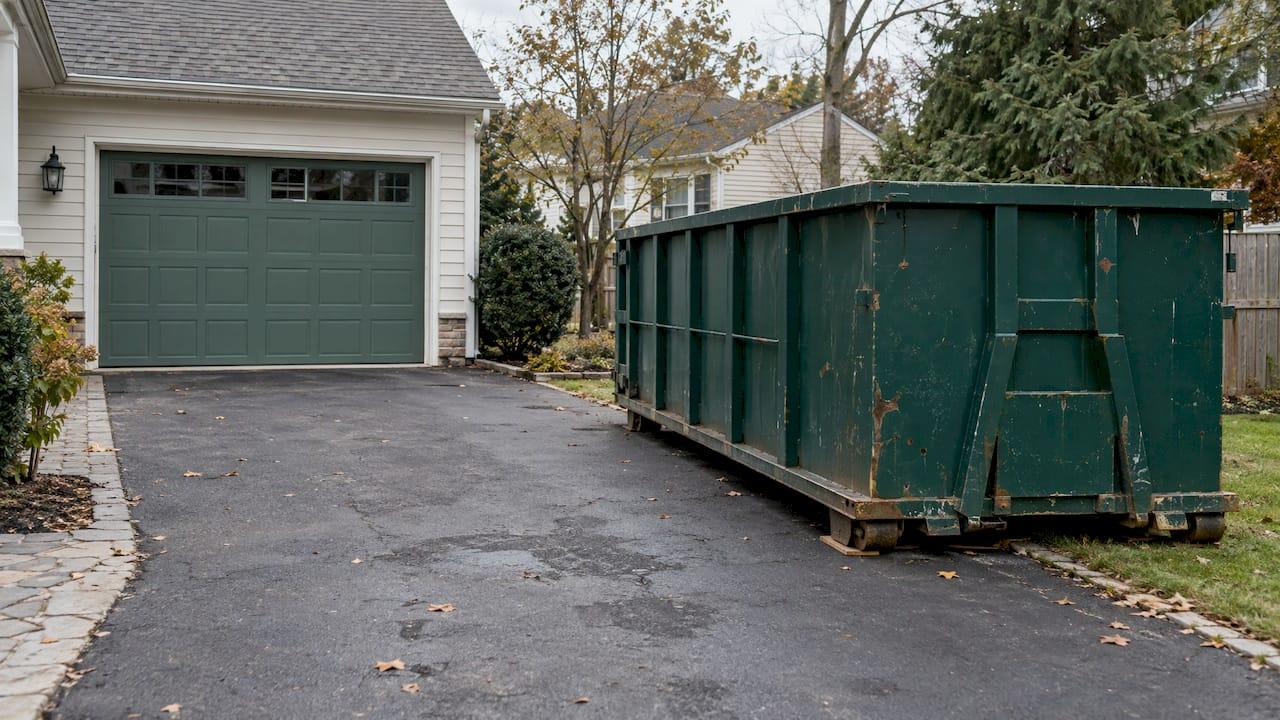
Put the dumpster on a flat, hard driveway or other private surface close to the door you will carry items through. Make sure the truck has a straight, open path in and out, with nothing overhead. Put plywood under it, and check whether your town needs a permit before it lands on a street. Get those four things right and the rest of the cleanout goes much more smoothly.
If you are clearing a parent's home, an apartment or a rental unit, you are probably doing it on a deadline and under stress. Placement is a small decision that can cause large problems: a blocked driveway, a cracked slab, a fine, a truck that cannot deliver. This guide walks through each part, and also explains when it makes more sense to hand the whole job to a crew.
TL;DR
- Choose a level driveway or private pad near the exit door. A street spot usually adds a permit and a deadline.
- Plan for a clear path of about 60 feet in length, 10.5 feet in width and 25 to 30 feet of height for the truck.
- Lay 3/4-inch plywood under the container and clear the drop zone of cars, toys and planters first.
- Load heavy items on the bottom, spread the weight evenly and walk bulky pieces in through the rear door.
- Not sure you want to sort, carry and load everything yourself? A donation-first cleanout crew can do it, with documentation for probate.
Table of Contents
- Where to place the dumpster
- Space and access the truck needs
- Choosing a size that fits the spot
- Protect the driveway and mark the spot
- Loading it safely and using the space well
- A realistic timeline
- Our perspective: when a crew is better than a container
- What a professional cleanout covers
- Get a quote for your cleanout
- FAQ
- Sources
Where to place the dumpster
Start with the driveway
For a residential project, a driveway is often the easiest location when it has enough space and gives the truck a clear path. It is private, it is close to the house, and it usually avoids the paperwork a public street brings.
A good spot has these traits:
- Flat and firm. Concrete or asphalt in good condition holds up better than gravel, pavers or a sloped apron.
- Close to the exit. Every extra step between the room and the container is time and strain, especially if you are moving furniture.
- Away from entrances and lanes. Do not block a front walk, a fire access route or a drive lane that neighbors, a landlord or tenants still need. Placement guides commonly advise keeping it clear of entrances, exits and drive lanes.
- Visible from the work area. You will see what goes in, and the container is less likely to collect other people's trash overnight.
Apartments, condos and shared lots
Multi-unit buildings add a second question: who controls the parking lot? Ask the property manager, landlord or condo association before you order anything. Many buildings limit where a container can sit, require advance notice, or already have an on-site dumpster that residents cannot use for bulk items. If you are working in a New Jersey condo, our guide to condo cleanout rules in New Jersey covers the building-level approvals to sort out first.
For a vacated rental, a single container near the unit's door keeps the site cleaner and safer to work in than several piles scattered around the property. A landlord handling a tenant's belongings after a move-out or eviction should also read what landlords must know about eviction cleanouts in NJ before anything is thrown away.
When the street is the only option
If there is no driveway, a street placement may be possible, but it is a different project. It typically involves a municipal permit, rules about cones, lighting and reflective markings, and a time limit. The rules differ by town, so call the municipal clerk or public works office, or check the municipality's website, before the delivery date is set. Your hauler can usually tell you what the town expects, but you remain the person responsible for the permit.

Permit penalties are real. In Jacksonville, Florida, for example, failing to obtain a required permit may bring a fine of up to $250, jail time of up to ten days, or both. New Jersey towns set their own rules and penalties, so ask your own municipality what applies.
Space and access the truck needs
A roll-off truck needs more room than the container itself. Drivers typically need at least 60 feet of length, 10.5 feet of width, and 25 to 30 feet of vertical clearance for delivery and pickup. Walk the route like a driver would:
- Look up. Check for power lines, cable drops, tree limbs and awnings along the whole approach and over the drop spot.
- Check the width. The truck must be able to back or drive in without scraping fences, mailboxes or parked cars.
- Check the turn. Tight cul-de-sacs, steep driveways and narrow streets can stop a truck that fits on paper.
- Plan the pickup, too. The truck needs the same clear path when it comes back, and it will be heavier and harder to maneuver then.
Do not count on getting a container through a gate. Residential gates are often 36 to 48 inches wide, too narrow for a 96-inch-wide roll-off container. If your only access is a side gate or an alley, ask about alternatives, or consider a crew that carries everything out by hand.
Choosing a size that fits the spot
The number in a dumpster's name is its capacity in cubic yards. Typical dimensions, according to one size chart, are:
| Size | Approximate dimensions (L × W × H) | Where it tends to fit |
|---|---|---|
| 10 yard | 12' × 8' × 3.5' | Garage, shed or single-room cleanouts |
| 20 yard | 16' × 8' × 6' | Larger rooms, basements, estate transitions |
| 30 yard | 22' × 8' × 6' | Whole-house jobs with a lot of furniture |
Because a bigger container needs a longer driveway, size and placement are linked. A 30-yard box on a short driveway may stick into the street and trigger a permit. A smaller one that is swapped once may be the better answer. Furniture, mattresses and appliances use up volume quickly, and a full house can fill more than people expect. Walk through every room before you decide, and tell the hauler honestly what is in the garage, attic and basement.
Heavy materials such as concrete, soil, tile and roofing change the equation, because weight limits and fees can apply. Ask what is included and what happens if you go over.

Protect the driveway and mark the spot
A loaded container is very heavy and sits on rails or wheels, which concentrate the load. Put sturdy 3/4-inch plywood under the rails or wheels to spread the weight and reduce the risk of damage. Sheets laid in two parallel runs under the container's path work for most driveways. Older asphalt, pavers and new sealcoat are the most vulnerable, and in hot weather asphalt softens more.
Before delivery day:
- Move vehicles, planters, toys and equipment out of the area.
- Clear cars, bikes, tools and debris from the delivery path, and trim low branches if needed.
- Mark the spot with cones, chalk or other visible markers so the driver does not have to guess, and last-minute changes are less likely.
- Tell neighbors, especially anyone who shares the driveway or parks on the street out front.
- Be reachable by phone. Drivers often cannot wait long and may leave if the path is blocked.
Loading it safely and using the space well
A container is only useful if it is loaded safely. Overloading and lopsided loads are the common problems, and moving heavy furniture is where most cleanout injuries happen.
- Heavy items first, on the bottom. Distribute heavy waste along the floor, because containers can become unstable when heavy items are piled on one side.
- Use the rear door. Walk heavy or bulky items in through the swinging door rather than lifting them over the walls, which risks back injury.
- Break things down and fill gaps. Taking apart shelving and bed frames, and packing tightly with a puzzle-like approach, avoids air pockets and wasted space.
- Keep the fill line below the rim. Items sticking out above the walls can prevent the hauler from transporting the load.
- Ask what is prohibited. Paint, solvents, batteries, propane tanks, electronics, tires and medical waste are commonly restricted, and rules vary by hauler and disposal site.
Space pressure is even sharper in a hoarded home, where the volume is high and the pathways are narrow. A property manager's account of how property management deals with hoarding residents is a useful look at the practical side, including why efficient use of dumpster space matters when a unit is full. If the home is heavily cluttered, also see our guide to how discreet hoarding cleanup works and what it costs.
And before anything goes in the container, sort. In an estate, papers, photographs, jewelry and sentimental items can be mixed in with ordinary belongings. A dumpster is not reversible. Go room by room, set aside keepsakes, documents and valuables first, and decide what can be donated. Our apartment cleanout checklist and our list of what to keep when downsizing can help you set up that sorting order.
A realistic timeline
The dumpster clock starts when it is delivered, and a rental period is usually limited, so extra days can cost extra. A workable plan looks like this:
- Before ordering: Walk the property, decide on the spot, confirm any permit or association approval, and finish keepsake sorting in the key rooms.
- A day or two before delivery: Clear the drop zone, lay the plywood and mark the spot.
- Delivery day: Be there or have someone there to confirm placement, since the driver sets it once.
- Loading days: Work from the farthest room toward the exit, heavy items first.
- Pickup: Make sure the path is clear again and the container is within its fill line.
For an estate, this is the stage where families often discover that the work is bigger than the plan. Hundreds of objects, relatives who live far away and a house to list can turn a weekend project into a month.
Our perspective: when a crew is better than a container
We are often called after a family has already ordered a dumpster, or while they are deciding whether to. Placement is solvable. What families tell us is harder is the rest: the lifting, the sorting, and the weight of deciding what happens to a parent's things.
A container takes everything you put in it and gives nothing back. Our approach is donation-first. We sort as we go, set aside keepsakes for the family, and send usable items to local charities, so they are not buried in a roll-off. We also provide professional documentation, which many executors need for probate, and we leave the property broom-clean.
That also takes the access problem off your plate. We carry things out ourselves, so a narrow gate, a short driveway or a third-floor walk-up does not limit the job. We are fully insured, and we work discreetly, which matters when neighbors are watching or a family is grieving.
If you want to compare the two routes in detail, we have written about professional estate cleanout versus DIY container removal in NJ.
Derek
What a professional cleanout covers
A crew handles the placement problem by not needing it: items are sorted, carried out, donated or disposed of responsibly and hauled away. Our published starting prices in New Jersey are:
| Service | Starting price |
|---|---|
| Single item or small pickup | from $150 |
| Single room, garage or basement | from $295 |
| Apartment or condo cleanout | from $650 |
| Foreclosure or eviction cleanout | from $950 |
| Full house cleanout | from $1,200 |
| Hoarding cleanup | from $1,500 |
| Large estate cleanout | from $2,200 |
Packing is $55 per hour per packer, and estate photography and online inventory is $75 per hour. Estate sales are commission-based at 15% to 35%, and online listings and consignment at 20% to 40%. Final pricing depends on the volume, access and condition of the property, so we give a firm quote after a walkthrough.
Get a quote for your cleanout
If you would rather not coordinate a container, a permit and weeks of hauling, we can look at the property and give you a firm quote. We handle full-house, apartment, hoarding, foreclosure and eviction cleanouts across New Jersey, with donation-first sorting, documentation and a broom-clean finish.

See our cleanout services and starting prices or check the New Jersey areas we serve. If you are in South Jersey, we also have pages for estate cleanout in Deptford and estate cleanout in Ocean City.
FAQ
Can I put a dumpster on the street in front of the house?
Often yes, but usually with a permit from your municipality, and with conditions on markings and duration. Rules differ from town to town, so call the clerk or public works office before delivery. A driveway typically avoids this step, although a homeowners' association or landlord may still have rules.
How far from the house should the dumpster be?
As close to the exit door as the truck can safely reach, while staying clear of entrances, walkways and drive lanes. A short carry saves time and reduces strain. Never place it under power lines or low branches, since the truck needs 25 to 30 feet of overhead clearance.
Will a dumpster damage my driveway?
It can, especially on older asphalt, pavers or thin concrete. Putting 3/4-inch plywood under the rails or wheels spreads the load and lowers the risk. Ask the hauler about their own surface protection and about who is responsible for damage before you sign.
What if the house is full and I cannot reach the driveway?
In a heavily cluttered or hoarded home, or one with narrow access, a crew that carries everything out can be more practical than a self-loaded container. We sort, donate, haul and clean, and we document the work. Call us for a walkthrough and a firm quote.
Sources
- Dumpster Placement Guide, Dumpsters.com
- How to Prepare for Dumpster Delivery, Dumpsters.com
- Can a Roll-Off Dumpster Fit Through Narrow Gates
- Dumpster Driveway Protection: Easy Tips for Homeowners
- Dumpster Permit Requirements in Jacksonville
- 6 Tips For Loading Your Dumpster Rental Effectively
- How to Load a Roll-Off Dumpster
- Dumpster Sizes and Dimensions Chart
- How Property Management Deals With Hoarding Residents