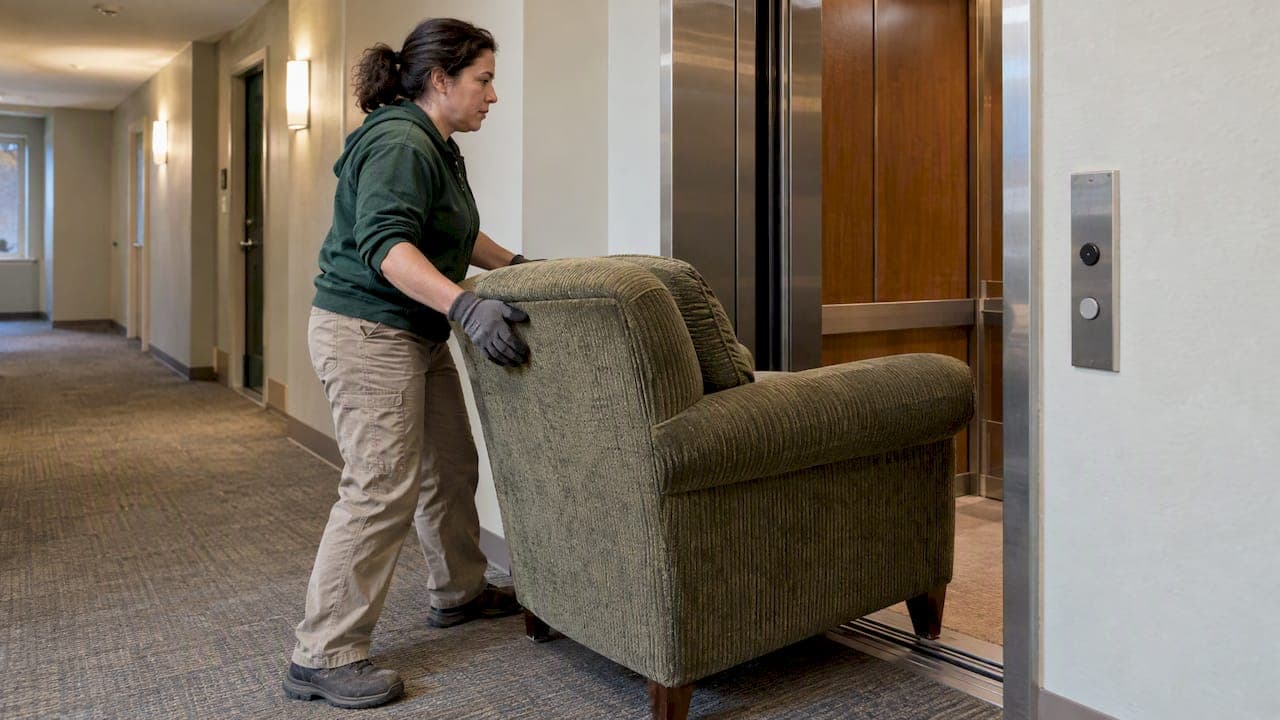
If you are clearing a condo after a death, a sale or a move, the rules that matter come from three places: your association's governing documents, your municipality's solid waste and dumpster ordinances, and state law on hazardous waste. Start with the association. Call the management office before you schedule anyone, because most delays come from skipping that step.
A note on the search term: "cleanout rules" also turns up plumbing code pages about drain cleanouts. That is a different subject. If you landed here for pipes, the Florida Plumbing Code material states that horizontal drains within buildings need cleanouts at intervals of no more than 100 feet. This guide is about emptying a condo unit.
TL;DR
- Get written permission from the board or management before moving furniture, placing a dumpster or reserving an elevator. Rules vary by association, so read your own documents.
- Municipal rules apply on top of building rules: bulk item caps, cleanout fees and dumpster permits differ from town to town in New Jersey.
- Never put paint, batteries, pesticides or cleaning chemicals in a community dumpster. Separate them for household hazardous waste collection.
- Document the unit and the common areas before and after the job. It protects the estate and helps with probate paperwork.
- Our condo and apartment cleanouts start from $650, after a walkthrough and a firm quote.
Table of Contents
- Why a condo cleanout is not like clearing a house
- Step one: read the governing documents
- Dumpsters, roll-offs and common property
- Municipal bulk trash and cleanout fees
- Recycling and mandatory separation
- Hazardous items never go in the dumpster
- Timeline and sequence that keeps management happy
- What the unit's rules cost you if you ignore them
- Our perspective on condo cleanouts
- When to hire a professional
- What a condo cleanout costs with us
- FAQ
- Sources
Why a condo cleanout is not like clearing a house
In a single-family home, you can usually put a dumpster in the driveway, run a truck to the door and work any hours the town allows. A condo shares walls, hallways, elevators, loading areas and trash systems with neighbors. That shared space is why the rules exist.
New Jersey's Condominium Act places a duty on the association to manage the common elements, which include halls, corridors, lobbies, stairways and elevators. You can see that framing in the state's compiled text of the Act and its case notes. In practice, the association has both the authority and the obligation to control how those areas are used during a move-out or cleanout.
The unit is yours, or the estate's. The route out of the unit is not.
Step one: read the governing documents
Every association has a master deed, bylaws and a set of rules and regulations. Ask the management office for current copies. If the owner has died, the executor or administrator will usually need to show their authority, such as letters testamentary or letters of administration, before management will talk about the unit. Ask what proof they want.
Look for these items:
- Move-in and move-out procedures. Many communities require advance notice, a scheduled window and sometimes a refundable deposit. Ask whether a cleanout counts as a move-out.
- Permitted hours. Weekday daytime windows are typical, but check yours.
- Elevator or loading dock reservations. In mid-rise and high-rise buildings, protective padding and a reserved time slot are common requirements.
- Contractor insurance. Management often asks for a certificate of insurance naming the association. Confirm that any company you hire is fully insured and can issue one.
- Dumpster and container rules. See the next section.
- Storage of materials outside the unit. One New Jersey community's published rules, for example, limit how long renovation materials may sit outside a unit without written consent from the section board. Your association may be stricter or looser, so do not assume.
Get every approval in writing, by email at minimum. Verbal permission from a front desk employee will not help you if a violation notice arrives later.
Dumpsters, roll-offs and common property
This is where families get surprised. Many associations require prior written board approval to place a dumpster or roll-off container on common property such as a parking area or driveway. Some prohibit them entirely and expect all debris to be carried out by a hauler's crew and truck.
Municipalities add their own layer. Mount Holly's ordinance, for instance, says no bulk storage container or portable storage unit may be placed by a private party on township property, a street or a right-of-way. Even where containers are allowed, a permit may be needed. Check with the town's code enforcement or public works office.
Community dumpsters are not a free disposal option, either. Ordinances can treat multi-unit complexes differently from single-family homes. Lower Township's solid waste chapter, for example, sets separate container limits for condominium and apartment complexes with more than six units in a building and requires covered dumpsters. Using a shared dumpster for a whole unit's contents can overfill it, trigger a violation and leave the owner or association paying for removal.
There is also a damage question. Where association rules make owners responsible for common areas such as dumpsters, damage caused during a cleanout (heavy furniture dropped into a bin, for example) can land on the unit owner or the estate. Walk the site with management before and after, and photograph the dumpster area, hallways and elevator.

Municipal bulk trash and cleanout fees
Curbside bulk pickup is built for occasional items, not for an entire home's contents. Some New Jersey towns have written that into law.
Little Egg Harbor's amended ordinance, for example, allows up to five bulk items per residential property for a collection and sets a separate cleanout fee. Notice and payment to the Department of Public Works come first when an entire dwelling is being emptied. Fines for violating such local rules can run from $100 to $250 per day in some places, according to the research we reviewed on these ordinances. That is one township's rule, not a statewide one. Yours may differ, and condos are sometimes served by private haulers instead of the town.
Three questions to ask the municipality or management:
- Does the town collect from this complex, or does a private hauler?
- Is there a bulk item limit, and is there a cleanout fee for emptying a whole unit?
- Do we have to notify the Department of Public Works or the hauler in advance?
Recycling and mandatory separation
New Jersey municipalities enforce recycling rules, and multifamily properties are included. Hoboken's recycling chapter, for instance, makes source separation mandatory for owners, tenants and occupants of dwelling units. Management is generally responsible for the complex's recycling system, so a cleanout crew that tosses cardboard, metal or glass into the trash can cause a violation notice to land on the association, which may then look to the unit owner.
A good crew separates recyclables, donations and trash at the unit, then coordinates with management on where each goes.
Hazardous items never go in the dumpster
Condos accumulate the same hazardous household products as houses: paint, stains, solvents, pesticides, batteries, pool or cleaning chemicals, old propane canisters. They cannot go in a community dumpster or a curbside pile. In New Jersey, counties run household hazardous waste programs, usually with scheduled collection days and pre-registration. We explain how to find yours and prepare for it in our county-first guide to household hazardous waste in New Jersey, and paint has its own rules covered in our NJ paint disposal guide.
If you find something you cannot identify, such as unlabeled containers or old medications, set it aside and ask the county program or a professional what to do. Do not guess.
Timeline and sequence that keeps management happy
Here is the order we recommend for a condo unit.
- Confirm authority. Gather death certificate, letters from the surrogate's office and contact details for the executor.
- Contact management. Ask for the rules packet, any move-out fee or deposit, and the earliest available elevator or loading slots.
- Walk the unit and take photos. Record the condition of the unit, doors, hallways and elevator pads. See our guide on estate cleanout documentation for executors.
- Secure keepsakes and papers. Set aside documents, jewelry, photographs and anything the family wants before volume work begins.
- Check municipal rules. Confirm bulk limits, fees and dumpster permissions.
- Schedule the crew inside the permitted window. Send management the company's insurance certificate.
- Sort donation-first. Usable furniture, housewares and clothing go to local charities before anything is discarded.
- Remove hazardous items separately.
- Final walkthrough with management. Check common areas and get written confirmation that no damage or violation is outstanding.
If the condo has to be turned over clean for a buyer or the next occupant, a final cleaning follows the cleanout. A move-out cleaning checklist can help you decide what else to cover before the keys change hands.
What the unit's rules cost you if you ignore them
The exact penalty depends on the documents, but typical consequences include:
| Mistake | What can follow |
|---|---|
| Moving items without a reserved elevator slot | Work stopped, rescheduling, possible fee |
| Placing a dumpster without approval | Removal at the owner's expense, daily fines |
| Using the community dumpster for the whole unit | Violation notice to the owner or association |
| Leaving hazardous waste in shared bins | Municipal non-compliance fines |
| Damage to common areas | Repair charges to the estate |
These are examples drawn from the ordinances and community rules cited above, not a guarantee of what your association will do. Ask management for their fine schedule in writing.
Our perspective on condo cleanouts
We work in New Jersey estates every week, and the pattern is consistent: the physical work is rarely the hard part. The hard part is the sequence. A family member arrives on a Saturday, discovers the building needs 72 hours notice for the elevator, and the closing or lease date does not move.
So we begin with a walkthrough and a firm quote, then handle the building paperwork with you. We send our insurance information to management, plan around the building's hours, and keep our crew inside the approved route. We sort donation-first, so usable items go to local charities rather than the dumpster, and we set aside keepsakes for the family. When an executor needs a record for probate, we provide documentation of what was removed and what was donated.

One firm rule from us: if a building says no containers, we do not argue and we do not improvise. We load a truck and haul it away. It costs the same management goodwill that you will need later, when the unit is listed or the estate closes.
We also stay realistic with families about emotions. A condo is often a parent's last home. Nobody should be pressed to decide about a lifetime of belongings in an elevator-reservation window. We leave time for the family to see what is going, and we leave the unit broom-clean.
— Derek
When to hire a professional
You can handle a small condo with a few friends and a pickup truck, if the association allows it. A professional is the better call when:
- The building has strict hours, elevator reservations or insurance requirements.
- You live out of state or cannot be on site.
- The unit is heavily cluttered or has hoarding conditions. See our note on estate cleanout service areas if you are unsure we cover your town.
- A sale, lease or probate deadline is close.
- You want donations tracked and a written record.
If you are weighing a rented container against a crew, our comparison of professional estate cleanout vs. DIY container removal in NJ covers where each makes sense.
What a condo cleanout costs with us
Our published starting prices:
| Service | Price |
|---|---|
| Apartment / condo cleanout | from $650 one-off |
| Single room, garage or basement | from $295 one-off |
| Single item / small pickup | from $150 one-off |
| Packing service | $55 per hour per packer |
| Estate photography and online inventory | $75 per hour |
Final pricing follows a walkthrough, because volume, floor level, access and the building's requirements all change the job. Request a walkthrough for your condo or apartment cleanout. We are fully insured, discreet and quick to respond.
FAQ
Do I need board approval to clear out a condo?
Often yes, at least for scheduling and common area use. Associations commonly want notice for move-outs, elevator or loading dock reservations, and written approval for any dumpster. Ask management for the rules packet before you book a crew.
Can I use the building's dumpster for a cleanout?
Usually not for a whole unit. Community dumpsters are sized for routine household trash, and local ordinances can set container limits for multi-unit complexes. Overfilling one can bring a violation notice, so have a hauler take the volume away.
Does the town pick up condo cleanout debris at the curb?
It depends. Some New Jersey townships cap bulk items per pickup, around five in one ordinance we reviewed, and charge a cleanout fee for emptying an entire dwelling. Many condos use private haulers instead, so check with both the municipality and management.
What should I do with paint and chemicals in the unit?
Keep them out of dumpsters and curbside piles. Set them aside and use your county's household hazardous waste program, or let a professional crew separate them. Check the county's collection calendar, since many require registration.
Are condo cleanout rules the same as plumbing cleanout rules?
No. Plumbing cleanouts are access points in drain lines, governed by plumbing codes. This article covers emptying a unit of belongings and debris, which is governed by your association and local solid waste rules.
Sources
- Florida Plumbing Code, Chapter 7 sanitary drainage (cleanout spacing)
- New Jersey Condominium Act, N.J.S.A. 46:8B, with case notes
- Clearbrook community rules and regulations (New Jersey)
- Township of Mount Holly, Chapter 114: Dumpsters, Roll-Off Containers and Portable Storage Units
- Township of Lower, Chapter 570: Solid Waste
- Little Egg Harbor ordinance amending Chapter 293, cleanout fee
- City of Hoboken, Chapter 151: Recycling