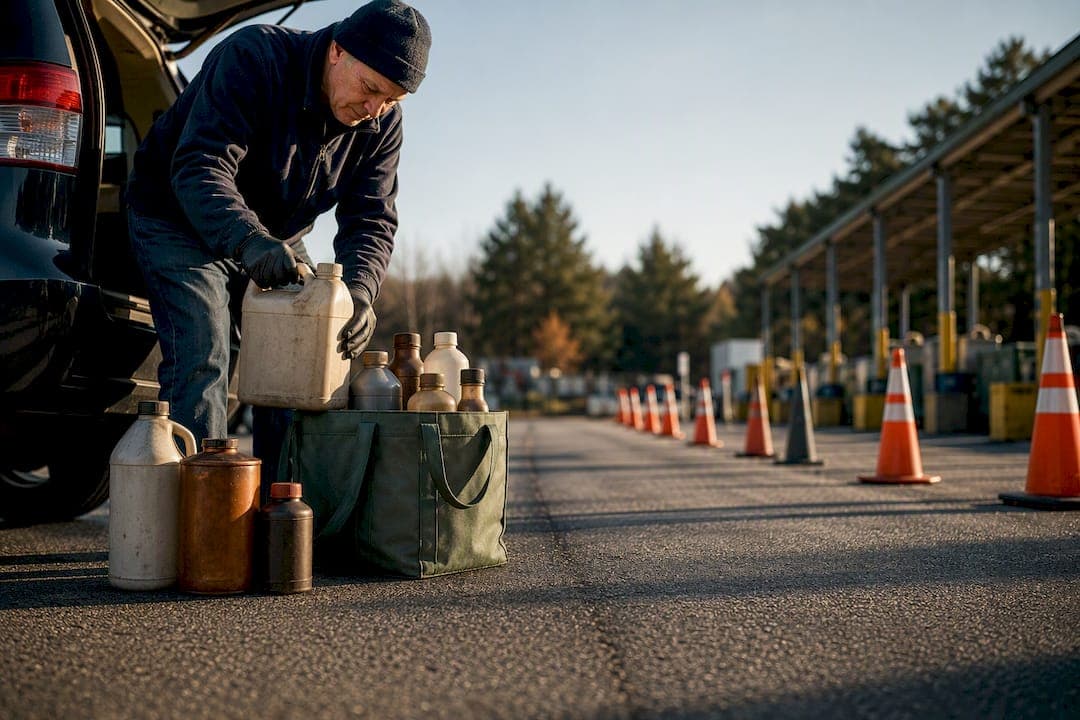
If you live in New Jersey, take leftover paints, solvents, pesticides, and similar household hazardous materials to your county's HHW program or a designated permanent facility. Check your county's calendar and registration requirements before you go, and keep everything in its original, labeled container. Never pour these products into a drain, storm sewer, or regular trash bin.
TL;DR:
- Most counties cap household hazardous waste, such as oil-based paints, solvents, and pesticides, at around 200 pounds or 20 gallons per household, with some variations.
- Registration, proof of residency, and adherence to specific item limits are mandatory for safe and legal drop-offs at county HHW events.
- Proper preparation involves keeping chemicals in labeled containers, segregating incompatible items, and loading HHW last to ensure safe transportation and handling.
- Acceptance of latex paint, electronics, and certain supplies varies by county, making it essential to check local rules before disposal.
- Alternatives like retail take-back programs, permanent facilities, and professional disposal services are recommended for large volumes or inconvenient locations.
Table of Contents
- How to find county HHW events and read the event page
- What counts as household hazardous waste in New Jersey
- County rules: registration, residency, and quantity limits
- How to prepare and transport HHW safely
- Paint and aerosol disposal rules for New Jersey residents
- Alternatives when a county event isn't the right fit
- When a donation-first estate cleanout team makes sense
- Why following county HHW rules protects people and the environment
- How Bereavement Cleanout Services handles HHW during a cleanout
- Sources
- FAQ
How to find county HHW events and read the event page
Every New Jersey county runs its own household hazardous waste program, and the fastest way to find yours is the county directory maintained by the Association of New Jersey Household Hazardous Waste Coordinators. It links directly to each county's solid waste page, where you'll find event dates, locations, and rules. Some municipalities also post their own drop-off dates on local calendars, so check your town's website too if you can't find a countywide listing.
Once you land on an event page, look for a few specific details before you load your car:
- The date, time window, and physical address of the collection site
- A registration link or form, since many counties require signup in advance
- Instructions for proving residency, such as a driver's license or tax bill
- The accepted-items list and any explicit exclusions for that event
If your town isn't listed anywhere, call your county's solid waste management office directly. Many counties also let you sign up for e-mail alerts, which is worth doing if your household tends to accumulate paint cans and old cleaners between collection dates.
What counts as household hazardous waste in New Jersey
Household hazardous waste covers products that are ignitable, corrosive, reactive, or toxic once you're done with them, according to EPA guidance. In practice, New Jersey county programs typically accept a consistent list of categories.
- Oil-based paints, stains, and paint thinners
- Solvents and adhesives
- Pesticides and herbicides
- Motor oil and antifreeze
- Aerosol cans
- Batteries, including rechargeable and lithium types
- Fluorescent lamps and mercury-containing devices
- Pool chemicals
- Certain strong household cleaners
Not every category is treated the same everywhere. NJDEP's household hazardous waste guidance lists common items like anti-freeze, fertilizers, and photo chemicals, but acceptance for latex paint, electronics, appliances, and medical sharps varies by county. Always check your specific county's list before assuming something will be taken.
County rules: registration, residency, and quantity limits
County programs share a similar structure, but the fine print differs enough that skipping it can mean getting turned away at the gate.
- Register in advance through your county's HHW event page, since many events use time slots with limited capacity.
- Bring proof of residency, typically a driver's license or a current tax bill matching the county you're visiting.
- Expect household-only acceptance. Business-generated waste is almost always excluded from these events.
- Watch for quantity and container limits, which cap what you can bring per household.
Ocean County's program is a useful illustration of how detailed these rules get. Its HHW program requires registration and proof of residency, and it caps household drop-offs at 200 pounds of dry material or 20 gallons of liquid, with no single container larger than five gallons. Other counties set different limits, so treat Ocean County's numbers as an example, not a statewide rule.
If you're dealing with business waste or quantities beyond what your county allows, contact the county office directly or work with a licensed hazardous waste contractor instead of trying to fit it into a residential event.
How to prepare and transport HHW safely
Getting your materials ready before you leave the house prevents most of the problems that happen at drop-off sites.
- Keep every product in its original, labeled container. Never transfer chemicals into food containers or unmarked jugs.
- Tighten lids and pad boxes so nothing shifts or leaks during the drive.
- Separate incompatible chemicals, keeping oxidizers away from solvents or other organics, and place liquids in a secondary container like a plastic bin in case of spills.
- Skip corroded or unlabeled containers unless the event staff gives you specific guidance for handling them.
EPA's household hazardous waste guidance recommends this kind of segregation because it reduces the chance of a dangerous reaction during transport or handling. At most drive-up events, staff will ask what you're bringing before you even open the trunk, then direct you to place items in the vehicle where they can reach them easily without lifting over other cargo.
Pro Tip: Load HHW last so it's the first thing out of your trunk when you arrive, and keep it separate from anything you plan to donate or recycle that day.

Paint and aerosol disposal rules for New Jersey residents
Paint questions come up more than almost anything else at HHW events, and the answer depends on the type of paint you have. Oil-based paints and finishes are generally treated as hazardous waste, and NJDEP's universal waste guidance allows qualifying oil-based finishes to be managed as universal waste when properly labeled and contained, which simplifies handling for county programs.
- Oil-based paint, stain, and lacquer: bring to your county HHW program
- Latex (water-based) paint: acceptance varies, some counties take it, others ask you to dry it out first
- Aerosol cans: many counties accept them intact, but never puncture or vent a can at home
- Leaking or pressurized cylinders: never place these in regular trash
Because New Jersey has no single statewide list for paint acceptance, checking your county page before you load the car is the only reliable way to avoid a wasted trip. For a deeper breakdown of oil-based versus latex rules by county, see this NJ paint disposal guide.
Alternatives when a county event isn't the right fit
County HHW events aren't the only lawful option, and sometimes they're not the most convenient one either.
- Retail take-back programs handle batteries, fluorescent lamps, and some paint brands, but confirm acceptance with the specific retailer first.
- County transfer stations and other NJDEP-listed permanent facilities accept many HHW categories year-round; call ahead for hours and rules.
- Hiring a professional makes sense for large volumes, safety concerns, or full estate cleanouts, and you should ask any contractor about their licenses, disposal partners, and documentation practices.
If you're weighing a container rental against professional removal, this comparison of cleanout options walks through when each approach makes sense.
When a donation-first estate cleanout team makes sense
Some situations call for more than a single trip to a county event. Large HHW volumes, limited mobility, tight probate deadlines, or a preference for donating usable items before anything is discarded are all reasons families turn to a full-service cleanout instead.
- A donation-first provider separates hazardous items from donatable goods before anything leaves the house.
- Hazardous materials get coordinated with county HHW programs or licensed disposal partners rather than dumped indiscriminately.
- Usable furniture, housewares, and other items go to local charities instead of a landfill.
- Documentation of what was removed and where it went supports probate requirements when the estate needs a paper trail.
For related logistics, see our guides on refrigerator disposal rebates and secure hard drive destruction for executors handling sensitive materials.
Why following county HHW rules protects people and the environment
Sanitation workers handle whatever ends up in a curbside bin, and paint thinner or old pesticide poured down a drain doesn't just disappear, it moves through pipes that were never built to carry it. Using your county's program instead of the trash can protects the people who handle waste every day and keeps chemicals out of local waterways. It also keeps donation channels open, since usable items get to charities instead of getting mixed in with hazardous discards. I've spent years around estate cleanouts, and the households that plan their HHW disposal ahead of time are always the ones with the smoothest, least stressful cleanout day.
— Derek
How Bereavement Cleanout Services handles HHW during a cleanout
When a family needs a full cleanout rather than a single drop-off trip, our donation-first approach separates hazardous materials, coordinates with county HHW programs or licensed disposal partners, and documents everything removed for probate. The team is insured and discreet, prepared to assist with this kind of transition.

To request an estimate, have your county, a rough list of materials, and an approximate volume ready. Visit our service page to get started.
Sources
- Household Hazardous Waste (HHW) | US EPA
- County Programs - Association of New Jersey Household Hazardous Waste Coordinators
- Household Hazardous Waste Program | Ocean County Government
- Household Hazardous Waste Quick Start Guide (EPA snapshot PDF)
- Division of Solid and Hazardous Waste Management — Used oil-based finishes as universal waste (NJDEP)
FAQ
What household products are considered hazardous waste?
Products that are ignitable, corrosive, reactive, or toxic count as household hazardous waste, according to EPA guidance. Common examples in New Jersey homes include oil-based paint, solvents, pesticides, motor oil, aerosols, batteries, and fluorescent lamps.
How do you dispose of paint for free?
Oil-based paint typically goes to your county's household hazardous waste program at no cost, since these events are funded through local solid waste budgets. Latex paint acceptance varies by county, and some programs ask residents to dry it out first, so check your county's paint disposal rules before your visit.
How do I dispose of spray paint cans in New Jersey?
Most New Jersey counties accept intact aerosol cans, including spray paint, at their household hazardous waste events. Never puncture, vent, or crush a can at home, and never place a pressurized or leaking cylinder in your regular trash.
Can latex paint be put in the garbage?
Latex paint is water-based and generally not classified the same way as oil-based paint, but rules for putting it in regular trash still depend on your county and municipality. Many programs prefer that residents dry it out completely first or bring it to a county event, so confirm the accepted method with your local paint disposal guidance before deciding.