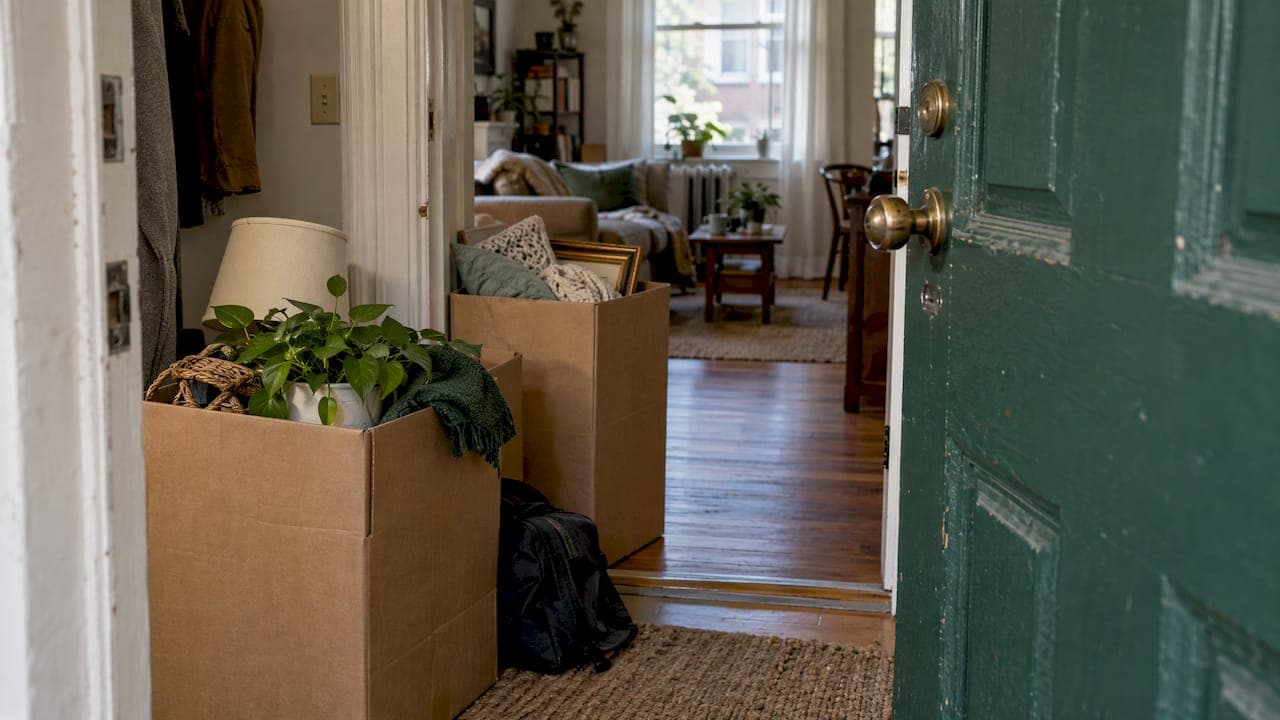
In New Jersey, you cannot clear out a tenant's belongings until a court has ordered the eviction and a Special Civil Part Court Officer has carried it out. Even then, what you may do with the items left behind depends on either a specific court order or a written notice process under the state's abandoned property statute. Skip a step and a cleanout meant to save time can turn into a legal problem.
This guide walks through the sequence in plain terms, for landlords, property managers, realtors and the social workers who help tenants and families through these moments. It is general information, not legal advice. For your specific case, talk to a New Jersey landlord-tenant attorney or the Special Civil Part clerk's office in your county.
TL;DR
- Only a court officer can carry out an eviction. Changing locks, shutting off utilities or removing belongings on your own is a criminal offense under N.J.S.A. 2C:33-11.1.
- After a warrant of removal is served, a residential tenant has at least three business days to leave. Commercial tenants do not get that window.
- Items left behind must be stored with reasonable care, and a written notice must go out before disposal, unless the court's order says otherwise.
- Once the legal steps are finished, a licensed, insured cleanout crew can clear the unit, document what was removed and hand it back broom-clean.
Table of Contents
- The legal order of events before any cleanout
- The three-business-day window
- What you cannot do: self-help eviction
- What happens to belongings left behind
- Can a cleanout happen during the storage period?
- Hoarding, clutter and unsafe conditions
- Planning the turnover once you have legal possession
- Our perspective on eviction cleanouts
- When to call a professional crew
- Need a cleanout after a lawful eviction?
- A note on New York
- FAQ
- Sources
The legal order of events before any cleanout
A cleanout is the last step of an eviction, never an early one. The usual path looks like this:
- Proper notice. Depending on the ground for removal, the required notice before court action ranges from three days (for disorderly conduct or injury to the premises) to one month (for lease rule violations), and longer for certain conversion cases. A landlord who does not serve the exact notice the law requires invalidates the later eviction attempt.
- Judgment for possession. The court rules in the landlord's favor.
- Warrant of removal. Landlords must apply within 30 days of the judgment, and the warrant must then be executed by a Court Officer within 30 days. Miss either window and you restart the process.
- Service of the warrant and the waiting period. The tenant gets time to leave.
- Lockout by the Court Officer. Possession returns to you.
- Handling what remains. This is where cleanout law applies.
Most cleanout questions come from steps 4 to 6, so those get the detail below.
The three-business-day window
The New Jersey Judiciary states that a residential tenant is entitled to at least three business days to vacate after being served with a warrant of removal. Those days do not include weekends, holidays or the day of service. The court's own residential warrant form tells the tenant to vacate and remove all possessions within that period.
If the tenant is still there afterward, the landlord must arrange for the Court Officer to carry out the lockout. The landlord cannot do it, and cannot use their own staff. The same court page lists the costs: a $35 fee for the warrant of removal plus a mileage fee, and an additional fee of up to $75 to the officer for executing the lockout.

Residential versus commercial
The timeline differs sharply by tenancy type. Legal aid guidance summarized on the same court page notes that a commercial tenant can be locked out immediately upon service of the warrant. If you manage mixed-use buildings, plan your turnover schedule by tenancy type, not by a single rule of thumb.
Why timing matters for crews and realtors
If you are a realtor or landlord lining up contractors, do not book a crew for the day the warrant is served. The unit is not yours yet. Book it for after the lockout, with a buffer for the tenant's possible last-minute departure and for the storage or notice steps described next.
What you cannot do: self-help eviction
This is the line landlords most often cross when they are frustrated by a delay. The New Jersey Courts' notice on illegal eviction explains that changing locks, shutting off utilities or removing property without a court-ordered warrant executed by a Court Officer is a criminal offense. It also exposes you to civil liability, and law enforcement has a duty to help the tenant get back in.
In practice, that means:
- No cleanout crew enters an occupied unit to "get a head start."
- No bagging belongings because the tenant "seems gone" without following the abandoned property process.
- No holding belongings as leverage for unpaid rent.
What happens to belongings left behind
After a lawful eviction, where the warrant has been executed and possession restored, the Abandoned Tenant Property Statute (N.J.S.A. 2A:18-72 to 2A:18-84) governs. In summary:
- You must store the property with reasonable care.
- To dispose of it legally, you send a notice by certified mail (return receipt requested) or receipted first-class mail to the tenant's last known address and any alternate addresses.
- The notice must tell the tenant they have 30 days from delivery, or 33 days from mailing, to claim the property.
- If it is not claimed, you may sell, destroy or dispose of it.
Legal aid explains the same rules for tenants in its guide to the abandoned property statute, which is worth reading so you know what the other side will have been told.
The Order for Orderly Removal exception
A common misconception is that you can keep or sell items the moment the lockout happens. You cannot. The exception is a court order: if the tenant obtained an Order for Orderly Removal, it may include a statement allowing the landlord to treat remaining items as abandoned, bypassing the notice and storage requirements. Read the order itself, and keep a copy in your file. Practitioners report that skipping the abandoned property notice is the most common reason landlords end up in later disputes.
A quick reference
| Situation | What the law points to |
|---|---|
| Tenant still in unit, no warrant | No entry or removal of belongings |
| Warrant served on residential tenant | At least three business days to leave |
| Lockout done, no order on abandoned items | Store with care, send notice, wait 30 days from delivery or 33 from mailing |
| Lockout done, order includes abandoned-property language | Items may be treated as abandoned per the order's terms |
| Mobile home | Longer notice: 75 days after delivery or 78 after mailing, plus Motor Vehicle Commission paperwork |
For mobile homes, the state's guidance also calls for a title search and an Abandoned Mobile Home Notice (OS/SS-121) sent by certified mail to the owner and any lienholders. That is a different process from clearing an apartment, so confirm it with your attorney before scheduling any work.
Can a cleanout happen during the storage period?
Yes, if it is done correctly. The statute requires you to store property with reasonable care. It does not say you must leave everything in the unit. Many landlords want the unit empty and re-rentable, so they move the belongings to a secured storage space, document them and run the notice clock from there.
What a careful process includes:
- Photos or video of the unit and its contents before anything moves.
- An itemized list, with special attention to documents, medication, electronics, photographs, jewelry and anything that looks sentimental or valuable.
- Secure storage with a record of where items are kept and for how long.
- Copies of the mailed notice, the receipt or return receipt, and the date the claim period ends.
- A written record of what was disposed of after the period ended, and what was donated or sold.
This documentation is what protects you if a former tenant later claims something was taken or discarded too soon.
Hoarding, clutter and unsafe conditions
Heavy clutter does not give a landlord extra powers. A hoarded apartment still goes through the same notice, court and lockout process. Serious clutter can be tied to a lease violation or damage to the premises, and in those cases the required notice depends on the ground you rely on, as described in the removal statute. Have an attorney confirm which ground fits your facts before you serve anything.
After possession is back, hoarding cleanups take longer and involve more sorting, because personal papers and valuables are often buried. Expect a slower pace, and expect the documentation to matter even more.

Planning the turnover once you have legal possession
Once the legal steps are finished, the practical clock starts: every vacant day costs rent. A few ways to keep that short:
- Line up your cleanout provider early, but schedule the work only after the lockout and after confirming what the court order says about belongings.
- Ask for a walkthrough and a firm written quote. Cost depends on volume, access (stairs, elevators, parking permits), the presence of hazardous or biological waste and how much sorting is required.
- Decide in advance who will make calls on items of possible value, and keep a log.
- Plan the cleaning that follows. For a sense of how often a rental needs cleaning between occupants, this rental home cleaning schedule guide is a handy benchmark, though local conditions and your lease terms come first.
- If a tenant dispute may lead to collections, keep your records organized from the start, since court-ready rent debt documentation is easier to build as events happen than afterward.
Our own landlord turnover checklist breaks the post-lockout steps into ten stages, and our guide to condo cleanout rules in New Jersey covers the association-level requirements, such as elevator reservations, that can slow a unit in a managed building.
Our perspective on eviction cleanouts
Most of our work follows a death in the family, so we meet people at a hard moment. Eviction cleanouts are different legally, but they are often just as human. Behind a foreclosure or eviction there is frequently a job loss, an illness or a loved one who has passed. The belongings in the unit are someone's life, even when the paperwork says "abandoned."
That shapes how we work. We start with a walkthrough and a firm quote, and we do not begin until you confirm the legal steps are complete. We follow a donation-first approach, so usable items go to local charities rather than a dumpster whenever the law allows disposal. We sort carefully for papers, photographs and keepsakes, and we document the work so you have a record for your files. Our foreclosure and eviction cleanouts start from $950, and the final price depends on what the walkthrough shows.
One piece of advice we repeat to landlords: the cheapest path is the one that is done by the book. A few extra days of notice cost far less than a dispute over discarded belongings.
— Derek
When to call a professional crew
You may not need one for a nearly empty one-bedroom. You probably do if:
- The unit is full of furniture, appliances or years of accumulation.
- There is hoarding, pest activity, odor or waste that calls for specialty cleaning.
- You need an itemized record of what was removed.
- You are a realtor or manager with a closing or a new tenant waiting.
- You would rather not have your own staff handle a former tenant's personal items.
If you are comparing options, our piece on professional cleanout versus container removal explains why sorting and documentation matter more than hauling volume. For budgeting, see our apartment cleanout cost guide.
What our pricing looks like
| Service | Published price |
|---|---|
| Foreclosure / eviction cleanout | From $950 |
| Apartment / condo cleanout | From $650 |
| Full house cleanout | From $1,200 |
| Hoarding cleanup | From $1,500 |
| Single room, garage or basement | From $295 |
| Single item / small pickup | From $150 |
All are one-off prices, and the final quote follows a walkthrough.
Need a cleanout after a lawful eviction?
We handle foreclosure and eviction cleanouts across New Jersey, with donation-first sorting, documentation, insured crews and a broom-clean handoff. See our cleanout services or check the towns and counties we serve. We also work in Newark, Jersey City and Elizabeth, where tight access and parking often affect the schedule.
A note on New York
People often search for New York's rules alongside New Jersey's. This article covers New Jersey only. The warrant, notice and abandoned-property rules above are New Jersey law and should not be assumed to apply in New York City or elsewhere in New York. If you own property there, confirm the local process with a New York attorney or the housing court before acting.
FAQ
How long does a tenant have to leave after a warrant of removal in NJ?
A residential tenant has at least three business days after being served. Weekends, holidays and the day of service do not count. Commercial tenants can be locked out immediately upon service.
Can I throw out a tenant's belongings right after the lockout?
Not automatically. Unless the court's order specifically treats the items as abandoned, you must store them with reasonable care and send the statutory notice. The tenant then has 30 days from delivery or 33 from mailing to claim them.
Can I change the locks myself if the tenant has stopped paying?
No. Only a Special Civil Part Court Officer can carry out an eviction. Self-help measures such as lock changes or utility shutoffs are a criminal offense in New Jersey, and the court states that any other attempt at eviction is illegal.
How much does it cost to file for a warrant of removal?
The New Jersey Courts list a $35 fee for the warrant plus a mileage fee, and an additional fee of up to $75 to the officer who executes the lockout. Check the court's page for current amounts before you file.
Sources
- What Happens If the Landlord Obtains a Judgment for Possession? | NJ Courts
- Notice Regarding Illegal Eviction | NJ Courts
- Warrant of Removal, Residential | NJ Courts
- Landlord/Tenant | NJ Courts
- Disposal of Remaining Personal Property Abandoned by Tenant | NJ DCA
- The Abandoned Tenant Property Statute | Legal Services of New Jersey
- N.J.S.A. 2A:18-61.2, required notice for removal of residential tenants
- Mobile home disposition instructions | NJ Motor Vehicle Commission
- How Often to Clean a Rental Home: 2026 Guide
- Rent debt collection with handoff templates