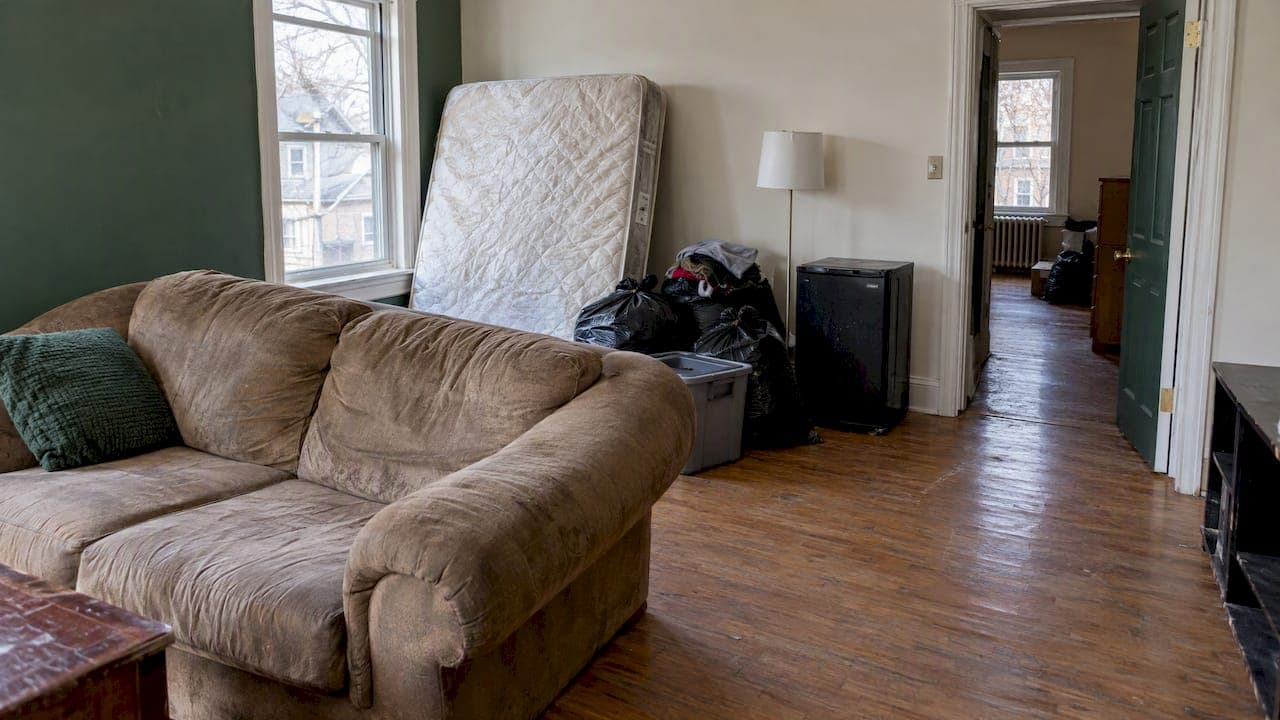
Most eviction cleanouts in the United States cost between $200 and $3,500 per unit, according to one national pricing guide covering 2023 to 2024. Where your unit lands in that range depends on its size, how much the tenant left behind, how hard the unit is to reach, and what it costs to dispose of the contents. In New Jersey, our published starting price for a foreclosure or eviction cleanout is $950, with a firm quote after a walkthrough.
This guide is written for landlords, property managers, realtors and social workers who need a unit cleared and want to know what the bill will look like before they call anyone. It covers typical price ranges, what pushes a quote up, the fees that surprise people, the legal steps that must come first, and how to bring the total down.
TL;DR
- National estimates for an eviction cleanout run from about $200 to $3,500 per unit, depending on size and condition.
- Our starting prices in New Jersey: $950 for a foreclosure or eviction cleanout, $650 for an apartment or condo, $1,200 for a full house.
- Disposal fees, hazardous items, stairs and parking often add more than the labor does.
- Do not start until the court process and your state's abandoned property rules are complete. Skipping them can cost far more than the cleanout.
- A binding quote after an on-site or video walkthrough is the best protection against surprise charges.
Table of Contents
- What an eviction cleanout actually is
- Typical eviction cleanout cost ranges
- What drives the price up or down
- Flat rate, by the load, or by the hour
- Fees that surprise landlords
- Legal steps before any cleanout starts
- Can you recover the cost from the tenant?
- Ways to lower the total
- Perspective: what we see on these jobs
- Our eviction and foreclosure cleanout service in New Jersey
- Eviction cleanouts compared with other cleanout types
- How to compare quotes
- FAQ
- Sources
What an eviction cleanout actually is
An eviction cleanout is the removal of everything a former tenant left behind after a lawful eviction or an abandonment. That usually means furniture, mattresses, clothing, food, appliances and a good deal of loose trash. The goal is a unit that is empty and ready for repairs, cleaning and a new tenant.
It differs from a regular move-out clean. A move-out clean assumes the tenant took their belongings and left surfaces to wipe down. An eviction cleanout is a hauling and sorting job first. Crews load, carry, sort for donation or recycling, and pay disposal fees at transfer stations or landfills. That is why the price follows volume and weight rather than square footage alone.
If you are unsure what condition the unit should be left in at the end, our guide to what "broom clean" really means explains the standard we hand over.
Typical eviction cleanout cost ranges
Published national figures vary because the jobs vary. A single studio with a few bags of trash is a different job from a three-bedroom house with every room full. Still, the ranges below give you a working budget.
| Job type | Typical range or starting price | Source |
|---|---|---|
| Eviction cleanout, any size, national estimate | $200 to $3,500 per unit | 2023 to 2024 national pricing guide |
| Single item or small pickup, NJ | From $150 | Our published pricing |
| Single room, garage or basement, NJ | From $295 | Our published pricing |
| Apartment or condo cleanout, NJ | From $650 | Our published pricing |
| Foreclosure or eviction cleanout, NJ | From $950 | Our published pricing |
| Full house cleanout, NJ | From $1,200 | Our published pricing |
| Heavy clutter or hoarding cleanup, NJ | From $1,500 | Our published pricing |
| Large estate cleanout, NJ | From $2,200 | Our published pricing |
Treat the "from" prices as starting points. A unit with light contents sits near the bottom of each band. A unit packed floor to ceiling, or one with biological or hazardous material, sits well above it.
A realistic example
Take a two-bedroom apartment on the second floor of a walk-up. The tenant left a sofa, two beds, a dresser, a table, kitchen items and about twenty bags of clothing and trash. Nothing hazardous, no rot, good access to the street. A job like that typically sits at the lower end of the eviction range because it is one truck, one crew and a moderate disposal bill.
Now take the same apartment with every room full, a refrigerator of spoiled food and a mattress in each bedroom. The crew time doubles, the truck makes two trips, and mattress and appliance fees appear on the invoice. Same address, very different price. That gap is the reason serious providers quote after seeing the unit.

What drives the price up or down
Volume and weight
Most junk and cleanout providers price by the space your items take up in the truck. Dense materials such as wet carpet, tile, concrete or heavy furniture raise disposal costs because landfills charge by weight. A truck and crew cost the same whether they haul one couch or the contents of a garage, so a half load usually costs more than half the price of a full one.
Property size and condition
Bedrooms and square footage set the baseline, but condition changes it more. Clean but full is one price. Full and soiled, with pet damage, spoiled food or heavy odor, is another. Hoarding conditions take longer because crews must sort as they go to find documents, cash and valuables. If the unit falls into that category, see our hoarding cleanup pricing starting at $1,500.
Access
No elevator, a fourth-floor walk-up, tight street parking or a long carry from the door to the truck all add labor hours. In dense New Jersey and New York neighborhoods, a permit or a reserved parking spot can also be part of the job.

Hazardous and specialty items
The same national guide puts additional hazardous-material removal at $150 to $500, and per-item disposal for things like appliances at $45 to $70. Mattresses, refrigerators with refrigerant, electronics and paint all carry special handling. In New Jersey, mattresses have their own disposal routes, which we cover in our mattress disposal guide.
Timing
Rush jobs and after-hours work cost more. The same pricing guide lists an after-hours service charge of about $150. If a new tenant or buyer is waiting, tell the provider your deadline up front so it is priced in, not added later.
Flat rate, by the load, or by the hour
Providers quote in three common ways. Knowing which one you are looking at makes quotes comparable.
- Flat rate. One price for the whole job, set after the provider sees the unit. It is the easiest to budget and the one we recommend asking for.
- Volume or load-based. You pay for the portion of the truck your items fill. It suits small, predictable jobs, but a surprise extra load changes the total.
- Hourly. Labor is billed by the hour, often per worker. It can work for packing or sorting, but it leaves the final cost open.
Whichever model you choose, ask what is inside the number: labor, transport, disposal fees and taxes. A low quote that leaves out disposal is not a low quote.
Fees that surprise landlords
Ask about each of these before you sign:
- Fuel or travel surcharges for units outside the provider's usual service area.
- Minimum load charges for small jobs.
- Disposal surcharges for mattresses, appliances with refrigerants, electronics and tires.
- Stair, elevator and long-carry fees.
- After-hours or weekend rates.
- Extra trips if the first load does not clear the unit.
- Sorting time when personal papers, medications or valuables are found.
The cleanest protection is a written estimate that lists these as line items, or states plainly that they are included.
Legal steps before any cleanout starts
Cost is the second question. The first is whether you are allowed to touch the belongings yet. A cleanout started too early can turn a $1,000 job into a lawsuit.
States differ, but the pattern is similar. Many require written notice and a set process for storing, selling or disposing of a tenant's belongings, and a typical notice gives the tenant 7 to 10 days to reclaim them. Ignoring those rules can expose a landlord to penalties, and leaving belongings on the street may count as illegal dumping.
New Jersey
Under New Jersey law, landlords must store a tenant's belongings after eviction or move-out and give notice before disposal, and tenants can sue for damages if the landlord breaks the law. The statutes are collected in the state's Division of Codes and Standards eviction law publication, which lists the sections on notice, storage and disposal of abandoned property. For a plain-language walk through, read our eviction cleanout laws in NJ guide.
New York
New York has its own abandoned property rules and its own timelines. Our New York abandoned property law guide covers the practical steps.
When the tenant has died
A tenant's death changes the order of operations, because the belongings belong to an estate and a family may want keepsakes or documents. Our action guide for landlords when a tenant dies lays out who to contact first. This is also where a donation-first approach matters most.
This article is general information, not legal advice. For a specific eviction, confirm your next step with your attorney or the court officer handling the warrant.
Can you recover the cost from the tenant?
Sometimes, partly. Landlords can generally deduct cleaning costs when a unit is left in poor condition, and they must provide an itemized list of those deductions. In New Jersey, a landlord has 30 days after the tenancy ends to return the deposit or the balance with an itemized statement. Keep your invoice, dated photos taken before and after, and the written notices you sent.
A deposit rarely covers a full eviction cleanout, so budget for the rest. Deductions also have to reflect cleaning and damage beyond normal wear, and a documented before-and-after record is what makes them hold up. If the unit needs air quality work after the cleanout, such as the ducts and vents, move-out vent sanitation steps show what that work involves and can help you document the condition you are billing against.
Ways to lower the total
- Get a binding estimate. An on-site walkthrough or live video assessment lets the provider price the real job, not a guess.
- Sort out donations first. Usable furniture, housewares and clothing can go to local charities instead of the landfill, which trims disposal fees. This is the center of how we work.
- Compare more than one quote. Compare what is included, not just the total.
- Bundle the work. One crew handling cleanout, trash-out and a broom-clean finish costs less than three separate visits.
- Be flexible on timing. A standard weekday slot is cheaper than a rush or after-hours call.
- Clear access. Reserve parking and an elevator if the building has one. Every hour of carrying you remove from the job comes off the labor line.
Perspective: what we see on these jobs
We do eviction and foreclosure cleanouts alongside estate cleanouts, and the two are closer than most people expect. In both, someone's belongings are being handled at a hard moment, and the property has to be turned over on a schedule. We start every job with a walkthrough so the quote is firm, we sort for donation before anything goes to disposal, and we document the work with photos and an itemized record. Landlords and property managers use that record for deposit accounting, and families and attorneys use it for probate.
The mistake we see most often is hiring on the lowest number without asking what it excludes. Disposal, mattresses and a second trip can add hundreds. The other mistake is starting before the legal notice period has run. The belongings are not yours until the law says they are, and a careful crew will ask to see your paperwork.
— Derek
Our eviction and foreclosure cleanout service in New Jersey
Our foreclosure and eviction cleanout starts at $950, with a written quote after a walkthrough. Smaller scopes start lower: $150 for a single item or small pickup, $295 for a single room, garage or basement, and $650 for an apartment or condo. Full houses start at $1,200, and heavy clutter or hoarding cleanups at $1,500. We are fully insured, we work discreetly, and we hand over a broom-clean unit with documentation of what was removed and where it went.

To get a firm number, request a walkthrough through our main site. You can also check where we work across New Jersey, including Elizabeth and Salem.
Eviction cleanouts compared with other cleanout types
The terms get mixed up, so here is how they differ in price drivers.
- Eviction cleanout: driven by legal timing, volume and disposal. Usually a landlord or property manager is the client.
- Foreclosure cleanout: similar scope, often a larger house, sometimes with winterization or lock changes handled separately. We price it with eviction work, from $950.
- Estate cleanout: driven by sorting. Families want keepsakes found, documents set aside and valuables sold or donated. Our large estate cleanouts start at $2,200, and estate sales run on a commission of 15% to 35%. For apartment-specific costs see our apartment cleanout cost guide.
- Hoarding cleanup: driven by time and safety. It starts at $1,500 and often needs specialty cleaning after the contents are out.
Some items left behind have resale value. Furniture and appliances can sometimes be sold rather than hauled, which offsets cost. See where to sell furniture in New Jersey for options, or our online listings and consignment service at 20% to 40%.
How to compare quotes
Use the same checklist with every provider so the numbers line up:
- Is the quote binding, and was it based on seeing the unit?
- Does it include labor, truck, disposal fees and taxes?
- How are mattresses, appliances and hazardous items handled?
- Is the provider insured, and can it show proof?
- What documentation do you get at the end?
- What happens to usable items?
- What is the finish: broom clean, or trash-out only?
A provider that answers all seven in writing is one you can plan around.
FAQ
How much does an eviction cleanout cost?
National estimates run from $200 to $3,500 per unit, depending on size and condition. In New Jersey our eviction and foreclosure cleanouts start at $950, and the final number is set after a walkthrough.
Who pays for an eviction cleanout?
The landlord usually pays up front. Part of it may be recoverable through itemized deductions from the security deposit, subject to your state's rules, so keep your invoice and photos.
Can I throw out a tenant's belongings right after an eviction?
Not automatically. Many states require notice and a storage or reclaim period, and New Jersey requires storage and notice before disposal. Confirm the timeline with your attorney before any crew starts.
How long does an eviction cleanout take?
A small apartment can be cleared in a few hours. A full house or a heavily packed unit can take a day or more with a larger crew. Your quote should state the expected time and any second trip.
Do you donate what the tenant left behind?
We sort for donation first and send usable items to local charities where the legal timeline allows. Items that cannot be reused go to responsible disposal.
Sources
- How Much Do Eviction Clean Outs And Services Cost?
- Handling a Tenant's Abandoned Property: An Overview (Nolo)
- The Abandoned Tenant Property Statute (Legal Services of New Jersey)
- New Jersey Division of Codes and Standards, eviction law publication
- Rental Security Deposit Guide (Apartments.com)
- New Jersey security deposit law summary