
In New York, a decedent's belongings belong to the estate and may only be released to a court-appointed executor or administrator presenting valid Letters Testamentary or Letters of Administration. For a living tenant who has vacated, abandoned property law in NY provides no single statewide disposal timetable, so local procedure and lease terms govern what you can do next.
Your three immediate actions:
- Secure the unit. Change locks or access codes and document the date and time.
- Photograph and inventory everything. Walk every room with a camera or phone; capture all items before touching them.
- Send written notice by certified or registered mail to the next of kin, estate representative, or last known address, and keep every mailing receipt.
Before releasing a single item, verify whether NY Real Property Law §236‑a applies (deceased tenant) or whether you are dealing with a voluntary vacancy. Either way, do not dispose of anything until you have legal authority in hand.
Key Takeaways
New York abandoned property law requires verified legal authority before any item is moved, donated, sold, or disposed of, whether the tenant died or simply vacated.
| Point | Details |
|---|---|
| Estate authority is required | Only a court-appointed executor or administrator with Letters Testamentary or Letters of Administration may authorize release of a deceased tenant's belongings. |
| No statewide disposal clock | New York provides no uniform post-possession timetable; local rules and lease terms govern what you may do and when. |
| Document everything immediately | Photograph, inventory, and send certified-mail notices within the first few days to protect against conversion claims. |
| Liens and hazardous items need special handling | Check for liens before selling financed goods; document and dispose of hazardous or perishable items per local health rules. |
| Bereavementcleanoutservices | Provides donation-first, insured estate cleanouts with probate-ready documentation and broom-clean handoffs across New Jersey and New York. |
Table of Contents
- What counts as "abandoned" versus property left after a death?
- How landlords and property managers should handle this lawfully
- What happens to a deceased tenant's belongings under §236‑a?
- How to lawfully donate, sell, or dispose of left property in New York
- When does hiring a professional cleanout service make sense?
- What timelines and costs should you expect?
- Practical templates and documentation to keep
- Handling this with both legal care and human dignity
- Bereavementcleanoutservices handles the hard parts for you
- Sources
What counts as "abandoned" versus property left after a death?
The distinction matters enormously for what you are legally allowed to do next.
Abandoned property applies when a living tenant has voluntarily vacated, returned keys, or shown clear evidence of departure, such as removed furniture, a forwarding address, or written surrender. Even then, New York's statutory silence means there is no fixed statewide clock for storage, sale, or disposal. Local rules, lease terms, and RPAPL provisions fill that gap.
Post-death estate property is a different situation entirely. When a tenant dies, every item in the unit belongs to the decedent's estate, not to the landlord, a grieving relative, or anyone else who shows up at the door. The estate's court-appointed representative controls those belongings.
This guide applies to all of you: landlords and property managers who need to re-let a unit, executors and family members navigating probate, and anyone hiring a professional estate or post-tenancy cleanout service in New York. The rules differ by situation, and the safest default is to treat any unclear case as estate property until you have documented proof otherwise.
How landlords and property managers should handle this lawfully
Follow this checklist in order. Skipping steps creates liability.
- Confirm the situation. Determine whether the tenant died, voluntarily vacated, or disappeared. Obtain a death certificate copy if available, or document evidence of voluntary surrender in writing.
- Secure the premises. Change locks or access codes immediately. Note the date, time, and who was present.
- Photograph and video the entire unit. Capture every room, closet, and storage area before moving anything. Photographs and a written inventory create an indisputable record that protects you against later claims.
- Prepare a written inventory. List every item by room, condition, and approximate value. Assign a photo reference number to each entry.
- Notify next of kin or the estate representative. Send written notice by certified or registered mail to the last known address and any known family members. Keep the green return-receipt card.
- Contact the county Public Administrator if no estate representative comes forward within a reasonable period. The Public Administrator is the lawful route when an estate is unclaimed, and contacting them early avoids long delays.
- Demand proper documentation before releasing anything. Acceptable documents are Letters Testamentary, Letters of Administration, or certified Surrogate's Court papers with photo ID. Informal requests from relatives, no matter how urgent, are not sufficient.
- Take possession only with legal authority. Landlords may assume possession after documented voluntary surrender, a lawful writ of execution, or court authorization. Never before.
Pro Tip: If you need a fast, lawful handoff, prepare a complete inventory packet (photos, written list, certified-mail receipts) and ask Surrogate's Court about filing an Affirmation of Urgency when time is critical. Courts respond faster when the paperwork is already organized.
What happens to a deceased tenant's belongings under §236‑a?
NY Real Property Law §236‑a gives the executor, administrator, or legal representative of a deceased tenant the right to terminate the lease by written notice and surrender of possession. The estate remains liable for rent and any damages incurred before that termination date.
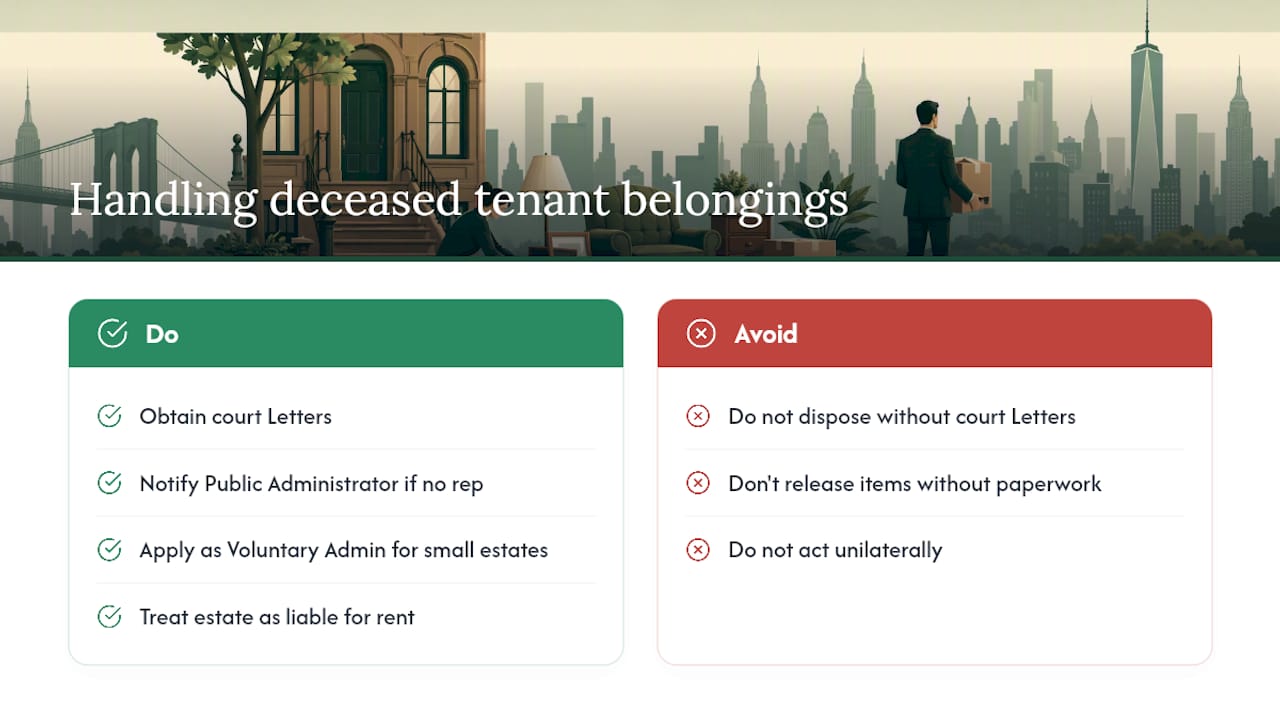
The core rule: A landlord cannot lawfully dispose of, donate, or sell a deceased tenant's belongings without court-issued Letters Testamentary or Letters of Administration. Releasing items to relatives without verified paperwork exposes you to an unlawful conversion claim.
Mishiyeva Law confirms that if no representative comes forward, the landlord's correct move is to notify the county Public Administrator, not to act unilaterally.
For smaller estates, New York offers a faster path. When a decedent's estate is modest in value, a family member can apply to become a Voluntary Administrator through Surrogate's Court, gaining authority to manage the apartment without going through full probate. This is a practical option for timely turnovers when the estate is modest.
Your key contacts: the county Public Administrator, the Surrogate's Court clerk, and a landlord-tenant or probate attorney for any contested or time-sensitive situation.
How to lawfully donate, sell, or dispose of left property in New York
Do:
- Document and photograph all items before touching them.
- Store belongings securely and maintain a chain-of-custody log.
- Notify claimants by certified mail and keep receipts.
- Obtain Letters Testamentary, Letters of Administration, or court authorization before any sale, donation, or disposal.
- Keep receipts for every donation and every sale, including the recipient organization's name and date.
Don't:
- Throw away, sell, donate, or re-let the apartment before estate authority is confirmed.
- Allow grieving relatives to remove items without verified legal paperwork, regardless of how distressing the situation feels.
- Sell financed goods (electronics, vehicles, jewelry) without checking for liens. Lienholders may have prior claims that override any sale proceeds you might apply to unpaid rent.
Hazardous and perishable items are a separate category. Perishable food, medications, and biological hazards must be handled according to local health department rules. Photograph and document them before safe disposal, and note the disposal method in your inventory log.
When a lawful sale does occur, any proceeds beyond documented costs may need to be accounted for to the estate. New York's statutory silence on disposal timetables does not grant permission to pocket proceeds without a transparent receipts trail.
When does hiring a professional cleanout service make sense?
Hire a professional when the volume of belongings is large, when there are biohazard or odor issues, when probate requires a detailed inventory, when your timeline is tight, or when family members cannot manage the logistics safely.
A qualified estate cleanout provider should deliver: written inventory and photo documentation, chain-of-custody receipts, donation tracking with receipts, disposal manifests, proof of insurance, a broom-clean handoff, and direct coordination with estate representatives or the Public Administrator.
Before hiring anyone, ask these questions:
- Are you fully insured, and can you provide a certificate of insurance?
- Do you provide written inventories and photo documentation for probate?
- Who are your donation partners, and do you provide donation receipts?
- How do you handle valuables or items with sentimental value?
- What are your pricing components, and will you provide a firm written quote?
Bereavementcleanoutservices follows a donation-first philosophy, directing usable items to local charities before considering disposal. Every cleanout includes inventory documentation suitable for probate, chain-of-custody receipts, and fully insured crews. That combination of legal awareness and compassionate handling is exactly what families and landlords need when the stakes are high.
What timelines and costs should you expect?
- Days 0–3: Secure the unit, complete photo documentation, and send certified-mail notices.
- Days 3 to several weeks: Wait for the estate representative or Public Administrator to respond and present paperwork.
- 1–14 days after authorization: Schedule and complete the physical cleanout, depending on urgency and crew availability.
- Weeks to months: Storage, estate sale, consignment, or probate proceedings run on their own timeline.
Cost components typically include cleanout labor, hauling and disposal fees, hazardous-waste removal (if applicable), storage fees, estate-sale or consignment commissions, and possible Surrogate's Court filing fees for expedited matters. Property size, hoarding level, and the presence of hazardous materials affect costs significantly. Always request a walkthrough and a firm written quote before work begins.
Practical templates and documentation to keep
Certified-mail notice (minimum required elements)
Include: tenant's full name, property address, date of notice, a brief statement that belongings remain on the premises, a deadline for the claimant to respond or retrieve items, and instructions for returning the signed receipt card. Keep the mailing receipt and the return-receipt card together in a dedicated file.
Inventory table for on-site walkthrough
Donation and sale receipt stub
Record: item description, recipient organization or buyer name, date, and estimated or actual value. Best practice steps include keeping these receipts in the same file as your certified-mail records and court papers. A complete paper trail is your protection in any probate or liability dispute.
Handling this with both legal care and human dignity
The legal steps in this guide exist for good reason. They protect landlords from conversion claims, protect families from losing heirlooms, and protect estates from unauthorized depletion. But behind every inventory list is someone's life, and that deserves respect.
The most defensible approach is also the most compassionate one: document carefully, notify promptly, wait for proper authority, and prioritize donation over disposal whenever possible. A donation-first workflow reduces costs, honors the decedent's belongings, and produces receipts that hold up in probate. Insured operations and meticulous chain-of-custody records give families confidence that nothing was handled carelessly.
When keepsakes are involved, set them aside and flag them in the inventory. Let the estate representative make the call. That small act of care makes a significant difference to grieving families.
Bereavementcleanoutservices handles the hard parts for you
When a New York estate or post-tenancy cleanout involves legal paperwork, probate documentation, and the weight of someone's personal belongings, the process deserves more than a basic haul-away crew.

Bereavementcleanoutservices provides donation-first estate cleanouts with written inventories, chain-of-custody receipts, and documentation formatted for probate. Fully insured crews coordinate directly with estate representatives and Public Administrators, so you are never left managing the legal handoff alone. The process starts with a walkthrough and a firm written quote. Bring your Letters Testamentary or Letters of Administration, and the team handles the rest, from sorting keepsakes to broom-clean handoff. Request your walkthrough today at Bereavementcleanoutservices.
Sources
- Can a Landlord Empty an Apartment After a Tenant’s Death in New York? - Mishiyeva Law, PLLC
- Abandonment of property by a tenant — Justia
- When a Tenant Dies, What Happens to Their Belongings | Siddiqi Law Group PC
For contested situations or urgent timelines, consult the Surrogate's Court clerk in your county or a licensed probate or landlord-tenant attorney before taking any action.
This article is general information, not a substitute for advice from a qualified lawyer. Consult a qualified legal professional about your own circumstances before acting on anything here.