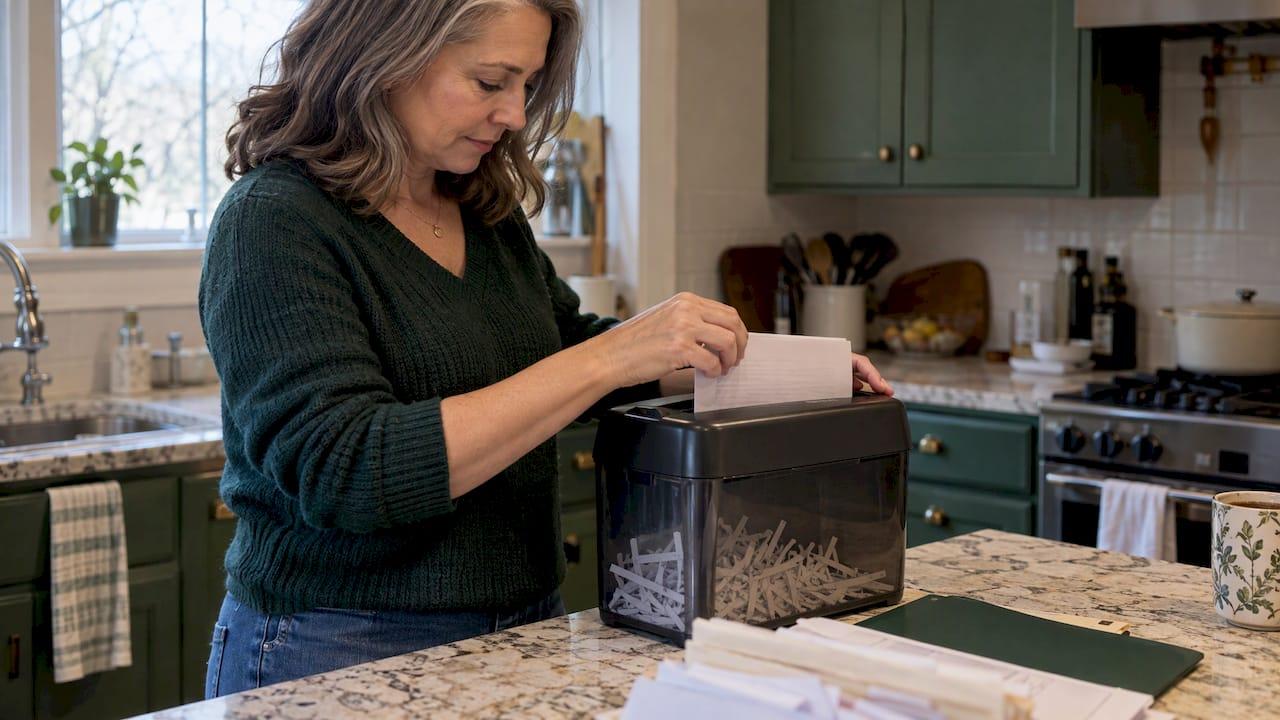
Do not shred anything in the first weeks after a death. Sort first, keep the papers that prove identity, ownership and the estate's finances, and shred the rest only after the executor and, if there is any doubt, an estate attorney confirm that no claim, tax question or probate step still depends on it. Most paperwork in a house is safe to destroy eventually. The order matters, because a shredded bank statement or tax return is very hard to replace.
This guide is for the person who is facing the boxes: an executor, a family member, a social worker helping a client, a landlord or realtor who has to clear a unit, or someone downsizing who wants their own affairs in order.
TL;DR
- Wait to shred until the executor has an inventory of assets, knows what probate requires and has confirmed that the estate's taxes and claims are in hand.
- Keep permanently: birth, marriage, divorce and death certificates, Social Security card, military discharge papers, deeds, vehicle titles, and a copy of the will and estate filings.
- Keep tax and financial records about seven years, and records of asset values at death until the asset is sold, plus seven years.
- Shred what is left, such as expired offers, closed accounts and duplicates, with a cross-cut or micro-cut shredder or a shredding service that gives a certificate of destruction.
- Document what you destroyed and what you donated or discarded, so the estate record stays clean.
Table of Contents
- Why the order matters: sort, then shred
- Who decides what can be destroyed
- What to keep permanently
- What to keep for a set period
- What you can shred
- How to shred safely
- A simple working method for a house full of paper
- When the house is full, not just the filing cabinet
- Our perspective
- How we can help with the cleanout side
- FAQ
- Sources
Why the order matters: sort, then shred
People reach for the shredder because paper with account numbers feels dangerous, and it can be. Identity thieves do target the recently deceased. But the opposite mistake is costly too. Estate attorneys frame the decision around function: keep documents that prove ownership, liabilities or entitlement to assets, and shred sensitive papers only when they have no ongoing legal or financial relevance.
That means the first job is not shredding at all. It is gathering everything into one place and sorting it into three piles:
- Keep permanently. Proof of identity, family status and ownership.
- Keep for a set period. Tax, financial, medical and insurance records.
- Shred. Papers with personal details but no remaining purpose.
If you are unsure which pile a paper belongs in, it goes in a labeled box for the executor and the attorney to review. A deceased person's papers are rarely in one place, either. They turn up in kitchen drawers, coat pockets, car glove boxes, garages and storage units, which is why the paper sort belongs inside the larger house cleanout, not before it or apart from it. Our guide to how to clean out a house after a death shows where paper fits in the sequence.
Who decides what can be destroyed
The executor (also called the personal representative) is the person with legal authority over the estate. The executor's duties are broad. The New York State Comptroller's survivor guide lists opening an estate bank account, inventorying assets, getting a tax ID number from the IRS, starting probate if needed, filing Form 56, paying claims, preparing tax returns and preparing an accounting for the court. Every one of those tasks generates or depends on paper.
If you are a family member without that authority, check with the executor before you destroy anything. If you are a social worker or case manager, confirm who holds legal authority before a cleanout begins. Our checklist on when to wait for probate and our guide on authority before donations explain why the same caution applies to belongings.

What to keep permanently
These papers establish who someone was, who they were related to and what they owned. Replacing them is slow, so treat them as permanent records. Several estate guides agree on the core list: birth and death certificates, marriage and divorce records, the Social Security card, military DD-214 discharge papers, property deeds, vehicle titles, and adoption or citizenship papers.
In practice, that looks like this:
- Birth, marriage and divorce certificates, and the death certificate (keep spare certified copies, since banks and agencies often want originals)
- Social Security card, passport and citizenship or adoption papers
- Military discharge papers
- Deeds, titles and mortgage payoff records
- The will, trusts, powers of attorney and any living will
- Retirement and pension plan papers
- Court filings, letters of appointment, the estate inventory and the final accounting
During probate the original will is usually filed with the court, so what you hold is a copy plus the court's paperwork. One more caution from the New York State Comptroller: a safe deposit box may be sealed at death, and estate documents kept inside it may become available only after a probate judge orders it opened. If the box is part of the picture, ask the estate attorney how to proceed before you do anything else.
What to keep for a set period
The right retention period depends on who is asking, and guidance varies a little. The table below shows the ranges that estate professionals commonly give, so you can choose the longer one when two sources differ.
| Record | Typical keep period | Basis |
|---|---|---|
| Tax returns and supporting records | About 7 years | The IRS generally has three years to review a return, six if income was underreported by more than 25% |
| Estate tax return | Three years after filing, longer if items were omitted | IRS Internal Revenue Manual 4.25.1 |
| Medical records | About 10 years | Keeps future claims and disputes resolvable |
| Wills, trusts, insurance policies | 7 to 10 years | Allows time for challenges |
| Property records and mortgage documents | While the estate owns the property, plus 7 years after sale | Estate retention guideline |
| Vehicle titles and registrations | 3 years after transfer | Estate retention guideline |
| Funeral planning documents | 3 years | Estate retention guideline |
| Records of asset values at death | Until the asset is sold, plus 7 years | Supports the stepped-up cost basis |
A few points on the table:
- Asset values. Appraisals and date-of-death statements matter when an heir later sells inherited property or investments, because they support the cost basis used to figure any gain.
- Medicare and insurance. Keep Medicare notices until final claims are processed and the estate is closed, and keep insurance papers until benefits are paid or claims are closed.
- Bills. Keep medical bills until they are paid or disputed. Keep final utility bills until the accounts are settled.
- State rules. Tax guidance is federal. The federal estate tax exemption is $15 million per person for 2026, so most families owe no federal estate tax, but some states have lower thresholds or their own rules. If the estate is in New Jersey or New York, ask the estate attorney or CPA which state requirements apply.
If the estate is large, contested or has unfiled tax returns, use the longer periods and ask the attorney before destroying anything. Retention periods are guidelines, not law, and an attorney or CPA who knows the estate can confirm them.
What you can shred
Once the executor has confirmed that nothing in a category is still needed, these are the usual candidates:
- Pre-approved credit card and loan offers
- Expired or closed credit cards (cut them in several pieces)
- Old bank statements past the retention window, and unused check stubs
- Advertising mail with a name and address
- Duplicate copies of records you have already filed
- Old utility bills with no estate value
- Lapsed insurance policies, after you confirm no claim is open
- Expired warranties and manuals for appliances that are gone
Before you shred anything with account numbers, confirm that the Social Security Administration has been notified of the death. The funeral home usually reports it, but you can check by phone, because the agency does not take death reports online or by email. It is also standard advice to ask the three credit bureaus (Equifax, Experian and TransUnion) to flag the credit file as deceased and to opt out of pre-approved credit offers, so the mail stops arriving.
How to shred safely
Identity theft is the reason to destroy papers at all. The University of Florida's gift-planning office treats anything carrying a name, address, Social Security number or bank account number as identity-theft material to destroy as soon as it is no longer needed. The method matters as much as the decision.
- Use the right shredder. A household strip-cut shredder leaves readable strips. For papers with Social Security or account numbers, use a cross-cut or micro-cut shredder.
- Use a shredding service for volume. For boxes, a professional shredding service is practical. Ask for a certificate of destruction and file it with the estate records.
- Handle the non-paper items. Hard drives, CDs and old phones hold personal data too. Destroy them or have them professionally wiped. Cut cards and IDs into several pieces.
- Scan what you want to keep as a copy. Where an original is not required, scan to a secure, encrypted vault and share access with the authorized family members before you shred the paper. Avoid casual phone photos stored in an unprotected camera roll.
- Store the keepers well. A lockable, fire-resistant cabinet works, and one trusted person should know where it is.
- Record it. Write a short log of what was shredded, when, by whom, and where the certificate is.
There are websites that suggest dissolving paper in bleach or burning it. Neither is a reliable way to handle a house full of records, and burning can break local rules and create a fire risk. A shredder or a certified service is the better route.
A simple working method for a house full of paper
A house that has not been sorted in years can hold decades of paper. A method that works for most families:
- Secure the home. Forward the mail and lock up documents and valuables in the early days.
- Gather first. Pull papers from desks, drawers, files, closets, vehicles and storage units into a few boxes or bins.
- Make four folders. Assets, liabilities, legal matters and household. AARP suggests this kind of folder system and advises asking your attorney which originals to keep before you scan or shred.
- Label a "ask the attorney" box. Anything unclear goes there.
- Photograph or list valuables. Write or video an inventory of items that will pass by will or trust. Our guide on estate cleanout documentation for executors shows how the inventory protects the executor.
- Shred in batches. Do it after each category is cleared, not all at once, and log each batch.
If the home will be sold, paper sorting and the cleanout run on one clock. A guide to clearing belongings before a sale covers preparing an inventory and separating important records from items to clear out, which is the same split you are making here.
When the house is full, not just the filing cabinet
The hardest cases are not a tidy desk. They are a hoarded home, a long-closed apartment, a storage unit nobody has opened in years. Papers are mixed in with clothes, mail, magazines and loose cash. Throwing out a bag without checking it can mean losing a deed, a stock certificate or an insurance policy.

This is where a professional crew that sorts methodically helps. Our process includes meticulous sorting of keepsakes, donation-first handling of usable items, broom-clean handoffs and documentation that supports probate. For a hoarded home, the levels of hoarding and what cleanup involves explains how the work is scoped. For a storage unit, see our probate-ready storage unit plan.
Our perspective
Most of the families we meet are not worried about the shredder. They are worried that they will throw away the wrong thing in the wrong week, and that worry is reasonable.
Our view is that a house should be sorted before it is emptied. Papers, keepsakes and usable household goods are all part of the same estate, and the executor needs a clear record of what was found and where it went. That is why our approach centers on careful sorting of keepsakes, donation-first handling and documentation that supports probate.
When a family has a house, an apartment or a storage unit to clear, one team can do the physical work while the family keeps their attention on the decisions that are theirs: which papers go to the attorney, which items stay in the family and when the property needs to be handed over broom-clean. We believe the combination of discretion, patience and a documented process is what lets people close an estate without second-guessing the sort.
Derek
How we can help with the cleanout side
When the paperwork is only part of a larger job, we handle the property. Our published starting prices are $295 for a single room, garage or basement, $650 for an apartment or condo cleanout, $1,200 for a full house cleanout, $1,500 for hoarding cleanup and $2,200 for a large estate cleanout. Foreclosure and eviction cleanouts start at $950. Packing is $55 per hour per packer, and estate photography and online inventory is $75 per hour. Actual quotes follow a walkthrough.
We work across New Jersey, are fully insured, and keep each job discreet. See the full list of services and prices or check our New Jersey service areas.
If the home is going to be sold, our guide on estate cleanout before closing explains how to document donations in the last days before closing. If you are still deciding what the house needs, estate sale versus estate cleanout explains the difference.
FAQ
How long should you keep documents after someone dies?
Identity, family and ownership records are kept permanently. Most tax and financial records are kept about seven years, medical records about 10 years, and asset-value records until the asset is sold, plus seven years. If sources differ, choose the longer period and ask the estate attorney or CPA.
Can I shred everything once probate is closed?
Not everything. Probate closing ends many obligations, but deeds, titles, certificates, the final accounting and records that support an heir's cost basis are still worth keeping. Tax returns and records tied to an inherited asset have their own timelines, so shred in categories, not all at once.
Is it safe to shred papers before notifying Social Security and the credit bureaus?
It is better to notify first. Confirm that the Social Security Administration has the death on record and ask the credit bureaus to flag the file as deceased. Those papers often carry the account numbers you need to complete these steps.
Should I use a home shredder or a service?
For a few pages, a cross-cut or micro-cut home shredder works. For boxes, a shredding service saves time and can provide a certificate of destruction, which you should file with the estate records. Strip-cut machines are not enough for papers with Social Security or account numbers.
Who can tell me what is safe to destroy in my situation?
The estate attorney or a CPA who knows the estate. State rules, unfiled returns, disputes and estate size all change the answer. If you are the executor, ask before you shred, not after.
Sources
- Shredding Documents After a Loved One's Death
- Life Changes: Getting Your Affairs in Order and A Guide for Survivors, NY State Comptroller
- Documents to Keep After Someone Dies (and for How Long)
- What to Shred After Someone Dies
- Estate Record Retention Guidelines, May 2025
- IRS Internal Revenue Manual 4.25.1, Estate and Gift Tax Examinations
- Tax Breaks: The Death And Taxes Edition, Forbes
- Keep? Shred? Share? University of Florida gift planning
- Family Caregiving Doesn't End When Care Recipient Dies, AARP