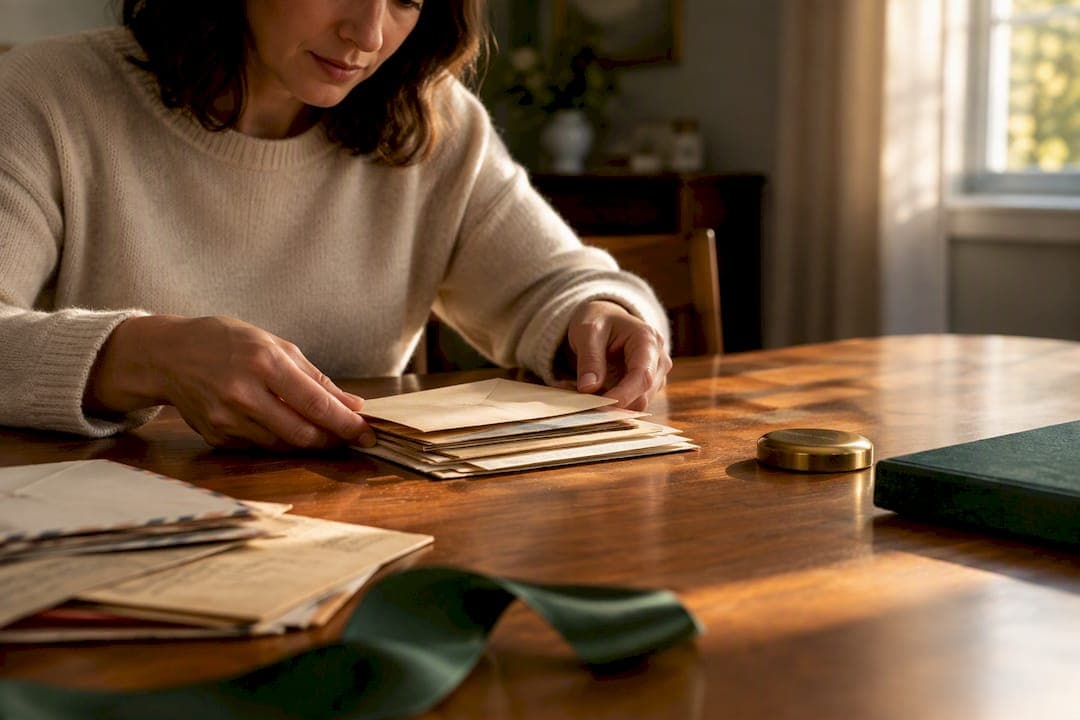
The single best first move is to separate every letter from the rest of the estate and set it aside before sorting anything else. Once you have them in one place, scan the readable ones with clear file names, keep the physical originals whenever possible, and jot down where each batch came from. Anything you can't decide on yet goes into a labeled "undecided" box rather than the trash.
TL;DR:
- Sorting letters by a single method, such as date, location, or correspondent, ensures consistency and prevents items from remaining unsorted.
- Digitizing fragile letters requires careful handling with flatbed scanners or photography, using clear file naming that includes sender, recipient, and date.
- Proper documentation includes photographing key pages and envelopes, linking images to an inventory, and attaching signed manifests for legal clarity.
- Keeping or donating letters depends on their legal relevance, family significance, and uniqueness, with undecided items reviewed after a set deadline.
- Professional estate cleanout services focus on donation-first sorting, careful preservation, and creating a legal-ready record to facilitate probate and honor the family's history.
Table of Contents
- How Do You Preserve Old Letters in the First Hour On-Site?
- How Do You Sort Letters Effectively for an Estate?
- What's the Best Way to Digitize Old Letters?
- How Should You Handle and Package Fragile Letters?
- How Do You Document Provenance for Probate?
- Should You Keep, Donate, or Dispose of Old Letters?
- How Do You Preserve the Story Behind Old Letters?
- Derek's Perspective: Sorting Letters Is an Act of Care, Not Just a Task
- Let Bereavementcleanoutservices Handle the Sorting So You Don't Have To
- Sources
- FAQ
How Do You Preserve Old Letters in the First Hour On-Site?
The first thirty minutes of a cleanout set the tone for everything that follows. Letters get lost, damaged, or accidentally discarded most often in this early rush, before anyone has slowed down enough to look closely at what's in a box.
- Find every container of letters first — desk drawers, shoeboxes, filing cabinets, closet bins — and move them to one clean, flat surface before opening anything.
- Set up three bins: Keep, Scan-Decision, and Donate/Dispose, following a donation-first approach so usable items don't end up in a dumpster by default.
- Flag anything that looks legal (wills, deeds, insurance papers mixed in with personal mail) and loop in probate counsel before moving it further.
- Photograph crowded boxes before you touch them. The original arrangement sometimes tells you who kept what, and that photo becomes your only record of it once the box is empty.
How Do You Sort Letters Effectively for an Estate?
Pick one sorting method and commit to it. Switching systems halfway through a box is how letters end up back in a pile, unsorted, three hours later.
- By correspondent works well when one person wrote most of the letters, or when a family member is asking about a specific relative.
- By date range works better for a mixed collection spanning decades, especially when the letters trace a life event like military service or a move.
- By location helps when letters came from multiple properties or storage units during the cleanout.
Respect whatever order you find. If letters are still in their original folders or wrapped with a ribbon, that arrangement often reflects a deliberate choice the person made while alive, and it's worth preserving before you impose your own system. When no order exists, chronological or alphabetical bins are the simplest fallback. Build a short inventory as you go: box or folder ID, sender or recipient, rough dates, and a flag for anything with possible legal relevance. Fragile or grouped letters belong in labeled folders or resealable bags rather than loose in a box.
Pro Tip: If five or more letters come from the same person, give them their own labeled folder. Fewer than that, drop them into a "Miscellaneous" folder and note the names in your inventory so nothing gets buried.
What's the Best Way to Digitize Old Letters?
Scanning turns fragile paper into something a whole family can actually read, but the method matters more than most people expect. Rushing this step is how you end up with three hundred photos named "IMG_2041" and no idea who wrote what.

Use a flatbed scanner or a copy stand for anything delicate. Automatic feed scanners can jam or tear pages that have gone soft with age, and pressing a fragile letter flat under a scanner lid risks creasing it if the paper doesn't sit right. Bound items or letters too brittle to flatten are safer photographed on a copy stand than forced into a scanner bed.
File naming matters just as much as the scan itself:
- Stick to Latin letters, numbers, hyphens, and underscores. Skip spaces, apostrophes, and accented characters.
- Build names around who, what, and when:
Smith_MarySister_1962-03.jpgtells you more at a glance thanletter14.jpg. - Keep a simple manifest, even a basic spreadsheet, linking each file ID to sender, recipient, approximate date, and where it was found.
Digitizing does not replace the original. Scans are useful surrogates, but digital files remain vulnerable to format obsolescence and hardware failure, so keep the physical letter unless there's a specific reason to let it go. Once you've scanned a batch, follow the 3-2-1 rule: three total copies, on two different types of media, with one stored off-site or in the cloud. A drive on a shelf and nothing else is not a backup. If you want the letters searchable rather than just archived, a guide to OCR and scan-to-text conversion walks through turning scanned images into text you can actually search.
How Should You Handle and Package Fragile Letters?
Old paper tears and creases faster than most people expect, especially after sitting folded in an envelope for decades. Archivists warn that hurried sorting in a crowded space is one of the most common causes of damage to family papers, more so than age itself.
- Work with clean, dry hands, or nitrile gloves if the paper looks brittle or the ink is smudging.
- Move letters flat, never folded, and keep boxes light enough that nothing underneath gets crushed.
- Use flat folders or shallow boxes rather than deep totes where letters shift and bend during transport.
- Label every box with an inventory ID and a short note on where it was found, the approximate date, and who handled it.
If a letter is so brittle that moving it risks tearing it apart, stop. Photograph it in place, note its location, and set it aside for a conservator rather than forcing it into a folder.
How Do You Document Provenance for Probate?
Letters sometimes carry more legal weight than families expect, especially when they reference gifts, debts, or intentions about who should get what. A little documentation now saves a lot of argument later.
- Record the basics per box or folder: who wrote or received the letters, where they were found, the approximate date range, and any note on why they might matter.
- Photograph envelopes and key pages, then link those image files to your inventory IDs so nothing floats free of its context.
- Attach a signed manifest to each retained box listing contents and who authorized keeping them. A short signed note like this can prevent a lot of confusion during probate, since it documents chain of custody in writing rather than leaving it to memory.
- Notify probate counsel promptly if any letter touches on a legal claim, and preserve the original packaging until an attorney has seen it.
The Executors: Protect Sentimental Clutter with Donation First Documentation guide walks through templates for exactly this kind of record-keeping.
Should You Keep, Donate, or Dispose of Old Letters?
Every family hits the same wall: too many letters, not enough certainty about what matters. A few clear rules make the decision faster and less painful.
- Keep anything tied to a legal claim, a named beneficiary, or a specific request from the deceased, along with anything genuinely unique to your family's history.
- Donate readable, non-unique correspondence the family agrees to release, following a donation-first process rather than defaulting to the trash.
- Dispose only after documenting the decision, and only after a waiting period if any heir is unreachable or hasn't weighed in.
- Undecided items go in their own box with a set review date, not an indefinite "we'll get to it later."
Pro Tip: Set the review date for the undecided box before you close it, not after. A concrete date on the calendar is what actually gets it reopened.
How Do You Preserve the Story Behind Old Letters?
A scanned letter without context is just an image. The stories around it are what make it worth keeping, and they disappear faster than the paper does.
- Record a short oral-history interview with a relative if a letter references an event or relationship worth understanding better. Capturing these memories while someone can still tell them adds context no scan can provide on its own.
- Transcribe key passages and store the transcript alongside the digital file, not in a separate folder where it'll get lost.
- Consider a small legacy project: a grandparent memory book, a labeled USB drive of scans for each sibling, or a simple family binder.
- Sharing copies with relatives sometimes surfaces details you didn't have, since a cousin or aunt may recognize a name or event the rest of the family had forgotten.
- Reserve local archives or historical societies for correspondence with genuine historical significance, not routine family mail.
Derek's Perspective: Sorting Letters Is an Act of Care, Not Just a Task
Sorting a parent's or grandparent's letters is emotional work disguised as paperwork. Treating it that way, and leaning on donation-first thinking for what the family doesn't need, turns a hard afternoon into something closer to honoring the person than clearing them out.
Documentation is the part people skip when they're grieving, and it's exactly the part that prevents disputes later. A signed manifest and a clear inventory don't just help an attorney. They give siblings a shared, factual record to fall back on instead of competing memories. A professional, documented approach doesn't remove the sadness from the work, but it does remove a lot of the friction that makes sadness worse.
— Derek
Let Bereavementcleanoutservices Handle the Sorting So You Don't Have To
A professional cleanout service can provide donation-first sorting, meticulous keepsake handling, and documentation that holds up during probate. Instead of spending a weekend deciding which letters matter while also managing an entire house, a team can separate keepsakes, photograph and inventory what's found, and provide a probate-ready record along with a broom-clean space.
Requesting a walkthrough is straightforward: reach out for a quote and let us know upfront if you want digitization or documentation-only service rather than a full cleanout. Every job comes fully insured. Current pricing details for full house cleanouts and smaller jobs are available on the Bereavementcleanoutservices site. If letters and keepsakes are the priority, start with a call and tell us that's the focus. We'll build the visit around it.
Sources
For technical scanning and handling detail beyond this guide, the National Archives' family archives resources and the Smithsonian's oral history guidance are solid starting points. Consult a conservator for anything fragile or potentially valuable before attempting repairs yourself.
- Digitizing family papers and photographs — National Archives
- Preserving your letters and documents — Smithsonian National Postal Museum
- Capturing your family's oral history — NMAAHC (Smithsonian)
FAQ
What's the fastest way to sort a large box of old letters?
Pick one method, by correspondent, date, or location, and apply it consistently rather than switching partway through. Sorting by date, correspondent, or location is the practical starting point that most families can manage without getting overwhelmed.
Should I scan letters before or after sorting them?
Sort first, then scan. Trying to digitize while you're still deciding what a letter is or who it belongs to usually means redoing the file names and inventory later.
Can I throw away letters if no one wants them?
Only after documenting the decision and giving heirs a reasonable window to weigh in, especially if any letter could be legally relevant. Bereavementcleanoutservices follows a donation-first approach for exactly this reason, routing readable correspondence to local charities instead of the landfill.
How much does it cost to have a professional sort and document letters during a cleanout?
Pricing depends on the scope of the job. A single room, garage, or basement cleanout that includes keepsake sorting starts from $295, while a full house cleanout with documentation starts from 1200 USD; current details are listed on the Bereavementcleanoutservices site.
Do I need a conservator for old letters?
Only for items that are extremely brittle, water damaged, or likely to have real historical or monetary value. For most family correspondence, careful handling, a flatbed scan, and a proper inventory are enough.