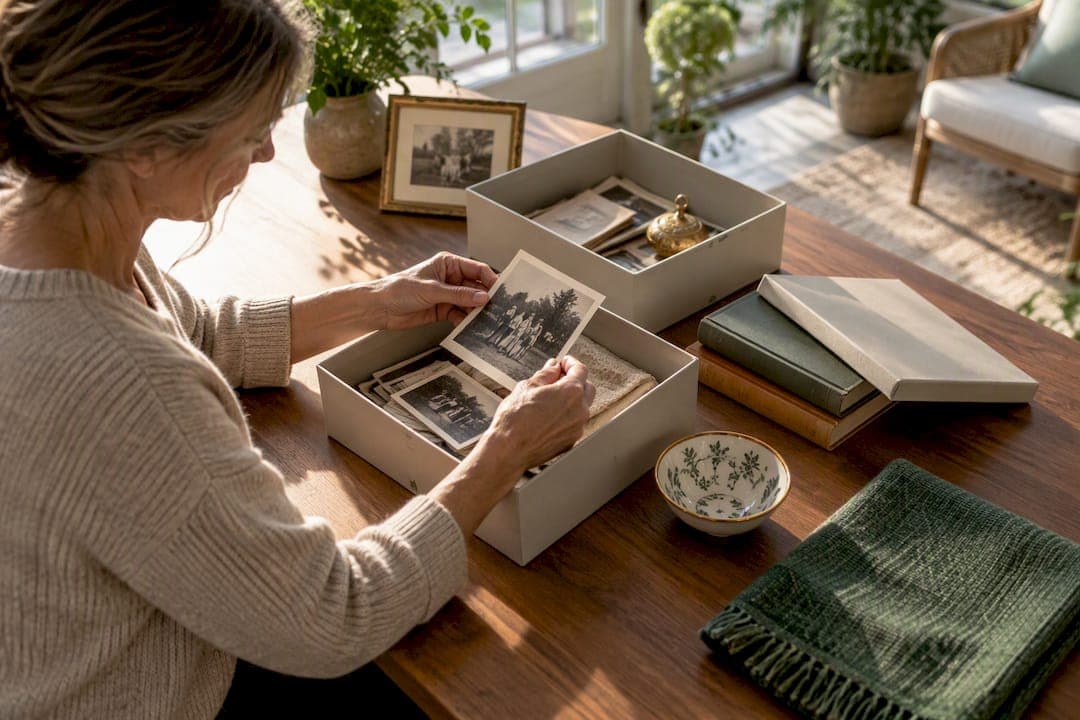
Start with one 30 to 45 minute session focused on a single category, like books or kitchenware, and sort everything into keep, pass to family, donate, sell, or discard. This works because it limits decision fatigue while still moving items out the door. Keep only a handful of pieces that hold real meaning, photograph and log the rest before it leaves the house, and plan disposal by channel rather than by guesswork. Emotional pacing, legal basics, and appraisal guidance follow below, and a donation-first cleanout service like Bereavement Cleanout Services is available if the volume becomes more than a family can manage alone.
TL;DR:
- Conducting focused 30 to 45-minute sessions for a single category prevents decision fatigue and speeds up the decluttering process.
- Sorting belongings by category—such as photos, documents, and collectibles—makes the process more manageable and reduces the risk of overwhelm.
- Valuing high-worth items through professional appraisal or auction offers better returns, especially when dealing with estate taxes or significant collections.
- Prioritizing donation and recycling over quick sales helps honor loved ones' wishes and keeps usable items out of landfills.
- Establishing clear communication, deadlines, and documentation with family prevents conflicts and confusion during the estate cleanout.
Table of Contents
- A short, practical checklist to run your first session
- Category-based sorting: photos, documents, furniture, collectibles
- Valuation and selling options: appraisal, auction, dealers, and marketplaces
- Donate and dispose responsibly: charities, tax receipts, and recycling
- Session pacing, timeline, and avoiding decision fatigue
- Legal, tax and probate basics that matter for collections
- When to hire a professional and what donation-first cleanouts do
- Talking to family and communicating wishes
- Inventorying and documenting collections
- Emotional care and grief-aware sorting
- Strategies for organizing and categorizing items before downsizing
- Finding and working with professional appraisers or estate sale experts
- Handling digital or non-physical inherited collections
- Separating memory from objects
- How a donation-first cleanout can help
- Sources
- FAQ
A short, practical checklist to run your first session
A single category, tackled in one sitting, keeps the process from turning into an all-day ordeal that nobody wants to repeat. Set a timer, pick one category such as photographs, kitchenware, or holiday decorations, and work through it without wandering into other rooms.
- Gather a phone or camera, sticky notes, a few boxes labeled keep, donate, sell, and discard, and a simple inventory sheet or app.
- Set a timer for a short session around half an hour to three quarters of an hour and commit to finishing that block before taking a break.
- Apply one rule per item: keep 1 to 3 true favorites, confirm whether another family member has claimed it, donate if usable, sell if valuable, and discard if damaged beyond repair.
- Write a short after-session note listing what got decided and what the next session should cover.
That last step matters more than it sounds. A one-line note like "kitchen done, dining room next, mom's china needs an appraisal" saves you from relitigating decisions you already made.
Pro Tip: Photograph an item before you decide its fate. It gives you a record without the pressure of keeping the object itself.
Category-based sorting: photos, documents, furniture, collectibles
Sorting by category, rather than room by room, prevents the kind of overwhelm that stalls a cleanout for months. Move through categories roughly in this order: photos and paper first, since they carry the least physical burden and the most emotional weight, then documents, then furniture, then specialty collectibles.
- Photos and memorabilia: stabilize loose prints, photograph or scan them, then decide whether to retain the physical copy, pass it to a relative, keep a digital version only, or donate albums with local historical value. Our guidance on estate photo sorting walks through this in more detail.
- Documents: secure wills, deeds, and financial statements in one folder, shred outdated junk mail and expired paperwork, and flag anything relevant to probate for the executor before it gets boxed up.
- Furniture and large items: measure it against the space you actually have, test whether it fits your life now, and consider repair or resale rather than storing it indefinitely with no plan.
- Collectibles: keep provenance intact, gather receipts, certificates, or prior appraisals, and never separate a set's components before someone qualified has assessed the whole inherited collection.
Working this way also makes later steps, like appraisal and donation, faster because you already know what you are holding.
Valuation and selling options: appraisal, auction, dealers, and marketplaces
Not every item needs a formal appraisal, but high-value pieces, anything going through probate, or items likely to trigger estate tax reporting usually do. Professional appraisals for personal property typically run $75 to $250 per hour, which is worth the cost when a piece might be worth thousands.
- Send rare or high-value items to auction, where competitive bidding tends to surface the strongest price.
- Use specialist dealers or consignment shops for mid-range collectibles that need a knowledgeable buyer but not a full auction house.
- Turn to estate sales or online marketplaces for items that need to move quickly and locally.
Get multiple offers before you sell anything. Appraisers and dealers recommend collecting more than one quote and resisting pressure to accept an immediate, low, on-the-spot offer, since the first buyer through the door rarely offers the best price.
If the person who gave you a valuable or meaningful gift is still living, ask before you sell it. That single conversation avoids a lot of family friction later.
Donate and dispose responsibly: charities, tax receipts, and recycling
A donation-first approach keeps usable items out of landfills and gets them to people who need them, which is often more in keeping with a loved one's wishes than a quick sale.
- Local nonprofits and shelters take clothing, household goods, and furniture in good condition.
- Museums or historical societies may want specialty pieces with local or historical significance.
- Larger charities often offer pickup service for bulky items you cannot transport yourself.
Keep every donation receipt, and ask the charity for a written acknowledgment if the value might affect your taxes. For anything substantial, a tax advisor can confirm what documentation you need. Hazardous materials, like old paint or batteries, and electronics require specific recycling paths rather than a regular donation run, and items that degrade in storage, such as photographs or textiles, should not sit indefinitely waiting for a decision.
Session pacing, timeline, and avoiding decision fatigue
Repeated short sessions beat one exhausting weekend. Spacing the work out, whether that means one category a week or a compressed four-weekend plan, keeps fatigue from creeping in and gives family members time to weigh in.
- Schedule 30 to 45 minute sessions and write a short after-action note at the end of each one.
- Set a firm review date on any box marked "decide later" so it doesn't sit untouched for years.
- Give family members a clear window to claim items, and remove anything claimed before an estate sale or donation run begins.
A four-weekend plan works well for a full house, starting with a low-stakes "weekend zero" walkthrough before the harder sorting begins.
Legal, tax and probate basics that matter for collections
Inherited property in the United States generally takes on a basis equal to its fair market value on the date of death, not what the original owner paid for it, according to IRS Publication 551. That matters if you later sell an item for more than its value at the time of inheritance, since the gain may be reportable.
Larger estates sometimes require formal appraisals or additional reporting, and the executor carries the duty to record and distribute assets accurately. Save every receipt, appraisal, and valuation document you generate during a cleanout. If a collection carries real value, a conversation with a tax or estate professional before you sell anything can prevent costly mistakes later.
When to hire a professional and what donation-first cleanouts do
Some situations call for outside help: a large volume of belongings, a tight closing deadline, executor obligations with legal weight, hoarding conditions, or simply more emotional strain than a family can absorb alone. A donation-first cleanout prioritizes routing reusable items to local charities, sorts keepsakes with care rather than speed, leaves the space broom-clean, and documents everything for probate.
- Confirm the company is insured and ask for references.
- Ask how they handle keepsakes specifically, not just general haul-away.
- Check for actual donation partnerships, not just a vague promise to "donate what we can."
- Get a clear quote process before anyone starts working.
Pro Tip: Ask a prospective cleanout company how they document items before removal. A real inventory process is a good sign they take probate needs seriously.
Talking to family and communicating wishes
Most of the conflict in a cleanout comes from silence, not disagreement. Before you start sorting, tell family members what categories you're tackling and when, so nobody feels blindsided by a decision made without them.
Set a deadline for claiming items and stick to it. An open-ended "let me know if you want anything" invites indefinite delay, while a clear window, say two weeks, gives people enough time to respond without stalling the whole process. Professional organizers suggest giving a wanted item to a family member now, while the giver can watch them enjoy it, rather than waiting for it to become an inheritance decision later.
When disagreements come up over a specific piece, separate the conversation about who gets the object from the conversation about what it meant. Two people can love the same item for different reasons, and naming that out loud often resolves the standoff faster than negotiating over the object itself. If a decision truly can't wait, put the item aside in a labeled box rather than forcing a resolution on the spot.
Keep a simple written log of who claimed what and when. It prevents the "I thought you said I could have that" conversation that tends to surface months later, especially once grief has had time to settle and memories of the original conversation blur.

Inventorying and documenting collections
A basic inventory turns a vague pile of belongings into a document you can actually use, whether for insurance, probate, or your own peace of mind. For each item worth noting, record a photo, a brief description, its approximate category, and any provenance, receipts, or prior appraisals that came with it.

A phone camera and a spreadsheet or a simple inventory app are enough for most households. For a photo shot list and the kind of metadata executors need for court-ready documentation, a structured approach saves time later if the estate goes through probate.
Photograph items before you clean, repair, or move them, since the original condition sometimes matters for valuation. Keep the inventory in one place, whether a shared folder or a printed binder, so the executor and family members are working from the same information rather than separate memories of what existed.
Emotional care and grief-aware sorting
Sorting through a parent's or spouse's belongings is not a logistics problem wearing an emotional disguise. It is genuinely both, and pretending otherwise is why so many cleanouts stall halfway through. Give yourself permission to stop a session early if it gets too heavy, and resume another day rather than pushing through out of guilt.
It helps to separate the object from the memory it holds. You can keep the memory of your grandmother's kitchen table without keeping the table itself, and recognizing that distinction is often what allows a cleanout to move forward at all. Grief tends to move in waves rather than a straight line, so expect some sessions to go smoothly and others to stall on a single box of letters.
If a category feels too raw to sort alone, ask a friend or relative to sit with you, even if they don't touch a single item. Having company changes the emotional weight of the task without changing the decisions you have to make.
Strategies for organizing and categorizing items before downsizing
Before you touch a single box, walk through the house and make a rough list of categories: photos, documents, furniture, kitchenware, collectibles, clothing, and anything else specific to the household. This list becomes your session schedule, one category at a time, so you always know what's next without having to decide fresh each time you sit down.
Group similar items physically before sorting them, since seeing all the mugs or all the tools together makes duplicates obvious and speeds up the keep or donate decision. A room-by-room keep checklist helps when a category spans multiple rooms, like paperwork tucked into a desk, a filing cabinet, and a kitchen drawer.
Label boxes clearly as you go, using the same four or five categories every time (keep, family, donate, sell, discard) so the system stays consistent across sessions and across family members helping out.
Finding and working with professional appraisers or estate sale experts
Look for an appraiser who specializes in the category you're dealing with, since a generalist may undervalue specialty items like stamps, coins, or vintage furniture. Professional organizations tied to specific collectible types, such as the American Philatelic Society for stamp collections, can point you toward qualified appraisers with relevant expertise.
Ask any appraiser or estate sale expert for references, a clear fee structure, and whether the appraisal is being done for insurance, sale, or estate tax purposes, since the number can differ depending on the reason. Estate sale companies typically work on commission rather than a flat fee, so confirm the percentage and what services it covers, including advertising, staffing, and cleanup, before you sign anything.
For families dealing specifically with trading cards or similar niche collectibles, a dedicated guide on protecting collectible value covers preservation steps worth knowing before you sell or hand a collection to an appraiser.
Handling digital or non-physical inherited collections
Digital collections, from photo libraries to email accounts to online game libraries, need their own sorting process. Start by locating login credentials, either through a password manager the deceased used or through account recovery processes offered by major platforms.
Back up anything meaningful, photos, videos, documents, to at least two locations before you close or delete any account, since some platforms permanently remove data once an account is deactivated. Digital estate planning laws vary by platform and by state, so check each service's own policy on deceased users' accounts rather than assuming one process covers everything.
Treat digital photo libraries the same way you'd treat a physical photo box: sort by rough category or date, then decide what to keep, share with family, or archive. A digital collection carries less physical weight, but the decisions around it deserve the same unhurried pace as sorting a closet.
Separating memory from objects
If you feel guilty putting a box in the donation pile, that feeling is common and it doesn't mean you're doing this wrong. Keeping a few objects that truly matter, and letting the rest go to people who will use them, honors a person's memory just as well as keeping everything would. Go slowly, and ask for help the moment it feels like too much.
— Derek
How a donation-first cleanout can help
When the volume outpaces what a family can manage in evenings and weekends, a donation-first cleanout alternative is built around the same principles covered above: careful keepsake sorting, documentation for probate, and a broom-clean handoff when the work is done.
- Estate photography and online inventory for probate and insurance records.
- Runs that route usable items to local charities before anything is discarded.
- Full house, apartment, or single-room cleanouts with a broom-clean finish.
A walkthrough comes first, followed by a firm quote, so you know the cost before any work begins. Reach out through the main service page when you're ready for a quote or want to see the full range of services.
Sources
For deeper reading: IRS Publication 551 on inherited property basis, AARP's collectibles selling guide, the American Philatelic Society's inheritance guidance, and a Star Tribune feature on downsizing family heirlooms.
- Publication 551 (12/2025), Basis of Assets | Internal Revenue Service
- Inherited a Collection | American Philatelic Society
FAQ
What is the hardest thing to get rid of when decluttering?
Photographs and handwritten items, like letters and cards, tend to be the hardest because they carry a person's presence in a way furniture or kitchenware doesn't. Digitizing them first, so you're not losing the memory even if you release the physical object, often makes the decision easier.
What does it mean to downsize a collection?
Downsizing a collection means reducing its size to what fits your space and needs while keeping the pieces that matter most, rather than storing everything indefinitely. It typically involves sorting by category, checking value where relevant, and choosing whether each item gets kept, donated, sold, or discarded.
What is the 5 5 5 rule for decluttering?
The "5-5-5 rule" is used inconsistently across decluttering resources, so treat it as an informal prompt rather than a fixed method. A category-based approach with timed 30 to 45 minute sessions tends to give more consistent results.
At what age is it most beneficial to downsize a house?
There's no single age that applies to everyone, since the right time depends on health, finances, and how much a household actually uses its space. Many people begin the process gradually well before a move becomes urgent, since starting early reduces stress and avoids rushed decisions about family heirlooms.