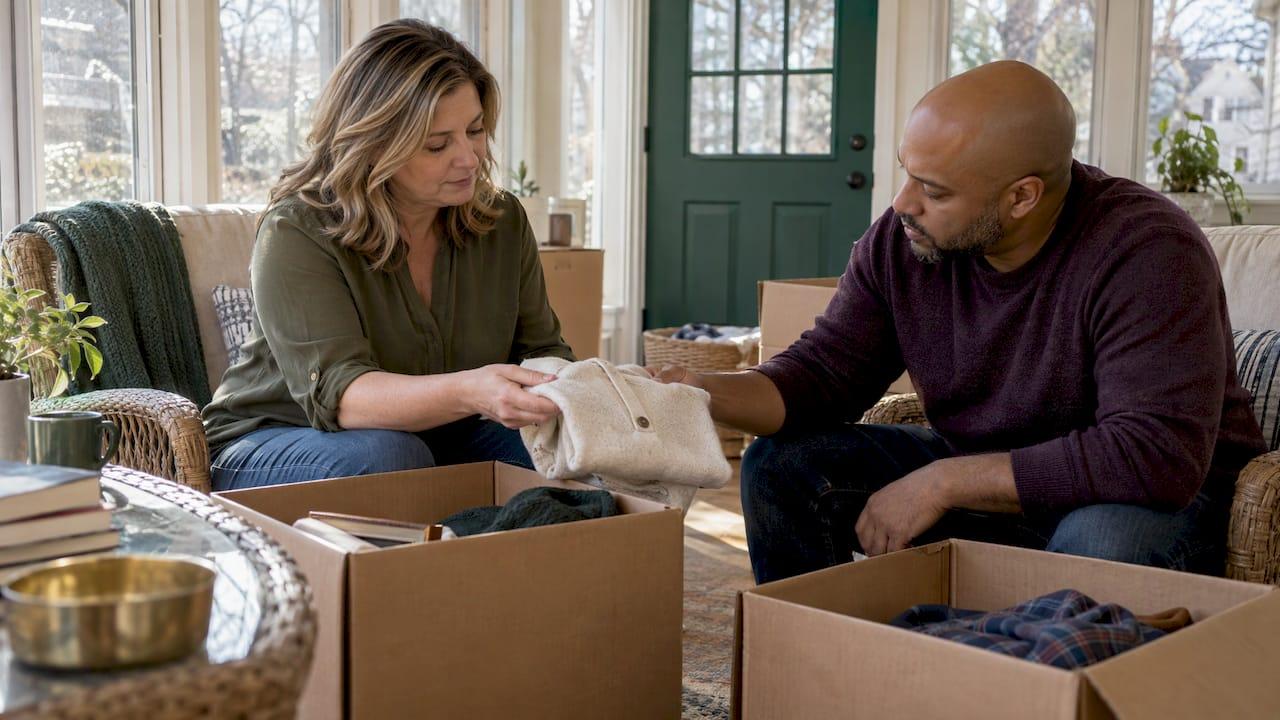
Decluttering after a death goes best when you set the pace yourself, confirm who has legal authority before anything leaves the house, and sort from the least emotional items to the most personal. You do not have to do it all alone or all at once. We handle the lifting, hauling, donation runs and documentation in New Jersey and New York, so your time and energy can go to the things only family can decide: the keepsakes.
TL;DR
- There is no required timetable. Most grief specialists suggest not making permanent decisions in the first weeks, and the work does not have to be done immediately.
- If probate is open, only the court-appointed personal representative may remove items. In New York, that includes hiring a cleanout company before letters are issued.
- Hold a family meeting first, then sort in layers: perishables and medications, everyday items, and only then photos, letters and heirlooms.
- Photograph and list significant items before they leave, and keep donation receipts.
- Donate what others can use, and hire help for the heavy, repetitive work so you keep your energy for the keepsakes.
Table of Contents
- There is no deadline, but there is a sensible order
- Before you remove anything: who has the authority?
- Start with a family meeting
- Sort in layers, from least to most personal
- Choosing keepsakes and recording what matters
- Letting go without guilt
- Donating, selling and disposing responsibly
- Where we take the weight off your shoulders
- Our perspective
- FAQ
- Sources
There is no deadline, but there is a sensible order
People often feel a rush to clear everything quickly. Sometimes there is a real reason, such as a lease ending or a house going on the market. Sometimes the urge is a way of getting control over a situation that feels out of control. A Psychology Today column on clearing a loved one's things says that is exactly when to listen to your heart rather than outside pressure. The same writer notes that sorting usually does not need to happen right away, and that nobody should pressure you, relatives included, into giving away things you want to keep.
Another Psychology Today piece puts it plainly: there are no rules for dealing with the stuff of grief. Some families clear a house in a weekend. Others wait a year. Some people find an empty drawer harder to face than the belongings themselves.
What helps is an order of operations. A gentle sequence recommended in a funeral-planning guide runs like this:
- Secure the home, remove perishables, deal with medications and locate important paperwork.
- Move to everyday items such as clothing and dishes, which carry less emotional weight and can be donated, recycled or discarded.
- Approach the most sentimental items, such as photo albums, letters and heirlooms, last, after time to process.
If a deadline forces your hand, you can still protect the personal items. Some families set the sentimental things aside and decide later, a approach consistent with the "90-day" advice of avoiding permanent decisions in the first three months, when grief can cloud judgment.
Before you remove anything: who has the authority?
This is the step families most often skip, and it is the one with legal consequences.
If the estate has to go through probate (the court process that validates a will and puts someone in charge of the deceased person's property), only the court-appointed personal representative, also called the executor, may remove items. According to one estate law firm's guidance, that person cannot act until appointed and holding court-issued letters, and unless you are certain you are the sole heir, you should not remove anything that is not already garbage or rotting.
In New York, the rules are specific. A New York estate attorney's guide says that before letters issue you may:
- secure the home,
- keep insurance in force and utilities on,
- photograph every room, and
- locate the will.
You may not take items for yourself, hold sales, hire a cleanout company or shred papers until letters issue. If you are in that waiting period, photographing every room and securing the house is the right use of your time. We are glad to talk through timing when the authority is in place.
Not everything is part of the probate estate. A law firm's guide to decluttering after a death explains that the personal representative should verify and file the will, obtain legal authority, and identify which items are in the estate versus passing directly to beneficiaries. Jointly owned property or accounts with named beneficiaries may not be subject to probate. A probate attorney can tell you what is protected before anything is discarded.
While you wait, gather the paperwork into one folder for the executor or attorney: the will and trust documents, funeral instructions, deeds and vehicle titles, insurance policies, account information, digital passwords and recent tax returns, as one planning checklist lists them. Our guides on what to do before a cleanout when probate is pending and when to wait for probate go through this in more detail.
Start with a family meeting
Most conflict after a death comes from the same four questions: when to begin sorting, who gets what, what to keep or give away, and what happens to the house. Grief counselor Litsa Williams recommends making a plan early for how and when things will be handled, holding a family sit-down to review the will and next steps, and setting up regular updates.
A simple set of ground rules, adapted from a planning guide, keeps the peace:
- Anyone can flag an item as meaningful.
- Items are held for 48 hours to a week before they are donated.
- Significant items are photographed before they leave the house.
To reduce arguments over who gets what, one funeral home suggests drawing up a list of possessions and sending copies to immediate family so everyone can state a preference. When two people want the same item, an advice columnist suggests asking them to work it out, and if they cannot, using a simple drawing.
If something has already been thrown out, Williams advises using "I" statements ("I was hurt when the clothes went without talking to me") rather than accusations, and giving each other slack, since grief drives poor choices. If the conflict cannot be managed, a professional mediator can help.
Give relatives and friends specific jobs too. A Psychology Today writer recommends assigning tasks such as buying boxes, making dump runs or researching donation sites, because people want to be useful.
Sort in layers, from least to most personal
Sorting by emotional weight lets you build momentum. A bereavement guide from a funeral provider network suggests starting small (a bathroom is easier than a closet), pacing yourself, and asking a sibling, friend or relative to help.
Layer one: the easy decisions
Spoiled food, used toiletries, expired medications and obviously broken items. Medications can and should be disposed of quickly, and durable medical equipment such as walkers and wheelchairs is always needed by a local senior center.
Layer two: everyday household goods
Clothing, dishes, linens, small appliances and furniture in good condition. These are the items most likely to be useful to someone else, which makes them the natural candidates for donation.
Layer three: papers, devices and valuables
Set aside papers, devices, keys and cards first. Back up photos and files, and reset devices and remove SIM and memory cards before they leave the house. Jewelry, art, antiques and collectibles deserve a look before anything is donated.
Layer four: the sentimental items
Photo albums, letters, journals and heirlooms come last. A five-category system described in Psychology Today works well here: discard, unsure (discuss as a group), "not now" (delay decisions made in the midst of grief), donate or give to others, and keep. The "not now" box is the part many families need most, but give it a date. The same publication cautions against boxing things away for another day, noting that one author's grandmother's unopened boxes sat for nearly three decades. Put a date on the calendar, perhaps a birthday or anniversary, to open them again.

A timer helps on hard days: work in short stretches and stop while you still feel steady.
Choosing keepsakes and recording what matters
Keepsakes are not only the obvious objects. The list in a Dignity Memorial guide includes important documents (tax returns, medical records, birth certificate, passport), photos, a few favorite clothes, heirloom furniture, jewelry including costume pieces, china and cast-iron cookware, handmade blankets and quilts, journals and correspondence. Its practical rule is to sleep on any undecided item, because disposed items cannot be brought back.
Two habits prevent regret and disputes later:
- Photograph before you part. Psychology Today's widow-focused column recommends photographing belongings such as letters or a car to catalog them before they go.
- Write down the story. Tax writer Kelly Phillips Erb suggests describing heirlooms with their story rather than a vague label, such as a specific piece of stoneware brought from the old country, in her Forbes guide to a parent's possessions. She also recommends keeping receipts, photographs and insurance schedules together for items with resale value.
An inventory also keeps things fair. A probate law firm recommends creating one first, to account for valuable or sentimental items, then sorting into keep, donate and discard, with open discussion or rotating selections when several family members want the same thing.
If you are downsizing yourself, for example before a move to assisted living, our room-by-room list of what to keep applies the same layered approach.
Letting go without guilt
Letting go of an object is not letting go of the person. Forbes' Erb notes that written instructions from the person who died, saying what should be donated or discarded, can give heirs permission not to feel guilty. If your loved one left none, you can write your own plan for the family: what you are keeping, what you are giving to whom, and what you are donating.
The Psychology Today author who sorted her father's house also notes that grief keeps the bond even as it changes, and that is a good reason to keep a few things that feel like him or her rather than everything. Some families find it easier to describe what is happening in neutral words ("I am putting a sweater in the donation box") when feelings run high. If the task brings up painful memories, it is fine to ask a friend to help, and some people find extra support such as therapy useful.
Donating, selling and disposing responsibly
A simple rule works for most of what remains: donate what someone can use, recycle what you can, and pay someone to haul away the rest, as The Widow's Guide puts it. A few practical notes:
- Keep every donation receipt. For tax purposes, claims between $250 and $500 need written acknowledgment, claims above $500 require IRS Form 8283 Section A, and claims over $5,000 generally need a qualified appraisal, according to a donation guide. Items must be in good used condition or better. Ask the estate's accountant how a deduction applies, since for an estate the gift generally must be made under the will or governing instrument, as the Forbes tax guide explains.
- Know what goes in a dumpster. Paint, batteries, chemicals and some electronics are commonly restricted, and this overview of items dumpsters do not accept shows why sorting hazardous items out first matters.
- Valuable items may be worth selling. Our guide to estate sale versus cleanout explains which route suits which home, and our article on what to do with leftover estate sale items covers what remains afterward.
- Gifts to family. Erb notes that in 2026 you can give up to $19,000 in cash or objects to any one recipient in a year without using your federal lifetime gift and estate tax exemption.
If the home is heavily cluttered, the question of cleaning out versus selling as-is comes up quickly. This guide on cleaning out a hoarder house or selling as-is frames that decision, and our own guide to the five levels of hoarding and what cleanup involves explains what the work looks like.
Where we take the weight off your shoulders
Once you have authority to act and the family has agreed on what stays, the heavy work is the part most people are glad to hand over. We offer donation-first estate cleanouts across New Jersey, with keepsake sorting, documentation useful for probate, broom-clean handoffs, discreet service and full insurance. Published starting prices include:
| Service | Starting price |
|---|---|
| Single item or small pickup | from $150 |
| Single room, garage or basement | from $295 |
| Apartment or condo cleanout | from $650 |
| Full house cleanout | from $1,200 |
| Large estate cleanout | from $2,200 |
| Estate photography and online inventory | $75 per hour |
| Packing service | $55 per hour per packer |

You can see everything we offer on our services page, or find your town on our New Jersey service areas page. For apartments, see our donation-first apartment cleanout guide for NJ families.
Our perspective
Families rarely call us because they do not care about the belongings. They call because they care a great deal, and the house is too much to face alone.
We believe the order matters. Authority first, then a family conversation, then the keepsakes, then everything else. That is why we work donation-first: usable items go to local charities, so a lifetime of belongings helps someone else instead of ending up in a dumpster.
We also sort keepsakes carefully and document what leaves the home, because executors need a clear record for probate and families need to know nothing meaningful was lost. Our estate photography and online inventory service exists for the same reason. When the work is done, you get a broom-clean home and a calmer next step.
You decide what stays. We do the lifting, the hauling and the paperwork trail, discreetly and fully insured.
Derek
FAQ
How long should I wait before decluttering after a death?
There is no single right answer. Grief counselors generally suggest waiting several weeks before major decisions, and some suggest up to 90 days for permanent ones. Handle perishables, medications and paperwork first, and let the sentimental items wait until you are ready.
Can I start clearing the house before probate is opened?
Only the court-appointed personal representative may remove items once probate is required. Before that, you can usually secure the home, photograph rooms and gather documents. Check with the estate's attorney, and see our guide to executor authority before donations.
What if family members disagree about who gets what?
Make a list of items, share it with everyone, and hold the family meeting before anything leaves. Hold donations for a set period so anyone can flag an item. If it still stalls, a mediator can help, and a simple drawing settles duplicates.
What should I do with items nobody wants?
Donate what someone can use, recycle what you can, and hire help to haul the rest. Keep your donation receipts and set aside papers and devices first. We run donation-first cleanouts in New Jersey, so usable items go to local charities.
Sources
- Psychology Today: The Stuff of Grief
- Psychology Today: 3 Things to Know When Clearing Out Your Loved One's Things
- Psychology Today: Sorting Through a Life, One Box at a Time
- Funeral.com: Sorting a Loved One's Belongings
- Nourishing Minimalism: Decluttering After the Death of a Loved One
- Spangler and de Stefano: Removing Personal Property
- NY Estates Lawyer: Cleaning Out a House After Death in NY
- Keane Thomas & Pinnacoli: Decluttering after Loved One's Death
- TributePlan: Sorting Through a Loved One's Belongings After Death
- What's Your Grief: Coping With Family Fighting After a Death
- Freitag Funeral Home: Getting Through the First Few Weeks
- al.com: Asking Eric
- Dignity Memorial: Dealing With a Deceased Loved One's Belongings
- Centering Corporation: Sorting Through
- The Widow's Guide: What about everything nobody wants?
- Forbes: What To Do With All Your Deceased Parents' Possessions
- National Relief Program: Donation guide
- Dumpster prohibited items
- Cleaning out or selling a hoarder house as-is