
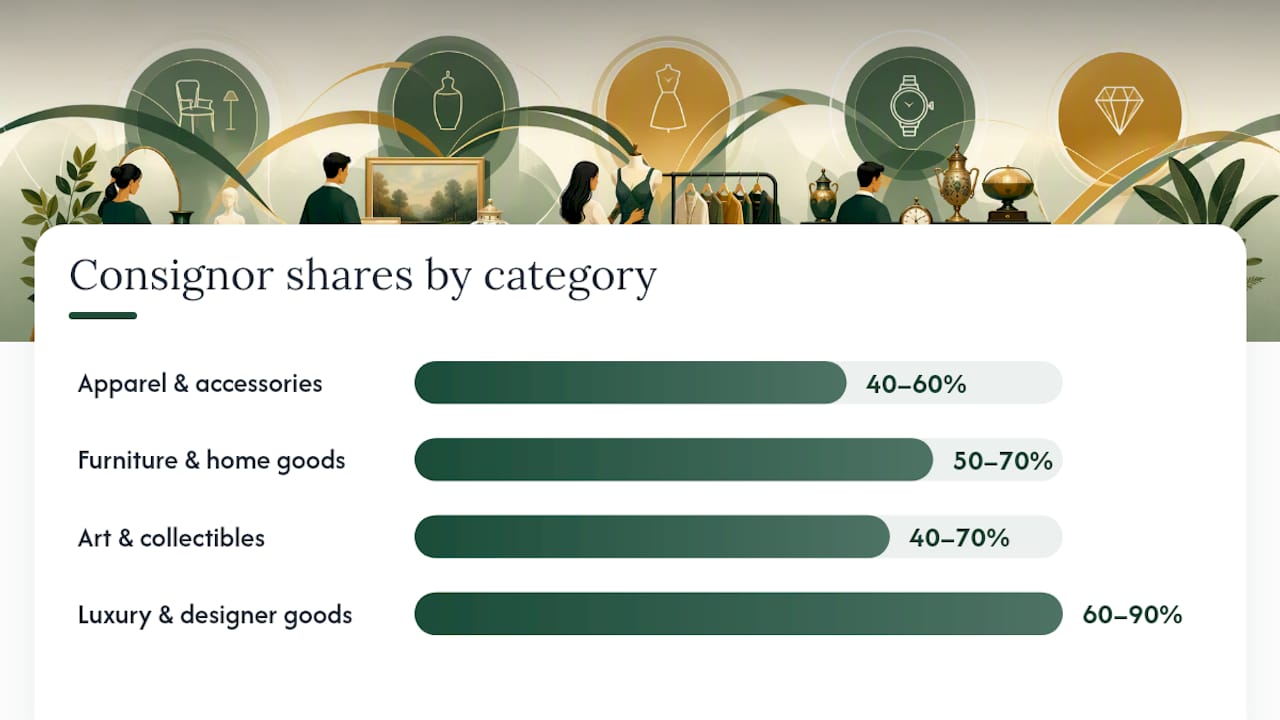
Most consignors keep between 40% and 60% of the sale price, and that split climbs toward 60% to 90% for luxury goods, fine art, or estate-quality furniture. The default in general apparel resale is a straight 50/50 split, but shops that handle photography, shipping, or repairs typically hold a larger share to cover that work. Tiered rates, buyer's fees, and store-credit bumps all shift the number you actually walk away with.
TL;DR:
- Consignment rates vary widely by category, with luxury and designer goods often earning consignors between 70% and 85% of the sale price.
- Fees such as buyer's fees, listing charges, and payout processing costs can significantly reduce the actual payout, making clear contractual terms essential.
- Tiered commission structures based on sale price or volume can raise the consignor's share, but only if you evaluate the actual benefit of store-credit incentives.
- Payout timing and transparency are critical, with trustworthy shops providing detailed statements and explicit payment schedules, typically within 14 to 30 days.
- Estate sale and cleanout services often operate on higher splits and shorter payout periods, emphasizing donation-first policies and detailed documentation to handle urgent deadlines.
Table of Contents
- What are typical consignment commission rates by category?
- How do you calculate your consignment payout?
- What fees and contract clauses actually change your payout?
- How do tiered splits and store-credit incentives work?
- What five factors should determine a fair commission rate?
- When should you expect your consignment payout?
- What should you ask before signing a consignment agreement?
- How do estate sale and cleanout services structure commissions differently?
- A practitioner's take on setting a fair split
- How Bereavement Cleanout Services structures estate sales and consignment
- Sources
What are typical consignment commission rates by category?
The category matters more than most people expect when they hand over a couch or a designer handbag. A 50/50 arrangement that feels fair for a rack of used sweaters can quietly shortchange someone consigning a mid-century dresser, because the shop's labor and floor space cost far more per item.
Here's how the ranges typically break down across the categories consignors ask about most:
- Apparel and accessories: Consignors usually keep 40% to 60%, with 50/50 the most common baseline in general resale shops.
- Furniture and home goods: Consignor share often runs 50% to 70%, since storage, delivery coordination, and floor space cost the shop more per item than a shirt on a rack.
- Art and collectibles: Splits swing widely, from 40% to 70%, depending on whether the gallery provides authentication, appraisal, or marketing services.
- Luxury and designer goods: Consignor share frequently lands between 60% and 90%, especially on online luxury platforms that pay 70% to 85% once an item clears a certain price tier.
- Electronics and specialty items: Rates get negotiated case by case, and refurbishment or authentication work usually pulls the consignor's share down slightly to offset that labor.
That luxury number surprises a lot of first-time consignors. A platform paying 85% on a designer bag isn't being generous. It's reflecting the fact that a $2,000 item takes roughly the same listing effort as a $40 blouse, so the shop's flat costs shrink as a percentage of the sale.
Every percentage above describes the consignor's cut, not the shop's. That distinction sounds obvious until you're mid-negotiation and someone says "we do 60/40" without specifying which number is yours. Always ask the shop to state explicitly: "You keep X%, we keep Y%." Written contracts should spell this out in plain language, not just as a ratio.
How do you calculate your consignment payout?
The math is simple once you know two things: the sale price, and whether fees come out before or after the percentage split. That second detail causes more disputes than the split percentage itself, because a "60% consignor share" can mean very different money depending on when fees get subtracted.
Here's the basic formula:
- Start with the final sale price. This is what the buyer actually paid, not the original list price.
- Subtract any fees the contract treats as "off the top." Processing fees, buyer's fees, or listing charges often come out before the split is calculated.
- Apply the agreed percentage to the remaining amount. That result is the consignor's payout.
- Confirm the payout date and method against what the agreement specifies.
Example 1: Straight 50/50, no fees. A jacket sells for an amount split evenly, so the consignor and the shop each receive an equal share. No complications.
Example 2: 60/40 store-favored split with a processing fee deducted first. A lamp sells for an amount from which a processing fee is deducted before the percentage split, resulting in a lower consignor payout than the nominal percentage might imply. That $2 difference is exactly the kind of thing that should be spelled out in writing before the item ever hits the floor.
A vintage chair sells for $600. Since it clears the $500 threshold, the consignor earns 60% of $600, or $360, rather than the lower baseline rate.
Markdowns complicate all three scenarios.
What fees and contract clauses actually change your payout?
Commission percentage gets all the attention, but buyer's fees, item fees, listing fees, and ACH or check payout fees quietly erode take-home pay in ways many consignors never anticipate. None of these are hidden exactly. They're just easy to overlook until the final statement doesn't match your mental math.
Common fees and clauses to look for:
- Buyer's fee: An additional charge applied to the buyer's price that may influence the final payout depending on how it's allocated between shop and consignor.
- Item or listing fee: A per-item fee sometimes charged in consignment agreements, especially in online marketplaces, which can reduce the consignor's net proceeds.
- Payout processing fee: Fees for payment methods like ACH transfers or paper checks that may reduce consignor payouts by a small amount per transaction.
- Cleaning or repair fees: Charges applied when items require preparation before sale, potentially affecting consignor earnings.
- Shipping pass-through: Actual shipping costs are sometimes deducted from consignor proceeds, particularly with online consignment.
The consignment period, automatic markdown schedule, and unsold-item procedure matter just as much as the percentage. A typical schedule marks items down at 30, 60, and 90 days, then either returns unsold goods to the consignor, donates them, or disposes of them, depending on what the contract says. Damage and loss liability clauses, along with pricing authority (who can discount an item without asking), round out the terms most likely to cause friction later.
Pro Tip: Never rely on a verbal understanding of fees. Ask for every fee type in writing, including what happens if an item is damaged on the floor, before you sign anything.
How do tiered splits and store-credit incentives work?
Shops rarely use one flat rate for every consignor. Tiered structures reward higher sale prices or long-term volume, and store-credit incentives let shops preserve cash while still giving consignors a better deal on paper.
Typical tiers look like this:
- Price-based tiers: 50% consignor share under $200, rising to 60% or 65% above $500 to $1,000.
- Volume-based tiers: Consignors who bring in a high number of items per month or year often earn a 5 to 10 percentage point bump over walk-in rates.
- Cash vs. store-credit tiers: A shop might offer 50% cash or 65% in store credit for the same item, banking on the fact that credit keeps money circulating inside the business.
That last point deserves real scrutiny before you take it. But if you'd never spend that credit, you've effectively taken a pay cut disguised as a bonus. Do the math against your actual buying habits, not the shop's marketing pitch.
What five factors should determine a fair commission rate?
Setting a defensible split isn't guesswork. It comes down to measurable costs and value drivers that any shop owner can calculate with a spreadsheet and a little honesty about overhead.
- Actual cost per transaction: rent, utilities, labor, and card processing fees all eat into the shop's share before profit even enters the picture.
- Item handling and storage footprint: a sectional sofa ties up floor space for weeks; a necklace fits in a drawer.
- Price point and resale velocity: high-ticket items that sell fast can sustain a higher consignor share without hurting shop margins.
- Marketing and platform reach: national online exposure justifies a different split than local foot traffic alone.
- Consignor value: volume, item quality, and exclusivity are legitimate negotiation levers, not favors.
| Factor | What it typically pushes toward |
|---|---|
| High overhead (rent, staff) | Lower consignor share to protect margin |
| Large or heavy items | Higher consignor share to offset storage cost |
| Fast-selling, high-ticket goods | Higher consignor share is sustainable |
| Strong online/national reach | Shop can justify a slightly larger cut for exposure |
| High-volume or exclusive consignors | Leverage for a better negotiated rate |
The Aravenda framework for setting splits recommends revisiting these numbers annually rather than setting a rate once and forgetting it. Rent goes up, card fees change, and consignor volume shifts. A commission structure that made sense two years ago might be quietly underpaying your best consignors today.
When should you expect your consignment payout?
Payout timing varies more than most consignors realize, and it's one of the clearest signals of how well-run a shop actually is. Reasonable terms typically fall into one of three patterns: payment at the moment of sale, weekly batch payouts, or monthly statements that consolidate everything sold that period.
A trustworthy consignor statement should include, at minimum, the item ID or description, the final sale price, any fees deducted, the net amount paid to you, and the date payment was issued. If a shop can't produce that level of detail on request, that's worth noting before you consign anything else there.
On the shop side, basic bookkeeping habits prevent most disputes before they start:
- Track inventory by consignor ID, not just by item, so you can pull a full history in seconds.
- State payment windows explicitly in the contract, whether that's "paid within 14 days of sale" or "monthly on the 1st."
- Issue monthly statements even for consignors who haven't sold anything, so silence never gets mistaken for a missed payment.
Itemized statements and clear payout timing consistently rank as the biggest trust builders in resale relationships, ahead of the commission percentage itself. A consignor who understands exactly when and how they'll get paid tolerates a lower split far better than one left guessing.
What should you ask before signing a consignment agreement?
A short checklist before you sign saves most people from the disputes that show up six months later. Ask these questions up front, in writing, not as a verbal aside during drop-off:
- Who sets the price, and can it change without your approval?
- How are fees handled, and are they deducted before or after the percentage split?
- How long is the consignment period, and what triggers a markdown?
- When do you get paid relative to the sale date?
- What happens to unsold items at the end of the term: returned, donated, or disposed of?
On negotiation, ask for documented tiers rather than a verbal promise of "we'll take care of you." Request a store-credit bump only if you'd genuinely use the merchandise, and consider bundling several high-value items together as leverage for a better rate across the whole batch.
Watch for a handful of red flags that should slow you down: verbal-only agreements with nothing on paper, vague payout timelines like "sometime after it sells," missing itemized statements, or a shop that refuses to specify what happens to unsold items. Ambiguity about fee timing and calculation basis is the single most common source of consignor complaints, and it's entirely preventable with a clearly written contract.
Pro Tip: If a shop won't put its unsold-item policy in writing, assume the worst-case outcome (disposal, not return) and decide if you're still comfortable consigning.
How do estate sale and cleanout services structure commissions differently?
Estate sales and cleanouts run on a different rhythm than retail consignment, mostly because families are working through a home on a deadline, often tied to probate or a closing date, rather than deciding whether to keep consigning at a boutique long-term.
A donation-first approach changes what happens to items that don't sell. Instead of returning unsold goods to a grieving family or quietly disposing of them, donation-first sorting routes usable items to local charities, which respects both the family's wishes and the practical reality that nobody wants boxes of unsold furniture sitting in a driveway for another month.
Payout windows in estate sale work also tend to run tighter and more documented than typical retail consignment. A 14 to 30 day payout window is common, and because estate proceeds often need to satisfy an executor or probate court, the paperwork carries more weight than a standard consignment receipt. Sample contract clauses and payout timeline language matter here in a way they simply don't for someone consigning a used couch at a local shop, because a family may need to show exactly what sold, for how much, and when funds arrived.
The split itself often mirrors the same category benchmarks covered earlier: furniture and antiques favor a higher share to the estate, everyday household goods settle closer to a standard rate, and full-service versus seller-managed listing decisions shift how much administrative work the estate keeps versus hands off entirely.
A practitioner's take on setting a fair split
For most small local shops, 50/50 remains the safest default on general apparel and everyday goods. It's simple, easy to explain, and matches what most consignors already expect from market benchmarks. Where I'd push back on convention is furniture and large estate items.
I've seen an unsold-items dispute resolved simply by both sides agreeing, in writing, to a donation-first clause before the sale even started. Nobody argued afterward because nobody had to guess what would happen.
— Derek
How Bereavement Cleanout Services structures estate sales and consignment
Setting a fair split gets a lot simpler when one company handles the entire process instead of juggling separate quotes from a cleanout crew, an estate sale company, and an online consignment platform. Bereavement Cleanout Services runs estate cleanouts, full estate sales, and online consignment listings under one roof, with a donation-first policy that routes usable items to local charities rather than letting them sit unsold.

That combined approach can shorten payout timelines by reducing coordination gaps between the cleanout crew, the sale, and the final accounting. Families benefit from having one set of documented terms instead of multiple, which can be helpful when managing probate paperwork. If you're weighing whether to manage an estate sale piece by piece or hand the whole process to one team, request a quote from Bereavement Cleanout Services and ask to see sample contract terms before you decide.
Sources
- What Is Consignment: How It Works (2026) - Shopify
- Consignment Commission Splits: 50/50 vs 60/40 vs 70/30 (ResaleOS)
- What Is the Right Consignment Split Percentage? A Data-Backed Guide for Shop Owners - Aravenda