
Before you sign anything, do three things: get a written contract, verify bonding and insurance directly with the issuing insurer, and insist on daily itemized settlement statements with a firm payment deadline. These three steps block the tactics behind the most common estate sale frauds.
Here is a checklist you can copy and use right now:
- Get a written contract before any work begins. A verbal agreement gives you nothing to enforce.
- Verify bonding and insurance by calling the agent listed on the certificate and confirming the policy number and effective dates, not just accepting a paper copy.
- Require daily itemized subtotals so you know exactly what sold and for how much each day of the sale.
- Set a written payment deadline with a penalty clause for late disbursement of proceeds.
- Attend the sale yourself or send a trusted representative. Any company that discourages your presence is a warning sign.
- Interview at least three companies and check each one's BBB complaint history before signing.
These actions work because investigative reporting repeatedly shows the same pattern: operators discourage owner attendance, skip itemized accounting, and then become unreachable when payment is due.
Key Takeaways
Families who insist on a written contract, verified insurance, and daily itemized accounting before signing with any estate sale company eliminate the conditions that make fraud possible.
| Point | Details |
|---|---|
| Three non-negotiable steps | Get a written contract, verify bonding/insurance with the insurer directly, and require daily itemized settlement statements. |
| Commission range to expect | Legitimate companies typically charge 30–40% of gross sales; unusually low rates often hide undisclosed fees. |
| If fraud occurs | Preserve all evidence, send a certified demand letter within two weeks, and file complaints with the State AG, BBB, and FTC. |
| Regulatory gap | Most states have no licensing requirement for estate liquidators, so documentation is your primary protection. |
| Bereavementcleanoutservices | Offers fully insured, documented estate cleanouts and sales in New Jersey with transparent accounting and a donation-first approach. |
Table of Contents
- What are the biggest estate sale scam red flags?
- How do you vet an estate sale company before hiring?
- What must every estate sale contract include?
- What should you do if you suspect estate sale fraud?
- How do you protect heirlooms and valuables before the sale?
- Why do estate sale scams keep happening?
- What does the estate sale process look like from start to finish?
- Real estate sale fraud cases that show the pattern
- What the most overlooked risk in estate sales actually is
- Bereavementcleanoutservices takes the risk out of estate cleanouts in New Jersey
- Authoritative resources and where to file complaints
- Sources
What are the biggest estate sale scam red flags?
Consumer-protection offices and investigative reporters have documented the same warning signs across dozens of cases. Knowing them before you hire is your first defense.
- No written contract offered. A company that wants to proceed on a handshake has no accountability when proceeds go missing.
- Cannot prove bonding or insurance. If a staff member damages or steals property, an uninsured company leaves you with no recourse.
- Vague or shifting pricing. Watch for commissions quoted verbally with no written fee schedule, or a low headline rate that hides setup, advertising, cleanup, and disposal add-ons.
- Pressure to sign quickly. Urgency tactics are designed to prevent you from comparing providers or reading the contract carefully.
- Discourages owner attendance. Multiple fraud cases trace directly to operators who told families their presence would "disrupt buyers" and then failed to account for proceeds.
- No itemized settlement statements. Without a day-by-day sales record, you cannot verify what sold or what you are owed.
- Staff purchasing items without disclosure. Employees buying items during setup or the sale itself, without written disclosure, is a direct conflict of interest.
- Affiliated consignment or retail shop. Consumer guidance warns that operators who also run their own retail channels may quietly shift your most valuable items out of the sale inventory and into their own store.
- Requests for large upfront cash payments into a personal account rather than a business account.
- Refusal to provide references from the past 12 months. A legitimate company has recent clients willing to speak.
Case pattern to recognize: In a 2025 case in Pennsylvania, a woman was convicted in a $35,000 estate sale fraud after multiple victims reported withheld proceeds and no itemized accounting. In Houston, families reported losing heirlooms and money after a company discouraged their attendance and never delivered settlement statements. In Virginia, an NBC4 Washington investigation found multiple families alleging a company kept their proceeds and stopped responding when payment was due.
Pro Tip: Watch for emotional-manipulation language. Phrases like "you don't want to be in the way" or "families who attend make buyers uncomfortable" are designed to remove your oversight. A professional company welcomes your presence and has nothing to hide.
How do you vet an estate sale company before hiring?
Use this sequence before you commit to any provider.
- Search online reviews on Google and Yelp, and check the company's BBB record for complaint history and resolution patterns. A single complaint is not disqualifying; a pattern of unresolved payment disputes is.
- Verify state business registration through your state's Secretary of State website. A company that cannot be found in the business registry is operating without accountability.
- Request bonding and insurance certificates. Then call the agent listed on each certificate to confirm the policy number and that coverage is current. Do not accept a certificate at face value.
- Ask for three client references from the past 12 months and actually call them. Recent references reflect current business practices.
- Review a sample contract and a recent settlement statement before your first meeting. A company that cannot produce these is not ready to work professionally.
- Visit an active sale or browse their listed inventory online to assess how they price, stage, and present items.
Interview questions to ask every company
Bring these to every provider conversation:
- What is your commission rate, and what is the exact fee structure beyond commission (setup, advertising, cleanup, disposal)?
- Who sets prices, and what is your markdown policy as the sale progresses?
- Are staff permitted to purchase items during setup or the sale? If so, how is that disclosed in writing?
- When will I receive my proceeds after the sale closes, and what is the penalty if payment is late?
- What happens to unsold items? Who pays for removal or disposal?
- How do you handle donations, and will I receive documentation for tax purposes?
- Can I attend the sale, and will I have access to daily sales totals each evening?
- Have you ever had a complaint filed with the BBB or a state consumer-protection office?
The Minnesota Attorney General's consumer guidance specifically recommends shopping around, verifying bonding and insurance, and insisting on written contracts with explicit payment deadlines.
Pro Tip: When you call references, ask two specific questions: "Did you receive your full proceeds on time?" and "Were you given an itemized list of every item sold and its price?" A hesitant or vague answer to either question is a red flag worth taking seriously.
What must every estate sale contract include?
A contract is your only enforceable protection. AARP reporting on estate sale disputes confirms that most states do not require a specific license for estate liquidators, so the contract is where consumer protection lives or dies.
Insist on every item below before signing:
- Commission percentage and total-cost disclosure: The exact rate and a written list of every fee (setup, advertising, cleanup, haul-away, disposal).
- Payment timing and late-payment penalty: A specific date by which you receive proceeds, with a written penalty (interest or flat fee) for late disbursement.
- Daily subtotals and final itemized settlement: A requirement that the company provides a day-by-day sales record and a complete itemized list of every item sold, its price, and the buyer category.
- Proof of bonding and insurance: Certificates attached to the contract, with your right to verify them directly with the insurer.
- Staff purchase policy: Written disclosure of any items purchased by staff or the operator, with those amounts deducted transparently from the settlement.
- Disposition of unsold items: Exactly who handles removal, at whose cost, and whether you have approval over donation recipients.
- Donation tax-benefit assignment: Confirmation that any charitable donation receipts are issued to the estate, not the company.
- No hold-harmless clause that waives your rights: Review any indemnification language carefully; do not sign away your right to pursue the company for negligence or fraud.
- Payment by check or ACH to the estate account: Never agree to cash payments or transfers to a personal account.
Sample contract language to insist on:
Pro Tip: Require that the bonding and insurance certificates be attached as exhibits to the signed contract, and include a clause stating that the estate may withhold final approval of the settlement until those certificates have been independently verified with the issuing insurer.
What should you do if you suspect estate sale fraud?
Act quickly. Evidence degrades, and payment windows matter for legal remedies.
First 48 hours
- Preserve all evidence: Save every email, text, contract, receipt, photo of the home before and after, and any written or verbal communication about the sale.
- Photograph the home and any missing or damaged items immediately.
- Send a written demand for a full accounting via email and text, so you have a timestamped record of the request.
- Do not allow further access to the property until you have a clear accounting.
First two weeks
- Send a certified demand letter to the company's registered business address. State the amount owed, the contract terms violated, and a deadline (typically 10–14 days) for full payment and itemized accounting.
- Contact your state's Attorney General consumer protection office. Every state has one; most accept online complaints and can sometimes intervene directly.
- File a complaint with the Better Business Bureau. This creates a public record and sometimes prompts a response from the company.
Days 30–90
- File a complaint with the Federal Trade Commission at ReportFraud.ftc.gov. The FTC tracks fraud patterns nationally and uses complaint data to identify repeat offenders.
- Report to local police. Withheld proceeds from a signed contract can constitute theft or fraud under state law.
- Consider small-claims court for amounts within your state's limit (typically $5,000–$10,000 depending on the state). You do not need an attorney, and a judgment can be enforced through a writ of garnishment.
- Consult a civil attorney if losses exceed small-claims limits or if the company has multiple victims, as a class action or coordinated civil suit may be viable.
Evidence checklist to preserve:
- Signed contract and all addenda
- All emails and text messages with the company
- Bank records showing any payments made to the company
- Photos of the home and its contents before the sale
- Any itemized lists or receipts provided
- Names and contact information of any witnesses
How do you protect heirlooms and valuables before the sale?
The safest approach is to remove anything irreplaceable before the company ever sets foot in the home.
- Pull obvious heirlooms from the sale inventory and store them in a locked room, a safe, or off-site before the company arrives for setup.
- Photograph every high-value item with a timestamp and record serial numbers for electronics, jewelry, and collectibles.
- Get independent appraisals for antiques, jewelry, art, and collectibles before the sale. Contact a certified appraiser through the American Society of Appraisers or the Appraisers Association of America. Ask for a written appraisal report with the appraiser's credentials and methodology.
- Tag items you are reserving or excluding with a clearly labeled "NOT FOR SALE" tag and document them in writing with the company before setup begins.
- Ask whether the company runs an affiliated consignment or retail shop. If they do, request a written, auditable process for how inventory is tracked and transferred, so items cannot quietly leave the sale for their own retail channel.
- Do a walkthrough on the final day of the sale to compare remaining inventory against your pre-sale documentation.
Why do estate sale scams keep happening?
The short answer is that most states do not require a specific license to operate as an estate liquidator. AARP's reporting confirms the industry is largely self-regulated, which means the burden of verification falls entirely on families, often during one of the most stressful periods of their lives.
Without a licensing requirement, anyone can open an estate sale company. There is no mandatory bonding threshold, no required insurance minimum, and no state agency routinely auditing settlement statements. The 2025 Pennsylvania conviction and the Houston and Virginia cases all followed the same structural failure: families trusted a company they had not properly vetted, signed contracts with no payment deadlines, and had no daily accounting to fall back on.
The practical response to this regulatory gap is documentation. Bonding and insurance certificates should be verified directly with the issuing insurer, not just accepted as paper. State business registration can be confirmed through your Secretary of State's online database in minutes. BBB complaint histories, while not definitive, surface patterns that individual reviews miss.
Pro Tip: To verify a bond, call the county treasurer's office in the company's operating county and ask whether a bond has been filed. For insurance, call the agent listed on the certificate directly and ask them to confirm the policy number, coverage type, and expiration date. A legitimate company will have no objection to this.
Authoritative sources to check before hiring:
- Better Business Bureau: Complaint history, ratings, and resolution records.
- State Attorney General consumer protection office: Complaint filings and enforcement actions. Find your state's office at Naag.
- Federal Trade Commission: National fraud reporting and consumer guidance.
- Secretary of State business registry: Confirms the company is legally registered in your state.
What does the estate sale process look like from start to finish?
Understanding the full timeline helps you spot delays or deviations that signal a problem.
Weeks 1–2: Consultation and contract. You interview providers, compare contracts, verify bonding and insurance, and sign with your chosen company. The contract should specify every fee, the sale dates, and the payment deadline.
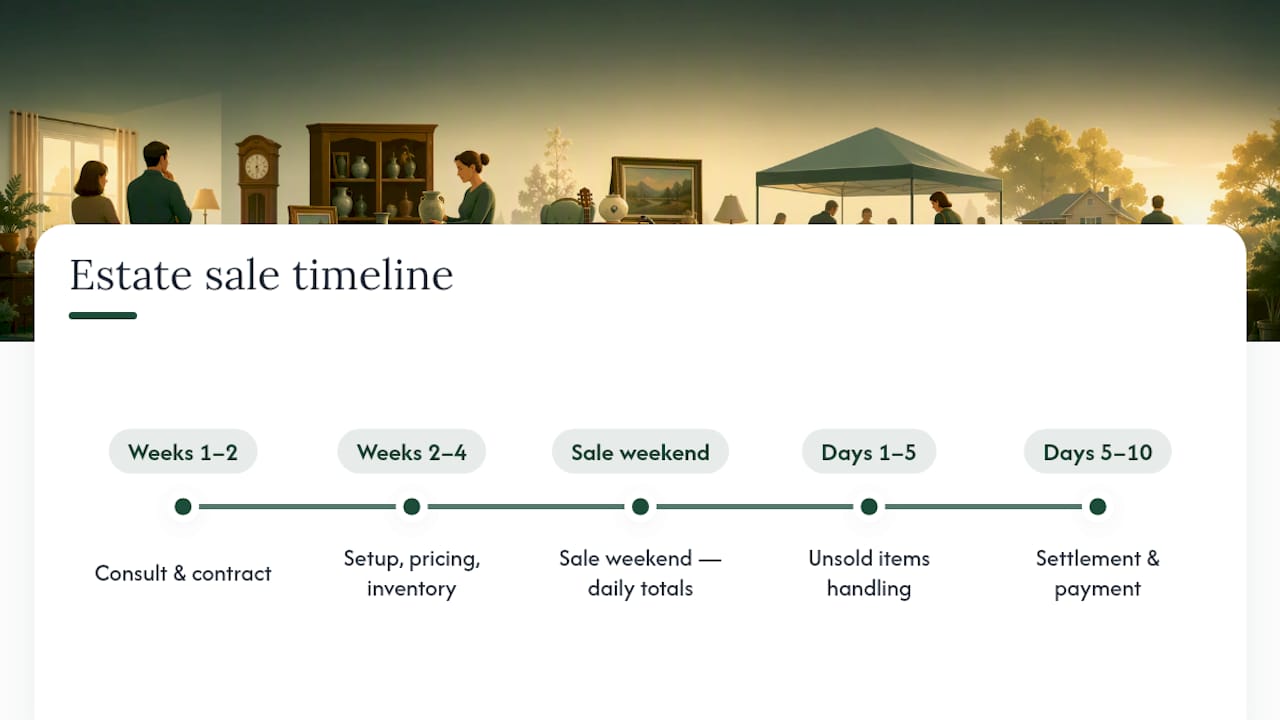
Weeks 2–4: Setup and pricing. The company inventories, prices, and stages items. This is when you should complete your pre-sale walkthrough, remove reserved items, and confirm the inventory list in writing.
Sale weekend (typically 2–3 days). The sale runs, usually Friday through Sunday. You or a representative should be present or available. The company should provide you with a daily subtotal each evening.
Days 1–5 after the sale: Unsold items. The contract should specify who handles removal, at whose cost, and whether you have approval over donation recipients. Get donation receipts in your name.
Days 5–10 after the sale: Settlement statement and payment. The company delivers a complete itemized list of every item sold and its price, deducts the agreed commission and fees, and pays the net proceeds by the contract deadline. Commission rates commonly run 30–40% of gross sales; unusually low rates often hide undisclosed fees.
If payment or the itemized statement does not arrive by the contract date, begin the escalation steps described above immediately.
Real estate sale fraud cases that show the pattern
These documented cases illustrate why the red flags above are not hypothetical.
The Houston case. Investigative reporting by Click2Houston documented families who lost both money and heirlooms after a company discouraged their attendance, never provided itemized statements, and stopped communicating when payment was due. The pattern was consistent across multiple victims: no daily accounting, no written payment deadline, and no recourse because contracts were vague or nonexistent.

The Virginia case. An NBC4 Washington investigation found multiple families alleging a Virginia estate sale company kept their proceeds and failed to respond to questions. Families pursued civil suits, a process that took months and yielded only partial recoveries for some.
The Pennsylvania conviction. A Hellertown woman was convicted in a $35,000 estate sale fraud after multiple victims reported withheld proceeds and missing itemized accounting. The criminal case succeeded precisely because victims had preserved contracts, emails, and bank records.
What these cases share: the operator discouraged oversight, provided no itemized accounting, and delayed or withheld payment. Every protective step in this guide, from requiring daily subtotals to verifying insurance, directly addresses the failure points these families experienced.
What the most overlooked risk in estate sales actually is
Most families focus on commission rates when they should be focused on documentation.
The regulatory gap is real and unlikely to close soon. Most states have no licensing requirement for estate liquidators, which means a bad actor can open a company, run a few sales, collect proceeds, and disappear before complaints accumulate. The families who recover their money are almost always the ones who had a signed contract with a specific payment date, preserved their evidence, and filed complaints quickly.
There is also a subtler risk that consumer guides rarely address: the affiliated retail shop. When an operator runs their own consignment store alongside their estate sale business, the incentive to quietly route your best items into their own inventory is structural, not incidental. Ask the question directly, and require a written, auditable answer.
Bereavementcleanoutservices takes the risk out of estate cleanouts in New Jersey
When a family is already managing grief, the last thing they need is the added weight of worrying whether their loved one's belongings are being handled honestly.

Bereavementcleanoutservices handles estate cleanouts and estate sales across New Jersey with fully insured operations, a donation-first sorting philosophy, and documented itemized accounting at every stage. Every engagement includes proof of insurance, transparent fee disclosure before any work begins, and settlement statements that give families a clear, line-by-line record of proceeds. Usable items go to local charities, with donation receipts issued to the estate. There are no surprise fees, no pressure tactics, and no affiliated retail channels competing with your sale. Contact Bereavementcleanoutservices for a walkthrough and a written quote.
Authoritative resources and where to file complaints
Use these sources to check a company before hiring or to report fraud after the fact.
- Better Business Bureau (BBB): Search complaint history and ratings for any estate sale company. File a complaint if you experience fraud; the public record can help other families.
- State Attorney General consumer protection office: The Minnesota AG's guidance on estate sale scams is a strong model; find your own state's office at Naag. File complaints here first for withheld proceeds or contract violations.
- Federal Trade Commission (FTC): Report fraud at ReportFraud.ftc.gov. The FTC uses complaint data to identify patterns and pursue repeat offenders nationally.
- Local police: Withheld proceeds under a signed contract can constitute theft or fraud under state law. File a police report to create an official record and support any civil action.
- Small-claims court: For losses within your state's limit, small-claims court is accessible without an attorney and can result in an enforceable judgment.
- Local investigative news: Reporters at outlets like Click2Houston and NBC4 Washington have documented estate sale fraud cases and sometimes prompt responses from companies that ignore direct complaints.
This article is general information, not a substitute for advice from a qualified financial advisor. Consult a qualified financial professional about your own circumstances before acting on anything here.
Sources
- I thought hiring an estate sale company would simplify clearing out my parents’ home. Instead, it created new problems. Here’s what I learned — AARP
- Estate Sales — Checkbook (National)