
Before signing, an estate sale contract needs a defined commission and its calculation base, an itemized list of every additional fee, a written scope of work, a firm payment timeline, and explicit instructions for unsold items. It also needs clear cancellation rights, proof of liability insurance, and a dispute resolution clause. As a practical floor, demand a written accounting and payout within 14 to 30 days of the sale's end, with no vague or open-ended fees. The sections below break down each clause and give you language to request.
TL;DR:
- Estate sale contracts should specify a commission rate between 25% and 50% of gross proceeds, with clear calculation methods and itemized high-value category handling.
- Fees for services like appraisal, cleaning, or advertising must be itemized, capped, or disclosed upfront to prevent unexpected costs.
- The agreement must set a firm payout timeline of 14 to 30 days after sale, with detailed reporting and handling procedures for unsold items, including donation proof if applicable.
- Liability insurance and balanced indemnification clauses are critical for risk protection, along with clear dispute resolution processes and limited exclusivity terms.
- Avoid vague language on accounting, holdbacks, or cancellation penalties, and always request signed, detailed exhibits or riders for key conditions before signing.
Table of Contents
- Estate Sale Contract Terms: The Clause-by-Clause Checklist
- What Legal Clauses Actually Protect You in an Estate Sale?
- Which Estate Sale Contract Type Fits Your Situation?
- What Should You Refuse to Sign in an Estate Sale Agreement?
- Sample Clause Language for an Estate Sale Contract
- How Does a Professional Cleanout Service Reflect These Contract Terms?
- What I've Learned Reviewing These Contracts Over and Over
- How Bereavementcleanoutservices Puts These Contract Protections Into Practice
- Where to Verify Contract Terms and Templates
- Sources
Estate Sale Contract Terms: The Clause-by-Clause Checklist
Every solid estate sale agreement rests on the same skeleton whether the company running your sale is a two-person operation or a regional firm. Miss one of these pieces and you're negotiating blind, often after the sale has already happened and the money is already spoken for.
Commission structure. Commission usually runs between roughly 25% and 50% of gross sale proceeds, depending on how much work the company takes on. That range is wide enough to hide real differences in service, so ask two follow-up questions before you focus on the number itself. First, is the percentage calculated on gross receipts before any deductions, or net after expenses come out? Second, are high-value categories like vehicles, fine jewelry, or firearms carved out and handled under a different rate? Many companies charge a lower percentage on big-ticket items since the effort to sell a $3,000 antique clock isn't ten times harder than selling a $300 lamp, even though the dollar commission would be.
Additional fees. This is where estate sale contracts quietly turn expensive. Common line items include cleanout and hauling charges, appraisal fees for specialty items, professional photography, online listing fees for platforms like EstateSales.net, and credit card processing surcharges. None of these are unreasonable on their own. The problem is when they're left undefined. Insist on an itemized fee schedule attached to the contract, or a hard cap on categories like advertising and hauling. A breakdown of typical fee structures can help you spot which charges are standard and which are inflated.
Scope of work. A contract that just says the company will "conduct the sale" tells you nothing. The scope should spell out:
- Inventorying and cataloging every item to be sold
- Pricing methodology, including whether an outside appraiser is used for high-value pieces
- Staging and display setup
- Staffing levels for sale days
- Marketing channels used (online listings, signage, email lists, social media)
- Sale-day management, including cash handling and security
- Post-sale cleanup and haul-away responsibilities
If the company can't produce this list without prompting, that's a signal they haven't thought through the job, or they're keeping things vague on purpose.
Payment timing and reconciliation. This is the clause families get burned on most often. A vague promise to "settle up after the sale" is not a payment term. Push for a written accounting document, itemizing every item sold and its price, delivered within a specific number of days after the sale closes. Most reputable companies can turn around a full accounting and payment within 14 to 30 days. Some companies hold back a small percentage for a set period in case of returns or disputes. That's reasonable if it's disclosed and time-limited. An indefinite holdback is not.
Unsold items. Estate sales rarely clear 100% of inventory. What happens to what's left matters as much as what happens to what sells. The contract should state clearly how unsold items will be handled, such as donation, disposal, or return to the family, including the timeline for these actions. If donation is the plan, documented proof of donation protects you for tax purposes and, in many cases, for probate reporting. Without a defined pickup window, some companies will assess a storage or disposal fee for items the family hasn't collected. That fee needs to be capped or eliminated in the contract, not discovered afterward.
Schedule and timeline. The agreement should list the prep period (when the company accesses the home to sort and price), the actual sale dates and hours, and a firm deadline for post-sale cleanup. A house left half-cleared for two weeks after the sale ends creates real problems if you're on a tight closing date or the property is going back to a landlord or bank.
Cancellation terms. Life during a bereavement or a rushed move doesn't always cooperate with a sale date. You need a defined notice period for cancellation, a reasonable and capped cancellation fee, not a punitive one, and clarity on whether any deposit is refundable. If the contract is silent on cancellation entirely, treat that as a red flag rather than an oversight.
What Legal Clauses Actually Protect You in an Estate Sale?
Commission and fees get most of the attention, but the clauses that determine who eats a loss if something goes wrong are just as important, and far more often glossed over. Think of the contract as a risk allocation document first and a pricing agreement second, since it primarily functions to define liability, insurance, and a dispute path before anyone talks about percentages.
-
Liability and insurance. Ask which party carries liability insurance for the sale itself, covering things like a shopper tripping on a rug or a piece of furniture damaged during setup. Request a certificate of insurance before you sign anything, not after. Reputable companies keep this on hand and provide it without hesitation, since verifying coverage is standard due diligence, not an unusual request. If the estate itself could be named as an additional insured for the sale period, ask for that in writing too.
-
Indemnification. Many vendor-drafted contracts include one-sided indemnity language that shifts nearly all liability onto the seller, meaning you. Read this clause carefully. A more balanced version limits your indemnity obligation to your own misrepresentations (for example, about an item's legal ownership) rather than making you responsible for accidents or damage during the sale itself.
-
Item withdrawal and high-value carve-outs. Say you decide, partway through the process, that Grandma's wedding ring shouldn't go into the public sale after all. Some contracts penalize you for that, either through a flat removal fee or by charging commission as if the item had sold at full price. This is a documented practice in some sample contracts, and it's worth negotiating out entirely. Ask for a named-item carve-out list attached as an exhibit, listing anything you want to reserve for private sale or family distribution, with zero penalty attached.
-
Exclusivity. Most estate sale contracts include exclusivity language, meaning the company handling your sale is the only one allowed to sell items from the property during a defined window. That's normal and often necessary for a company to invest real effort in marketing your sale. The negotiation point is scope: limit exclusivity to the sale period and the specific property, not to "all estate property" or an open-ended timeframe that could tie up future decisions.
-
Dispute resolution. Litigation over a few thousand dollars in disputed commission is rarely worth the legal fees for either side. Mediation-first clauses, where both parties agree to attempt mediation before filing a lawsuit, are increasingly standard practice and worth requesting if the draft contract goes straight to arbitration or litigation. Also check the venue clause. A contract that requires disputes to be resolved in a state you don't live in adds real cost to any conflict resolution.
-
Force majeure. A standard force majeure clause addresses what happens if a hurricane, blizzard, or public health event forces a postponement. It should specify whether the company can reschedule without penalty, and whether either party can cancel outright if the delay extends past a defined window, without one side owing the other a fee.
Pro Tip: Ask for the named-item carve-out list to be signed and dated separately from the main contract. If a dispute ever comes up over a specific piece, having a standalone exhibit makes your intent much easier to prove than pointing to a buried clause on page four.
Which Estate Sale Contract Type Fits Your Situation?
Not every estate sale runs the same way, and the contract terms shift depending on which model you're using. Estate liquidation generally takes one of four forms: on-site sale, consignment, clean-out, or buy-out. Picking the wrong one for your timeline or goals creates friction no amount of clause-tightening can fix.
- On-site estate sale. The company runs the sale inside the home over one or several days, typically for the 25–50% commission range discussed earlier. The contract needs strong logistics language: staffing, security, parking arrangements, and clear sale-day hours.
- Consignment. Items move to the company's showroom or warehouse and sell over weeks or months rather than a single weekend. Here, the contract needs a defined duration (with a return-or-renew clause when that period ends), plus clarity on how often you'll receive payment as items sell individually rather than in one lump accounting.
- Clean-out or flat-fee service. You pay a set price to clear the property, and the company keeps or disposes of the contents rather than paying you a share of sales. The scope boundaries matter enormously here. Get a written list of what's excluded from the flat fee, disposal cost caps, and proof of donation or disposal for anything hauled away.
- Buy-out. The company pays the estate an agreed sum up front for the entire contents, then keeps whatever it earns reselling them. This shifts nearly all resale risk off the family, but the contract should specify any warranties you're making about item condition or ownership, since a buy-out price is often locked in regardless of what actually sells later.
If your priority is speed, closing a house for sale, meeting a probate deadline, clearing a rental unit, a clean-out or buy-out gets you there fastest. If your priority is maximizing dollar return, an on-site sale or consignment arrangement typically nets more, but takes longer and carries more variables to negotiate up front.
What Should You Refuse to Sign in an Estate Sale Agreement?
Some contract terms are negotiable with the right push. Others should send you straight to a different vendor. Knowing the difference before you're sitting at a kitchen table with a pen in hand saves you from signing something under pressure you'll regret in six weeks.
-
Negotiate advertising and marketing costs. If the contract lists advertising as a pass-through expense rather than something covered by commission, ask for a dollar cap, something like "advertising expenses shall not exceed $250 without prior written approval from the seller." This single line prevents a company from running a $600 print ad campaign and billing you after the fact.
-
Negotiate the payout window. If the draft contract says payment will be made "promptly" or "within a reasonable time," strike that language and insert an actual number. Fourteen to thirty days is a fair, commonly used standard.
-
Negotiate holdback percentages. A small holdback for post-sale disputes is normal. An unspecified or open-ended holdback is not. Cap it, and set a release date.
-
Refuse vague accounting language. If the contract doesn't require an itemized sales report, listing what sold, for how much, and to which payment method, walk away or demand it be added before signing.
-
Refuse indefinite payout windows. Related to the point above, but distinct: some contracts specify accounting will happen, without ever committing to a date. That's not an oversight. It's a way to buy the company flexibility at your expense.
-
Refuse punitive cancellation penalties. A cancellation fee that eats your entire deposit, or exceeds a reasonable percentage of expected commission, is designed to trap you into a sale you no longer want to run.
-
Refuse automatic commission retention on removed items. As covered earlier, some sample contracts let the vendor charge commission on items you pull from the sale, valuing them as though they'd sold at asking price. This should never appear in a contract you sign.
-
Refuse to proceed without proof of insurance. No certificate, no signature. This isn't negotiable. It's a baseline vendor should meet before entering your home.
-
Refuse unlimited exclusivity. If the exclusivity clause doesn't name a specific end date or property, get it added before moving forward.
When you do win a concession during negotiation, document it as a signed rider or addendum rather than a verbal agreement or an email exchange. A rider that says "Section 4 is amended to cap advertising costs at $250" carries the same weight as the main contract and eliminates any ambiguity later.
Certain situations call for an attorney's eyes before you sign anything: unusual indemnity language that shifts broad liability onto the seller, the presence of high-value antiques or collectibles where valuation disputes are more likely, or an active probate proceeding where the court has its own requirements for how estate assets get liquidated. A quick attorney review, often an hour or less of billed time, is cheap insurance against a contract clause that costs thousands later. Reading up on common estate sale scams beforehand also helps you recognize manipulative language before it reaches the signature line.
Sample Clause Language for an Estate Sale Contract
Having the concepts down is one thing. Seeing how they translate into actual contract wording is another. Below are short, editable examples for the clauses that cause the most disputes, along with a one-page checklist you can bring to a vendor meeting or use to redline a draft agreement.
Commission calculation: "Company shall receive a commission of [X]% of gross sale proceeds, calculated before deduction of expenses. Items in the following categories shall be commissioned at [Y]% instead: vehicles, fine jewelry, and firearms."
Itemized fees: "Additional expenses, including cleanout labor, appraisal services, and online listing fees, shall not exceed $[amount] in total without prior written approval from Seller. All expenses shall be itemized in the final accounting."
Payout timing: "Company shall provide Seller with an itemized accounting of all sale proceeds within [14 to 30] days of the sale's conclusion, with payment issued no later than [X] days after accounting is delivered."
Unsold item disposition: "Unsold items shall be [donated to a licensed charitable organization / disposed of / returned to Seller] within [X] days of the sale's conclusion. Company shall provide documented proof of donation or disposal upon request."
Cancellation: "Either party may cancel this agreement with [X] days' written notice. In the event of cancellation by Seller, any cancellation fee shall not exceed $[amount] or [X]% of estimated commission."
Insurance and indemnity: "Company shall maintain general liability insurance of not less than $[amount] and shall provide Seller with a certificate of insurance prior to the sale date. Seller's indemnification obligations shall be limited to claims arising from Seller's misrepresentation of item ownership or condition."
Exclusivity carve-out: "This agreement grants Company exclusive rights to sell items located at [address] during the period of [dates]. The following named items are excluded from this agreement and reserved for private sale or family distribution: [list]."
Dispute resolution: "Any dispute arising from this agreement shall first be submitted to mediation in [venue] before either party may pursue arbitration or litigation."
Here's a fast checklist to run through before signing:
- Commission percentage and calculation base clearly stated
- High-value item categories addressed separately, if applicable
- Itemized fee schedule attached or capped in writing
- Full scope of work listed, not summarized
- Payout window specified in days, not vague language
- Unsold item disposition and pickup deadline defined
- Proof-of-donation or disposal requirement included
- Cancellation notice period and fee cap stated
- Certificate of insurance requested and received
- Indemnity clause reviewed for one-sided liability
- Named-item carve-out list attached as a signed exhibit
- Exclusivity clause limited by date and property
- Dispute resolution clause requires mediation first
Commission rates commonly land between 25% and 50% of gross proceeds, depending on scope, and full accounting with payment inside a 14 to 30 day window is a realistic, achievable standard to hold any vendor to. Treat any contract that can't meet those benchmarks as a starting point for negotiation, not a final offer.
For high-value or antique items specifically, ask the vendor whether pricing is done in-house or by an outside appraiser, and get that appraiser's name and credentials in writing. A rider that lists named items alongside their appraised value gives you a paper trail if a dispute over pricing or removal comes up months later.
How Does a Professional Cleanout Service Reflect These Contract Terms?
The clauses covered above aren't abstract legal theory. They describe how a well-run estate sale or cleanout should actually operate day to day, and you can tell a lot about a company by whether its standard practices already match what a strong contract would require.
Bereavementcleanoutservices builds its process around a donation-first philosophy, meaning usable items go to local charities rather than the landfill whenever the family agrees to that path. In contract terms, that translates into a donation coordination clause specifying which organizations receive items and on what schedule. Every broom-clean handoff, the standard for leaving a property fully cleared, comes paired with documentation: itemized records and receipts that matter for probate filings, not just peace of mind.
Here's how those operational habits map onto the clauses discussed earlier:
- Donation-first sorting supports an unsold-item disposition clause with a named charity and pickup timeline
- Documented receipts for donated or disposed items support a proof-of-donation requirement, useful for both probate and tax purposes
- Fully insured operations mean a certificate of insurance is available on request, not something you have to chase down
- Broom-clean guarantees translate into a defined post-sale cleanup deadline in the contract itself
If you're evaluating a vendor, ask directly for a sample contract or a written rider before committing. A company confident in its process will hand one over without hesitation.
What I've Learned Reviewing These Contracts Over and Over
The mistake I see most often isn't a bad clause. It's no clause at all. Families get a one-page agreement with a commission percentage and a signature line, and nothing else, then find out three weeks later that "additional fees" meant $400 in disposal charges nobody mentioned upfront. A single line capping expenses would have prevented it.
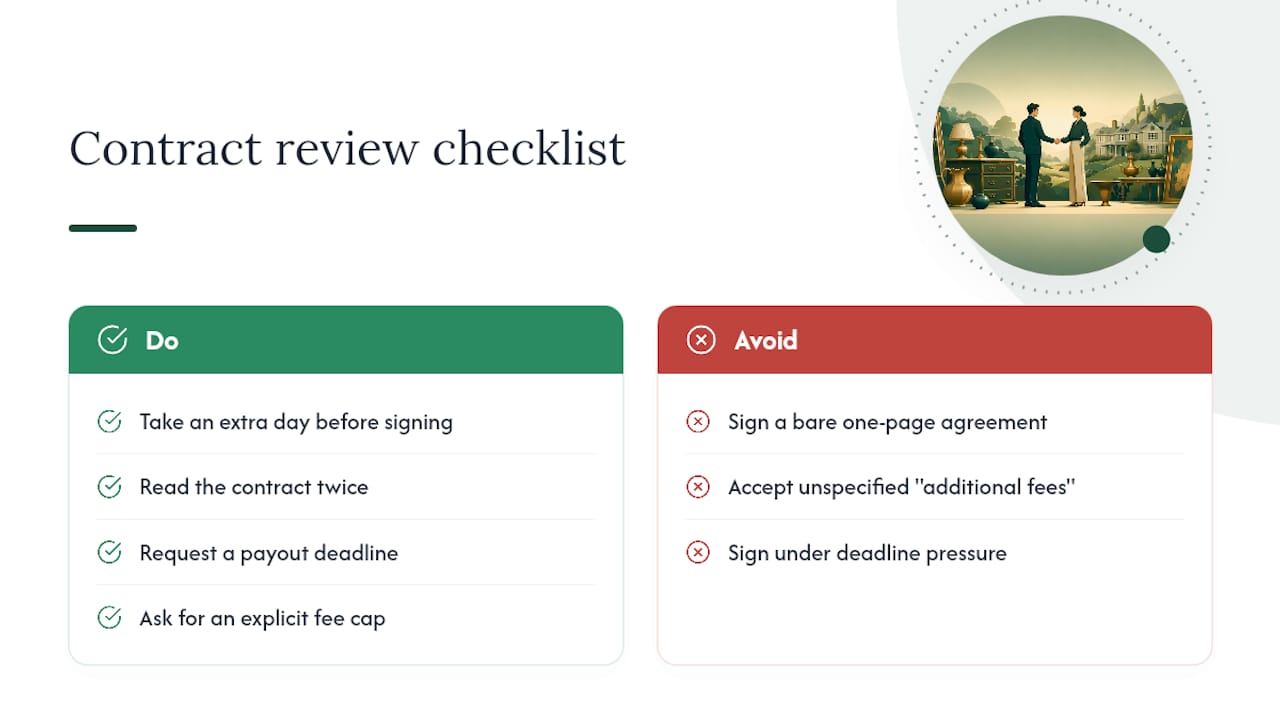
Negotiation outcomes tend to be modest and specific rather than dramatic. You're adding a payout deadline, a fee cap, and a carve-out for Mom's china. Those three changes solve most of the disputes I've seen play out.
The bigger issue is timing. Families sign these contracts during some of the worst weeks of their lives, often with a probate deadline breathing down their neck. That pressure is exactly when a vague clause slips through unnoticed. Take the extra day. Read it twice. Ask for the changes. A legitimate company will not walk away over a reasonable request for clarity.
— Derek
How Bereavementcleanoutservices Puts These Contract Protections Into Practice
Bereavementcleanoutservices is the practical alternative to piecing together a vendor relationship on a vague, one-page form. Every service, from cleanout to estate sale management, comes with the documentation and insurance backing this guide recommends you demand in writing.

The donation-first approach means unsold items go to local charities with proof of donation on file, not a mystery disposal fee added after the fact. Fully insured operations mean a certificate is available before work begins, not after you ask twice. Broom-clean handoffs come standard, with sorting and photographic documentation built into the process rather than billed as an extra. When you're ready to move forward, ask for a written agreement that spells out scope, fees, timeline, and disposition of unsold items exactly as outlined above, and request a sample contract before committing to anything. You can request a quote and review a sample agreement directly with Bereavementcleanoutservices to see how these terms look on paper before a single box gets packed.
Where to Verify Contract Terms and Templates
For a downloadable starting template, JotForm's estate sale contract covers standard sections like scope and dispute resolution. For probate-specific timing questions, a probate sale guide explains how estate sale schedules interact with court deadlines. Consult a local attorney for any clause involving unusual liability or high-value assets.
Sources
- Estate sale contracts: Key clauses and considerations | UpCounsel
- Understanding Estate Sale Contracts and Commissions | Fritz Realty Group
- Estate Sale Contract Template | JotForm PDF Templates
- All the Best Estate Sales — Updated contract (PDF)
- Typical estate sale commission: What companies charge | LegalClarity