
If you need to sell estate items online, you have two realistic paths: hire a full-service estate sale provider that photographs, lists, and settles everything for you, or run a seller-managed online auction yourself. Choose full-service if you're grieving, live out of state, or need probate-ready documentation. Choose seller-managed if you have time, lower-value items, and want to keep more of the proceeds.
- Full-service: commission is generally a significant portion of sales, with settlement usually occurring within days to a couple weeks after sale close
- Seller-managed: flat or capped fees (some platforms cap at 10%, up to $1,000), but you handle photos, buyer questions, and pickup logistics
- Next step: contact a full-service provider for a walkthrough, or start listing on a seller-managed auction platform today
Key Takeaways
Selling estate items online works best when you match the item's value and your available time to the right channel: full-service for volume and speed, seller-managed for control and lower fees.
| Point | Details |
|---|---|
| Match the route to your situation | Full-service suits time-constrained or grieving families; seller-managed suits patient, cost-conscious sellers. |
| Understand the fee structure | Full-service runs 30-40% commission; seller-managed platforms can cap fees near 10%, up to $1,000. |
| Sort before you shoot | Separate keepsakes from sellable inventory first, using a donation-first approach for anything that won't sell. |
| Prioritize high-demand categories | Designer furniture, jewelry, art, and collectibles sell fastest; skip mass-market or damaged goods. |
| Request documentation upfront | Ask any provider for a sample settlement statement and proof of insurance before signing. |
| Choose a full-service, donation-first provider | Bereavement Cleanout Services offers insured, broom-clean estate cleanouts with documented settlement statements across New Jersey. |
Table of Contents
- Best Ways to Sell Estate Items Online
- How Do You List and Sell Estate Items Step by Step?
- What Do Estate Sale Fees and Timelines Look Like?
- What Sells Well and What Doesn't at Estate Auctions
- Should You Hire a Full-Service Provider or Manage the Sale Yourself?
- Let Bereavement Cleanout Services Handle the Sale for You
- Frequently Asked Questions
- Sources
Best Ways to Sell Estate Items Online
Three models cover almost every estate situation, and picking the right one saves you weeks of frustration.
Full-service online estate sale companies handle everything: they walk through the home, photograph and catalog each item, write descriptions, list across marketplaces, manage buyer communication, schedule pickups, and cut you a check after the sale closes. Companies like ezDownsizing photograph, market, and settle within about a week of auction close, which matters when a probate deadline or a property closing is looming.
Seller-managed online auction platforms put you in the driver's seat. You upload photos, set reserve prices, and answer buyer messages yourself, but you keep more of the sale price. DIYAuctions structures this around a fee cap (10%, up to $1,000) and a single organized pickup day, which limits both your cost and your foot traffic.
Curated consignment and virtual marketplaces work best for individual high-value pieces. Chairish curates vintage and designer furniture listings and handles shipping logistics, while remote consignment services can list a piece while it stays in your home until it sells.
- High-volume estates with dozens of rooms: full-service
- One or two valuable furniture pieces: curated consignment
- Time-rich, cost-conscious sellers: seller-managed auction
How Do You List and Sell Estate Items Step by Step?
Whichever route you choose, the underlying workflow looks the same. Skip a step and you either leave money on the table or create headaches at settlement.
- Triage and sort first. Separate keepsakes from sellable inventory before anyone touches a camera. A donation-first sort, where usable but low-value items go to charity rather than the trash, keeps the process fast and respectful of what the family wants to keep.
- Photograph with intent. Shoot each item against a clean background, in natural light, from three or four angles. Note dimensions, condition, maker's marks, and any repairs. This is the same discipline real estate photographers use when handling listing photos after a sale closes, and it applies just as well to furniture and decor.
- Write honest, specific descriptions. "Mid-century walnut dresser, minor veneer chip on left drawer" sells faster than "vintage dresser, good condition."
- Decide on listing spread. Cross-listing to multiple channels (eBay, Etsy, Poshmark, Mercari) widens buyer reach; platforms like ResaleOS use AI-assisted cataloging to push one listing to several marketplaces at once, which helps move leftover items instead of hauling them to storage.
- Set reserves on higher-value pieces so nothing valuable sells for pennies in a slow week.
- Coordinate pickup or shipping. Bundle local pickups into one or two scheduled days; ship smaller valuables with tracking and insurance.
- Verify payment before releasing items, and expect the final settlement statement to itemize gross sales, commission, and any donation or disposal fees.
Pro Tip: Ask any provider for a sample settlement statement before you sign anything. If they hesitate to show you one, that's a red flag worth taking seriously.
What Do Estate Sale Fees and Timelines Look Like?
ezDownsizing reports delivering settlement within roughly a week of auction close, which is fast compared to a traditional in-person estate sale that can take a month to wind down.
Seller-managed platforms flip the cost structure. DIYAuctions caps its fee at 10%, up to a maximum of $1,000, which means a $15,000 estate sale costs the same in fees as a $10,000 one once you hit the cap. That predictability appeals to families liquidating larger estates who want to know their maximum cost up front.
- Full-service: commission is generally a significant portion of sales, with settlement typically occurring within days to two weeks
- Seller-managed: fee capped around 10% (up to $1,000), but you invest your own time
- Pickup-only sales limit buyer pool to local shoppers; shipping-enabled listings reach buyers nationwide but add packing costs
Shipping widens your buyer pool considerably, but it also adds packing material and carrier fees that eat into net proceeds on bulky items like furniture.
What Sells Well and What Doesn't at Estate Auctions
Buyers gravitate toward items with a story or a brand name behind them. Designer and mid-century furniture, vintage jewelry, authenticated art, and collectibles (coins, watches, signed memorabilia) consistently draw bids because they're scarce and easy to authenticate. Chairish built its entire model around this demand, curating only pieces likely to sell well to a verified buyer pool.
What usually doesn't move: mass-market furniture from big-box retailers, damaged small electronics, worn linens, and generic kitchenware. These items are better donated than listed, since photography and listing time cost more than they'd ever recoup.
- Sells well: designer furniture, vintage jewelry, collectibles, authenticated art, quality glassware
- Rarely sells: particleboard furniture, outdated electronics, stained textiles, chipped everyday dishware
- Check for maker's marks, hallmarks, and original packaging. These small details often double what a piece fetches
- Route high-value pieces to consignment, mid-value volume to an estate auction, and everything else to donation
Should You Hire a Full-Service Provider or Manage the Sale Yourself?
The decision usually comes down to four factors: how much time you have, how emotionally taxing the process feels, how much inventory you're dealing with, and whether you need documentation for probate or a landlord turnover.
- Assess your bandwidth. If you're grieving, out of state, or juggling a job and a probate deadline, full-service handles the heavy lifting.
- Ask about insurance and donation policy before signing with any provider. A reputable company should carry liability coverage and offer a documented donation-first process for items that don't sell.
- Request a sample settlement statement. You want to see exactly how commission, donation fees, and disposal costs get itemized before the sale even starts.
- Watch for red flags: vague fee structures, no proof of insurance, reluctance to provide references, or pressure to sign same-day.
Pro Tip: If you need documentation for probate court or a property manager, confirm in writing that the provider will supply itemized records. Verbal promises don't hold up in probate proceedings.
When you want broom-clean handoffs, insured operations, and a donation-first approach that respects what a family wants to keep, a full-service model built around exactly that fit is worth the commission.

A donation-first approach protects both memory and proceeds
Estate work is never just about moving furniture. Every keepsake carries weight, and families deserve a process that treats sorting through a parent's home with the same care as the sale itself. The most common mistake happens when families rush the triage step, boxing up sentimental items alongside sellable ones just to clear a deadline, then regretting it later.
The lesson from working alongside families through this process again and again: documentation matters as much as the sale price. A clear settlement statement and a photographed inventory protect everyone involved, especially when siblings or a probate court need to see exactly what happened to every item.
Let Bereavement Cleanout Services Handle the Sale for You
Bereavement Cleanout Services is the alternative to a do-it-yourself listing marathon for families across New Jersey who need estate items sold without adding another task to an already heavy week. Our process covers estate photography, online inventory, and donation-first sorting, so usable items go to local charities while keepsakes get set aside and documented before anything else moves.
A first call is a straightforward walkthrough. We assess the home, flag items with resale value, and give you a timeline, typically days rather than weeks, along with an itemized settlement statement once the sale closes. Every job is fully insured, and every handoff finishes broom-clean, which matters if you're coordinating with a realtor or a landlord on a tight turnover window. If you want documentation ready for probate and a team that treats the process with the same care your family would, start with a walkthrough through Bereavement Cleanout Services.
Frequently Asked Questions
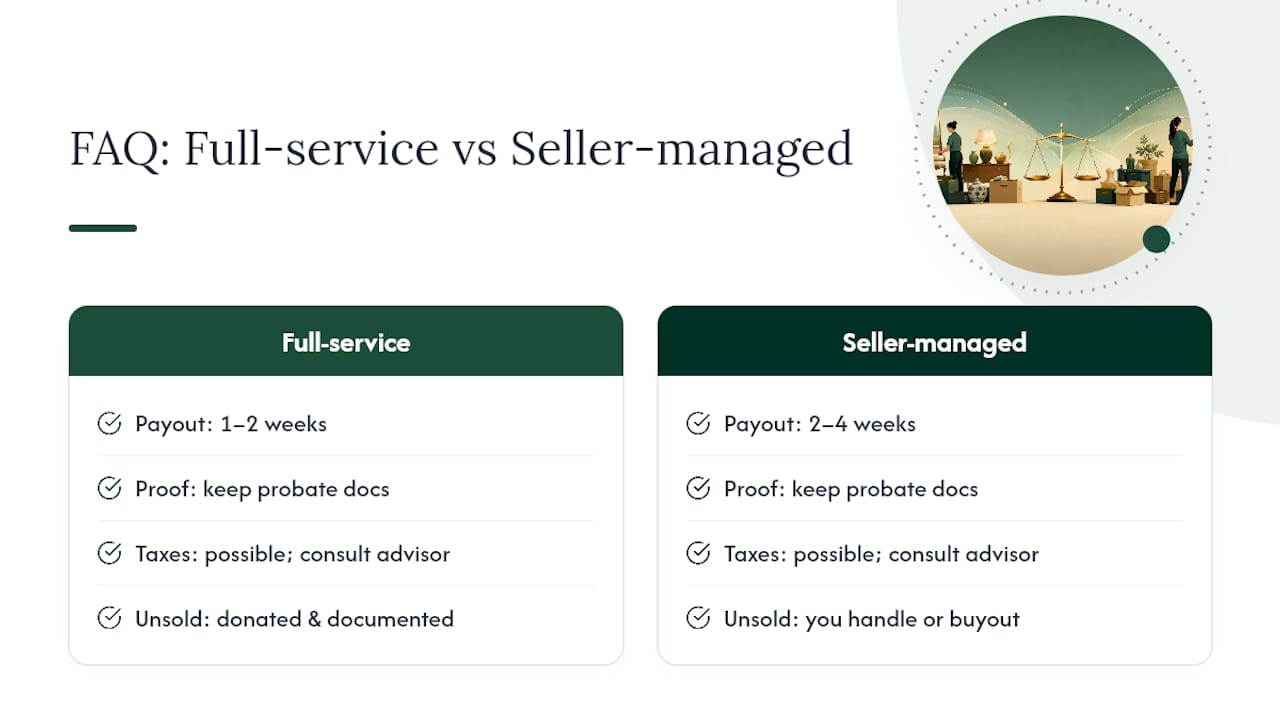
How long does it take to sell estate items online? Full-service providers often settle within a week or two of the sale closing, while seller-managed listings depend on how quickly you photograph, list, and respond to buyers, typically two to four weeks from start to payout.
Do I need proof of ownership to sell estate items? Yes. Executors and family members should keep a copy of the will, letters testamentary, or another probate document on hand, since some marketplaces and high-value buyers ask for proof of legal authority to sell.
Are proceeds from an estate sale taxable? Estate sale proceeds can have tax implications depending on the item's value and your state's rules; consult a tax professional or the estate's attorney before assuming otherwise.
What happens to items that don't sell? A donation-first provider routes unsold, usable items to local charities and documents the donation, while a seller-managed platform leaves disposal up to you unless the platform offers a leftover buyout option.
Can I combine a full-service sale with a seller-managed one? Some families use a full-service provider for the bulk of the home and consign one or two standout pieces separately through a curated marketplace to maximize the price on high-value items.
Sources
- DIYAuctions — Run Your Own Estate Sale
- ResaleOS — Estate Sale solutions
- Chairish — Consign with us
- ezDownsizing — Selling Estate Items / Online-Auction Estate Sale Services