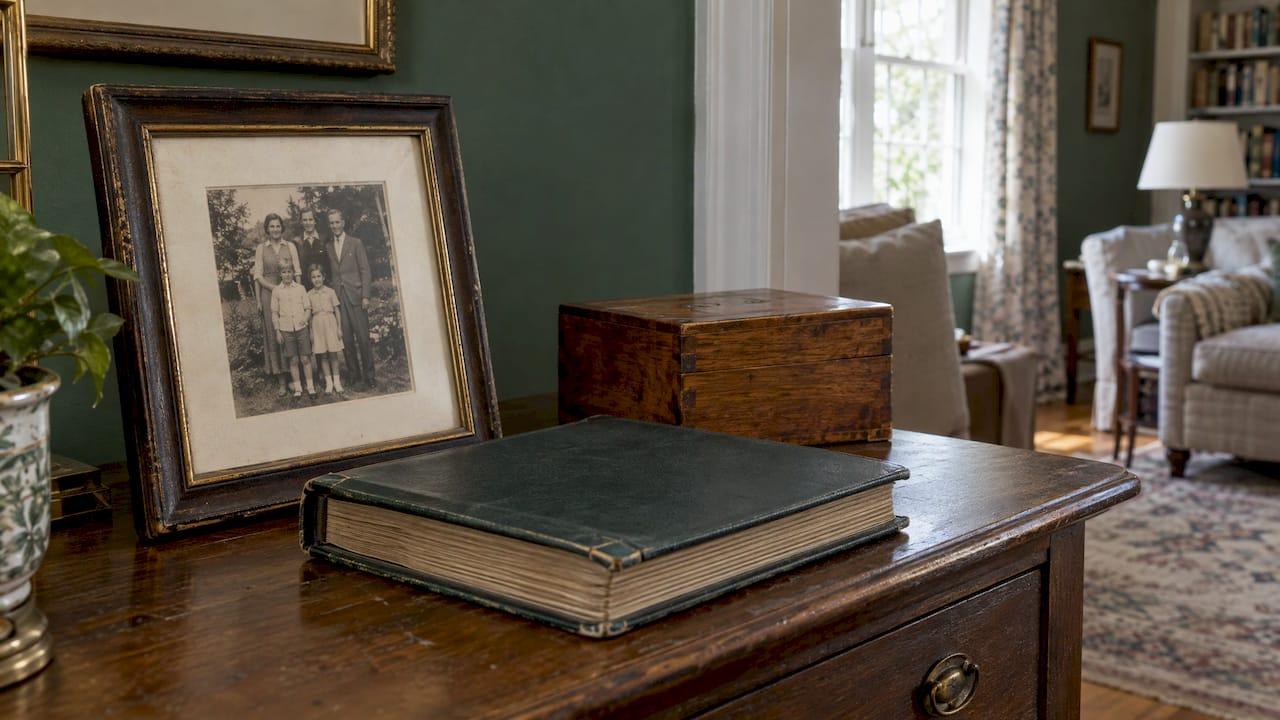
The best thing to do with a loved one's heirlooms is to slow down, find out who has legal authority over them, photograph and inventory everything, and only then decide what to keep, share, sell, donate or let go. Heirlooms are rarely the problem. The pressure of a house that must be emptied, and a family that grieves differently, is. A clear order of steps takes most of that pressure away.
This guide is for families managing an estate, and for the social workers, realtors, landlords and downsizing seniors who work alongside them. It covers the decisions in the order you will meet them.
TL;DR
- Confirm who has legal authority over the belongings before anything leaves the house. In most estates that is the executor or personal representative.
- Photograph and list every significant item first, then sort into keep, sell, donate and discard. Do the most sentimental rooms last.
- When several relatives want the same piece, use a fair method such as taking turns choosing, rather than arguing item by item.
- Value is not only money. Get an appraisal for anything that may be rare or valuable, and record the story behind each piece.
- Items you cannot keep can still have a good home: a family member, a museum or historical society, or a charity.
Table of Contents
- Start with who has the authority to decide
- Secure the house, then take an inventory
- Sort into four categories
- How to divide heirlooms fairly between relatives
- Work out what an heirloom is worth
- Preserve what you keep, and document what you cannot
- Good homes for heirlooms nobody can keep
- Our perspective on heirlooms
- How we help with the heirloom stage
- Common mistakes to avoid
- FAQ
- Sources
Start with who has the authority to decide
Before anyone takes a ring from a jewelry box, settle who is in charge. A will or living trust can leave specific items to specific people, and the executor or successor trustee is responsible for making sure those objects reach the named inheritors. If the will is silent or vague about belongings, the executor still has to follow the law of your state and keep the estate's property safe until it is distributed.
In practice, the first legal steps are to verify the will and file it with the probate court, obtain legal authority to manage and distribute assets, and work out which items are part of the probate estate and which pass directly to a named beneficiary. Probate is the court-supervised process of settling a person's estate. If you are unsure whether you may give away, sell or donate an item yet, ask the estate's attorney before you act. Our guide for executors on probate house cleanouts and authority before donations walks through what usually has to happen first.
There is a practical reason to wait. Once an item is gone, it cannot be undone, and a missing ring or watch is one of the quickest ways to start a family dispute.
Secure the house, then take an inventory
You do not need to decide anything on day one. You need to protect what is there. Funeral.com suggests a gentle sequence: secure the home, remove perishables, deal with medications and locate important paperwork, then sort everyday low-sentiment items, and leave photo albums, letters and heirlooms for last, once you have had time to process.
Then build the inventory. Keane Thomas & Pinnacoli recommend listing all significant belongings, including jewelry, antiques, collectibles, financial documents, insurance policies, family heirlooms and memorabilia, because a shared list prevents disputes later. Professional organizer Allie Shaw, quoted in Architectural Digest, suggests listing items of sentimental value (photo albums, heirlooms, documents) and items of monetary value (jewelry, china), going room by room and item by item.
A useful inventory has four things for every piece:
- A clear photo from more than one angle, plus any marks, signatures or labels.
- Where in the house it was found.
- Anything the family knows about it: who owned it, when, and why it mattered.
- A first guess at its category: keep, sell, donate or discard.
Write down the stories now. Who made the quilt, where the clock stood, which cousin always asked about the punch bowl. In a year, nobody will remember, and a documented story often decides whether an item is kept or passed on.
Sort into four categories
The simplest working system is the one most estate guides share: keep, sell, donate, discard. Here is how to apply it to heirlooms in particular.
| Category | What belongs here | Watch out for |
|---|---|---|
| Keep | Items a family member truly wants and will use, display or store properly | Keeping things out of guilt, and splitting up sets or collections |
| Sell | Items with real market value that nobody wants to keep | Selling before an appraisal on anything that might be rare |
| Donate | Usable household goods, and historic or collection-worthy items offered to a museum or society | Donating before the executor has authority, or before valuable items are identified |
| Discard | Damaged, unsafe or unusable items | Throwing out papers, photos or letters without a look |
Two habits keep sorting from turning into regret. First, work one room or one category at a time, so the work has an end. Second, start with low-emotion spaces. Funeral.com suggests a bathroom, pantry or linen closet as a place to build momentum before you open the bedroom closet.
If a decision stalls, use a holding box. Anything you cannot decide on goes in a labeled box, dated, to be reviewed after a set period. Our step-by-step guide to cleaning out a house after a death shows how to build that pause into the whole timeline.
How to divide heirlooms fairly between relatives
The hard part is not usually the expensive piece. It is the ordinary object that two people remember differently. Choose the method before you start, while everyone is calm.
Nolo describes three approaches a will can set up:
- Children take turns choosing items until each has roughly equal value.
- The executor decides who gets what.
- Two children who both want an object bid privately, with the winner paying the estate so that money passes under the will's terms.
Fidelity adds that for an item that cannot be split, the person who does not receive it can be given another sentimental item or a gift of similar value. It also points out that an impartial executor, even a non-family member, removes emotion from distribution because that person follows the document.
Some cautions that save relationships:
- Name tags and sticky notes are not binding. The University of Kentucky Extension notes that labeling items with names is likely not legally binding in court. Treat them as a record of wishes, then confirm them with the executor in writing.
- Share appraisals. Appraisals of antiques and jewelry should be made known to all beneficiaries, so nobody wonders later what was worth what.
- Do not break up collections. A set of letters, a photo archive or a matched service loses meaning when divided. The Maryland State Archives warns that dividing papers, correspondence or pictures among siblings destroys the continuity of the materials.
For a longer walk-through, including how to run a turn-taking round, see our guide to dividing a parent's belongings fairly among siblings.
Work out what an heirloom is worth
Two kinds of value are in play, and they often disagree. Family Tree Magazine explains that monetary value is the open-market fair market value, shaped by scarcity, condition and collectible popularity. Its example is a grandmother's crystal candy dish with a $500 value to the family but an appraised value of $80, which would also be the insurance value. Neither number is wrong. They answer different questions.
So what should you do?
- Decide what you are trying to learn: the insurance value, the resale price, or the value for a donation.
- For rare or potentially valuable pieces such as antiques, artwork or collectibles, Fidelity recommends hiring a professional appraiser.
- Hold on to paperwork. For a collectible like a luxury watch, records matter: watch service documentation is part of how condition and provenance, meaning the history of ownership, are understood.
- Check for anything that came with the item: receipts, boxes, letters, certificates.
If you plan to sell, get the value question settled first. Items that look ordinary, such as old costume jewelry, flatware or tools, sometimes turn out to be worth more than they seem, and sometimes the reverse. Once an appraisal is on paper, you can share it with every beneficiary, which is the best protection against suspicion.
If you think donating a high-value item may affect your taxes, speak to a tax professional or the estate's attorney before you give it away. Tax treatment depends on the item and your situation.
Preserve what you keep, and document what you cannot
Keeping an heirloom is only half the job. Storing it badly can ruin it. The National Museum of African American History and Culture's Family Treasures Toolkit gives five basic rules:
- Keep items out of bright or direct light, because fading cannot be reversed.
- Keep temperature steady and comfortable for a person, which means not in attics, near heaters or vents.
- Dust gently with a soft, lint-free cloth and avoid harsh cleansers.
- Keep storage areas clean and free of food to guard against insects.
- Avoid basements, plumbing areas and other damp places.
For photographs, the same toolkit says to store them flat in archival, acid-free folders, sleeves and boxes, and to avoid laminated albums, PVC sleeves, staples, tape and glue. The Conservation Center for Art & Historic Artifacts adds that digitizing photographs helps long-term preservation, and that you should prioritize faded or favorite prints if you cannot scan everything. Make a copy for display and keep the original in storage.
For things you cannot keep, a good photograph and a short written story is a respectful way to let go. It means the memory stays in the family even when the object does not. Many families are surprised by how much easier a decision is once the photo exists.
Good homes for heirlooms nobody can keep
When no relative has room or interest, you still have choices that honor the item.

A museum or historical society. The Family Treasures Toolkit suggests contacting local museums or heritage centers, using their online donation portals and learning their procedures. If an institution accepts a donation, you are no longer the owner. The Maryland State Archives guide says donors and institutions should know the appraised and market value and the provenance of the item, and that a gift with a tax deduction can be worth more than a sale, so consult a tax expert first. This route suits military uniforms, local business records, regional photographs and family papers tied to a place.
A younger relative. Grandchildren, nieces and nephews often value things their parents did not. Offering an item with its story attached works better than offering it with a deadline.
Sale. Pieces with real market value can fund the estate or be divided as cash. An on-site estate sale suits a house full of furniture, china and collectibles. Online listings suit individual higher-value pieces.
Donation to charity. Household goods with plenty of use left do the most good in a local charity's hands. This is the heart of a donation-first cleanout, where the usable items go to neighbors who need them rather than to a landfill.

Responsible disposal. Some things are broken, moldy or unsafe. Letting those go is not a betrayal of the person who owned them.
Our guide on what to do with leftovers after an estate sale shows how to sort what remains into donation-first buckets.
Our perspective on heirlooms
Families rarely come to us worried about the furniture. They come worried about the wedding ring, the recipe box, the Army jacket in the closet, and the fear of throwing out the one thing that mattered.
We built our process around that fear. Keepsakes are sorted first and set aside with care. Usable household goods go to local charities, which is why we are donation-first. And because probate often needs a paper trail, our work is documented, so an executor has a record of what was done with the home.
We also believe nobody should have to empty a house alone, in a hurry, while grieving. A walkthrough, a firm quote and a team that is fully insured and discreet lets the family stay focused on remembering, while the practical work gets done.
The best outcomes we see come from a simple rule: decide who has authority, protect the heirlooms, then clear the rest. In that order, the house gets emptied without the family getting divided.
Derek
How we help with the heirloom stage
If the volume of belongings is what is holding you back, we take that part off your hands. We sort with a donation-first approach, set aside keepsakes for the family, document our work for probate, and leave the property broom-clean. We are fully insured and work across New Jersey.
We can also photograph the contents and build an online inventory at $75 per hour, which gives every sibling the same view of what is in the house. A single room, garage or basement cleanout starts at $295, and a full house cleanout starts at $1,200. Estate sales run at 15 to 35% and online consignment at 20 to 40%. See our cleanout services and pricing or check our New Jersey service areas to request a walkthrough. If you are boxing items for a move to a relative's home or assisted living, our guide to packing a loved one's home covers the careful way to do it.
Common mistakes to avoid
- Clearing before the will is found. Check files, safes and with the family attorney first. Our guide on finding the will and donating first covers it.
- Deciding in the first week. Grief makes quick choices feel urgent. Secure the home and wait.
- Assuming a verbal promise settles it. Memory differs, and notes are not binding. Write it down and share it.
- Splitting sets and archives. A photo collection divided among five people is a collection lost.
- Storing in the attic or basement. Heat and damp are the biggest threats to paper, textiles and photos.
- Skipping the photographs. Photograph first, so every decision can be revisited and shared.
For a full order of operations, our estate cleanout checklist shows when to wait for probate and when to move.
FAQ
What counts as a family heirloom?
An heirloom is an item valued for the stories and memories it carries, not just its age or price. It can be jewelry, furniture, art, a quilt, a set of letters or a tool. Legal commentary describes heirlooms as items whose meaning goes beyond rarity, which is why a modest object can matter more to a family than a valuable one.
Who decides what happens to a deceased person's heirlooms?
The will or trust decides first, and the executor or successor trustee carries it out. If the documents do not address an item, the executor generally manages it under state law and the court's direction. Check with the estate's attorney before giving anything away.
What if siblings cannot agree on who gets an heirloom?
Use a neutral method: take turns choosing, offer an alternative gift of similar value, or let an impartial executor decide. A private bid, with the payment going to the estate, can also settle a tie. Agree on the method before choosing begins, and share any appraisals with everyone.
Should I get an heirloom appraised before donating or selling it?
For items that may be rare, such as antiques, artwork, collectible watches or fine jewelry, yes. An appraisal tells you the market value, which matters for insurance, fair division and any tax treatment. Speak to a tax professional before claiming a deduction for a donation.
What if I am overwhelmed and cannot handle the whole house?
Start with a single room or ask for help with the heavy work while you keep control of the keepsakes. Our team can sort, set aside what the family wants, donate what is usable and document the work. Our respectful house cleanout guide explains what that looks like.
Sources
- Leaving Items of Sentimental Value, Nolo
- Decluttering after a Loved One's Death, Keane Thomas & Pinnacoli
- Sorting a Loved One's Belongings, Funeral.com
- Death Cleaning, Architectural Digest
- Estate Planning for Heirlooms, Fidelity
- Transferring Cherished Possessions: Who Gets What?, University of Kentucky Extension
- A Basic How-to from Storage to Donation, Maryland State Archives
- How to Organize Your Family Keepsakes and Collections, Family Tree Magazine
- Family Treasures Toolkit, NMAAHC
- Caring for Family Treasures, Conservation Center for Art & Historic Artifacts
- Understanding the Role of Heirlooms and Personal Belongings in Inheritance Cases
- The Role of Watch Service Documentation for Collectors