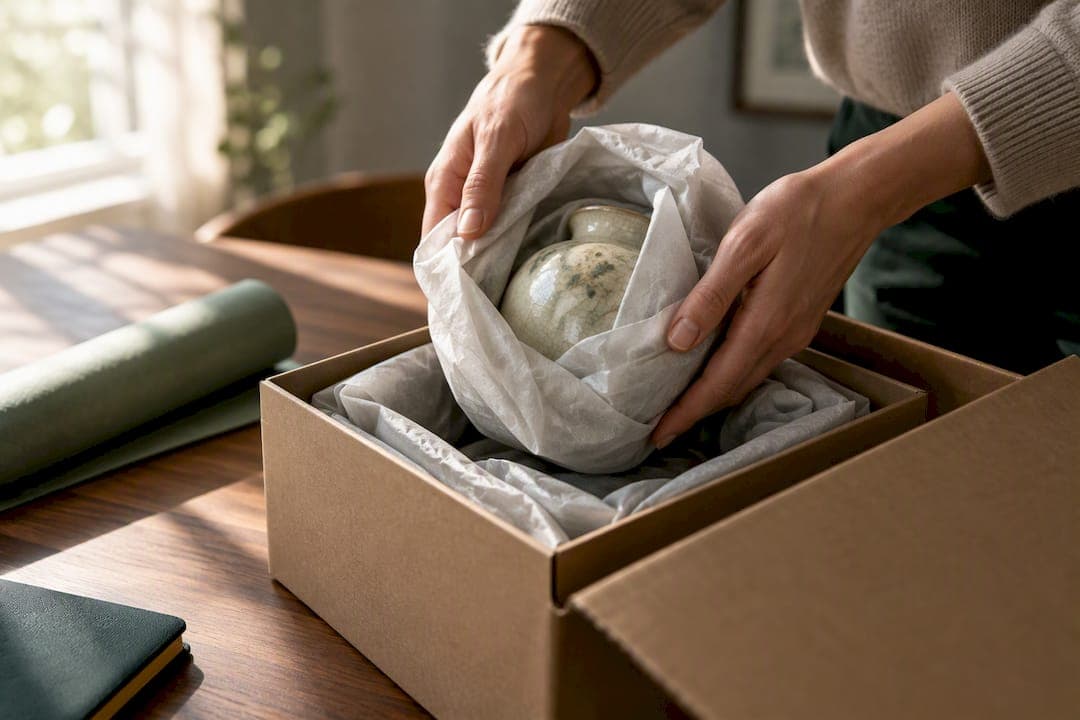
The quickest way to keep a fragile heirloom safe in transit is to immobilize and support it inside a correctly sized, rigid container, and to document its condition before you pack a single item. In the next hour, photograph and record each piece, separate the highest-risk objects for special handling, and decide which pieces need double-boxing or a custom crate rather than a standard carton. A porcelain figurine, a framed mirror, or a stack of family photographs each calls for its own approach.
TL;DR:
- Use double-walled boxes and custom internal supports to prevent shifting and absorb shocks, especially for structurally weak or valuable heirlooms.
- Photograph and record detailed condition notes before packing to establish a damage baseline and support insurance claims if needed.
- Wrap fragile objects to cushion their weakest points, and employ object-specific supports like foam cutouts or internal braces rather than relying solely on padding.
- For high-value or irregularly shaped items, consider professional crating with rigid shells, custom supports, and in some cases, hiring conservators instead of DIY packing.
- Labels such as "fragile" do not guarantee careful handling; proper packing and quality materials are crucial to prevent damage during transit.
Table of Contents
- Before you pack: inventory, photos, and risk triage
- Materials, boxes, and basic packing principles that actually protect heirlooms
- How to pack common heirloom categories: china, glass, and beyond
- When to crate or hire a professional packer versus DIY packing
- Labeling, carrier realities, insurance, and claims
- Unpacking, inspection, and what to do if damage is found
- Practitioner perspective: why museum packing logic matters for heirlooms
- How Bereavement Cleanout Services can help with packing and crating
- Sources
- FAQ
Before you pack: inventory, photos, and risk triage
Every well-packed heirloom starts with a record of what it looked like before anyone touched it. Photograph each item from several angles, including close-ups of any existing chips, cracks, loose joints, or discoloration, and keep those images with your shipment paperwork. This step matters because it establishes a baseline. If a plate arrives with a hairline crack that was already there, your photos prove it, and if new damage appears, the comparison is immediate rather than a matter of memory. Collection-care guidance from institutions that move objects professionally treats this documentation step as non-negotiable for anything of value, and the same logic applies at kitchen-table scale.
Alongside the photos, write down what you know about each piece. This does not need to be formal, but it should be thorough enough that someone else, a family member, an appraiser, or an insurer, could understand the object without seeing it in person.
- Provenance or family history, even a one-line note like "grandmother's wedding china, 1958."
- Dimensions, weight, and any maker's marks, signatures, or serial numbers.
- Current condition, noted honestly rather than optimistically.
- A rough estimate of value, based on comparable sales or a prior appraisal if one exists.
Once you have photos and notes for everything, sort the items into three groups. The first is what you carry yourself, in your car or on your person: small, irreplaceable, or fragile-beyond-reason items like a grandmother's ring, a single Fabergé-style egg, or a fragile daguerreotype. The second is what gets packed and shipped or moved by truck using the methods in the next two sections. The third is what likely needs a professional's eyes before anyone touches it: a large gilded mirror with a compromised frame, a marble-topped table with hairline cracks, or anything a family member already suspects is structurally unstable. If you are unsure which category an item belongs in, treat it as though it belongs in the third group until you know otherwise. For readers still deciding what to keep at all during a move or downsizing, a room-by-room approach to prioritizing heirlooms can make the sorting process less overwhelming before packing even begins. If your inventory needs to hold up for probate or estate purposes, a documented photo inventory with proper metadata is worth setting up before the first box is taped shut.
Materials, boxes, and basic packing principles that actually protect heirlooms
Most damage to fragile heirlooms happens not because the item was hit, but because it shifted inside a box that was too big, too weak, or cushioned with the wrong material. Getting the box and the fill right solves most of the problem before you even touch the object.
Start with the box itself. Standard single-wall cartons flex under stacking weight, which transmits pressure straight to whatever is inside. For anything genuinely fragile, use sturdy double-walled boxes, which resist crushing far better when other boxes are stacked on top during a move or in a truck. For framed art or mirrors, a corrugated mirror box, sized specifically for flat, glazed items, gives you a rigid shell built for that shape rather than a general-purpose carton pressed into service. Sizing matters as much as strength: leave roughly two to three inches of clearance on every side of the object so there is room for cushioning without the item touching the box walls directly.
Cushioning choice is where a lot of well-intentioned packing goes wrong. Crumpled newspaper or packing paper alone can leave voids, and as it settles during transit, an item that was snug at the start of the trip can end up loose by the end. Conservation-informed packing favors materials that hold their shape and support the object rather than just filling space around it.
- Ethafoam and Volara are closed-cell foams used in museum transit for shaped, cushioned supports that cradle an object at its strongest points.
- Corrugated dividers create individual compartments for stemware, ornaments, or small ceramics so pieces never touch each other.
- Foam-in-place kits work for oddly shaped items but should be tested on a small scale first, since expanding foam generates heat and pressure as it cures.
- Packing paper is fine for wrapping and light gap-filling, but it should never be the only thing standing between two hard surfaces.
Pro Tip: Wrap fragile items so the wrapping cushions the object's weakest point, a rim, a handle, a seam, rather than wrapping it uniformly and hoping for the best.
Double-boxing, packing a wrapped and cushioned item inside a smaller box, then placing that box inside a larger one with two to three inches of cushioning on every side, is one of the most reliable ways to protect anything with real sentimental or monetary value. This method works because it creates two layers of shock absorption instead of one, and it is the approach museums and shippers use for their highest-value pieces, a method reflected in one client's own $200 crating approach for china and crystal. For items with structural weak points, hairline cracks, loose joints, thin necks on vases, a rigid internal brace or a shaped foam cutout that matches the object's exact form does more good than a thicker layer of generic padding. Museum collection-care literature notes that adding more loose padding can actually create pressure points rather than removing them, since soft fill can bunch unevenly around fragile edges. Object-specific support, not just more cushioning, is what prevents cracks from spreading during a bumpy ride.
How to pack common heirloom categories: china, glass, and beyond
Different heirlooms fail in different ways, so the packing method has to match the object, not just its fragility rating.
Plates and flat china should never nest flat, since the weight of a stack concentrates pressure at the center of the bottom plate. Instead:
- Wrap each plate individually in packing paper, then a layer of bubble wrap, securing the wrap without taping directly to the surface.
- Stand plates on their edges inside a divided box, similar to how records are stored, rather than laying them flat.
- Add a cardboard divider or extra padding between each plate so they never touch.
- Limit stacking or nesting groups to two or three bowls with paper between each, and provide at least about 5 centimeters of cushioning at the base of the box before the first item goes in.
- Fill any remaining gaps at the top of the box with crumpled paper so nothing shifts when the box is lifted or tipped.
Stemware and glassware need individual attention because the stem and rim are the weakest points on almost every piece. Wrap each glass separately, stuffing the interior lightly with paper to prevent the walls from collapsing inward under pressure, then wrap the exterior and place each piece in its own compartment within a divider insert. Heavier glassware goes on the bottom of the box, with lighter or more delicate pieces layered above, and weight should be distributed evenly rather than piled to one side.
Vases and ceramics often have hollow interiors and irregular shapes that make them harder to stabilize than flat items. Stuff the hollow center loosely with acid-free tissue or packing paper to support the walls from the inside, then wrap the exterior in bubble wrap, paying particular attention to the neck, handles, and any protruding details. Oversized or unusually shaped vases generally do better packed alone in a properly sized box rather than sharing space with other items, since irregular shapes are hard to cushion evenly when packed alongside something else.
Framed art and mirrors carry a specific risk: the glass. For anything glazed, decide first whether to remove the glass entirely, wrapping it separately with cardboard on both sides, or to leave it in place and rely on foam corner protectors at all four corners plus a strip of tape in a star pattern across the glass to control shattering if it breaks. A suitable double-walled or corrugated mirror box, sized to the frame's dimensions, gives flat glazed pieces the rigid protection they need during a move. Apply a backing board if the frame does not already have one, and avoid nailing or stapling into an old or weakened frame, since that can loosen joints that are already under stress. Check the frame's structural soundness before you do anything else. A frame with a cracked corner or a warped edge needs bracing or crating rather than a standard box, an approach reflected in museum transit handbooks that call for rigid crates with shaped internal supports for anything with real value or fragility.
Photographs and paper documents need a different kind of protection than ceramics or glass, since the enemy here is chemical degradation as much as physical damage. The Library of Congress recommends storing photographs in enclosures that meet the ISO 18902 or Photographic Activity Test standard, and specifically warns against PVC-based sleeves, adhesives, and other unstable materials that can react with the image over time. In practice, that means using PAT-compliant sleeves or folders, placing photographs on rigid backing board so they cannot bend inside the box, and keeping negatives separate from prints rather than stacking them together. Marketing language like "archival" on a product label is not a reliable guarantee. ISO and PAT compliance is the standard worth checking for. If you are unearthing boxes of old family photos during a move or cleanout, there is specific guidance on sorting and handling paper keepsakes safely that pairs well with the archival standards above. If you plan to digitize photos before storing or shipping the originals, matching your scanning batch method to the volume of photos you're working through can save considerable time.

Textiles, quilts, lace, embroidered linens, should be rolled rather than folded whenever possible, since folds create permanent creases and stress lines over time. Roll around an acid-free tube with the right side facing out for most textiles, then wrap the roll in unbleached muslin or acid-free tissue.
Furniture, especially antique pieces with joinery, veneer, or delicate legs, often benefits from partial disassembly before a move. Removable legs, shelves, or doors should come off and be wrapped separately, with all hardware bagged and labeled. Pad every joint and corner, and block any moving parts, drawers, doors, so they cannot swing or slide during transport.
When to crate or hire a professional packer versus DIY packing
Not every heirloom belongs in a cardboard box, no matter how carefully you wrap it. Some objects are valuable, structurally compromised, or awkwardly shaped enough that a custom crate or a professional packer is the safer bet, even at added cost.
Run through a short checklist before deciding:
- Is the item worth more than a few hundred dollars, either financially or in what it would cost to have restored if damaged?
- Does it have existing cracks, loose joints, or structural weaknesses that a standard box cannot accommodate?
- Is it an odd shape, oversized, or does it require a shipping method with limited handling control, such as a common carrier?
- Does your homeowner's or renter's insurance, or a third-party transit policy, require professional packing for a claim to be valid?
If you answered yes to two or more of these, a custom crate is worth the investment. Professional crating typically means a rigid outer shell built to the object's exact dimensions, shaped internal supports carved or cut from conservation-grade foam like Ethafoam or Volara, and controlled clearances that immobilize the object rather than letting it float in loose fill. The cost of crating scales with the size and complexity of the piece, since a simple rectangular crate for a small mirror costs far less than a shaped case for an irregular marble sculpture.
Pro Tip: Before hiring any pack-and-ship or white-glove service, ask what documentation they provide, condition photos, packing material lists, and a signed inventory, since this paperwork is what supports an insurance claim if something goes wrong.
When vetting a service, ask directly what materials they use, whether they photograph the item before and after packing, and whether their crates are built to the object's specific shape or assembled from stock parts. A service that cannot answer these questions clearly is probably not equipped for genuinely fragile or valuable heirlooms.
Labeling, carrier realities, insurance, and claims
Writing "fragile" on a box feels like it should help, but it carries less weight than most people assume. The United States Postal Service discontinued its Special Handling-Fragile service in June 2022 after finding that the designation did not reliably change how packages moved through sorting and distribution. The practical takeaway is that labels alone do not protect a package. The box itself has to be built to survive ordinary handling, including drops, stacking, and machine sorting, without relying on anyone reading and respecting a sticker.
Insurance is the other piece of the puzzle. You generally have two options: declared value coverage through the carrier itself, or a third-party transit insurance policy, which often covers a broader range of circumstances and can offer higher coverage limits for genuinely valuable items. Whichever you choose, keep the following on hand:
- Your pre-shipment photos and written inventory from the documentation step.
- Receipts, appraisals, or prior insurance valuations that establish the item's worth.
- A photo of the fully packed box, sealed and labeled, before it leaves your hands.
- Copies of the shipping receipt and tracking information.
Photographing the finished package matters more than people expect. If a claim ever comes down to a dispute about whether the item was packed adequately, that single photo can be the difference between a paid claim and a denied one. Keep your packing materials, too, at least until the item has arrived safely, since a carrier investigating a damage claim may want to inspect how something was cushioned.
Unpacking, inspection, and what to do if damage is found
Resist the urge to pull an heirloom straight out of the box the moment it arrives. Photograph the outside of the package first, including any visible dents, tears, or crushed corners, then photograph the inside as you open it, before moving the item at all.
- Compare the item's current condition against your pre-shipment photos, checking every angle you originally documented.
- If damage is present, photograph it immediately, keep all packing materials exactly as they were, and contact the carrier to begin a claim within their stated timeline, since most carriers set strict windows for reporting damage.
- For anything beyond cosmetic damage, especially structural cracks in ceramics, torn canvas, or warped frames, stabilize the piece by keeping it flat or supported and contact a conservator before attempting any repair yourself.
Common pitfalls include waiting too long to report damage, discarding packaging before a claim is resolved, and attempting a repair that a carrier or insurer later treats as evidence you altered the item.
Practitioner perspective: why museum packing logic matters for heirlooms
Most packing advice focuses on cushioning, more bubble wrap, more paper, more foam. Museum practice inverts that priority. Immobilize first, then cushion. An object that cannot move inside its container will survive far more handling than one that is merely surrounded by soft material, because movement, not impact alone, is what causes most cracks and chips during transit. That single change in sequence, support before padding, is the biggest gap between how most families pack and how professionals do.

The second lesson is that generic padding has limits. A shaped foam cutout or an internal brace built for a specific object's weak points outperforms a thick layer of bubble wrap every time, especially for anything with a crack, a loose joint, or an oddly distributed weight. Families often over-pad the strong parts of an object and under-support the weak ones.
The third is knowing when to stop trying to save money on a box. If an item is worth crating, the cost of a professional quote is almost always smaller than the cost of restoration, or the cost of losing something that cannot be replaced at any price.
— Derek
How Bereavement Cleanout Services can help with packing and crating
Packing a house full of heirlooms while managing an estate, a move, or a loved one's belongings is a lot to carry alone, and getting it wrong on a piece that cannot be replaced is a risk most families would rather not take. A professional packing service is available, typically charged by the hour, which follows a documentation-first approach: photographing items, recording their condition, and packing fragile pieces with materials and methods designed to prevent damage during transit.
A typical booking starts with an onsite assessment, where we look at what needs to travel, what needs crating, and what can be safely boxed with standard materials. From there, we build a documented inventory, often paired with an estate photography and inventory service charged by the hour, so families have a photo and written record of every piece before it's touched. For items that need it, packing and crating are handled with the same object-specific approach described earlier: rigid boxes, proper clearance, and support built around each item's actual weak points rather than generic padding.
- Packing service for fragile china, glassware, framed art, and collectibles, priced per hour per packer.
- Estate photography and online inventory to document condition and provenance before anything moves.
- Full house, apartment, or large estate cleanout services for families managing an entire property, not just a few boxes.
If a piece is genuinely rare, extremely high in value, or already structurally compromised, an independent conservator may be the better call for that specific item. For everything else, from a full china cabinet to a house full of packed boxes, request a quote through our site and we'll walk you through what a documented, carefully packed move actually looks like.
Sources
For photographs and paper documents, the Library of Congress's photo care guidance lays out the ISO 18902 and PAT standards that determine which enclosures are actually safe for long-term storage. For understanding why a "fragile" label no longer guarantees special handling, the Federal Register notice on USPS's 2022 rule change explains the reasoning behind the discontinuation. For object-specific risk assessment and crating logic, the UNESCO and Smithsonian handling-in-storage guidance and the Smithsonian's Art in Transit handbook cover documentation, crating, and transit practices used for museum-grade objects.
- Care, handling and storage of photographs - Library of Congress
- Federal Register: USPS Special Handling—Fragile discontinuation
- Handling of collections in storage (UNESCO / Smithsonian guidance)
- Art in Transit handbook (Smithsonian) - packing and transport
FAQ
What is the best way to pack fragile items?
Immobilize the item inside a correctly sized box using shaped cushioning like foam or dividers, leaving two to three inches of clearance filled with support material so nothing can shift. Document the item's condition with photos before you start packing, and use a rigid outer box, double-walled where possible, since a container that flexes under stacking weight transfers pressure directly to whatever is inside.
What is the best packaging for delicate items?
Double-walled boxes paired with shaped, closed-cell foams like Ethafoam or Volara offer the most reliable protection, since they resist crushing and immobilize the object rather than just filling space around it. For photographs and paper, enclosures that meet the ISO 18902 or PAT standard are the safest choice, since ordinary plastic sleeves can chemically damage images over time.
Will UPS pack fragile items for you?
Some shipping and pack-and-ship locations offer professional packing services for an additional fee, though policies and pricing vary by location. If you are shipping something of real value or fragility, ask specifically what materials and methods they use, and consider a custom crate for anything with existing structural weaknesses.
Should I write "fragile" on my package?
A "fragile" label does not guarantee special handling. The United States Postal Service discontinued its Special Handling-Fragile designation in 2022 after finding it did not reliably change how packages were handled during sorting and transit. The label doesn't hurt, but the box's construction and internal cushioning are what actually protect the item.