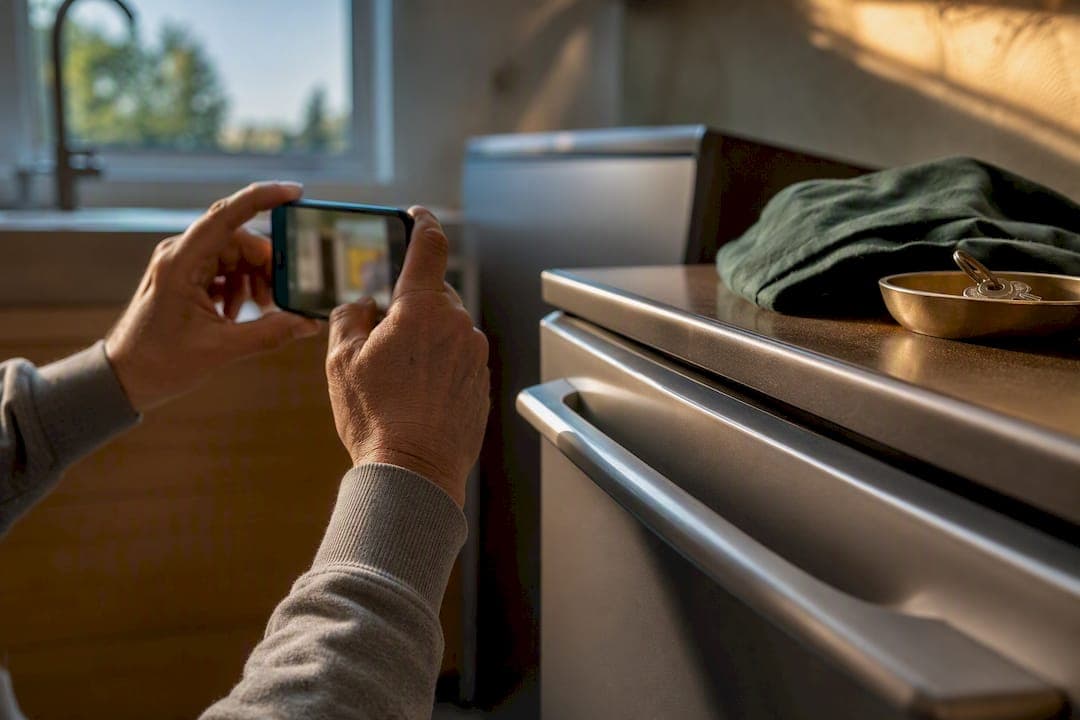
Your fastest realistic path is local pickup through a classifieds app for most working appliances, a used-appliance dealer or consignment shop for large or built-in units, and an auction for premium brands or full estate lots. Anything broken or unwanted goes to donation or scrap. Before you list anything, inspect the unit, snap photos, record the model and serial number, and check CPSC.gov for open recalls. Most buyers expect to pick up, but offering delivery for a fee often earns a higher price.
TL;DR:
- Most working appliances sell quickly through local classifieds and apps, especially with delivery options, but buyers expect to pick up in person.
- Large or built-in units are better sold through dealers or consignment shops, which may pay less upfront but handle logistics and estate deadlines more efficiently.
- Auction sales are ideal for estate lots or premium brands, often yielding higher final prices due to competitive bidding, especially with capped commissions.
- Nonfunctional appliances should be recycled, sold for scrap, or donated, with reuse options limited by size, condition, and refrigerant disposal laws.
- Proper preparation, including testing, cleaning, photographing, and documenting appliances, significantly boosts resale value and reduces buyer disputes.
Table of Contents
- Where to Sell Estate Appliances: Matching the Channel to the Item
- How Do You Prepare an Appliance Before Listing It?
- Pricing and Valuation: What's This Appliance Actually Worth?
- Logistics, Pickup, and Staying Safe During the Handoff
- Donate, Recycle, or Scrap: What to Do With What Won't Sell
- Estate-Specific Appliance Sales: When to DIY and When to Call a Pro
- What I'd Tell a Family Doing This for the First Time
- Need Hands-Off Help Selling or Clearing Estate Appliances?
- Where to Check Prices, Schedule Donations, and Plan Shipping
- Sources
- FAQ
Where to Sell Estate Appliances: Matching the Channel to the Item
The channel you pick matters more than almost any other decision you'll make when you sell estate appliances. A washer that sits for three weeks on the wrong platform often sells for less than it would have on day one somewhere else. Here's how to sort your options.
Local classifieds and apps work best for standard appliances in working condition, things like refrigerators, dryers, dishwashers, and window units that don't need special handling. Facebook Marketplace, Craigslist, and OfferUp charge no listing fees and put you directly in touch with buyers close enough to pick up the same day. The tradeoff is you handle every message, every negotiation, and every no-show yourself.
Used-appliance dealers and consignment shops make sense when you want a hands-off transaction, or when you're dealing with a large or built-in unit that's genuinely hard to move. Dealers who specialize in appliances often buy outright at a discount to retail, or they'll take an item on consignment and split the proceeds once it sells. Consignment usually nets more than an outright sale, but it takes longer and you don't get paid until a buyer shows up. For a family managing an estate on a deadline, a straight cash offer from a local dealer can be worth the lower price just to close the loop.
Auctions and estate-lot sales shine when you've got multiple appliances to move at once, or when you're dealing with a premium brand set (think Sub-Zero, Miele, or Wolf) that draws serious bidders. Competitive bidding at an auction can drive final prices higher than a fixed-price listing, particularly for estate lots where buyers are hunting for a deal on several items in one trip. Auction platforms that cap their commission percentage let you keep more of the final sale price than a full-service estate sale company would, which matters if margins are thin.
Online shipping platforms, eBay chief among them, work only for small, high-value pieces. A stand mixer, an espresso machine, or a vintage toaster oven can justify the box and the shipping label. A refrigerator cannot. Shipping heavy appliances is genuinely expensive, and freight costs can run into the hundreds of dollars, which eats into or erases your profit on anything bulky. Reserve eBay for countertop appliances and small specialty units, and stick to local pickup for anything that needs two people to lift.
Scrap and parts routes are your answer when the unit doesn't work and isn't worth repairing. Scrap metal yards pay by weight for the steel and copper inside old appliances, and some parts resellers will buy specific components (compressors, motors, control boards) even from a dead machine. It won't make you rich, but it beats paying a disposal fee.
A quick way to think through your options:
- Fast, no fees, general appliances: local classifieds and marketplace apps
- Hands-off, large or built-in units: used-appliance dealer or consignment
- Multiple items or premium brands: auction or estate-lot sale
- Small, high-value pieces: eBay or another shipping-capable platform
- Nonworking units: scrap yard or parts buyer
If you're managing an entire household of items rather than a single appliance, it's worth reading about how to sell estate items online and comparing a full-service approach against managing the listings yourself.
How Do You Prepare an Appliance Before Listing It?
Preparation is where most of your resale value gets made or lost. A buyer who sees a clean, well-photographed, clearly tested appliance pays with confidence. A buyer who sees a dusty unit with no model number and a vague description negotiates hard, or walks away entirely.
- Unplug and stabilize the unit. For refrigerators and freezers, defrost fully and let them sit unplugged for at least 24 hours before moving. Drain any water lines on dishwashers, washers, or ice makers to prevent leaks during transport.
- Test every function and record it. Run the dishwasher through a cycle, spin the dryer, cycle the fridge compressor, and film short videos of each function working. Note any faults honestly, a squeaky belt or a slow-draining tub matters less if you disclose it upfront.
- Find and record the model and serial number. These are usually on a sticker inside the door frame, on the back panel, or under the lid. Write down the manufacture date too, since it directly affects resale value.
- Check CPSC.gov for open recalls tied to that model number. A recalled appliance can still be sold in most cases, but you need to disclose it, and some buyers will walk away rather than deal with it.
- Deep-clean based on appliance type. Wipe down gaskets and interior walls on refrigerators, run a cleaning cycle on washers and dishwashers, and vacuum coils on the back of fridges and behind dryers.
- Photograph in this order: full front view, interior, serial tag close-up, any cosmetic flaws, and the appliance in its current location, including the path a buyer would need to move it through (stairs, narrow hallways, tight doorframes). Photographing the appliance in its actual setting prevents the kind of last-minute surprise that kills a sale after the buyer already drove over.
- Write an honest, specific listing. Include exact dimensions, a rough weight estimate, the model number, age, condition notes, and whether you expect the buyer to arrange pickup or if delivery is available for a fee.
Pro Tip: Keep the video files even after the sale closes. If a buyer disputes the condition after pickup, a dated test video showing the appliance running normally is your best evidence that it left your possession in working order.
Pricing and Valuation: What's This Appliance Actually Worth?
Search completed sales, not active listings, and use those numbers as your anchor. Anyone can list a ten-year-old dryer for $400. What matters is what buyers actually paid for that exact model recently, and eBay's sold-listings filter (search the model number, then filter by "sold items") is the closest thing to a real answer you'll find without hiring an appraiser.
As a starting rule of thumb, premium appliance brands hold a meaningfully higher percentage of their original retail price than mid-range or commodity brands at the same age. A five-year-old Sub-Zero refrigerator and a five-year-old builder-grade fridge from a big-box retailer will not depreciate at the same rate, even if they looked similar new. Age matters too: appliances lose value fastest in the first three years, then depreciation slows as the item settles into whatever "used but functional" price the market assigns it.
If you want a fast directional number before you dig into sold listings, instant appliance value checkers can estimate a price range from live listings and photos. Treat that estimate as a starting point, not a final answer. Cross-check it against actual completed sales before you commit to a listing price.
A few practical adjustments to make once you have a baseline number:
- Add a premium for delivery. If you're willing to load and drop off the appliance yourself, you can often price 10 to 15% higher than an equivalent pickup-only listing.
- Subtract for removal effort. If the appliance is in a basement, up a flight of stairs, or behind a tight doorway, price it lower or expect longer time on the market.
- Consider an auction start price carefully. A low starting bid with no reserve tends to draw more early interest and can spark competitive bidding that pushes the final price above a comparable fixed listing, especially for estate lots with multiple desirable pieces.
- Sell attachments separately when it makes sense. Stand-mixer bowls and beaters, vacuum attachments, and other accessories frequently sell for more combined when listed apart from the base unit rather than bundled in.
- Bundle only true matched sets. A washer and dryer from the same brand and era sell faster as a pair than as two separate listings, since buyers replacing a laundry setup usually want both at once.
Logistics, Pickup, and Staying Safe During the Handoff
Set the rules before a buyer ever messages you, not after they show up with a truck that's too small.
- Decide who loads and disconnects the unit. Most private sales put this responsibility on the buyer, but say so explicitly in your listing. State whether the appliance needs to be disconnected from gas, water, or a dedicated electrical line, and whether you or the buyer handles that step.
- Require appropriate equipment. A refrigerator or washer needs a dolly and at least two people. If a buyer shows up with a sedan and no help, you're within your rights to reschedule rather than risk your floors or their safety.
- Meet in daylight and require payment before release. Cash, Venmo, or Zelle confirmed on your phone before the appliance leaves your property protects you from disputes after the fact.
- Document "sold as-is, where-is." A simple text confirmation or a printed note the buyer signs at pickup, stating the condition and that the sale is final, heads off after-the-fact complaints.
- Photograph the appliance's location and floor level in your listing. This single step does more to cut down on failed pickups than almost anything else, since buyers frequently underestimate the difficulty of moving a large appliance until they see the stairs or the narrow hallway for themselves.
- Price delivery separately if you offer it. A flat fee based on distance, or a referral to a local mover for larger jobs, keeps your listing clean while still giving buyers who can't self-haul an option to say yes.
- Have a fallback if a buyer cancels. Take a small deposit for scheduled pickups on high-demand items, and keep your listing live (marked "pending") until payment actually clears, so you can relist instantly if someone flakes.
Donate, Recycle, or Scrap: What to Do With What Won't Sell
Not every appliance is worth the effort of a full sale, and that's fine. Donation and recycling exist precisely for this gap.
- Check size and condition limits before scheduling a donation. Most donation pickup services accept only small, single-person-carry appliances, which means large refrigerators, built-in dishwashers, and heavy washers are frequently excluded from standard donation pickups.
- Call ahead for organizations like the Salvation Army. They generally accept working, non-built-in appliances but exclude gas appliances and anything with a mechanical problem, so confirm eligibility before you schedule a truck.
- Try a Habitat for Humanity ReStore for appliances in good working condition. Many locations schedule free pickup for larger items that standard donation services won't touch.
- Scrap metal yards pay by weight for nonworking units, and this is often the most realistic option once repair isn't worth it.
- Municipal recycling programs in many towns will haul away appliances curbside on a scheduled bulk pickup day, sometimes free, sometimes for a modest fee.
- Handle refrigerants and batteries correctly. Refrigerators, freezers, and window units contain refrigerant that must be professionally recovered before disposal, and this is required by law in most areas, not optional.
If you're sorting through a whole household of leftover items after an estate sale wraps, this breakdown on what to do with unsold estate sale items walks through the donation and disposal decision in more detail.
Estate-Specific Appliance Sales: When to DIY and When to Call a Pro
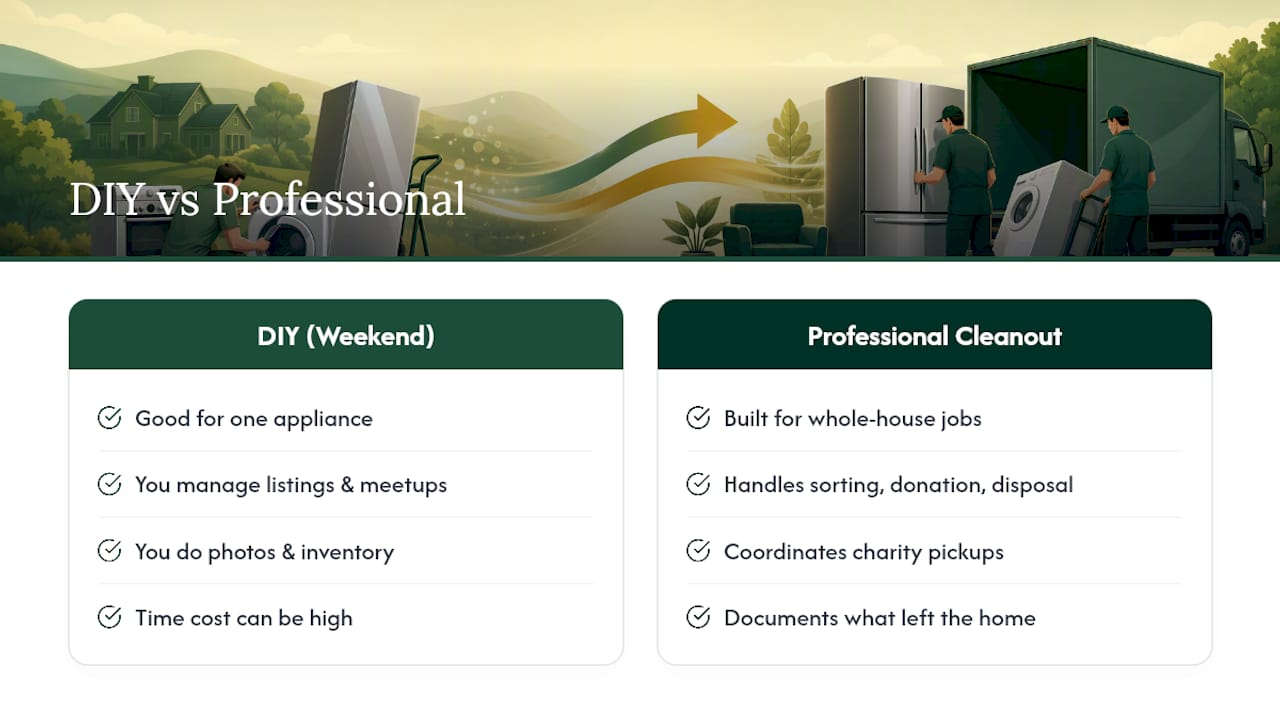
Selling one appliance on your own weekend is manageable. Sorting an entire household's worth of appliances while also managing probate paperwork, grieving relatives, and a closing deadline is a different job entirely.
Start with a simple checklist: a timeline for when the home needs to be cleared, a full inventory of what's sellable versus what's donation-only, a separate pass to identify and photograph keepsakes before anything gets touched, and documentation of high-value items for the executor's records. Photographing keepsake items with brief provenance notes before sorting begins prevents disputes among heirs later and speeds up decisions the executor has to make anyway.
A donation-first approach to an estate cleanout does more than move items out of a house quickly. It coordinates charity pickups on a schedule, documents what left the home and where it went, and keeps sellable appliances separated from items headed straight to disposal, so nothing valuable gets swept into a dumpster by mistake.
Weigh the commission or fee against your own time. If you're driving two hours each way to manage listings and buyer meetups on a house you're also trying to sell, a professional estate cleanout that handles sorting, donation coordination, and disposal often costs less in real terms than the days you'd spend doing it yourself.
What I'd Tell a Family Doing This for the First Time
Sell the appliances that are safe, working, and worth real money first. Everything else, don't force it. A pro tip that gets overlooked: pick one appliance today, run it through the prep checklist above, and list it. Momentum matters more than a perfect plan when you're managing an estate on a deadline. If the volume or the emotional weight gets too heavy, donation-first estate services exist specifically to take that load off your hands without losing track of what's valuable.
— Derek
Need Hands-Off Help Selling or Clearing Estate Appliances?
If you've read through the checklists above and realized you'd rather not spend three weekends fielding Marketplace messages and coordinating dolly-equipped strangers, there's a faster route. A donation-first estate cleanout process can sort sellable appliances, coordinate charity pickups for what won't sell, handle disposal for what's left, and document everything, which matters when an executor needs proof of what happened to estate property.
This type of service fits families working against a probate deadline, anyone managing a full house rather than a single appliance, or people who simply don't have the time or emotional bandwidth to negotiate with strangers over a used dryer. Items get sorted, donation-eligible pieces go to charities, and sellable items get routed toward estate-sale or consignment support instead of sitting in a driveway. If that sounds like the better fit for your situation, request a quote from Bereavement Cleanout Services and get a walkthrough scheduled.
Where to Check Prices, Schedule Donations, and Plan Shipping
Before you list or donate anything, a few quick references save time. For pricing, cross-check any quick estimate from an instant appliance value checker against actual completed sales for your exact model, and review resale value guidance by brand and age before setting your number. For donations, confirm size and condition limits with donation pickup services and check Salvation Army acceptance guidelines ahead of scheduling a truck. If you're weighing shipping a smaller unit, freight and shipping guidance for appliances explains what it actually costs to send something heavy across distance.
Sources
- How to Ship Appliances | FreightCenter
- What Are My Home Appliances Worth? Complete Resale Value Guide (2026) | ValueSnap Blog
- Maximize Your Payout With a Home Appliances Auction | DIYAuctions
- Donate Your Used Small Appliances: Schedule a Pickup Today! | PickupPlease
- Donate | The Salvation Army
- Appliance Value Checker — What Is My Appliance Worth? (Free)
FAQ
What is the best way to sell used appliances?
For most working appliances, local pickup through a classifieds app gets the fastest sale with no fees. Large, built-in, or premium-brand units often do better through a dealer, consignment shop, or auction.
How do I sell old home appliances that no longer work?
Nonworking appliances usually aren't worth listing for sale. Take them to a scrap metal yard for salvage value, check for a parts buyer if a specific component still works, or use a municipal bulk pickup program.
Can you get money for old appliances?
Yes, working appliances in decent condition typically sell for a meaningful percentage of their original retail price, especially premium brands, which retain value better than commodity models. Even nonworking units can bring in scrap value based on weight.
What is the 50/50 rule for appliances?
There's no single standardized rule in the appliance resale industry. Most sellers instead rely on checking completed sold listings for the exact model and applying rough percent-of-new depreciation estimates adjusted for brand and age.
Should I hire a professional for an estate full of appliances?
If you're managing probate deadlines, sorting keepsakes, and coordinating multiple sales at once, a donation-first estate cleanout service can save significant time and reduce stress compared to managing every appliance sale individually.