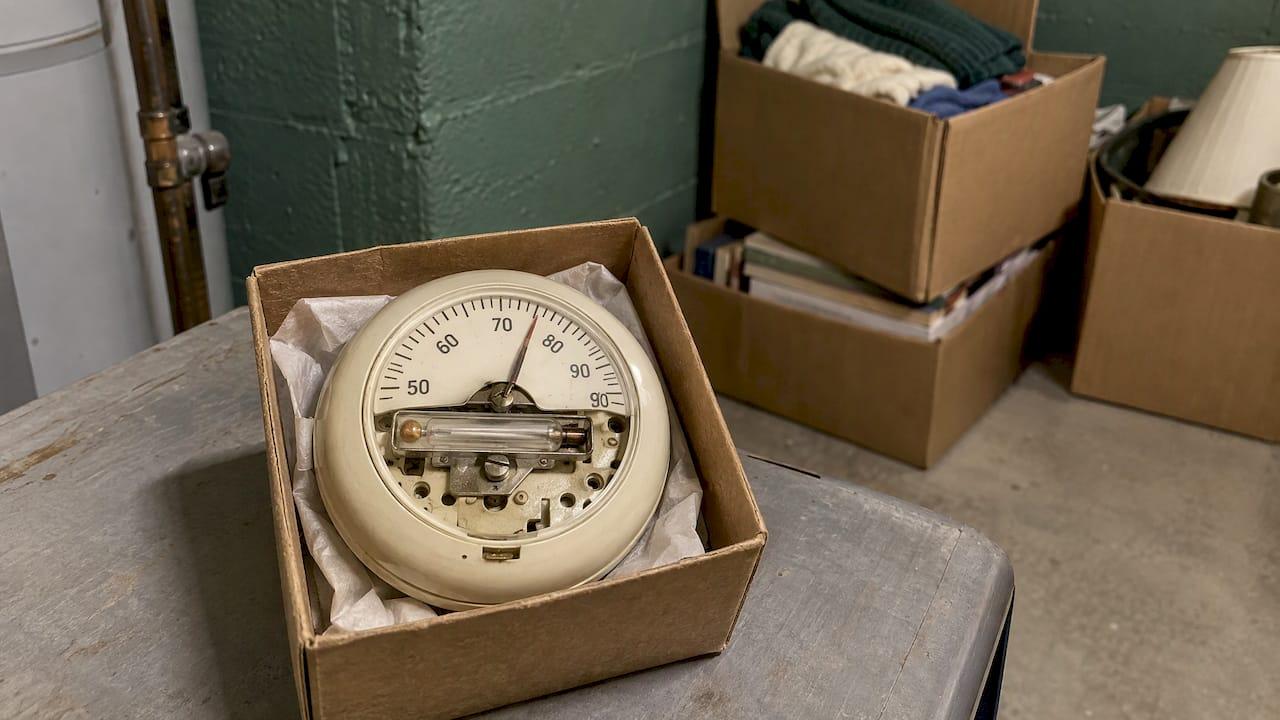
An old round or rectangular dial thermostat on the wall of a loved one's home may contain a sealed glass tube of liquid mercury. It cannot go in the trash or curbside recycling in New Jersey. It goes, whole and unopened, to a thermostat recycling drop-off or a household hazardous waste (HHW) site run by your county. If you are clearing a whole house, we handle the sorting and hauling of items like this as part of an estate cleanout, so nothing hazardous ends up in the wrong place.
This guide covers how to tell whether a thermostat has mercury, how to pack and carry it, where New Jersey residents can take it, and what to do if it breaks.
TL;DR
- Many older, non-programmable dial or switch thermostats contain a small glass ampule of silver liquid mercury. Digital models do not.
- Leave the ampule in the thermostat. Take the whole unit to a county drop-off or HHW collection. Never put it in household trash or curbside recycling.
- Drop-off rules, hours and proof-of-residency requirements differ by county, so check your county's page before you drive.
- If the ampule breaks, keep everyone out, ventilate, and never use a vacuum or broom. A spill larger than two tablespoons calls for professional cleanup.
Table of Contents
- How to tell if a thermostat contains mercury
- Why it can't go in the trash
- How to pack and transport it safely
- Where to take a mercury thermostat in New Jersey
- If the thermostat breaks or leaks
- Mercury is rarely the only hazard in an estate
- Planning the thermostat into a cleanout
- Promo: let us take it off your list
- Our perspective
- FAQ
- Sources
How to tell if a thermostat contains mercury
Thermostats sold before about 2006 often contain a glass tube of liquid mercury, according to the California thermostat recycling program. Digital thermostats do not use mercury. The same source says an intact mercury thermostat is safe as long as the sealed glass bulb stays protected by the cover.

To check, turn off the heating or cooling system, then pull off the front cover. Utah's environmental agency advises looking for one or more glass ampules (switches) holding a silver liquid. NH Recycles adds that a mercury thermostat is typically dial- or switch-operated and non-programmable, that you will see a small glass tube with a bubble on top, and that intact ampules are safe to handle.
The quick checklist:
- The home was built before the early 2000s and the thermostat looks original.
- It has a dial or a sliding lever and no programming buttons or screen.
- Behind the cover you see a small, sealed glass tube with a silver liquid inside.
If you are not sure, treat it as mercury-containing and take it to a drop-off site that accepts thermostats. Staff there can sort it out.
Why it can't go in the trash
New Jersey's recycling regulations define a thermostat as a temperature control device with metallic mercury in an ampule, and treat these thermostats and removed ampules as universal waste. Universal waste is a category of common hazardous items managed under simpler rules than full hazardous waste, so that they are collected and recycled instead of landfilled. The EPA's table confirms New Jersey has adopted universal waste rules that cover mercury-containing equipment.
Municipal rules follow the same line. The City of Linden's ordinance, for example, says the city will not collect thermostats in curbside garbage, and points residents to drop-off centers run by the Union County Utilities Authority.
The practical takeaway: do not toss it in a dumpster during a cleanout, and do not leave it in a pile at the curb with other discards.
How to pack and transport it safely
Keep the thermostat intact. Do not pry out the glass ampule. Ocean County states plainly: bring the entire thermostat with the mercury contained in the device, and do not remove the mercury and bring it separately.
For packing, the US EPA's guidance on storing and transporting mercury recommends:
- Place the item in a larger container with a tight-fitting lid.
- Cushion it with kitty litter or an oil-absorbent material.
- Label the container "Mercury - DO NOT OPEN."
- Keep it away from children and pets until you can drop it off.
- Carry it in a secured cardboard box in a trunk or truck bed, with the passenger compartment ventilated.
Michigan's environmental agency gives a similar household method: a zip-lock bag inside a rigid container with a tight lid, such as a coffee can, labeled and kept from shifting in the car.
Two tips for estate situations. First, if the thermostat is still wired to the wall, shut off power to the heating system before removing it, or have the heating contractor or a qualified person do it. Second, set the packed thermostat aside from the donation and sale piles right away, so it does not get mixed into boxes that other people will carry.
Where to take a mercury thermostat in New Jersey
New Jersey disposal is handled county by county. Your options are generally a permanent drop-off, a permanent HHW facility, or scheduled HHW collection days. Always confirm hours, residency rules and limits before you go. Here are examples from official county pages.
| County | Where | What to know |
|---|---|---|
| Ocean | Northern Recycling Center, Lakewood, and Southern Recycling Center, Manahawkin | Part of the Thermostat Recycling Corp. program. Drop-off Monday to Saturday, 7:30 a.m. to 3:00 p.m. Bring the whole thermostat. |
| Monmouth | Reclamation Center permanent HHW facility | Lists mercury-containing devices such as thermostats and thermometers as accepted. The county's permanent facility is free to residents with proof of residency. |
| Morris | MCMUA household hazardous waste programs | Accepts thermometers and thermostats containing mercury. Permanent facility in Flanders. |
| Union | Household special waste events | Thermostats are on the accepted list for scheduled collection days. |
| Bergen | 2026 HHW collection events | Free to county residents with ID. Accepts mercury switches, thermostats and thermometers. |
If your county is not listed, search the county's solid waste or utilities authority name with "household hazardous waste." The EPA also points residents to state and local collection programs and an online recycling locator.
What to check before you drive
- Residency. Many county programs require proof of residency, such as a driver's license or a utility bill. Ocean County's 2025 recycling guide lists proof of residency and volume limits for its appointment-only HHW events. If you are an executor from out of the county, ask the program whether the decedent's address counts.
- Appointments. Some sites and events require one. Monmouth's page, for example, directs residents to call to schedule.
- Schedule. Event-based programs run on set days a few times a year, and dates change annually. Use the county's current calendar.
- Packaging. Ask whether they want the item in a container, and whether loose or broken ampules are accepted.
Our guide to household hazardous waste in New Jersey has more on county calendars and preparing for collection days.
If the thermostat breaks or leaks
An intact ampule is stable. A broken one needs care. The EPA and CDC guidance for cleaning up a household mercury spill says to:
- Get everyone, including pets, out of the area. Open windows to the outside and close interior doors and cold-air returns.
- Wearing gloves, collect the beads with stiff paper or cardboard, an eye dropper, tape, or shaving cream. Never use a vacuum or a broom.
- Seal all contaminated materials in labeled bags and check for stray beads with a flashlight.
- Keep the area ventilated for at least 24 hours.
- Contact your local health department, municipal waste authority or fire department about disposal.
- Call Poison Control at (888) 222-2122 if anyone feels sick.
The same guidance says a spill larger than two tablespoons warrants professional cleanup. A single thermostat holds far less than that, but if you find several broken devices, or mercury has soaked into carpet or a floor, call your local health department first. Pregnant women and young children should stay out of the area until it is cleared.
Mercury is rarely the only hazard in an estate
A house with a dial thermostat is often a house with other items that need special handling: fluorescent bulbs, old paint, propane cylinders, pool chemicals, and sometimes asbestos-era materials. A walkthrough is the time to find them, not halfway through loading a truck. For asbestos in particular, this explanation of what to do about asbestos after a fire shows why you should not disturb suspect materials before you know what they are.
Other items we see on NJ disposal lists have their own rules, and we have written them up:
- Paint disposal rules in New Jersey
- Safe ways to dispose of propane tanks
- Refrigerator disposal and rebates
- TV and electronics recycling
Planning the thermostat into a cleanout
The thermostat is a small task. The trouble comes when it is one of fifty small tasks, each with its own county rule, while you are also deciding what to keep, donate and sell. A simple order keeps it manageable:
- Walk the house with a notepad and list every hazardous or restricted item, including thermostats, before anything is moved.
- Separate those items into one labeled area, away from donations and sale items.
- Check your county's drop-off or HHW schedule and book any appointment.
- Make one trip with everything packed, rather than several partial ones.
- Keep the drop-off receipt or note the date with your estate records.
If the house is also being prepared for sale or a landlord turnover, the timeline tightens. HHW events may be months apart, so identify mercury items early.
Promo: let us take it off your list

We do estate cleanouts across New Jersey with donation-first sorting, keepsake sorting, professional documentation that supports probate, and broom-clean handoffs. We are fully insured. Our published starting prices are $295 for a single room, garage or basement, $650 for an apartment or condo, and $1,200 for a full house. Hoarding cleanup starts at $1,500 and large estate cleanouts at $2,200.
See our cleanout services or check the New Jersey areas we serve.

Our perspective
When a family calls us, the thermostat is almost never the reason. It is one of the things we find while walking a house with them, alongside old paint, bulbs, propane cylinders and boxes nobody has opened in years.
Our donation-first approach means we sort for usable items and keepsakes first, and we keep anything hazardous separate from the start. That separation matters because the usable things should reach local charities, and the things that need special handling should reach the right place without anyone in the family having to research county rules in the middle of grieving.
The documentation we provide is meant to support the executor. A clear record of what was removed and how the house was left helps when probate questions come up. If a house also needs a broom-clean finish for a sale or a new tenant, we plan the work in that order: sort, separate, remove, clean, hand off.
Derek
FAQ
Can I throw a mercury thermostat in the trash in New Jersey?
No. New Jersey classifies mercury thermostats as universal waste, and municipalities such as Linden state they will not collect them with curbside garbage. Take the whole thermostat to a county drop-off or an HHW collection.
Do I need to remove the mercury before dropping it off?
No. Ocean County asks for the entire thermostat with the mercury still contained in the device, and says not to remove the mercury and bring it separately. Do not open or pry at the glass ampule.
What about an old mercury thermometer?
Thermometers with mercury are accepted at many of the same county HHW programs, including Monmouth, Morris, Bergen and Union. Pack it in a rigid container with a tight lid and confirm with your county before you go.
How much does it cost to drop one off?
Many county programs are free for residents. Monmouth's and Bergen's HHW programs are listed as free with proof of residency or ID. Check your own county, since rules and fees vary.
Sources
- Mercury Thermostats Disposal, Utah DEQ
- Thermostat Care consumer information
- How to Identify and Safely Recycle Mercury Thermostats, NH Recycles
- NJ recycling regulations, N.J.A.C. 7:26A
- State Universal Waste Programs, US EPA
- City of Linden solid waste ordinance
- Storing, Transporting and Disposing of Mercury, US EPA
- Keep Your Home and Workplace Mercury Free, Michigan EGLE
- Solid Waste Management, Ocean County
- Ocean County Recycling Guide
- Monmouth County Reclamation Center acceptable wastes
- Monmouth County HHW acceptable items
- MCMUA household hazardous waste
- Union County household special waste
- Bergen County 2026 HHW collection events
- Cleaning up Mercury Spills in your House, EPA