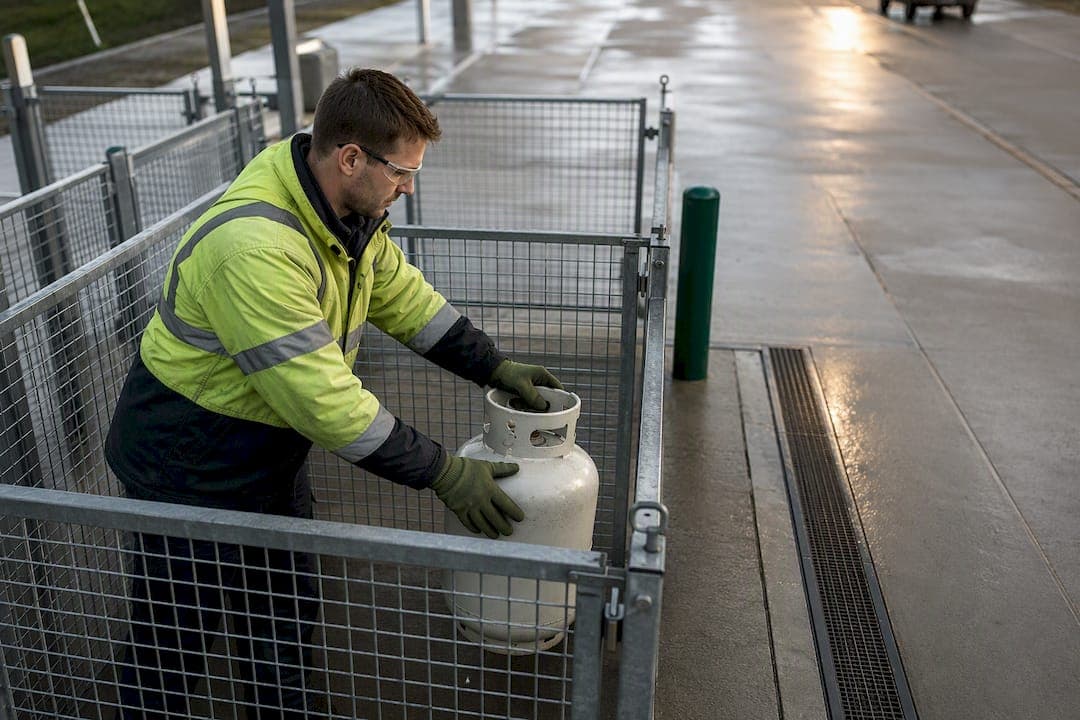
New Jersey residents have three practical, legal options for propane tank disposal: county household hazardous waste (HHW) events, retail exchange or refill programs, and licensed propane suppliers or cleanout professionals. County HHW events are usually free for residents and the best first stop for most households. Retail exchange programs work well for standard 20 pound grill tanks, while damaged or bulk quantities call for a professional.
TL;DR:
- County household hazardous waste events are usually free and best for disposing of damaged or bulk propane tanks, but they are not held year-round.
- Proper preparation involves ensuring the valve is closed, labeling tanks if used for retail exchange, and securing them upright during transport to prevent leaks or hazards.
- Retail exchange programs accept standard tanks in good condition, but damaged, old, or unrecertified tanks typically require a professional that can safely requalify or recycle them.
- Handling damaged or large quantities of tanks safely necessitates professional removal because it involves certified equipment and adherence to DOT transportation regulations.
- Propane tanks should never be disposed of with regular trash due to residual pressure risks; they require specialized handling at HHW events, retail programs, or through licensed professionals.
Table of Contents
- Where to take propane tanks in New Jersey
- How to prepare and transport a propane tank safely for drop-off
- County HHW events in New Jersey: what to expect and how to register
- Retail exchange and refill programs: rules and best practices
- When to hire a professional or fold tank removal into an estate cleanout
- Why you can't throw propane tanks in regular trash
- Practical perspective: small actions that make HHW runs painless
- How Bereavement Cleanout Services can help
- Official resources and county HHW pages to bookmark
- Sources
- FAQ
Where to take propane tanks in New Jersey
Not every drop-off point treats propane tanks the same way, so it helps to know your options before loading one into the car.
- County HHW events: Free for residents in most cases, though registration and proof of residency are common requirements at check-in.
- Municipal transfer stations and MUA recycling centers: Some accept BBQ-size tanks year-round, but policies vary by town, so call first.
- Retail exchange and refill programs: Blue Rhino displays and similar retailer setups accept many 20 pound tanks, with rules that differ by location.
- Local propane suppliers and commercial recyclers: Many will take a tank for a small fee, particularly if it can be recycled or requalified rather than scrapped.
County programs tend to be the least expensive route, but they are not year-round. Retail exchange is faster if you already own a standard grill tank in decent shape. For anything unusual, a supplier or recycler with the right equipment is worth the extra step.
How to prepare and transport a propane tank safely for drop-off
Getting a tank accepted on the first try usually comes down to preparation.
- Confirm the valve is fully closed and keep the tank upright before you move it.
- Never attempt to remove the valve or puncture the cylinder yourself, since specialized equipment and trained handlers are required for that work.
- If you plan to use a retail exchange program, label the tank "RECYCLE" so staff can identify it quickly.
- Call the drop-off site ahead of time to confirm it accepts tanks and to ask about any fees.
- Transport the tank upright and secured in a ventilated part of the vehicle, never in an enclosed trunk.
- Avoid storing tanks inside your home or garage any longer than necessary while you arrange disposal.
If you are clearing out multiple tanks at once, from an estate or a large property cleanout, a professional is often the safer route because of DOT placarding limits on transporting several cylinders at once.
Pro Tip: Keep the tank in the open bed of a truck or with a window cracked if it must ride in a car. Propane fumes build up fast in a sealed space.
County HHW events in New Jersey: what to expect and how to register
County household hazardous waste events are the backbone of propane disposal for most New Jersey households. Programs like the one run by Union County list propane tanks among accepted items and typically make the events free, but residential-only. Business waste is usually turned away entirely.
Before you go, check your county's HHW calendar, since most require pre-registration and proof of residency such as a driver's license or a recent utility bill. The MCMUA's HHW guidance is a good example of how a Morris County resident would confirm what is accepted and what paperwork to bring.
A few practical points make the visit smoother:
- Bring valid photo ID and proof of address, since staff will check both at intake.
- Expect a drive-through or staffed unloading process. Do not remove tanks from your vehicle until directed.
- Some sites cap the number of tanks per household or charge a small per-tank fee, so ask when you register.
If you are also dealing with old paint, solvents, or cleaning chemicals from a cleanout, it is worth reviewing what to bring to an NJ hazardous waste drop-off before your visit so you make one trip instead of several.
Retail exchange and refill programs: rules and best practices
Retail exchange is the fastest option if your tank is in reasonable shape. Blue Rhino's exchange program collects and refurbishes standard 20 pound BBQ tanks through displays at grocery stores, hardware stores, and gas stations, and the company recommends marking a tank with an "R" or writing "RECYCLE" on it before dropping it off.
Not every tank qualifies, though.
- A tank lacking a modern overfill protection device, often found in older models common in New Jersey, may be refused outright.
- Damaged valves or dented cylinders are automatic rejections at most exchange points.
- A tank that is past its recertification date will need requalification before any retailer will touch it.
Before making the trip, call ahead to Home Depot, Lowe's, or your local propane dealer to confirm they will accept your specific tank and whether a fee applies. Policies differ by store and even by location within the same chain.
When to hire a professional or fold tank removal into an estate cleanout
Some situations call for more than a car trip to the HHW event.
- A damaged tank with a dented body, corroded fittings, or a broken valve should never be handled without professional equipment.
- Bulk quantities, several tanks accumulated over years in a shed or basement, often exceed what a county event or retailer will take in one visit.
- Tanks that need requalification before reuse are best routed through a licensed propane supplier, which can also handle recycling for tanks beyond saving.
- If an HHW site or retailer refuses a tank on sight, a professional hauler is usually the next step rather than trying another location.
A licensed pro will purge the tank safely, transport it according to DOT rules, and document its disposal or recycling, which matters when several tanks turn up during a larger property cleanout. If you are weighing whether to rent a container yourself or bring in a crew, this comparison of DIY removal versus a professional cleanout team walks through the tradeoffs.
Why you can't throw propane tanks in regular trash
An "empty" propane tank almost never is. Residual gas can remain under pressure long after a tank stops producing usable flame, and that pressure turns dangerous the moment a tank gets crushed in a garbage truck or compactor, according to industry guidance on transporting propane. That risk is why landfills, shredders, and most municipal recycling centers will not knowingly accept a tank in the regular waste stream.

The EPA's household hazardous waste guidance recommends trained handlers and controlled facility procedures for items like propane cylinders, even though HHW is not classified the same way as regulated hazardous waste under federal rules. Puncturing or tampering with a tank yourself is never the answer. It takes specialized equipment to release residual gas safely, and attempting it at home risks a fire or an explosion.
Practical perspective: small actions that make HHW runs painless
The families who get through an HHW visit fastest are the ones who batch everything into a single trip. Old paint, propane tanks, cleaning chemicals, and anything else on the accepted list go in one load, sorted and labeled before you leave the house. If you are clearing an estate, separate anything reusable first. A donation-first sort keeps usable items out of the hazardous waste pile entirely. When a tank looks questionable, dented, old, or unclear valve condition, skip the gamble on rejection and call a professional instead.
— Derek
How Bereavement Cleanout Services can help
Estate cleanouts often turn up more than furniture and boxes. Old propane tanks from a grill, a camper, or a home heating setup show up regularly, and figuring out where each one goes adds one more task to an already heavy week. A professional cleanout service can include safe tank removal as part of a full cleanout, so families are not left coordinating a separate HHW trip on top of everything else.

- A donation-first approach encourages giving usable items to charities before disposing of them.
- Many cleanouts finish with a broom-clean handoff and professional documentation, which may help for probate.
- Operations are typically insured, aiming to provide a discrete, compassionate process built around families managing a difficult transition.
If a cleanout includes propane tanks, chemicals, or other items you are unsure how to handle, request a walkthrough and quote and let a professional team sort it out.
Official resources and county HHW pages to bookmark

Bookmark the EPA's HHW guidance, your county's HHW event page, and PERC's propane disposal resources to confirm current dates, registration steps, and retailer policies before you go.
Sources
- Propane Tank Disposal and Recycling | PERC
- Propane Tank Disposal – County of Union, New Jersey
- MCMUA - HHW - Propane
- Blue Rhino tank recycling FAQ
FAQ
Where do you dispose of old propane tanks?
Most New Jersey residents can drop off old propane tanks at a county HHW event, a retail exchange location such as a Blue Rhino display, or through a licensed propane supplier. Union County's recycling page lists local businesses that accept tanks, sometimes for a small fee.
Can I dispose of propane tanks at Home Depot?
Some Home Depot locations host Blue Rhino exchange displays that accept standard 20 pound tanks, but policies vary by store. Call your local store ahead of time to confirm acceptance and whether your tank qualifies.
What are the regulations for propane tanks in New Jersey?
New Jersey handles propane tanks as household hazardous waste, and guidance from MCMUA and other county programs warns against putting tanks in regular trash or removing valves yourself. County HHW events accept tanks for residents, often requiring registration and proof of residency, and business waste is typically excluded.
Does Ace Hardware take old propane tanks?
Acceptance depends on the individual store, since some Ace Hardware locations host exchange or refill displays similar to those found at other retailers. Calling ahead is the most reliable way to confirm whether a specific location accepts tanks and under what conditions.
What happens if I throw a propane tank in the trash?
A discarded tank can still hold residual pressure even when it feels empty, which creates a fire or explosion risk if it gets crushed in a garbage truck or compactor. That risk is why most municipal facilities in New Jersey refuse tanks in the regular waste stream and direct residents to HHW events or retail exchange instead.