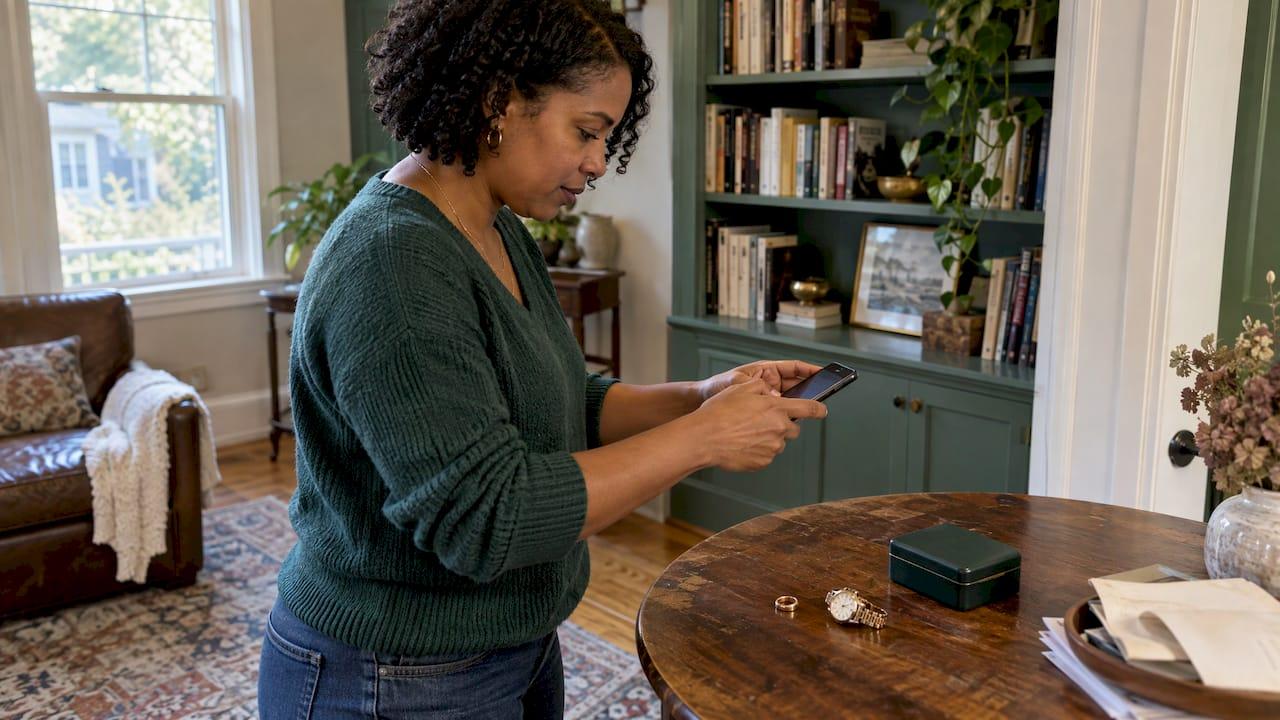
To document valuables for insurance, build a room-by-room inventory that pairs each item with a photo, a description, proof of ownership and a value, then store copies away from the house. When a home is being emptied, sold or inherited, the best moment to do it is before anything is moved. Our estate photography and online inventory service exists for that moment, so the record is made while the house is still intact and the family can concentrate on everything else.
This guide walks through what an insurer looks for, how to record each item, which belongings need an appraisal or separate coverage, and where to keep the finished record.
TL;DR
- Insurers may ask for proof of ownership and value after a loss, and incomplete records can lead to underpaid claims.
- For every item, record the type, brand, model, serial number, condition, cost and purchase date, and attach a photo.
- Standard homeowners policies cap payouts on jewelry, art, cash and similar categories, so high-value pieces may need an appraisal and scheduled coverage.
- Keep at least two copies in different places, and update the inventory when you buy, sell, inherit or donate.
- Our estate photography and online inventory service is $75 per hour and produces a documented record of a home's contents.
Table of Contents
- What an insurer actually needs from you
- Why this matters during an estate or downsizing
- Step 1: Walk the house and make a room list
- Step 2: Photograph rooms first, then items
- Step 3: Record what a photo cannot show
- Step 4: Gather proof of ownership and value
- Step 5: Know which items need an appraisal or separate coverage
- Step 6: Store the record where a fire cannot reach it
- Step 7: Keep it current
- Special situations
- Why we make the inventory part of the cleanout
- Let us build the record for you
- FAQ
- Sources
What an insurer actually needs from you
After a covered loss such as a fire, theft or water damage, the insurer asks two things about each item: did you own it, and what is it worth? A photograph, a receipt, a serial number, a box or a warranty card can answer the first. An appraisal or a replacement price answers the second.
The Iowa Insurance Division describes a home inventory as a detailed list of belongings with descriptions, receipts, purchase dates, photographs, appraisals and estimated values. Without one, it notes, insurers may default to estimating the value of lost items, which often leads to underpayment.
The type of coverage on your policy changes what the record needs to show. The same division explains that actual cash value pays after depreciation, while replacement cost reimburses the cost to repair or replace an item with a similar one. Under either, a clear record of what you had is what lets you claim all of it.
You do not have to hand the inventory to your insurer in advance. The Maryland Insurance Administration notes that you are not required to give your insurer a copy. You simply need to be able to produce it when a claim arises.

Why this matters during an estate or downsizing
A house in transition is exactly where records get lost. A family is sorting a parent's belongings, an executor is trying to account for everything, or someone is leaving a home of forty years for assisted living. Items go into donation bins, relatives take keepsakes, and a few weeks later nobody can say what a silver set or a coin collection looked like.
A dated record made before the work starts helps in several ways:
- It shows what was in the home if a loss happens while the house is vacant or being prepared.
- It gives the estate a documented list of what was kept, sold, donated or passed to family.
- It supports probate paperwork. Our guide on estate cleanout documentation for executors explains what to record before donations begin.
For questions about authority over the property or how items must be handled in probate, speak with the estate's attorney. Our probate house cleanout guide covers why authority comes before donations.
Step 1: Walk the house and make a room list
Start with a notebook, a spreadsheet or an app, and create one section per room. Include the places people forget. UConn Extension lists the attic, basement, garage, toolshed, lawn equipment and rented storage facilities.
Work one room at a time and finish it before moving on. A half-finished inventory of every room is harder to use than a complete inventory of three. If time is short, begin with the rooms holding the most value: the bedroom with jewelry, the den with electronics and collectibles, the dining room with silver and china.
UConn also points out that getting started small is real progress. Record a video or photos of each room, take close-ups of high-value items, save them in a labeled folder, and add detail over time.
Step 2: Photograph rooms first, then items
Photos are the fastest way to prove something existed. Use two passes.
- Wide shots. Film or photograph each room from several angles. The Delaware Department of Insurance advises recording each room from different angles, including closets, drawers and cabinets.
- Close-ups. Photograph each valuable item, plus the model and serial number plates on appliances and electronics. The Texas Department of Insurance recommends pictures of major appliances and their model numbers.
Good light and a plain background make details readable. Place a small ruler or coin beside jewelry, and photograph hallmarks, signatures and maker's marks. If you may also sell some items later, the eBay photo requirements show the sizes and formats online buyers expect, so one careful set of pictures can serve both purposes.
Where it goes wrong: photos taken on a phone and never backed up. If the phone is in the house when the loss happens, the record goes with it.
Step 3: Record what a photo cannot show
A picture will not tell an adjuster what an item is made of, when it was bought, or what it cost. UConn Extension advises recording each item's type, brand name, model and serial numbers, material, color, size, condition and distinguishing features, plus the cost, the purchase date and where the paperwork is kept.
A simple table works well:
| Item | Room | Brand / model / serial | Condition | Purchase date and price | Proof kept |
|---|---|---|---|---|---|
| Oak dining table, 6 chairs | Dining room | Maker's mark under top | Good | 1998, $2,400 | Receipt in folder |
| 14k gold necklace | Bedroom | Hallmark photographed | Excellent | Gift, 2011 | Appraisal 2024 |
| 65-inch television | Living room | Model and serial photographed | Good | 2022, $900 | Emailed receipt |
For an inherited or long-owned item, you will rarely have a receipt. Write what you do know: who owned it, roughly when it was acquired, and any family history. That context is useful to the estate and to the people who later receive the piece.
Step 4: Gather proof of ownership and value
New Mexico State University notes that sales receipts are evidence of ownership and matter for establishing the value of unappraised items. It suggests a file box for receipts on major purchases, with some kept in a safe deposit box.
Useful proof, roughly in order of strength:
- Appraisals from a qualified appraiser
- Purchase receipts and invoices, including emailed ones
- Credit card or bank statements showing the purchase
- Warranty cards, manuals and original boxes
- Dated photographs showing the item in the home
For value, the key point is that insurers generally pay on current market or replacement value, not on what you paid. A Realtor.com report on rising gold prices gives an example: a 14k necklace of about 8 grams might bring only around $600 in a claim without receipts, which is why it advises getting an appraisal with photos and receipts first.
Step 5: Know which items need an appraisal or separate coverage
This is the step that most often surprises people. Standard homeowners policies pay for belongings under a personal property limit. The NAIC's consumer guide says that limit is typically 50% of the dwelling coverage, for example $75,000 on a $150,000 dwelling policy. Within that total, certain categories carry smaller caps.
The Wisconsin Office of the Commissioner of Insurance states that policies cover valuables such as jewelry, furs, art and antiques only up to set dollar amounts. If replacement costs exceed those limits, you may want scheduled personal property coverage, which lists specific items at agreed values.
MoneyGeek gives examples of typical sublimits: $2,000 for art, $500 for cash, and as little as $1,500 for stolen jewelry, even on a policy with $100,000 of personal property coverage. It suggests treating a single item worth $2,000 or more as a sign that a sublimit may leave you underinsured, and says scheduled coverage generally pays replacement cost without depreciation.

Realtor.com reports that appraisals typically cost $150 to $400 depending on the number of items and the appraiser, and that professional jewelry assessments should be renewed every three to five years. Prices and limits vary by insurer and state, so confirm your own policy's numbers.
Fine art is handled differently. PropertyCasualty360 says an appraisal is preferred to a receipt for art, and that it must detail material, condition, age and origin and come from an appraiser qualified in that item type.
Your next step is a call to your insurance agent or insurer with your list. Ask which categories your policy caps, whether the items you have found exceed those caps, and whether scheduling makes sense. For an estate, ask the same about the policy covering the house while it is vacant, and involve the estate's attorney.
Step 6: Store the record where a fire cannot reach it
An inventory kept only in the house is at risk from the same event it is meant to cover. The California Department of Insurance recommends keeping an updated hard or electronic copy in at least two of these places:
- A fire-resistant safe at home
- A locked cabinet at work
- A relative's home
- Your accountant or lawyer
- A safety deposit box
The Texas Department of Insurance adds that an electronic copy of the pictures and inventory lets you reach it from anywhere. For a family, one practical setup is a shared cloud folder organized by room, plus a printed copy with a trusted relative or the estate's attorney.
Step 7: Keep it current
An inventory from ten years ago misses the new television, the inherited ring and the piece that was sold. The California Department of Insurance suggests updating at least three times a year, such as at the start of each season, and adding major purchases as soon as possible. Maryland's guidance and Delaware's guidance both say once a year at minimum, or whenever you add valued items.
During a cleanout, add one more habit: update the record every time something leaves the house. Note what was kept by family, what was sold, and what was donated. That log is as useful to an estate as the original list.
Special situations
Executors and families. Photograph and list valuables before relatives begin taking things. Our guides on finding the will and donating first and on protecting sentimental items cover the sorting side.
Downsizers. Record what you are keeping and what you are passing on, then review it against the new, smaller living space. Our downsizing keep-list helps decide what moves with you.
Realtors and landlords. A dated photo record of a property's contents before a turnover protects everyone if there is a later question about what was there.
Social workers. For clients who cannot manage this themselves, a documented inventory made by a service gives the family or guardian a clear record to work from.
Why we make the inventory part of the cleanout
Most families we work with are not thinking about insurance when they call. They are thinking about a house full of a loved one's things and a deadline. The inventory is the piece that is easy to skip and hard to recreate.
That is why we offer estate photography and online inventory as its own service. We sort keepsakes carefully, follow a donation-first approach so usable items go to local charities, and provide professional documentation that supports probate. A photographed, itemized record made before the work begins ties all of that together.
We are fully insured and discreet, and we respond quickly when a property needs attention. Our aim is that you never have to wonder later what was in the house, where it went, or whether you can prove it.
Derek
Let us build the record for you
Writing down every item in a parent's home is slow work, and it is hard to do while grieving. Our estate photography and online inventory service is $75 per hour, and packing is $55 per hour per packer if you want belongings prepared for a move. Both fit alongside our cleanout services across New Jersey, which start at $295 for a single room, garage or basement and $650 for an apartment or condo.

If items are worth selling, our estate sales run on a 15-35% commission and online consignment on 20-40%. See our estate sale vs. cleanout guide to decide which fits, then contact us through our website to schedule a walkthrough and quote.
FAQ
What is the best way to document valuables for insurance?
Combine a video walk-through of each room, close-up photos of valuable items, and a written list with brand, model, serial number, cost and purchase date. Add receipts and appraisals, then store copies in two separate locations.
Do I need receipts for everything?
No, but receipts help most for expensive items. Where you have none, use dated photos, bank or card statements, warranty cards, manuals and an appraisal for jewelry or art. Write down what you know about when and how the item was acquired.
Which items usually need an appraisal?
Jewelry, fine art, antiques and collectibles are the usual ones, because standard policies cap payouts in those categories. Ask your insurer where your policy's limits sit and whether any single item exceeds them.
How often should I update my inventory?
At least once a year, and after any major purchase, inheritance or sale. California's insurance department suggests three or four times a year, such as at the start of each season. Update it whenever items leave a home during a cleanout.
Can someone document a loved one's belongings for us?
Yes. Our estate photography and online inventory service records a home's contents for families, executors, social workers and realtors across New Jersey. The record is made before sorting and donations begin.
Sources
- Iowa Insurance Division: The Importance of a Home Inventory
- Maryland Insurance Administration: Home Inventory
- UConn Extension: Protect What You Own
- Delaware Department of Insurance: Homeowners Guide
- Texas Department of Insurance: Make a Home Inventory
- New Mexico State University: Household Inventory
- Realtor.com: Higher Gold Prices Expose Gaps in Homeowners Insurance
- NAIC: A Consumer's Guide to Home Insurance
- Wisconsin OCI: Personal Property Home Inventory
- MoneyGeek: Scheduled Personal Property Coverage
- PropertyCasualty360: Scheduling Personal Property
- California Department of Insurance: Home Inventory Guide
- eBay photo requirements