
The fastest way to verify a charity is to confirm its IRS tax-exempt registration before you click any donation link. Search the IRS Tax-Exempt Organization Search for the exact legal name and EIN, cross-check one watchdog rating for financial red flags, and pay through a traceable method. Keep every written acknowledgment you receive. Those three moves catch the overwhelming majority of fake or misleading appeals before your money leaves your account.
TL;DR:
- Confirm the charity's IRS registration status by searching its exact legal name and EIN in the IRS TEOS before donating.
- Use direct website URLs with HTTPS and familiar payment processors, and avoid unverified contact links to prevent fake donation pages.
- Check at least one watchdog rating and a transparency profile to identify financial red flags or transparency issues quickly.
- For donations over $250, obtain a written acknowledgment showing the date, amount, and receipt of goods or services for IRS compliance.
- Report suspected fraud immediately through official channels and save all proof to protect yourself and help stop scams.
Table of Contents
- Charity Verification Donations: The 2-Minute Checklist
- Where to Check: Registries vs. Watchdogs
- How to Verify Donation Receipts and Payment Pages
- Red Flags That Should Stop You Cold
- Reporting Suspected Charity Fraud
- What Estate Cleanouts Teach You About Donation Verification
- A Practical Note on Why Verification Habits Stick
- Quick Links for Verification and Reporting
- Sources
- FAQ
Charity Verification Donations: The 2-Minute Checklist
You don't need an afternoon to vet a charity. You need five steps, done in order, before you type in a card number.
- Search IRS TEOS first. Open the Tax Exempt Organization Search and match the organization's exact legal name and EIN. If it doesn't appear, it's either not a registered 501(c)(3) or its status has been revoked, according to the IRS.
- Go to the donation page directly. Type the charity's domain yourself rather than clicking an email or social link, then confirm the page uses HTTPS and a recognizable payment processor.
- Check one watchdog and one transparency profile. A star rating plus a seal on a transparency portal will surface most obvious problems fast.
- Confirm the receipt policy before you give. Ask how the organization documents large gifts, especially if you're donating $250 or more.
- Pay traceable and save proof. Credit card, ACH, or a verified donation portal beats gift cards or wire transfers every time, and you'll want the confirmation on file.
That's it. Most of this takes less time than reading the appeal email itself.
- IRS registration status
- One watchdog rating
- Receipt policy
- Payment method
- Saved confirmation
Where to Check: Registries vs. Watchdogs
Not every verification tool answers the same question, and knowing which one to use for which concern saves you from checking five sites when one would do.
- IRS TEOS tells you whether a charity is legally tax-exempt and eligible to issue deductible-donation receipts. It also flags revocations, which matter more than most donors realize since a charity can lose status quietly and keep soliciting.
- Candid, formerly GuideStar, hosts Form 990 filings and transparency seals that show how much financial detail an organization is willing to share publicly.
- Charity Navigator issues star ratings built mainly from financial health and governance metrics. A high star count means the numbers look clean on paper, not that the programs work.
- BBB Wise Giving Alliance, through Give, evaluates charities against 20 accountability standards and publishes pass/fail reports rather than stars.
- CharityWatch does something the others largely don't: manual, analyst-driven deep dives into state and federal filings. The organization has warned that automated rating formulas can miss inefficiencies or outright abuses that a human reviewer would catch.
The difference between Charity Navigator and GuideStar comes down to philosophy: one scores financial health, the other rewards transparency, and neither replaces a manual look at the Form 990 itself. Use TEOS to confirm the charity is real, then layer a watchdog check on top to judge how it operates.
How to Verify Donation Receipts and Payment Pages
A legitimate receipt isn't optional paperwork. For any single gift of $250 or more, the IRS requires a contemporaneous written acknowledgment that includes the date, the amount, and a statement about whether you received any goods or services in return.
Before you pay, look at the page itself:
- Type the charity's URL yourself instead of following a link from a text or social post.
- Confirm the page shows a valid SSL lock and routes to a payment processor or merchant account you recognize.
- Avoid gift cards, cryptocurrency, wire transfers, or an unsolicited Venmo or Zelle request from an appeal you didn't initiate.
- Save screenshots, confirmation emails, and any written acknowledgment the moment you receive them.
Pro Tip: Take a screenshot of the donation confirmation page immediately after you pay, even if you expect an email receipt later. Cloned charity sites often vanish within days, and that screenshot may be your only proof the transaction happened at all.
A donor and accountant checklist for spotting fake receipts recommends comparing the organization name on your receipt against the name on your bank statement. A mismatch there is one of the clearest signs something's wrong.
Red Flags That Should Stop You Cold
Some warning signs matter more than others. These are the ones that should make you close the tab, not just pause.
- Urgency paired with unusual payment demands. A charity asking for immediate payment through gift cards or a wire transfer is not behaving like a real nonprofit.
- Names that mimic well-known charities. A single added word or swapped letter in an organization's name, or an EIN that doesn't match the name on file, is a deliberate tactic.
- Receipts missing basic details. No EIN, no date, no amount, or a different organization name than the one you thought you gave to.
- Unexplained fundraising spikes or high overhead with no explanation. Consistently high fundraising-to-program ratios with no public rationale deserve a second look.
Crowdfunding pages deserve their own caution here. They're frequently run by individuals rather than registered charities, which means your gift likely isn't tax-deductible unless a verified 501(c)(3) is the actual recipient. That's not automatically fraud, but it's a different transaction than a charitable donation.
Reporting Suspected Charity Fraud
If something already went wrong, speed matters more than perfection.
- File at Reportfraud and preserve every screenshot, email, and receipt you have.
- Call your bank or card issuer right away to ask about a chargeback or reversal, especially if you paid in the last few days.
- Contact your state Attorney General's charity registration office, since most states require charities to register before soliciting there.
- Submit IRS Form 13909 if you suspect abuse of tax-exempt status specifically.
- Notify Give.org or CharityWatch so other donors researching the same name see the warning.
What Estate Cleanouts Teach You About Donation Verification
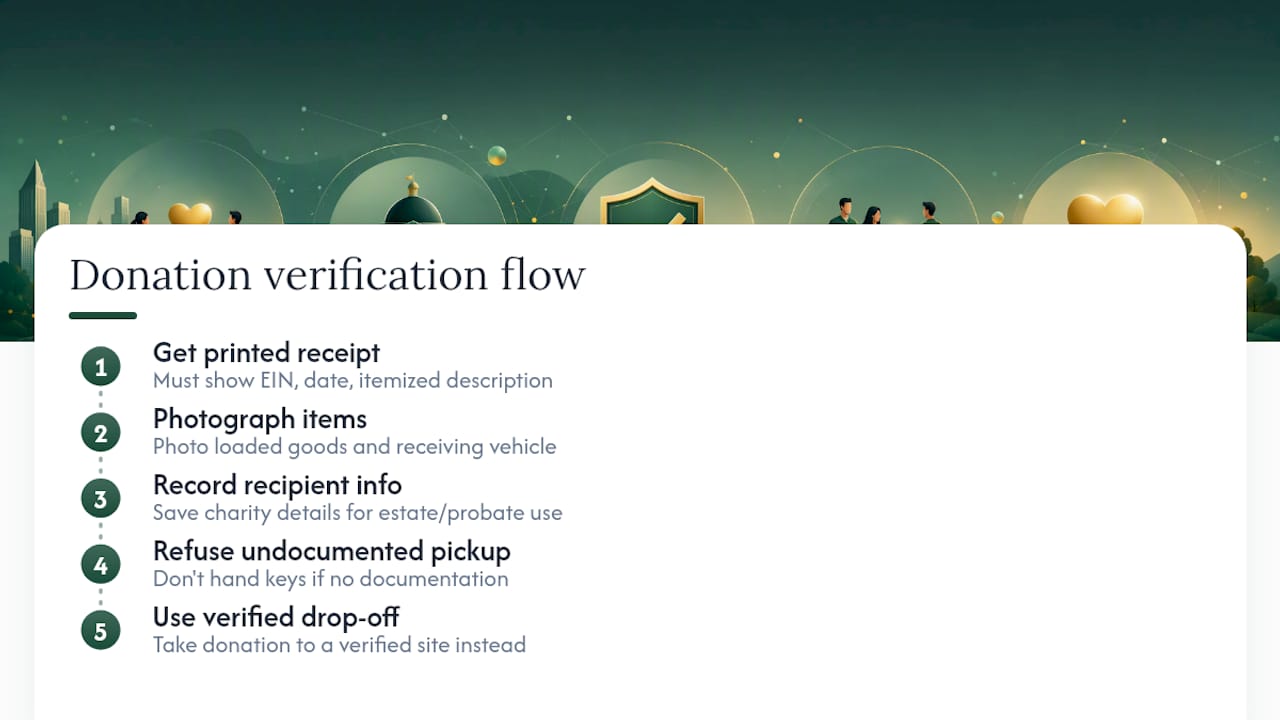
Household donations run into the same problem cash gifts do: no paperwork, no proof. When a family works through a loved one's belongings, the receiving charity should hand over a printed receipt at pickup listing its EIN, the date, and an itemized description whenever possible.
Photograph the loaded items and, if you can, the receiving vehicle. That record protects an executor during probate and gives the family something concrete if a tax question comes up later. It's the same standard outlined in donation receipt rules for estate cleanouts: documentation isn't a courtesy, it's evidence.
Some estate cleanout services build this into their process by recording recipient details for every donation run, which protects both the donor and the estate. If a pickup organization shows up without a way to document the transfer, don't hand over the keys. Instead, take the load to a verified drop-off site.
A Practical Note on Why Verification Habits Stick
Verification-first giving isn't extra work bolted onto generosity. It's the habit that keeps generosity from being exploited. Confirm the EIN, prefer traceable payments, and save every receipt without exception. Those two or three seconds of friction protect your money and, just as much, protect the legitimate charities that lose donor trust every time a scammer borrows their reputation.
— Derek
Quick Links for Verification and Reporting
- IRS Tax-Exempt Organization Search for registration status and EIN confirmation
- CharityWatch for deep-dive analyst reviews
- ScamWatch's donor checklist for spotting forged receipts
- Reportfraud and your state Attorney General's office for filing complaints
If you're sorting a loved one's belongings and want the same documentation standard applied to physical donations, Bereavement Cleanout Services' donation-first estate cleanout services record recipient details on every pickup, giving families a paper trail for probate and peace of mind during an already difficult process.
Sources
- Tax Exempt Organization Search — IRS
- CharityWatch difference — CharityWatch
- Spotting fake donation receipts and refund scams: A donor & accountant checklist to stop charity fraud | ScamWatch
FAQ
How Do I Verify If a Charity Is Legitimate?
Search the exact legal name and EIN in the IRS Tax-Exempt Organization Search first. If the charity doesn't appear, it isn't currently a registered 501(c)(3). Follow that with one watchdog rating and a check of the donation page's payment processor before you pay.
How Can I Check If a Donation Request Is Legit?
Type the organization's website address yourself instead of clicking a link from an email or text, and confirm the page uses HTTPS with a recognizable payment processor. Compare the name on any receipt against the name on your bank statement, since mismatches are a common sign of a cloned or fraudulent page.
How Much Can I Claim in Charitable Donations Without Proof?
For any single donation of $250 or more, the IRS requires a contemporaneous written acknowledgment listing the date, amount, and whether you received goods or services. Smaller gifts still need a bank record or receipt to support a deduction claim.
What's the Difference Between Charity Navigator and GuideStar?
Charity Navigator issues star ratings based mainly on financial health and governance metrics, while Candid (formerly GuideStar) focuses on transparency seals and hosting Form 990 filings. Neither replaces a manual review, which is where CharityWatch's analyst-driven approach fills the gap.
Where Do I Report Suspected Charity Fraud?
File a complaint at ReportFraud.ftc.gov, contact your bank about a possible chargeback, and reach out to your state Attorney General's charity office. If the concern involves tax-exempt status specifically, submit IRS Form 13909.