
In New Jersey, take used tires to a county tire amnesty event, a permitted recycling facility, a participating retailer, or a licensed hauler for larger loads. Whichever route you choose, ask for proof: an NJDEP temporary hauler registration confirmation, an interim scrap tire manifest, or a county drop-off receipt. Expect household limits, a rim-removal rule at most sites, and a small per-tire fee depending on the county.
TL;DR:
- County tire amnesty events are limited to one-day schedules and require residents to ask for proof of disposal, such as a registration confirmation or receipt.
- Fees typically range around $2 per tire in counties like Ocean, but can be waived or vary depending on grant funding and current programs.
- Proper tire preparation includes removing rims, counting and photographing tires, and stacking them carefully to avoid rejection or additional charges.
- Businesses and property managers should secure detailed, itemized documentation and proof of registration to avoid liability during large-scale tire removals or estate cleanouts.
- Confirm hauler registration and obtain a final-disposition receipt to ensure tires are legally tracked from pickup to authorized disposal facility.
Table of Contents
- Where Can You Legally Dispose of Tires in New Jersey?
- What Do Tire Disposal Fees and Household Limits Look Like?
- How Should You Prepare Tires for Drop-Off or Pickup?
- What Should Businesses and Estate Cleanouts Document?
- How Do You Verify a Tire Hauler Is Legitimate?
- Where to Confirm NJ Tire Disposal Rules Before You Go
- Get Tires Off Your Hands the Right Way
- Why Paperwork Matters More Than the Tires Themselves
- Sources
- FAQ
Where Can You Legally Dispose of Tires in New Jersey?
Curbside garbage pickup will not take tires, and neither will a standard dumpster rental. Tires need a dedicated channel, and New Jersey gives you four practical ones depending on how many you have and how fast you need them gone.
County amnesty and drop-off events work best for homeowners with a handful of tires. The Bergen County Utilities Authority runs one of the state's longest-standing programs, sponsoring scheduled amnesty days since 1995 because discarded tires eat up landfill space and create fire and mosquito-breeding hazards when left in piles. Its 2026 calendar lists four one-day events, held from 9:00 a.m. to 2:00 p.m., so timing matters more than most people assume.
Municipal transfer stations and household hazardous waste days are the second option, and county rules differ enough that you should never assume statewide uniformity. Union County accepts automobile tires at its household hazardous waste events but caps participation at eight tires per household and requires rims removed before you arrive.
Retailers and service stations will often take your old tires when you buy replacements, though most charge a per-tire disposal fee and some require an appointment.
Permitted recyclers and licensed haulers make sense for commercial loads, landlords clearing multiple units, or anyone hauling more than a car trunk's worth. This is also where legal tire disposal NJ rules get stricter, since larger loads draw more scrutiny.
Before you load the car, call ahead and confirm:
- Household or per-visit tire limits
- Whether rims must be removed
- If an appointment or specific arrival window is required
- Which tire types are accepted (passenger only, or also truck and off-road)
What Do Tire Disposal Fees and Household Limits Look Like?
Fees and limits are set county by county, not by the state, so the number you see in one town may not apply thirty miles away. That inconsistency is the single biggest source of frustration for residents trying to figure out tire disposal new jersey rules on their own.
Ocean County has historically charged $2 per tire at its recycling centers, though grant funding has periodically waived that fee for limited windows. Union County does not charge per tire at its household hazardous waste events but enforces the eight-tire household cap and rim-removal rule mentioned above. Bergen County's amnesty events are free to attend during scheduled hours, but only during those exact dates. Miss the window and you are back to a retailer or permitted facility.
A few patterns hold across most counties:
- Fees are typically charged per tire, not as a flat rate for the visit.
- Cash or exact change is common at drop-off events; some county sites now direct residents to pay or register online in advance.
- Waivers and free periods depend on grant funding, so a fee that applied last year may not apply this year, and vice versa.
Statistic Callout: Ocean County's per-tire fee has stood near $2 since 2019, but county pages note it can shift with funding, so verify the current rate before you load a truck.
Grant cycles and staffing levels drive most of these changes, which is exactly why checking the county's own page before you drive anywhere beats relying on a blog post, even this one, for the exact number.
How Should You Prepare Tires for Drop-Off or Pickup?
Poor staging is the fastest way to get turned away at an event or to blow up a quote from a hauler. A little prep work fixes almost all of it.
- Count every tire and separate them from other debris. Mixed loads slow down inspections and can trigger rejection at some sites.
- Photograph the pile before pickup. This protects you if a count is disputed later and speeds up quoting for larger jobs.
- Note the tire type and size (passenger, light truck, off-road). Some county programs only accept standard passenger and light truck tires.
- Remove rims if the receiving site requires it, which is standard at Union County events and common elsewhere.
- Keep tires dry, stacked, and accessible so a hauler is not digging through a garage or shed to find them.
A mixed dumpster with tires buried under furniture and debris almost always costs more, since haulers charge for sorting time on top of disposal.
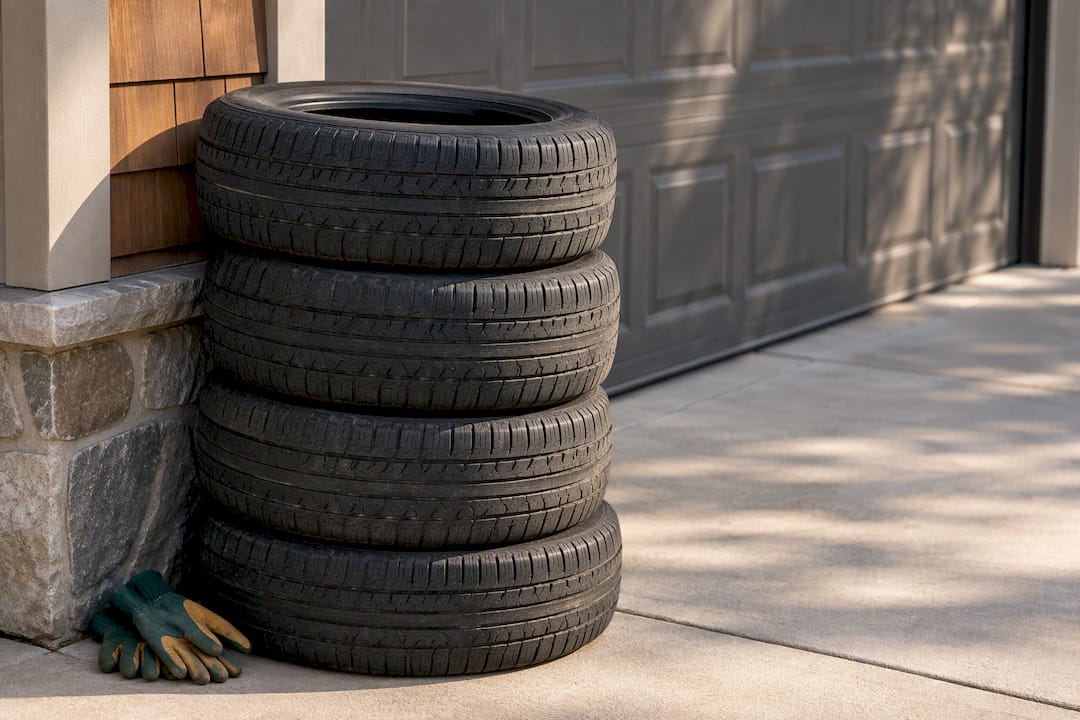
Pro Tip: Stack tires against an exterior wall or garage door the morning of pickup. Loose, staged tires load in minutes; buried ones can add an hour to a job and a line item to your invoice.
What Should Businesses and Estate Cleanouts Document?
Executors, realtors, landlords, and property managers face a different risk than a homeowner dropping off four tires on a Saturday. When you are managing an estate, a foreclosure, or a rental turnover, sloppy tire removal can turn into a liability question later, especially during probate review.
Before you sign off on any quote, ask for:
- An itemized breakdown separating labor, loading, transportation, disposal, and any special-tire surcharge (large truck or off-road tires often cost more to process)
- Proof of the hauler's NJDEP temporary registration
- An interim scrap tire manifest or a final-disposition receipt showing where the tires actually ended up
- Photographs and a written tire count for your own probate, landlord, or project file
This is standard practice for large removals: separate the tires from general debris, photograph the pile, and require an itemized quote before work begins. It is a small amount of paperwork that prevents a much bigger headache if anyone ever questions where the load went.
A cleanout service that handles the whole property, not just the tires, tends to fold this documentation into the broader estate cleanout process automatically, which matters most when you are also juggling keepsakes, furniture, and a probate timeline.
How Do You Verify a Tire Hauler Is Legitimate?
The real compliance question is not whether someone claims to "recycle" your tires. It is whether the load can be traced from your property to an authorized final destination. New Jersey built its rules around exactly that traceability gap.
Under state law, the NJDEP requires temporary scrap tire hauler registration and use of an interim scrap tire manifest while the state builds out its permanent tracking system. Generators and retailers are told not to release tires to an unregistered hauler, full stop.
At pickup or drop-off, ask for:
- Confirmation the hauler has completed NJDEP temporary registration
- A copy of the interim scrap tire manifest
- A final-disposition receipt once the load reaches its destination
| What to request | Why it matters |
|---|---|
| NJDEP registration confirmation | Confirms the hauler is legally authorized to move scrap tires |
| Interim scrap tire manifest | Creates a traceable record from your property to final destination |
| Final-disposition receipt | Proves the tires reached an authorized facility, not a roadside or vacant lot |
If a hauler cannot produce any of this, or a "free pickup" offer seems too casual, NJDEP's Scrap Tire Management office can be contacted for compliance help, and unregistered hauler activity or suspected illegal dumping should be reported there directly.
Where to Confirm NJ Tire Disposal Rules Before You Go
County event dates, fees, and hauler registration status change often enough that a phone call or a quick page check beats relying on last year's information.
- NJDEP Scrap Tire Management covers hauler registration and the interim manifest system statewide.
- Bergen County Utilities Authority Tire Recycling Program lists current amnesty event dates and hours.
- Union County Tire Recycling explains household limits and the rim-removal requirement.
- Ocean County Solid Waste Management posts current per-tire fee information for its recycling centers.
Get Tires Off Your Hands the Right Way
If sorting tires is one small piece of a much bigger job, you do not need to handle it alone. Bereavementcleanoutservices coordinates full estate and property cleanouts across New Jersey, from a single garage of old tires and clutter to a large estate cleanout with hoarding-level accumulation, and every job includes documentation you can hand to a probate attorney, a landlord, or a family member without a second thought.
Pricing is transparent from the first walkthrough, with fees varying by job size and conditions. Quotes typically separate labor, hauling, and disposal costs, and many services prioritize routing donation-eligible items to local charities first, respecting budgets and family wishes.
Call Bereavementcleanoutservices for a firm quote before you commit to a DIY haul or an unverified "free pickup" offer. You will get a broom-clean result, a paper trail, and one less thing to manage during an already difficult transition.
Why Paperwork Matters More Than the Tires Themselves
Most guides on this topic treat tire disposal as a logistics question: which bin, which day, which fee. That misses the point. The real risk in New Jersey right now is not finding a place to drop off a tire. It is trusting a hauler who cannot prove where that tire actually ends up.
The state's shift toward temporary hauler registration and interim manifests tells you where enforcement is headed. Homeowners rarely think about paperwork for four tires, and they usually get away with skipping it. Executors, landlords, and cleanout coordinators do not have that luxury, because a probate file or a liability claim can resurface a disposal decision months later.
My honest read: county amnesty events and retailer take-back programs handle the volume just fine for most households. What is overrated is the assumption that "recycling" alone protects you. What deserves more attention is the manifest, the registration confirmation, the receipt. Get that piece right first, and the rest of tire disposal in New Jersey is genuinely simple.
— Derek
Sources
- NJDEP | Scrap Tire Management
- Tires - Bergen County Utilities Authority
- Tire Recycling – County of Union, New Jersey
- Solid Waste Management | Ocean County Government
FAQ
What is the tire disposal fee in NJ?
Fees vary by county rather than being set statewide. Ocean County has historically charged $2 per tire at its recycling centers, while Bergen County's scheduled amnesty events run fee-free during posted hours. Always confirm the current rate on the county's own page before your visit.
What does Costco do with old tires?
Costco Tire Centers generally accept old tires for recycling when you purchase new ones through their service, charging a disposal fee that is included in the sale. Policies can vary by location, so confirm directly with your local Costco Tire Center before assuming free take-back.
How much is a disposal fee for tires?
Disposal fees in New Jersey are typically charged per tire rather than as a flat rate, and they depend entirely on the county or retailer. Ocean County's posted rate has been $2 per tire, while some county amnesty events charge nothing during scheduled dates.
Is it illegal to dump a tire?
Yes. Releasing scrap tires to an unregistered hauler or dumping them outside an authorized facility violates New Jersey's scrap tire regulations, and the NJDEP requires generators to use registered haulers and interim manifests to track proper disposal. Suspected illegal dumping or unregistered hauler activity can be reported to NJDEP's Scrap Tire Management office.
How do I know if a tire hauler is registered with NJDEP?
Ask the hauler directly for proof of their NJDEP temporary scrap tire hauler registration and a copy of the interim scrap tire manifest before releasing any tires to them. If they cannot produce either document, NJDEP's Scrap Tire Management program offers compliance guidance and can confirm registration status.