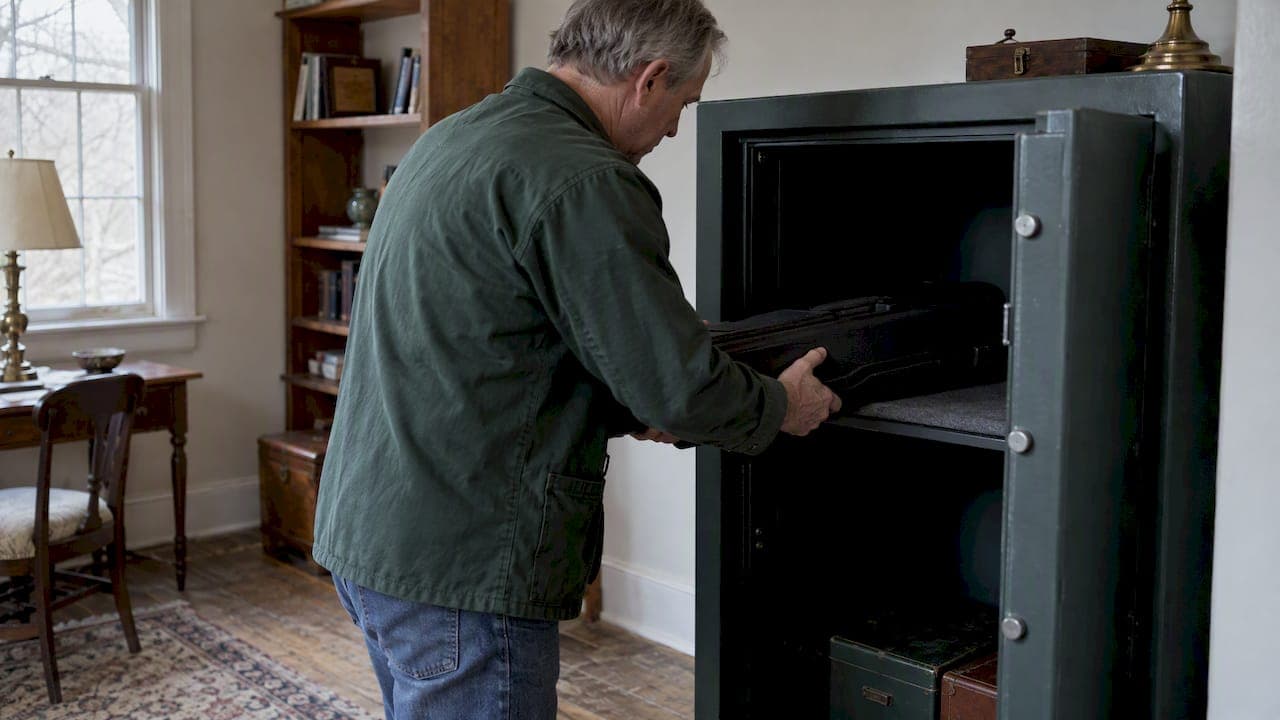
Secure any firearms you find, do not hand them to heirs or anyone else, and wait until you have confirmed legal eligibility and completed any required federal or state procedures. For firearms regulated under the National Firearms Act, that means filing ATF Form 5 or Form 4 as appropriate before any transfer happens. Getting this sequence right protects you and the people you are trying to help.
TL;DR:
- Executors can hold registered firearms without being considered a transfer during probate, but must ensure the owner is legally eligible to possess them.
- NFA-regulated firearms require ATF Forms 5 or 4 for transfer or registration, and unregistered NFA items are treated as contraband under federal law.
- State laws often add transfer restrictions and require background checks, so verifying local regulations is essential before transferring firearms across state lines.
- When firearms are found, they should be unloaded, photographed, securely stored, and documented before making any decisions about sale, donation, or transfer.
- Seek legal or ATF guidance immediately if firearm registration status is unclear, prohibited person's involvement is suspected, or estate complexities arise.
Table of Contents
- Who may legally possess estate firearms
- Immediate safety and documentation steps when firearms are found
- NFA items: special rules, ATF Form 5, and Form 4
- State and interstate transfer rules that trip up executors
- Deciding whether to transfer, sell, donate, or surrender firearms
- Storage and transfer logistics while paperwork is pending
- When to call an attorney, the ATF, or an FFL
- Legal considerations for unregistered or unclear-provenance firearms
- Handling firearms in estates without a will
- Insurance and liability concerns during probate
- Talking to heirs about firearms in the estate
- How we approach firearms during an estate cleanout
- Support for executors managing an estate that includes firearms
- FAQ
- Sources
Who may legally possess estate firearms
An executor can generally possess a firearm that was registered to the decedent while the estate moves through probate, and this temporary custody is not treated as a transfer under 27 CFR § 479.90a. That protection has limits, though, and it does not erase federal restrictions on who can lawfully hold a gun.
Federal law bars certain people, known as prohibited persons, from possessing firearms at all. This category includes people convicted of certain felonies, some misdemeanants, individuals adjudicated mentally ill, and specific non-citizen groups. Simply being named executor can create what is called constructive possession, meaning legal responsibility for the firearm even if you never touch it.
If you have any reason to think you might fall into a prohibited category:
- Do not accept physical custody of the firearms under any circumstances.
- Contact an estate attorney before taking any action involving the guns.
- Ask the probate court about appointing a special administrator to handle firearms specifically.
- Keep the items secured by someone else, such as another family member or an FFL, until the question is resolved.
Immediate safety and documentation steps when firearms are found
Before anything else happens with an estate's firearms, lock them down and record what you have. The order matters, and skipping steps creates both safety risks and paperwork headaches later.
- If you have firearm training, unload each weapon and separate it from any ammunition.
- If you do not have that training, close off the room or cabinet where the guns are stored and limit access to one trusted person.
- Photograph every firearm, capturing the make, model, and serial number clearly for your records.
- Store the inventory privately, since this becomes part of your probate documentation rather than something to share broadly.
- Place firearms in a locked safe or cabinet rather than leaving them in a closet or under a bed during the estate process.
- Decide who to call first based on what you find: a federal firearms licensee for routine guidance, an attorney if ownership or eligibility questions arise, or local law enforcement if a weapon appears unsafe or its legal status is unclear.
Pro Tip: Photograph firearms next to a ruler or coin for scale, and include a photo of the full serial number string separately from the wide shot.
Resist the urge to let a family member take a gun home "just to hold onto it." Informal handoffs like this can violate federal transfer rules and complicate the probate record, especially if that firearm later turns out to require NFA paperwork.
NFA items: special rules, ATF Form 5, and Form 4
Some firearms, including short-barreled rifles, suppressors, and machine guns, fall under the National Firearms Act and carry extra registration requirements. These items live in the NFA Registration and Transfer Record, and their status changes what you are legally allowed to do with them.
Executors may hold NFA-registered firearms during probate without triggering a transfer, but moving one of these items to an heir requires action:
- File ATF Form 5 to transfer a registered NFA firearm tax-free to a lawful heir.
- File ATF Form 4 if the firearm is going to someone outside the estate in a taxable transfer.
- Gather supporting documents: proof of executor appointment, a death certificate, and fingerprints and photos for any individual recipient.
- File the paperwork before probate closes whenever possible, since ATF guidance allows a reasonable time to arrange transfers but recommends resolving them while the estate is still open.
An unregistered NFA firearm is treated as contraband under federal law, and ATF guidance on estate transfers states it must be reported rather than sold, gifted, or stored with a dealer informally. That single fact changes the entire plan for an item if its registration status is in doubt. If you cannot confirm whether a firearm is properly registered, contact the NFA Branch directly and do not move, consign, or sell it in the meantime. Handing an unregistered NFA item to a dealer without prior authorization counts as an illegal transfer, even if your intention was simply temporary storage.
State and interstate transfer rules that trip up executors
Federal law sets a floor, not a ceiling, and state rules often add requirements that catch executors off guard. Background checks, permit-to-purchase rules, and storage mandates vary enough that what works in one state can be illegal in another.
- Check the firearm laws in both the decedent's state and the heir's state before assuming direct inheritance is allowed.
- Some states require every transfer, inheritance included, to go through a licensed dealer with a background check.
- For interstate transfers, route the firearm from one federal firearms licensee to another in the heir's state rather than shipping it directly or driving it across state lines yourself.
- Confirm whether your state treats inheritance as an exception to normal transfer rules, since that assumption does not hold everywhere.
This is one of the more common mistakes we see in estate administration: assuming that because federal law permits something, state law automatically agrees. It frequently does not.
Deciding whether to transfer, sell, donate, or surrender firearms
Once ownership questions are settled, you still have to decide what happens to each firearm, and that decision often comes down to value and family interest.
- Hire a qualified firearms appraiser for collectible pieces, military surplus, or anything with unclear market value, and keep the written appraisal with your probate records.
- Sell through a federal firearms licensee or an established consignment arrangement if no heir wants a piece, which keeps the transaction documented and legal.
- Consider donation to a licensed program or surrender to local law enforcement for firearms nobody wants and nobody can legally keep.
- Save every receipt and chain-of-custody record connected to a sale, since proceeds typically flow back into the estate and need to be accounted for during probate.
Storage and transfer logistics while paperwork is pending
Firearms often need to sit somewhere safe for weeks or months while probate and, if applicable, NFA paperwork work their way through the system. Planning for that gap matters as much as the eventual transfer itself.
- Ask a local federal firearm licensee about temporary storage. Most will store firearms for a fee and provide documentation you can use for your estate records, and a complete guide to secure storage covers the hardware and environmental factors worth considering if you decide to store firearms yourself instead.
- Check whether your local police department or sheriff's office offers firearm storage, which can work well for a small number of items but may involve longer retrieval times than an FFL.
- Build your timeline around realistic ATF processing, since NFA transfer applications do not move quickly, and align estate closing dates with that reality rather than the other way around.
Whichever storage option you choose, confirm in writing what documentation you will receive when you retrieve the firearms later. That paperwork becomes part of your probate file.
When to call an attorney, the ATF, or an FFL
Certain situations call for professional help immediately rather than later. If you suspect you might be a prohibited person, if a firearm's NFA registration status is unclear, or if the estate involves an interstate transfer with conflicting state rules, stop and get guidance before taking further action.
- Bring a death certificate, letters testamentary or letters of administration, any existing firearm paperwork, serial number photos, and relevant trust language to the first meeting.
- An attorney can petition the court for a special administrator or resolve eligibility questions you cannot answer yourself.
- The NFA Branch can confirm registration status directly when records are unclear or missing from what the decedent left behind.
- A federal firearms licensee can handle the mechanics of a lawful transfer once the legal questions are settled.
Estate planning specialists who work with gun collections, including those referenced in ACTEC's guidance on managing guns in an estate, frequently recommend a dedicated gun trust for complex holdings because ordinary trusts often fail to account for NFA requirements.
Legal considerations for unregistered or unclear-provenance firearms
Firearms with no visible serial number, missing paperwork, or no record in the family's memory create one of the thorniest situations an executor can face. The safest assumption is that you do not yet know what you have, and that uncertainty should slow you down rather than push you toward a quick resolution.
Start by checking the firearm itself for a serial number, which might be stamped somewhere other than where you expect. If you find one, the NFA Branch can help determine whether the item appears in the registry. If there is no serial number at all, or the number has been altered or removed, treat the firearm as a potential legal problem and contact law enforcement or the ATF directly rather than attempting to sell, gift, or even move it across state lines.

Old firearms inherited from estates sometimes turn out to be unregistered NFA items that a previous owner modified or acquired decades ago without realizing the legal consequences. Because unregistered NFA firearms are treated as contraband, possessing one, even unknowingly, carries real legal exposure for an executor who continues to hold or distribute it. Reporting the item is the appropriate step, not selling it quietly or passing it along to a family member who expressed interest.
When provenance is unclear for reasons other than NFA status, such as a firearm that may have been stolen or imported without proper documentation, the same caution applies. Keep the item secured, keep it photographed, and let an attorney or law enforcement sort out the history before anyone takes further action.
Handling firearms in estates without a will
Dying without a will does not remove any of the firearm rules described above. It does change who has authority to act and how quickly that authority gets established, which matters because firearms sitting in a home during the gap between death and court appointment still need to be secured.
In an intestate estate, the probate court appoints an administrator rather than recognizing an executor named in a will. Until that appointment happens, no one technically has the legal standing that 27 CFR § 479.90a extends to executors managing a decedent's registered firearms. Family members should still secure the firearms physically, following the same unload-and-store steps outlined earlier, but should avoid treating any one person as having full authority over the guns until the court names an administrator.
Once appointed, the administrator generally steps into the same role an executor would occupy, with the same obligations around prohibited-person status, NFA paperwork, and state transfer rules. If multiple heirs disagree about who should receive a firearm, or if eligibility questions arise among several potential heirs, that disagreement is best resolved through the probate court rather than through an informal family decision. Intestate estates often take longer to resolve than those with a clear will, and firearms kept in limbo for an extended period may need interim storage through a federal firearms licensee or local law enforcement rather than sitting in the decedent's home indefinitely.

Insurance and liability concerns during probate
Firearms sitting in a home during probate carry liability exposure that many executors do not consider until something goes wrong. A homeowner's policy may or may not extend coverage to firearms left in a property that is otherwise vacant or only occasionally visited, and that gap matters more the longer probate drags on.
Check with the decedent's insurance carrier early about whether the existing homeowner's or renter's policy still covers the firearms, and ask specifically about coverage during a period of vacancy, since many policies reduce or suspend coverage once a home sits empty for a set number of days. If coverage is unclear or inadequate, a rider or a separate policy covering the firearms specifically may be worth the modest cost relative to the exposure.
Liability runs in both directions. If a firearm stored in the estate home is stolen, lost, or involved in an incident while under your informal watch, you could face both the financial loss and questions about whether you exercised reasonable care as executor. Documented, secure storage, whether that means a locked safe on-site, a federal firearms licensee's storage service, or police department storage, reduces that exposure and gives you a paper trail if questions come up later. Keep any storage receipts, insurance correspondence, and photos of the secured firearms together in your probate file, since this documentation does double duty: it protects you and it supports the estate's final accounting.
Talking to heirs about firearms in the estate
Firearms carry more emotional weight than most estate property, often tied to memories of hunting trips, military service, or a parent's daily routine. That weight means conversations about who gets what can turn difficult quickly, even in families that otherwise get along.
Start the conversation early and be straightforward about the legal constraints involved. Heirs need to understand that a firearm cannot simply be handed over at a family gathering, especially if NFA paperwork or an interstate transfer is involved, and that the delay is a legal requirement rather than a personal choice on your part. Explaining the process, rather than just the outcome, tends to reduce frustration.
Be direct about eligibility questions as well. If an heir who wants a particular firearm might be a prohibited person, that conversation is uncomfortable but necessary before any transfer moves forward. It is better to raise the issue privately and early than to have a transfer rejected or flagged later in the process.
Where multiple heirs want the same firearm, treat it like any other contested estate asset: document interest, consider an appraisal to establish value, and let the group agree on a resolution, whether that means one heir buys out the others' interest or the firearm is sold and proceeds are split. Keeping a written record of these conversations, alongside your probate inventory, helps prevent disputes from resurfacing after the estate closes.
How we approach firearms during an estate cleanout
When our team encounters firearms during a cleanout, we pause and secure the area rather than sorting around them. Items stay untouched until an executor or attorney confirms next steps, and we document everything with court-ready photos before anything moves. Our donation-first approach still applies to the rest of the home, but firearms get held to a higher standard because the legal stakes are higher.
— Derek
Support for executors managing an estate that includes firearms
Firearms are rarely the only complicated part of an estate, and we built our process around that reality. We offer secure on-site sorting, court-ready photo inventories that attorneys and courts can rely on, and coordination with the professionals who need to be involved before anything changes hands.

- We document firearms and other high-value items with the same probate-ready detail throughout the home.
- Our donation-first policy keeps usable household items out of landfills while respecting what a family wants to keep.
- Our team works discreetly with executors, attorneys, and families during a difficult transition.
If your estate includes firearms along with everything else that needs sorting, packing, or clearing out, reach out for a walkthrough and quote and we will build a plan around what the law requires and what your family needs.
This article is general information, not a substitute for advice from a qualified lawyer. Consult a qualified legal professional about your own circumstances before acting on anything here.
FAQ
Do you have to register a gun if you inherit it?
Registration requirements depend on the firearm type. A standard firearm generally does not require new federal registration when inherited, but an NFA-regulated item requires filing ATF Form 5 to register it to the new owner, and some states layer on their own registration or permit rules.
What is the three-year rule for a deceased estate?
There is no federal three-year rule specific to firearms in an estate, and this question often confuses state-level probate timelines with firearm transfer rules. Executors should focus instead on completing NFA paperwork, such as Form 5, before probate closes, since ATF guidance only allows a reasonable time to arrange transfers.
Can I inherit a gun in Michigan?
Inheriting a firearm is generally possible in most states, but the specific rules on background checks, permits, and registration vary by state and by firearm type. Executors and heirs should confirm the current requirements with the state's law enforcement agency or a local attorney rather than relying on federal rules alone, since state restrictions often add requirements that federal law does not address.
What happens to guns when the owner dies?
An executor can typically possess firearms that were registered to the decedent while the estate is in probate, without that possession counting as a transfer under 27 CFR § 479.90a. From there, the firearms are either transferred to an eligible heir following the correct forms, sold through a licensed dealer, or surrendered if no lawful recipient exists.
Sources
- 27 CFR § 479.90a (eRegulations)
- Transfers of National Firearms Act Firearms in Decedents’ Estates — ATF
- Managing guns in your estate — ACTEC (video)