
A probate inventory list is a sworn, court-ready document that identifies every probate asset a decedent owned and assigns each one a fair market value (FMV) as of the date of death. If you've just been appointed personal representative, your three immediate steps are:
- Collect titles, account statements, deeds, and any documents that prove ownership.
- Secure high-value items — jewelry, art, vehicles, and collectibles — to prevent loss or damage before the estate closes.
- Download a fillable estate inventory template (or your state's court form) and begin entering assets by category.
Most U.S. jurisdictions expect the inventory filed within about three months of your appointment, as seen in Colorado's Form JDF 941 and North Carolina's E-505; however, local deadlines may differ, so pull your local probate court's form before you start and confirm the exact timeline required in your jurisdiction. If you discover additional assets after filing, you'll need to file a supplemental inventory — courts expect it.
Key takeaways
A complete, well-documented probate inventory list protects you from personal liability, speeds estate settlement, and reduces disputes among beneficiaries.
Table of Contents
- What goes on a probate inventory list?
- How do you value assets for the estate inventory?
- How to show ownership, liens, and net inventory value
- Step-by-step process and ready-to-use schedule template
- Special asset classes that need extra attention
- Common mistakes to avoid when completing the inventory
- Why precise inventories matter more than most people realize
- How Bereavementcleanoutservices supports your probate inventory process
- Sources
What goes on a probate inventory list?
Most state court forms organize assets into named schedules. Mirroring that structure in your own working document reduces omissions and aligns with what clerks expect to see. The standard categories are:
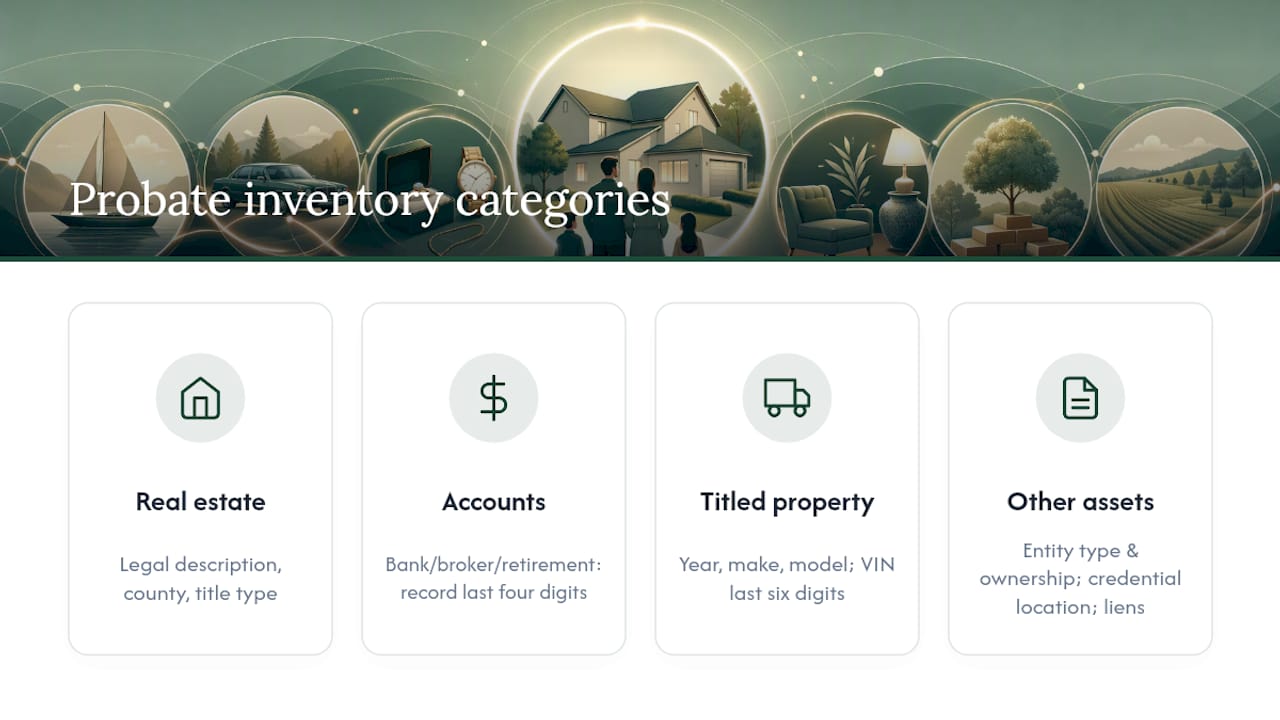
Real estate. Record the full legal description (or street address plus parcel number), county, and state. Note whether the decedent held title as sole owner, joint tenant, or tenant in common, and at what percentage.
Bank accounts. List the bank name, account type (checking, savings, CD), and the last four digits of the account number only. Never write the full account number on a filed copy.
Investment and brokerage accounts. Record the institution name, account type, and last four digits. FINRA is a reliable starting point for locating official brokerage statements and confirming account details when records are incomplete.
Retirement plans. List the plan type (IRA, 401(k), 403(b)), custodian name, and last four digits. Check the beneficiary designation before listing — amounts payable directly to a named beneficiary generally bypass probate.
Life insurance payable to the estate. Include only policies where the estate itself is the named beneficiary. Record the insurer, policy number (last four digits), and face value or cash surrender value as of date of death.
Vehicles and titled property. Record year, make, model, and the last six digits of the VIN. Include boats, trailers, and recreational vehicles if titled.
Business interests. Note the entity name, type (LLC, partnership, corporation), and the decedent's ownership percentage. Locate the operating agreement or articles of organization.
Personal property. Jewelry, art, antiques, collectibles, and firearms each deserve their own line with a description, serial number where available, and an estimated or appraised value. Ordinary household goods — furniture, kitchenware, clothing — can be grouped as a single line item when their combined value is modest. Michigan's Form PC-577 and California's self-help guide both permit grouping low-value household items while requiring separate listings for high-value pieces.
Digital assets. List account names, platforms, and where login credentials are stored. Do not attempt to access accounts without proper legal authorization.
Debts and encumbrances. Mortgages, car loans, and mechanics' liens belong on the inventory alongside the assets they encumber.
A practical starting point is the two-step approach: first list everything the decedent owned, then determine which items are probate assets and which pass outside probate. Assets held in a living trust, accounts with a named beneficiary, and property held in joint tenancy with right of survivorship typically bypass probate entirely. Mark those separately in your working document so you don't accidentally file them as probate property unless your local court specifically requires disclosure of nonprobate assets.
How do you value assets for the estate inventory?
The core rule is straightforward: use fair market value as of the decedent's date of death. FMV is what a willing buyer would pay a willing seller, with neither under pressure. Court forms and statutes require FMV — not the sale price you hope to get, and not replacement cost.
Acceptable supporting evidence includes:
- Bank and brokerage statements dated on or within a few days of the date of death.
- Broker statements showing market value for publicly traded securities.
- A formal appraisal report for real estate, jewelry, art, classic vehicles, or any asset where value is disputed or affects estate taxes.
- Vehicle valuation guides (such as Kelley Blue Book or NADA) for standard automobiles.
- Recent sales comparables for real property when a formal appraisal is not yet complete.
Courts commonly accept estimates at the inventory stage, but they will expect supporting evidence or formal appraisals later for large or contested items. Label estimates clearly in your working document and keep supporting documents organized by schedule category.
When you do commission a formal appraisal, record the appraiser's name, license or professional credential (ASA, MAI, GIA, or equivalent), date of appraisal, scope (as-is, date-of-death value), and contact information. Retain the original report and note it next to the corresponding item in your inventory.
Pro Tip: Next to each asset, note the valuation method and source — for example, "FMV via bank statement, 06/12/2024" or "Appraisal by Jane Doe, ASA, 07/05/2024." That notation speeds court review and protects you if a beneficiary later questions the figure.
The Alaska Court System's probate guidance reinforces this: list how each item is titled, include appraiser details when used, and send copies of the inventory to interested persons who request them.
How to show ownership, liens, and net inventory value
Stating ownership clearly matters as much as the dollar figure. Courts need to know whether the decedent owned an asset outright or held a partial interest.
Common ownership phrases to use:
- Sole owner — decedent held 100% individually.
- Joint tenancy with right of survivorship (JTWROS) — asset passes outside probate; note the co-owner's name.
- Tenancy in common — list the decedent's percentage (e.g., 50%).
- Payable-on-death (POD) or transfer-on-death (TOD) — note the beneficiary; generally not a probate asset.
- Held in trust — note the trust name; generally not a probate asset.
For liens and encumbrances, record the type (mortgage, auto loan, mechanics' lien), the creditor's name, and the outstanding balance as of the date of death. Michigan's Form PC-577 permits deducting liens from real property value for inventory purposes but does not extend that treatment to personal property — check your state's rules before netting out any lien.
The table below shows how a typical court schedule presents gross value, encumbrances, and net inventory value:
POD and TOD accounts and JTWROS property should appear in your working document with ownership notes, but confirm with your attorney or local court whether they belong on the filed inventory.
Step-by-step process and ready-to-use schedule template
Follow these steps in order. Skipping ahead — especially to filing before valuations are confirmed — is one of the most common causes of delays.
- Read the appointing order and local court rules. Your letters testamentary or letters of administration will specify your authority. Pull the local probate court's inventory form. The Florida Eleventh Judicial Circuit's estate inventory form is one example of how county-level forms can vary from state defaults.
- Gather documents. Collect deeds, vehicle titles, account statements, insurance policies, retirement plan summaries, and any password manager or digital asset records.
- Secure high-value items. Move jewelry, art, collectibles, and important documents to a safe location before the property is accessed by others.
- Assign FMV and attach evidence. Match each asset to a statement, appraisal, or valuation guide. Date your sources.
- Complete the court form or the sample template below. Use the schedule structure your court expects.
- Sign, file, and serve. File with the clerk of the probate court. Serve copies to interested persons who request them, as required by your state.
- File a supplemental inventory if new assets appear. Filing a supplement is the correct procedure — it preserves your duty of full disclosure and reduces later disputes.
Use this schedule-style template as a working document or adapt it to your state's form:
On filed copies, use only the last four digits of any account number. Attach appraisal reports, account statements, and titles as labeled exhibits that correspond to the item number in your schedule.
Special asset classes that need extra attention
Retirement accounts and life insurance
Check the beneficiary designation first. If a named individual is the beneficiary, the account bypasses probate and generally does not appear on the court-filed inventory. If the estate is the beneficiary, list the account name, custodian, last four digits, and the balance as of the date of death. Note the beneficiary status in your working document either way.
Business interests
Locate the operating agreement, articles of organization, or shareholder agreement. Confirm the decedent's ownership percentage and check whether a buy-sell agreement governs what happens to the interest at death. For closely held businesses, you'll likely need a business valuation from a CPA or certified business appraiser — don't estimate this one.
Digital assets
Create a separate log of account names, platforms, and where login credentials are stored (password manager name and location, for example). Do not attempt to access accounts without legal authorization. Note whether any accounts have transfer-on-death designations or digital estate plan instructions.
Collectibles, art, and jewelry
Photograph each item before it moves. Gather receipts, provenance documentation, or prior appraisals if available. For items that materially affect estate value, a formal appraisal from a credentialed specialist — GIA for gemstones, ASA for general personal property — is worth the cost.
Common mistakes to avoid when completing the inventory
Personal representatives who rush the inventory often create problems that take months to untangle. The most frequent errors:
- Omitting beneficiary-designated assets from your working document. Even if they don't go on the filed inventory, you need to know they exist.
- Failing to note ownership percentages. A 50% tenancy-in-common interest is worth half the property's FMV, not the full amount.
- Listing values without any supporting evidence. Courts accept estimates, but unsupported figures invite challenges from beneficiaries.
- Writing full account numbers on filed copies. Use only the last four digits on anything submitted to the court.
- Forgetting to document lien amounts. A property listed at gross value without noting the mortgage gives a misleading picture of the estate.
Practical organizing habits that save time:
- Photograph high-value items the day you secure them.
- Keep a master folder — physical or digital — with originals organized by schedule category.
- Label every supporting document to match the item number in your inventory schedule.
- Redact sensitive identifiers before filing.
Pro Tip: Prepare a blank supplemental inventory form at the same time you file the original. When a previously unknown asset surfaces — an old savings bond, a forgotten brokerage account — you'll be ready to file the supplement without delay.
Why precise inventories matter more than most people realize
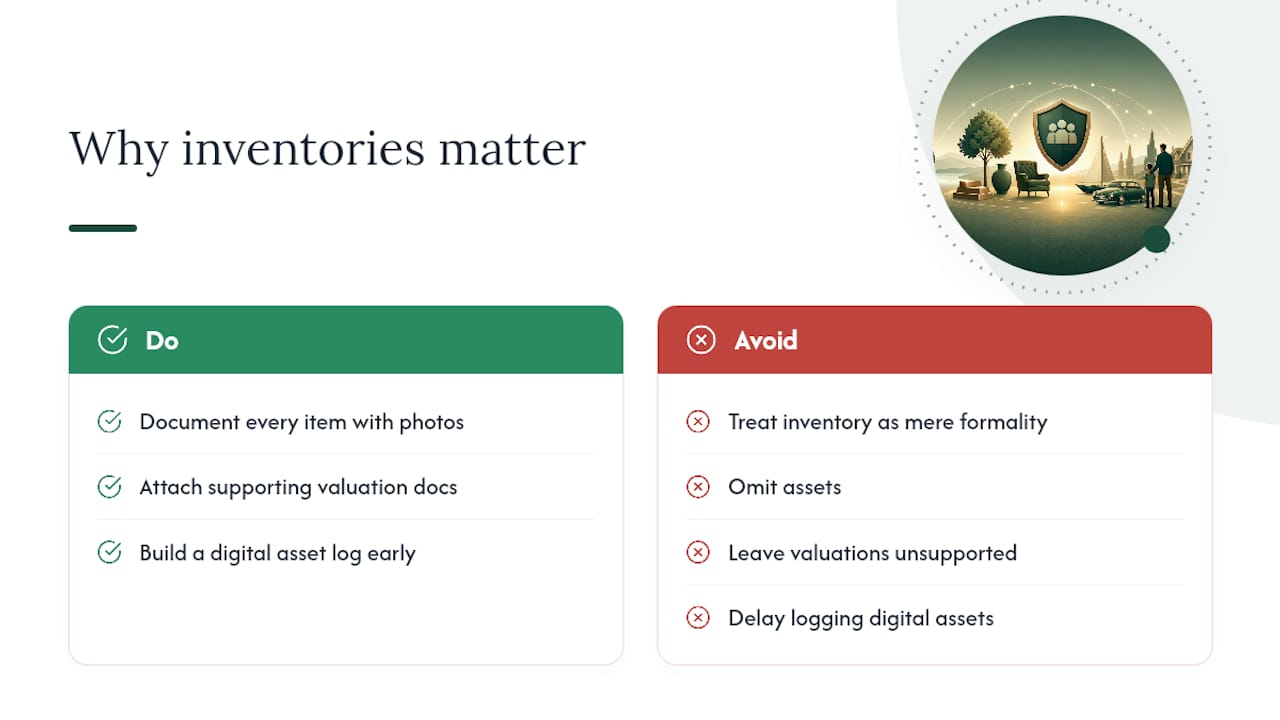
There's a tendency to treat the probate inventory as a formality — a box to check before the real work of settling the estate begins. That framing is a mistake, and one that costs families real money and real time.
An incomplete or poorly documented inventory doesn't just slow down court approval. It exposes the personal representative to personal liability. Courts in most states hold the personal representative to a fiduciary standard, which means an omitted asset or an unsupported valuation can become grounds for a surcharge — a court order requiring the representative to personally make up the shortfall. That's a serious consequence for what often starts as simple disorganization.
The other underappreciated risk is family conflict. When beneficiaries can't see a clear, itemized record of what existed and what it was worth, suspicion fills the gap. A thorough estate inventory list, with photographs and supporting documents attached, removes that ambiguity. It shows everyone exactly what was there and how it was valued.
The digital asset question is where most inventories fall short right now. Cryptocurrency wallets, online brokerage accounts, subscription services with stored value, and even reward points can represent meaningful money. They're also the easiest to miss because they leave no paper trail in the house. Building a digital asset log into your process from day one — before you touch anything else — is the single habit that separates a complete inventory from an incomplete one.
How Bereavementcleanoutservices supports your probate inventory process
When the property itself needs to be documented, sorted, and cleared before or during probate, Bereavementcleanoutservices offers hands-on services that directly support what you're doing here. The team photographs and itemizes personal property on-site, producing a documented inventory exported as a spreadsheet or PDF that you can use alongside your court filing. Every item is sorted with a donation-first approach — usable belongings go to local charities, reducing disposal costs and honoring the decedent's belongings with care.

Clients also receive labeled boxes, appraiser referrals for high-value items, and a broom-clean handoff once the property is cleared. The process starts with an on-site walkthrough and a firm quote, so there are no surprises. If you're managing an estate in New Jersey and need professional documentation and cleanout support, request your walkthrough at Bereavementcleanoutservices.
Sources
State probate court forms and statutes are the authoritative source for your jurisdiction's specific requirements. The resources below cover several states and provide practical guidance:
- Coloradojudicial
- Nccourts
- Courts
- 1. Inventory and estimate property value | California Courts | Self Help Guide
- Inventory and Management of Assets - Alaska Court System
- What Is a Probate Inventory and Why Would You Need One?
- Estate Inventory
- Finra
Always check your local probate court's website for the exact form required in your county. If you discover additional property after filing, submit a supplemental inventory promptly — courts expect it, and it protects you.
This article provides general information about probate inventory requirements in the United States and is not legal advice. Rules vary by state and county. Confirm current requirements with your local probate court or a qualified estate attorney before filing.