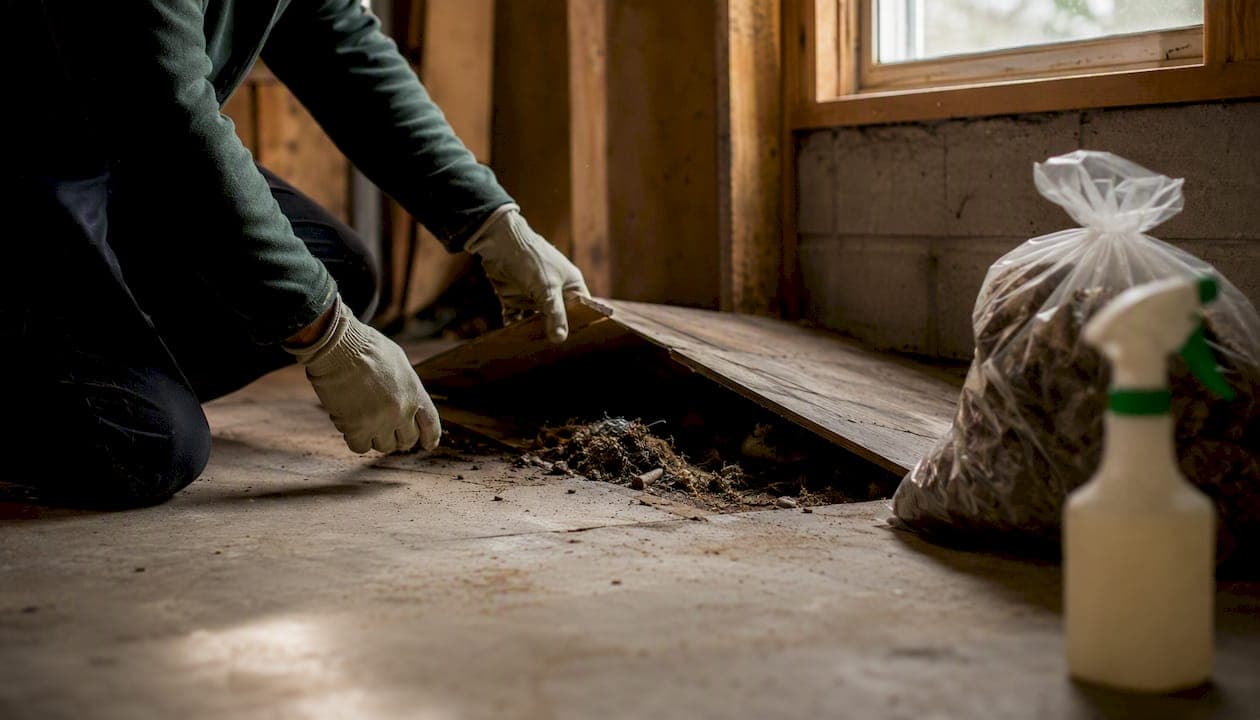
You stop rodent odor removal problems the same way every time: locate the source, ventilate the space, wet down and disinfect with a 1:10 bleach solution or an EPA-registered disinfectant, then treat what's left with an enzyme cleaner or replace it if it's too far gone. That sequence matters more than any single product you buy. Skip a step, and you're just masking a smell that will come back within days.
Here's a checklist you can start on right now, before you read another word:
- Open windows and run fans to ventilate the room for at least 30 minutes.
- Close off the area from pets and kids while it airs out.
- Put on gloves, an N95 mask, and eye protection before touching anything.
- Walk the room slowly and note where the smell gets stronger, not weaker.
- Set out an odor absorber (activated charcoal works well) near the suspected source.
- Call a professional if the smell is coming from inside a wall, ceiling, or duct you can't reach.
Pro Tip: Close the room for 20 to 30 minutes with doors and windows shut, then walk in and take one deep breath at the doorway before you start hunting. Your nose adjusts to a smell fast, so that first breath after a break is your most reliable clue to which direction to search.
Key Takeaways
Rodent odor removal works reliably when you locate the source, disinfect with a CDC-backed method, and treat or replace whatever porous material absorbed the contamination.
| Point | Details |
|---|---|
| Find the source first | Use the 30 minute stagnation method and check wall cavities, insulation, and ducts before cleaning anything. |
| Never dry-clean droppings | Wet debris before touching it to avoid aerosolizing pathogens, per CDC guidance. |
| Match the disinfectant to the job | Use a 1:10 bleach solution or an EPA-registered disinfectant with a minimum 5-minute dwell time. |
| Pick the right product category | Enzyme cleaners target urine, absorbers target decomposition odor, air purifiers manage room air only. |
| Know when to call a pro | Bereavementcleanoutservices handles inaccessible contamination, insulation removal, and documented, insured cleanouts. |
Table of Contents
- How Do You Find the Source of a Rodent Smell?
- What Safety Gear Do You Need Before Cleaning?
- What Are the Exact Steps for DIY Rodent Odor Removal?
- Which Products Actually Remove Rodent Odor?
- How Long Does Rodent Odor Last and What Does Cleanup Cost?
- When Should You Call a Professional for Rodent Odor?
- How Do You Prevent Rodent Odor From Coming Back?
- Why Safety-First Cleanup Matters More Than a Quick Fix
- Get Professional Help With Rodent Odor and Estate Cleanouts
- Frequently Asked Questions
- Sources
How Do You Find the Source of a Rodent Smell?
You can't neutralize what you haven't found, and rodent odor removal fails most often because someone treats the room instead of the rodent. The good news is that your nose is a surprisingly precise tool once you know how to use it.
Start with the stagnation method mentioned above: seal the room for half an hour, then walk it slowly with the door barely cracked. Odor concentrates near its source and thins out as it spreads, so the spot where it hits you hardest is usually within a few feet of the problem. A single decomposing carcass can smell for close to three weeks depending on the animal's size and the room's temperature and humidity, which is why the smell often seems to appear unexpectedly and then fades over time.
Rodents hide in predictable places, so check these first:
- Wall cavities, especially near pipes or wiring where mice travel.
- Attic insulation, where nests are common and hard to spot from the trapdoor.
- Under and behind large appliances like refrigerators and dishwashers.
- Baseboards and the gaps behind them along exterior walls.
- Crawlspaces and subfloors, particularly near foundation vents.
- HVAC ducts and vents, where dead rodents sometimes fall through gaps.
- Cardboard boxes and cluttered storage areas in basements or closets.
A flashlight beam raked low across a surface will often reveal droppings or grease rub marks along a wall, the dark smudges mice leave as they repeatedly travel the same route. If you own or can borrow a moisture meter, run it along baseboards and insulation. Damp insulation near an exterior wall is a strong sign of urine saturation, not just leaks. A UV flashlight can also pick up dried urine trails on hard flooring, since uric acid fluoresces faintly under ultraviolet light in a darkened room.
Flies clustering near a specific wall or vent almost always mean a carcass, while a sharp, persistent ammonia smell without flies usually points to long-term urine buildup rather than a single dead animal.
What Safety Gear Do You Need Before Cleaning?
Don't vacuum or sweep dry rodent droppings or nesting material. That single habit, according to the CDC's cleanup guidance, is the fastest way to turn a contained mess into an airborne health hazard, because disturbing dry waste can aerosolize viruses and bacteria that you then breathe in.
Before you touch anything, gather this gear:
- An N95 or P2 respirator, not a basic dust mask.
- Disposable rubber or vinyl gloves, and a second pair if the first tears.
- Eye protection, especially if you're working overhead in an attic.
- Disposable coveralls if you're dealing with heavy nesting material or insulation.
Once you're geared up, the safe handling sequence is straightforward. Ventilate the space first, then spray the contaminated area with a bleach solution mixed at one part bleach to ten parts water, or use an EPA-registered disinfectant. Let it sit for at least five minutes before you touch anything. Only after that soak time should you scoop up droppings or wipe down surfaces, and everything goes straight into a sealed, double-bagged trash bag.
The CDC and OSHA both point to the same core risk: it's not the droppings sitting still that hurt you, it's the dust cloud created when they're disturbed dry. Wetting first isn't optional caution, it's the entire point of the protocol.
That sharp, sometimes eye-watering smell you notice in heavily contaminated spaces comes largely from ammonia and related gases released as rodent urine and waste break down, according to NOAA's chemical profile data. It's a strong enough irritant on its own to justify the mask and the ventilation, even before you factor in pathogen risk.
What Are the Exact Steps for DIY Rodent Odor Removal?
The full protocol runs in one direction: locate, ventilate, protect yourself, remove the source, disinfect, treat what's porous, dry it out, then monitor. Skipping steps or doing them out of order is the single biggest reason people end up "cleaning" the same room three times.
Gather your materials before you start: PPE, your disinfectant of choice, an enzyme cleaner such as Nature's Miracle for anything urine-related, disposable towels, sealed trash bags, box fans, activated charcoal or baking soda for lingering odor, and ideally a HEPA air purifier with an activated carbon filter for the room afterward.
- Locate the strongest-smelling spot using the sniff-triangulation method described earlier.
- Ventilate the room fully with windows open and fans running, and keep it running throughout the cleanup.
- Protect yourself with a respirator, gloves, and eye protection before disturbing anything.
- Soak and remove the carcass or waste. If accessible, remove the carcass directly, bag it, and dispose of it in an outdoor trash bin.
- Disinfect the entire area with a 1:10 bleach solution or EPA-registered disinfectant, letting it sit at least five minutes.
- Treat porous materials with an enzyme cleaner that breaks down the uric acid crystals responsible for lingering urine smell, since enzyme cleaners only work when they reach the actual contaminated material and are given time to sit.
- Dry the area thoroughly with fans, since trapped moisture invites mold on top of the odor problem you already have.
- Monitor the space over the next 24 to 72 hours and repeat treatment if any smell returns.
A few things not to do matter just as much as the steps themselves. Never vacuum or sweep dry debris. Never mix bleach with ammonia-based cleaners, which creates toxic fumes. And never run an ozone generator in an occupied home. Professionals sometimes use ozone or hydroxyl generators in controlled, evacuated settings, but that's a specialist tool, not a homeowner shortcut.
Different surfaces call for different handling. Hard floors, tile, and sealed wood generally clean up fine with disinfectant and an enzyme follow-up. Carpets and padding are trickier: light contamination can often be steam cleaned, but heavily soaked padding usually needs to be cut out and replaced, since scrubbing urine-stained carpet tends to push it deeper into the padding rather than lifting it out. Upholstery and mattresses follow the same logic. Insulation that's been used as nesting material is often a lost cause for cleaning and needs to be removed and replaced. Wall cavities may require cutting an access panel, and if the smell is coming from inside your ductwork, that's a job better suited to an HVAC vent-cleaning specialist than a spray bottle.
Pro Tip: Recheck the room after 24 to 72 hours with the windows closed again. If the smell has faded but not vanished, that's usually a sign of residual contamination in something porous, not a failed cleaning job. Treat it a second time before assuming you need to replace materials.
Which Products Actually Remove Rodent Odor?
Match the product to the problem, not the other way around. Enzyme cleaners break down urine. Absorbers pull decomposition odor out of the air. Air purifiers manage what's left floating around the room. None of them substitute for finding and removing the actual source.
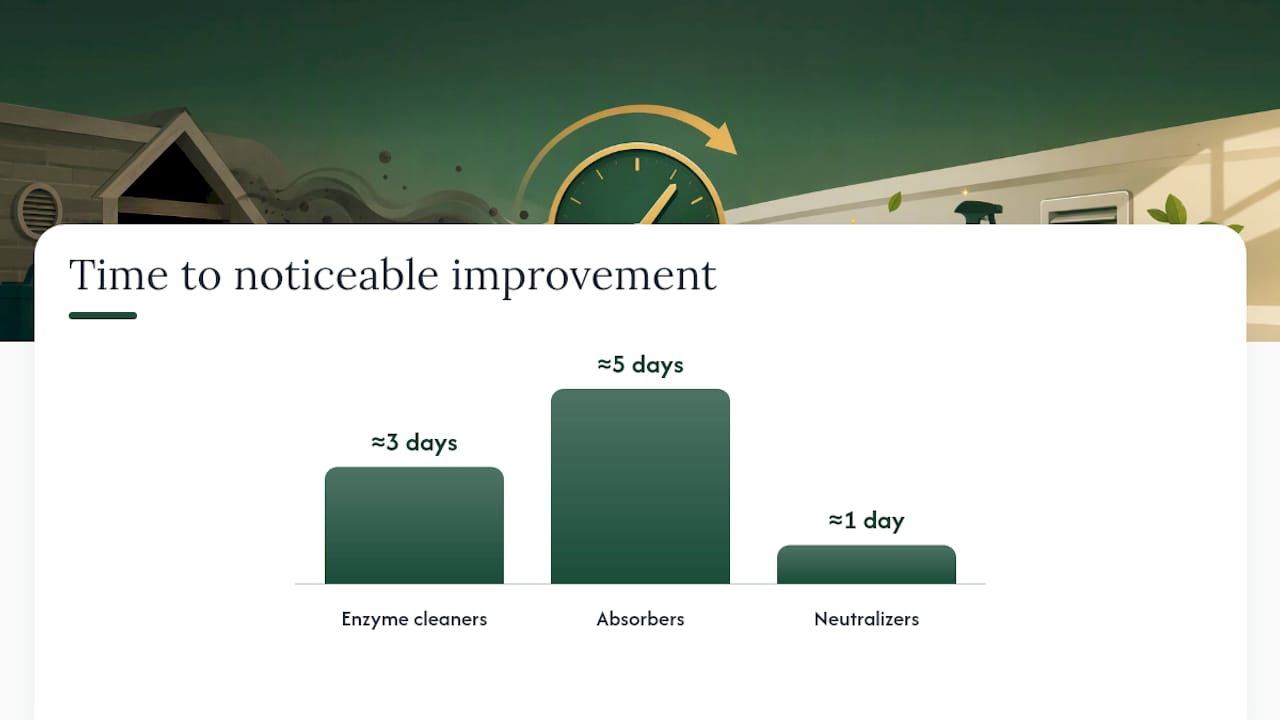
For urine odor, enzyme cleaners like Nature's Miracle or Rocco & Roxie Stain & Odor Eliminator work by breaking down the uric acid crystals that regular cleaners just can't touch. These need direct contact and enough dwell time to actually reach the contamination, which is why spraying the surface of a carpet does far less than saturating the padding underneath.
For decomposition odor from a carcass you can't fully access, granular absorbers like SMELLEZE or Rat Sorb are built specifically for that job. They pull moisture and odor out of insulation, wall cavities, and crawlspaces over several days. Zero Odor works differently, targeting odor molecules directly rather than just masking them, and it's a reasonable option for stale, lingering smell once the main source is gone.
Activated charcoal and other carbon-based absorbers are useful everywhere, but they have a real limit worth understanding upfront.
Activated charcoal and similar adsorbents reduce airborne odor temporarily, but they don't remove the underlying contamination. A HEPA air purifier with an activated carbon filter helps clean the air in a room, but it won't do anything for odor trapped inside insulation or a wall cavity.
Here's how the main categories stack up against each other:
| Product category | Best for | Application area | Safety notes | Time to noticeable improvement |
|---|---|---|---|---|
| Enzyme cleaners (Nature's Miracle, Rocco & Roxie) | Urine odor and stains | Carpet, upholstery, subfloors | Ventilate while wet; avoid mixing with bleach | Days, with repeat applications |
| Absorbers (SMELLEZE, Rat Sorb) | Carcass decomposition odor | Attics, wall cavities, crawlspaces | Non-toxic but replace/refresh regularly | Several days to a week |
| Neutralizers (Zero Odor) | Lingering, stale odor | Enclosed closets, small rooms | Follow label ventilation guidance | Hours to a few days |
| Activated charcoal/carbon | Airborne odor reduction | Any enclosed space | Not a substitute for source removal | Hours, temporary only |
| HEPA + activated carbon air purifier | Room air quality | Occupied living spaces | Never use ozone generators in occupied homes | Hours, ongoing while running |
A few cautions worth repeating before you buy anything. Enzyme cleaners fail if they never reach the actual contaminated material underneath a carpet or cushion. Absorbers only manage the smell while the source is still decomposing or drying out. They aren't a fix on their own. And air purifiers, no matter how good the filter, can't reach odor sealed inside a wall or packed into insulation.
How Long Does Rodent Odor Last and What Does Cleanup Cost?
Small, accessible problems usually clear up within a week of proper cleaning. Odor trapped behind a wall or soaked into insulation can drag on for weeks and often needs professional removal to fully resolve.
The timeline generally breaks down like this:
- Hours: Ventilation and absorbers start cutting airborne smell almost immediately.
- 1 to 7 days: Odor drops sharply once the carcass or waste is removed and enzyme treatment has had time to work.
- 1 to 3 weeks: Hidden contamination, like a nest inside a wall, keeps producing smell until it's fully located and treated.
- Weeks to months: Insulation, subfloors, or wall cavities with heavy saturation often need replacement, not just cleaning, before the smell fully disappears.
DIY costs stay low: gloves, disinfectant, an enzyme cleaner, and an absorber or two typically run you under the cost of a single professional visit. What pushes a job into professional territory is usually access work. Cutting into drywall to reach a carcass, pulling and replacing contaminated insulation, and cleaning ductwork all add labor and disposal costs that a homeowner can't reasonably do alone, especially in tight attic or crawlspace conditions.
A simple rule of thumb: if you've completed one full, proper DIY cycle including source removal and disinfection and the smell is still there after a week, or if you can't physically reach the source, budget for professional help rather than repeating the same steps a third time.
When Should You Call a Professional for Rodent Odor?
Call a professional when you can't locate the source, when the smell persists after a genuine DIY effort, or when the contamination involves insulation, ductwork, or a spot you'd need to cut into a wall to reach.
Watch for these signs that DIY has reached its limit:
- The odor is still strong a week after a full cleaning cycle.
- You or a family member develop respiratory symptoms in the affected room.
- The smell covers a large area rather than one obvious spot.
- You suspect contamination inside HVAC ducts or return vents.
- Insulation feels damp, matted, or visibly nested in.
Professional crews approach the problem differently than a homeowner with a spray bottle. They're equipped to safely remove and dispose of a carcass in a wall cavity, pull and replace saturated insulation, open and repair drywall or ceiling access points, and in some cases use hydroxyl or carefully controlled ozone treatments that require the space to be evacuated during application. Many also coordinate HVAC duct cleaning when contamination has spread into the ventilation system, since a thorough vent cleaning is not something most homeowners can safely do themselves.
Before hiring anyone, ask a few direct questions:
- Can you show proof of insurance?
- Do you have references from similar odor or biohazard jobs?
- What's your containment and disposal protocol?
- Do you use enzyme or oxidation treatments, and what's the process?
- What guarantee do you offer if the odor returns?
How Do You Prevent Rodent Odor From Coming Back?
Exclusion and sanitation stop recontamination, and that's really the whole prevention playbook. Seal the entry points, remove what's attracting rodents in the first place, cut down on clutter, and check regularly.
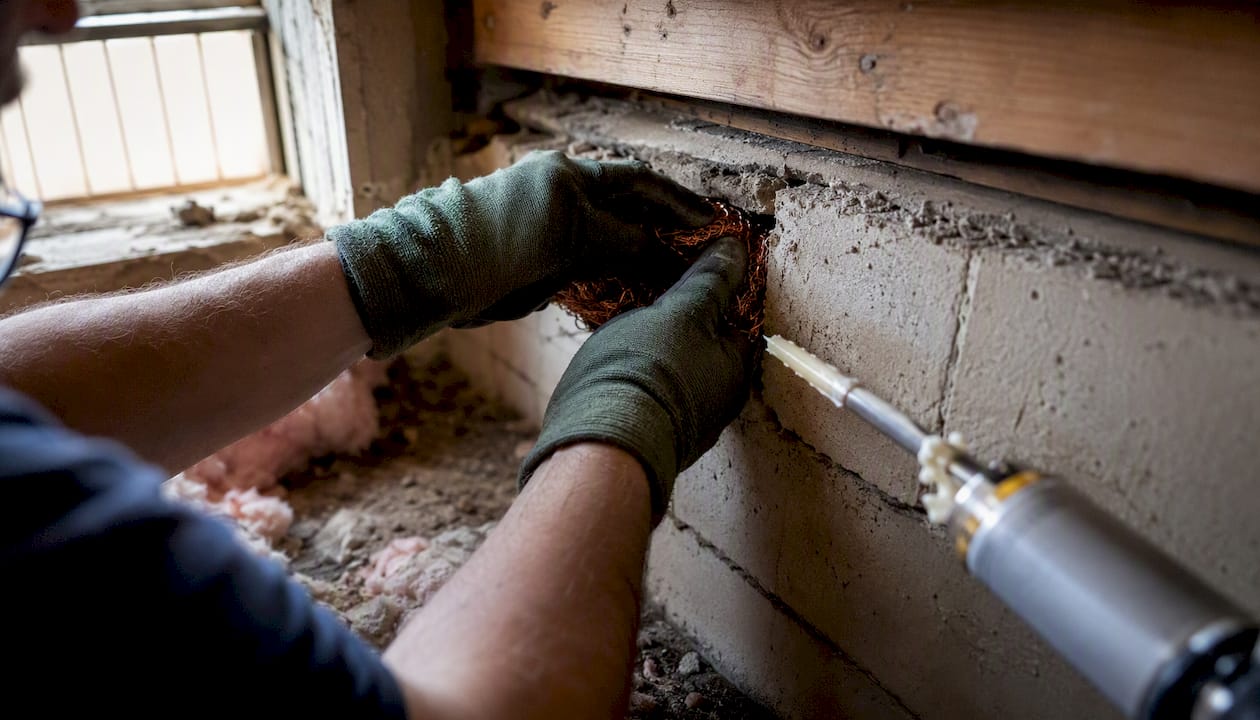
Mice can squeeze through gaps as small as a quarter of an inch, so sealing matters more than most homeowners expect. Pack steel wool into small gaps and caulk over it, since rodents generally won't chew through steel wool. Add door sweeps to exterior doors, screen chimney openings and vents, and store food, including pet food, in sealed containers rather than bags.
On the sanitation side, clean regularly under and behind large appliances where crumbs collect unnoticed, and walk your attic or crawlspace a couple of times a year looking for new droppings or nesting material before it becomes a bigger problem. Bait stations and traps have their place, but they work best as monitoring tools alongside exclusion, not as a replacement for it.
Fall and spring are the two seasons to reinforce your defenses, since rodents actively seek indoor shelter as temperatures shift in both directions. A quick perimeter check each season, looking for new gaps, chewed wiring, or fresh droppings, catches problems while they're still small and a lot cheaper to fix.
Why Safety-First Cleanup Matters More Than a Quick Fix
Odor and contamination issues show up constantly in estate cleanout work, often in homes where a family member lived alone for years and nobody caught a rodent problem until it had spread through insulation, wall cavities, and stored belongings. What stands out in those situations isn't the smell itself. It's how often people reach for a scented spray or a quick scrub instead of actually finding the source, which just delays the real fix and sometimes makes the contamination worse.
Handling these situations with care matters for more than hygiene. Estate cleanouts often involve keepsakes, documents needed for probate, and items a family still wants to sort through by hand, even in a room that's been affected by odor or pest activity. That's part of why Bereavementcleanoutservices built a donation-first approach into every job: usable items go to local charities instead of the dumpster, and every cleanout ends with a broom-clean handoff and documentation families can actually use.
If you're facing contamination that's inaccessible, extensive, or simply more than you want to handle alone during an already difficult time, a fully insured professional service is a reasonable and often better choice than pushing through a DIY job in a house that isn't yours to keep struggling with.
Get Professional Help With Rodent Odor and Estate Cleanouts
Bereavementcleanoutservices provides insured estate and odor cleanouts that locate contamination, remove biohazards safely, deodorize affected spaces, and hand the property back to you broom-clean with documentation you can use, whether that's for probate or your own peace of mind.

The service covers a full inspection to find every source of contamination, safe removal of affected materials, insulation and wall remediation where needed, deodorization, responsible disposal, and donation runs for anything still usable. It's a different situation than tackling a rodent problem alone in a house that isn't yours to keep managing, especially in the middle of an estate settlement where time, documentation, and sensitivity all matter at once. The team works with the same donation-first philosophy across every job: usable items go to local charities, keepsakes get sorted carefully, and everything is backed by fully insured operations.
If odor, clutter, or contamination in a loved one's home feels like more than you can take on right now, request a rapid inspection or estimate and get a clear plan for what needs to happen next.
Frequently Asked Questions
How do I get rid of mouse urine smell in carpet? Blot up any wet urine first, then apply an enzyme cleaner like Nature's Miracle directly to the padding, not just the carpet surface, since scrubbing pushes urine deeper into porous material rather than lifting it out. If the padding is heavily saturated, cutting it out and replacing that section is usually faster and more reliable than repeated treatments.
What is the fastest way to eliminate rodent odor in a room? Ventilate immediately with open windows and fans, then locate and remove the source. Absorbers like activated charcoal or a HEPA purifier with an activated carbon filter reduce airborne smell within hours, but the odor only fully clears once the actual contamination is disinfected and treated.
Are natural rodent odor solutions like baking soda effective? Baking soda and activated charcoal work as mild absorbers for lingering smell in the air, but they don't disinfect or eliminate the source. Use them alongside proper cleanup, not instead of it.
How long does dead rodent smell typically last? A single decomposing rodent can smell for up to about three weeks depending on its size and the room's temperature and humidity. Locating and removing the carcass shortens that timeline dramatically, sometimes to a matter of days.
Can I use an ozone generator to remove rodent odor myself? No. Ozone generators are unsafe in occupied homes and should only be used by trained professionals with proper evacuation procedures. Stick to ventilation, enzyme cleaners, and activated carbon air purifiers for DIY work.
When is professional rodent odor treatment worth the cost? When the source is inaccessible, such as inside a wall or duct, or when insulation and subfloors are heavily contaminated, professional remediation is usually faster and more thorough than repeated DIY attempts. It's also the safer route when a homeowner isn't equipped to handle insulation removal or drywall access work.
Sources
- CDC — Rodent control and cleanup guidance
- OSHA — hazardous incident bulletin on aerosol hazards
- NOAA Chemical Database — chemical profile
Always follow the manufacturer's instructions on any cleaning product you use, and never mix bleach with ammonia-based cleaners or other chemicals.