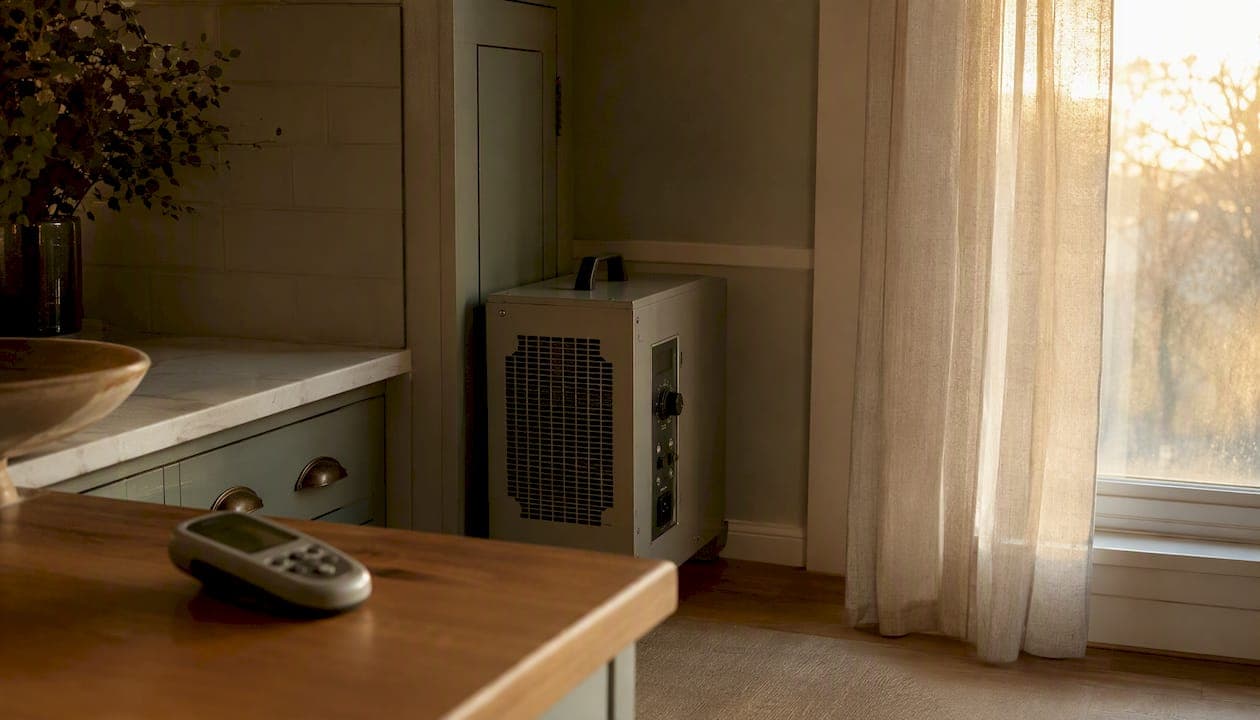
Ozone treatment can reduce certain stubborn odors, but only in vacant, thoroughly cleaned spaces and only at concentrations that exceed safe human exposure limits. The EPA is direct on this point: ozone at concentrations safe for people is largely ineffective against many odor-causing chemicals, and the concentrations that do work require complete evacuation of the space. That single fact shapes every decision in this guide.
Three ozone generator lines come up consistently in restoration and rental contexts:
- OdorFree — high-output units suited for vacant apartments and post-fire smoke remediation in larger spaces
- OdorStop — mid- to high-range generators with safety timers and remote controls, used in medium homes, vehicles, and small commercial spaces
- Enerzen — affordable consumer and light-industrial units commonly used for cars, closets, and single-room treatments
When the job involves persistent odors after a loss, extensive contamination, or a property that needs to be safely cleared and handed over, a professional service like Bereavementcleanoutservices is the safer and more reliable path than a DIY ozone run.
Key Takeaways
Ozone treatment reduces certain residual odors only in vacant, thoroughly cleaned spaces, and safe concentrations require complete evacuation and post-treatment clearance testing before re-entry.
| Point | Details |
|---|---|
| Ozone works only after source removal | Cleaning and removing contaminated materials must come before any ozone treatment; ozone cannot substitute for this step. |
| Safe levels are largely ineffective | The EPA confirms that ozone at concentrations safe for people does not reliably remove many odor-causing chemicals. |
| Match the unit to the space | OdorFree suits large vacant spaces; OdorStop fits medium homes and vehicles; Enerzen covers cars and small rooms. |
| Clearance testing is mandatory | Use a calibrated ozone meter to confirm levels are below 0.05 ppm before re-entering any treated space. |
| Bereavementcleanoutservices for complex jobs | For persistent odors, estate situations, or large properties in New Jersey, professional assessment and remediation is the safer and more reliable option. |
Table of Contents
- Which ozone generator fits your situation?
- How do you choose the right ozone generator?
- How does ozone actually work on odors, and what are the safety rules?
- When should you use ozone, and when should you hire a professional?
- What practitioners actually recommend
- When professional odor remediation is the right call
- Sources
Which ozone generator fits your situation?
The three brands above cover most residential and light-commercial use cases, but they are not interchangeable. Output, safety features, and price band vary enough that choosing the wrong class of unit wastes time and money, and in some cases creates risk.
| Product | Best for | Ozone output / coverage | Safety features | Price band | Portability | Warranty / support |
|---|---|---|---|---|---|---|
| OdorFree | Vacant apartments, rental turnovers, post-fire smoke | High output; rated for larger vacant spaces | Timer; designed for unoccupied use | Mid to high; rental and purchase | Moderate; restoration-grade build | Manufacturer warranty; restoration channel support |
| OdorStop | Medium homes, vehicles, small commercial spaces | Mid to high; adjustable output on most models | Timer, remote control, lockout on most models | Mid-range; consumer and pro tiers | Good; compact enough for vehicle use | Manufacturer warranty; widely available |
| Enerzen | Cars, closets, small rooms; occasional light commercial | Lower to mid; suited for small enclosed spaces | Basic timer on most models | Budget to mid; consumer pricing | Highly portable; lightweight | Standard consumer warranty |
OdorFree
OdorFree units are built for the restoration market. The output levels are high enough to treat a vacant two- or three-bedroom unit after a fire or heavy smoke event, which is why restoration contractors and rental property managers reach for them. They are not designed for occupied spaces, and the manufacturer documentation reflects that. If you are managing a post-fire rental turnover or a vacant unit with embedded smoke residuals, OdorFree sits at the right output tier. Renting before buying makes sense here: these units are expensive, and most landlords run this treatment infrequently enough that rental is the better economic choice.
OdorStop
OdorStop occupies a practical middle ground. The combination of adjustable output, built-in timers, and remote controls on most models means you can set a timed treatment, leave the space, and re-enter after ventilation without guessing at timing. That safety architecture matters. Vehicles and medium-sized rooms are the sweet spot; the portability is good enough to move between a car and a spare bedroom without difficulty. Consumer and professional tiers exist, so the price range is wider than Enerzen but narrower than full restoration equipment.
Enerzen
Enerzen is the entry point. For a single car interior or a small closet with a pet odor problem, an Enerzen unit is often sufficient and costs a fraction of professional-grade equipment. The trade-off is output ceiling: these units are not rated for large spaces, and pushing them beyond their coverage spec produces little additional benefit. They are widely available online and in home improvement stores, which makes them convenient for one-off treatments.
A word on marketing claims. Many consumer ozone listings use terms like "air purifier" or "odor eliminator" without disclosing evacuation requirements or output limitations. Consumer science reviews and vendor analyses have found that peer-reviewed tests often show no meaningful odor removal at safe concentrations. Read the actual output specs in mg/hr or g/hr, not the marketing copy.
Pro Tip: If you run any ozone treatment, use a calibrated ozone meter to verify that levels have returned to safe limits (below 0.05 ppm, the EPA's public health standard) before re-entering the space. Do not rely on smell alone.
How do you choose the right ozone generator?
Output rating, safety features, and honest coverage claims are the three criteria that separate a useful unit from a risky or ineffective one.
Selection criteria
- Output in mg/hr or g/hr — Ignore vague "coverage area" claims unless the manufacturer also states the output rate. A unit rated for 1,000 sq ft at low output is not the same as one rated for 1,000 sq ft at restoration-level output.
- Timer and remote control — A built-in timer that shuts the unit off automatically is non-negotiable for safe use. Remote controls add a layer of safety by keeping you out of the space during operation.
- Lockout or safety interlock — Some professional units include a lockout that prevents re-entry during treatment. This is worth paying for in larger spaces.
- Ozone monitor compatibility — The unit should be usable alongside a standalone ozone meter. If a seller discourages monitoring, that is a red flag.
- Build quality and service life — Restoration-grade units (OdorFree, professional OdorStop tiers) are built for repeated use. Consumer units (Enerzen) are adequate for occasional treatments but may not hold up to frequent commercial use.
- Warranty and written safety documentation — Any reputable seller provides written instructions that include evacuation requirements, ventilation timing, and clearance guidance.
Questions to ask before you buy or rent
- What is the output in mg/hr or g/hr, and what is the basis for the coverage claim?
- Has the unit been third-party tested, and can you share those results?
- What ozone meter do you recommend for clearance testing?
- What is the recommended treatment duration for my space size?
- How long should I ventilate before re-entry?
- Do you provide written safety instructions that include evacuation requirements?
- What is the return or exchange policy if the unit does not perform as described?
Red flags
- Marketing language that contradicts EPA guidance (e.g., "safe to use while occupied," "no need to leave the room")
- No timer or automatic shutoff
- No written safety instructions or evacuation guidance
- Seller discourages or dismisses the use of an ozone meter
- Coverage claims with no stated output rate
Typical price ranges
Consumer units like Enerzen run roughly $50–$200 for purchase. Mid-range units like OdorStop consumer tiers fall in the $200–$600 range. Professional-grade systems like OdorFree restoration units can run $600–$2,000 or more for purchase; rental from a restoration supplier typically costs $75–$200 per day depending on output class. For a one-time treatment, rental is almost always the better value unless you manage multiple properties regularly.
How does ozone actually work on odors, and what are the safety rules?
Ozone (O3) is an unstable molecule that reacts with other compounds by donating its third oxygen atom. When it contacts certain odor-causing molecules, particularly unsaturated organic compounds found in smoke, it can break them down chemically. That is the mechanism behind ozone odor removal, and it is real. The limits are equally real.
IAQ Science at Lawrence Berkeley National Laboratory notes that ozone reacts slowly with many indoor VOCs, and that those reactions can produce harmful byproducts including aldehydes and ultrafine particles. Research by Britigan et al. published in the Journal of the Air & Waste Management Association confirms that ozone reacting with indoor organic films can generate formaldehyde and ultrafine particles under realistic indoor conditions. You are not simply neutralizing odors; you are introducing a reactive gas that creates its own chemistry in the space.
AirNow's guidance frames this clearly: ozone is beneficial in the upper atmosphere but harmful at ground level, where it irritates lungs and reacts with indoor VOCs to form additional pollutants. The paradox is that the concentrations needed to affect odor molecules are the same concentrations that damage respiratory tissue.
Effectiveness by odor type
- Smoke odor — Ozone can reduce residual smoke odor in vacant, post-cleaning spaces, particularly surface-level and airborne residuals. It does not penetrate deeply into porous materials like drywall or subfloor that have absorbed smoke over time.
- Pet urine — Ozone is largely ineffective against urea-based compounds in pet urine unless the contaminated materials have already been removed or replaced. The chemistry does not break down urea well.
- Mold odor — Ozone may reduce musty surface odors temporarily, but it does not kill mold embedded in building materials and does not address the moisture source driving mold growth.
- General VOCs — Reaction rates are slow, and byproduct formation is a real concern. Activated carbon filtration is often a safer and more effective alternative for ongoing VOC control.
The professional ozone shock treatment: step by step
The NADCA white paper describes ozone as a finishing step used only after thorough inspection, cleaning, and removal of contaminated materials. The sequence matters.
- Inspect and identify sources — Find and remove or replace contaminated materials (soaked carpet, damaged drywall, urine-saturated padding). Ozone cannot substitute for this step.
- Clean thoroughly — Wipe surfaces, clean HVAC components, and address any biological contamination before introducing ozone.
- Dry the space — Moisture slows ozone reactions and can contribute to byproduct formation. The space should be as dry as possible.
- Seal and contain — Close windows and doors. Remove plants, pets, and any people. Post visible warning signs at all entry points.
- Run a timed treatment — Set the timer based on space size and unit output. Do not exceed the recommended duration.
- Allow dwell time — Leave the space sealed for the manufacturer-recommended period after the unit shuts off.
- Ventilate — Open windows and run fans for at least 30–60 minutes before re-entry.
- Test with an ozone meter — Confirm levels are below 0.05 ppm before anyone enters. Do not skip this step.
Pro Tip: Restoration guides from practitioners like those at Breathe Better Air consistently reinforce the same sequence: clean first, dry, then ozone as a finishing step. Skipping source removal and going straight to ozone is the most common DIY mistake.
When should you use ozone, and when should you hire a professional?
The right answer depends on the odor source, the space, and whether the contamination has been fully addressed.
Scenario-based guidance
- Car interior with smoke or pet odor (post-cleaning) — A consumer unit like Enerzen or a mid-range OdorStop is a reasonable option after you have cleaned surfaces and removed contaminated materials. Keep the car unoccupied during treatment.
- Vacant rental unit with residual smoke odor (post-cleaning) — An OdorFree or professional OdorStop unit is appropriate after thorough cleaning and material removal. Measure ozone levels before re-entry.
- Recent fire damage — Source removal and professional cleaning come first. Ozone finishing may help with residual airborne odor in a vacant space, but structural materials that have absorbed smoke typically need replacement, not ozone.
- Active pet urine contamination — Remove and replace saturated materials first. Enzyme cleaners applied to subfloor and framing are more effective than ozone against urea compounds. Ozone finishing is optional after materials are replaced and surfaces are clean.
- Mold or moisture odor — Address the moisture source first. Ozone does not remediate active mold. HEPA air purifiers with activated carbon are a safer ongoing option.
- Large or multi-unit property — Professional remediation is the practical choice. Managing ozone treatments across multiple units simultaneously requires equipment, monitoring, and coordination that DIY approaches cannot safely provide.
Practical alternatives to ozone
- HEPA air purifiers with activated carbon — Effective for ongoing VOC and odor control in occupied spaces; no evacuation required. For embedded surface odors in mattresses and upholstery, deep-cleaning services address the source directly rather than treating the air around it.
- Enzyme cleaners — The right tool for biological odors (urine, vomit, decomposition residuals). They break down the organic compounds ozone cannot reach.
- Thermal fogging — A professional technique that uses a deodorizing solution in a fine fog to penetrate porous materials; useful for smoke odor in occupied structures where ozone is not appropriate.
- Hydroxyl generators — Produce hydroxyl radicals that react with VOCs; can be used in occupied spaces, unlike ozone generators, making them a safer alternative for ongoing remediation.
- HVAC duct cleaning — Smoke and odor residuals accumulate in ductwork and get redistributed every time the system runs. Cleaning ducts is often a prerequisite for any odor remediation to hold.
- Thorough cleaning and material removal — The most consistently effective step. No gas treatment compensates for leaving contaminated materials in place.
When to hire a professional
Persistent odor after cleaning is the clearest signal that source removal is incomplete or that contamination has penetrated beyond surface materials. Other indicators: extensive smoke or water damage, properties with health-sensitive occupants, large or multi-unit spaces, or any situation where safe clearance testing is required before re-occupancy. For allergy-sensitive households, allergy-aware cleaning approaches that address embedded allergens and odors in soft furnishings are worth considering alongside broader remediation.
The cost trade-off is real: renting monitoring equipment, managing treatment timing, and handling ventilation across a large space adds up quickly. Professional labor often costs less than the combination of rental equipment, monitoring gear, and the risk of an incomplete treatment that requires repeating.
What practitioners actually recommend
There is a gap between what ozone marketing promises and what practitioners observe in the field. Ozone is a useful finishing tool in specific, controlled conditions. It is not a remediation strategy on its own.
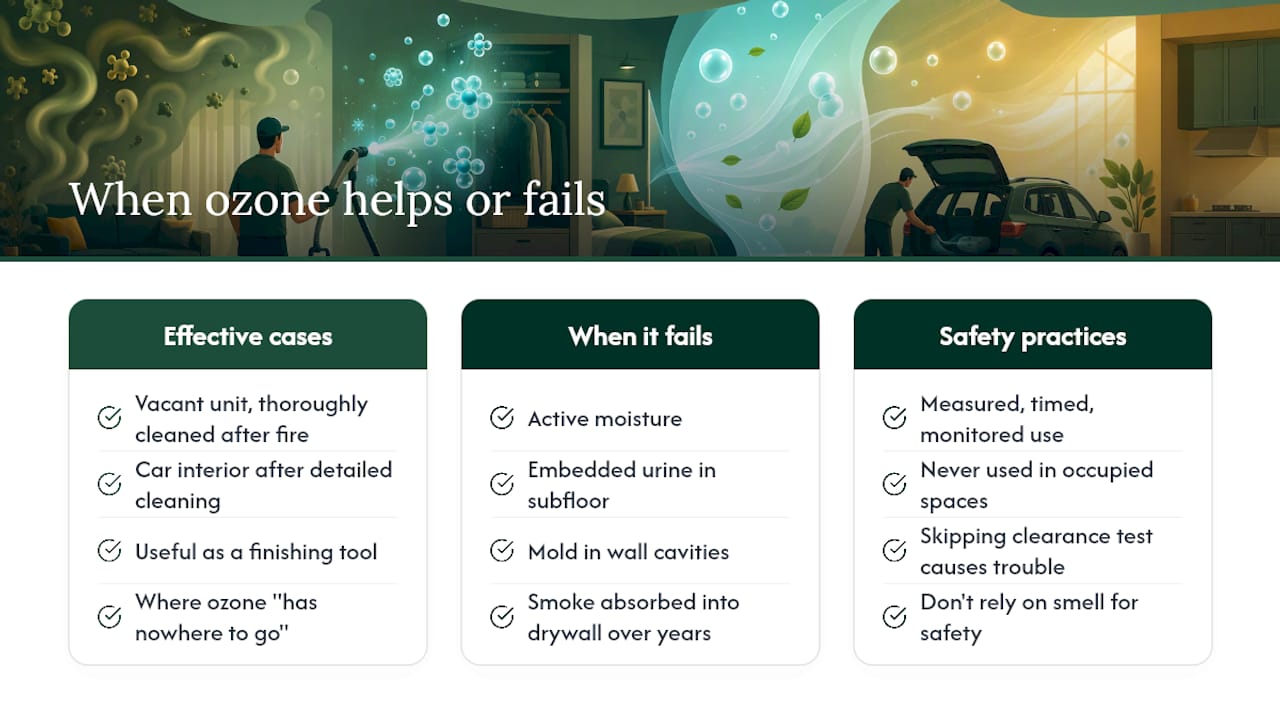
The cases where ozone has genuinely helped are narrow: a vacant unit that has been thoroughly cleaned after a fire, with surface residuals that respond to oxidation. A car interior treated after detailed cleaning, where the ozone has nowhere to go but the remaining airborne and surface molecules. Those are real wins, and they are worth acknowledging.
The cases where ozone fails are broader. Active moisture, embedded urine in subfloor materials, mold in wall cavities, smoke absorbed into drywall over years — none of these respond meaningfully to ozone. Running a high-output generator in a space with these conditions does not solve the problem. It delays proper remediation and, in some cases, creates new chemical byproducts in the process.
The safety discipline matters as much as the chemistry. Practitioners who use ozone well treat it with the same respect as any other reactive agent: measured, timed, monitored, and never used in an occupied space. The homeowners who get into trouble are the ones who run a unit overnight in a house they plan to sleep in, or who skip the clearance test because the ozone smell has faded. Smell is not a reliable indicator of safe ozone levels.
When a job involves a family home, a sensitive situation, or contamination that goes beyond surface odors, the right call is professional assessment before any treatment begins.
When professional odor remediation is the right call
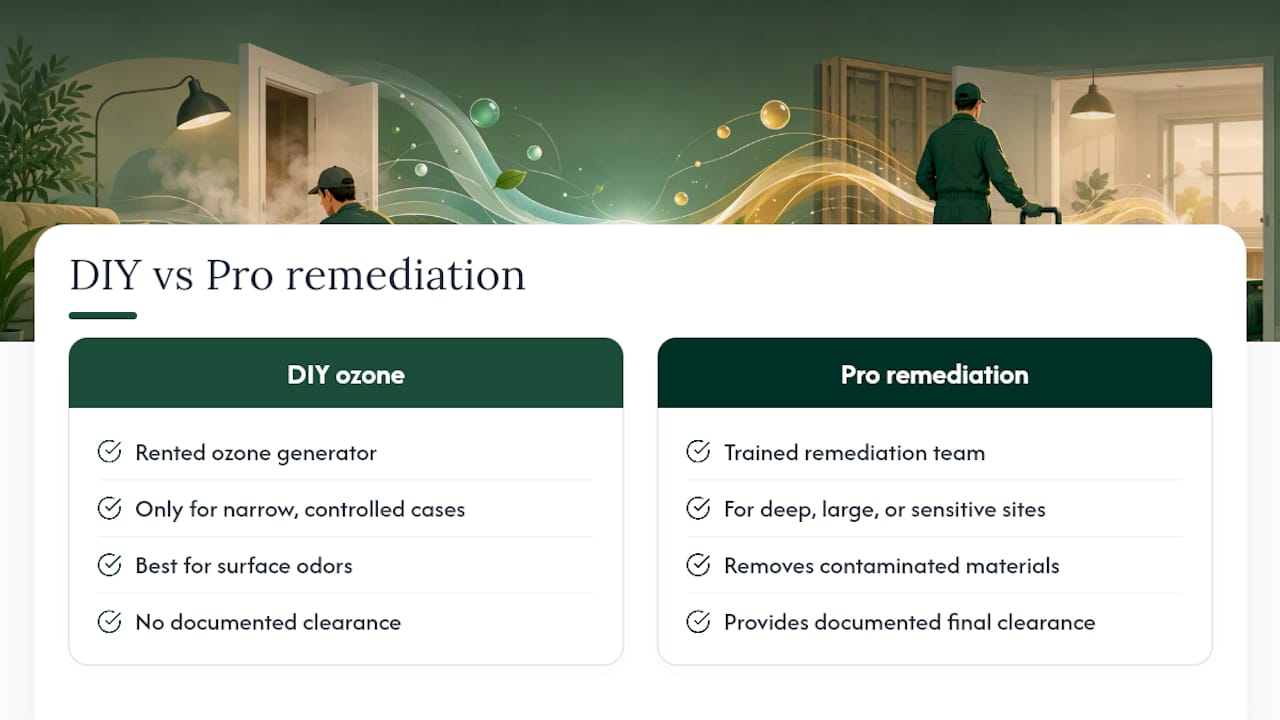
DIY ozone treatments work in narrow, well-controlled conditions. When the contamination is deeper, the space is larger, or the situation is sensitive, professional remediation delivers results that a rented generator cannot.

Bereavementcleanoutservices handles the full scope of odor and contamination remediation for New Jersey families and property managers: estate and home cleanouts, removal of contaminated materials, biological waste cleaning, HEPA cleaning, and controlled deodorization finishing where appropriate. The team works in situations where odor is not just a nuisance but a sign of deeper contamination, and where the people involved need a service that is discreet, thorough, and fully insured.
If you have cleaned a space and the odor persists, that is the signal that source removal is incomplete. Bereavementcleanoutservices can assess the property, identify what needs to come out, and handle the remediation from material removal through final clearance. For complex jobs, estate situations, or any property where re-occupancy requires documented clearance, contact Bereavementcleanoutservices to schedule a walkthrough and get a firm quote.
Sources
These are the primary agency and research sources cited throughout this article. Review them before attempting any DIY ozone treatment.
- Ozone generators that are sold as air cleaners — EPA
- Ozone facts — AirNow
- Ozone reactions on indoor surfaces — UCI aerosol chemistry (Britigan et al., JAWMA 2006)
Consult these sources directly before purchasing or renting an ozone generator, and follow their guidance on evacuation, ventilation, and clearance testing.
This article is general information, not a substitute for advice from a qualified doctor. Consult a qualified healthcare professional about your own circumstances before acting on anything here.