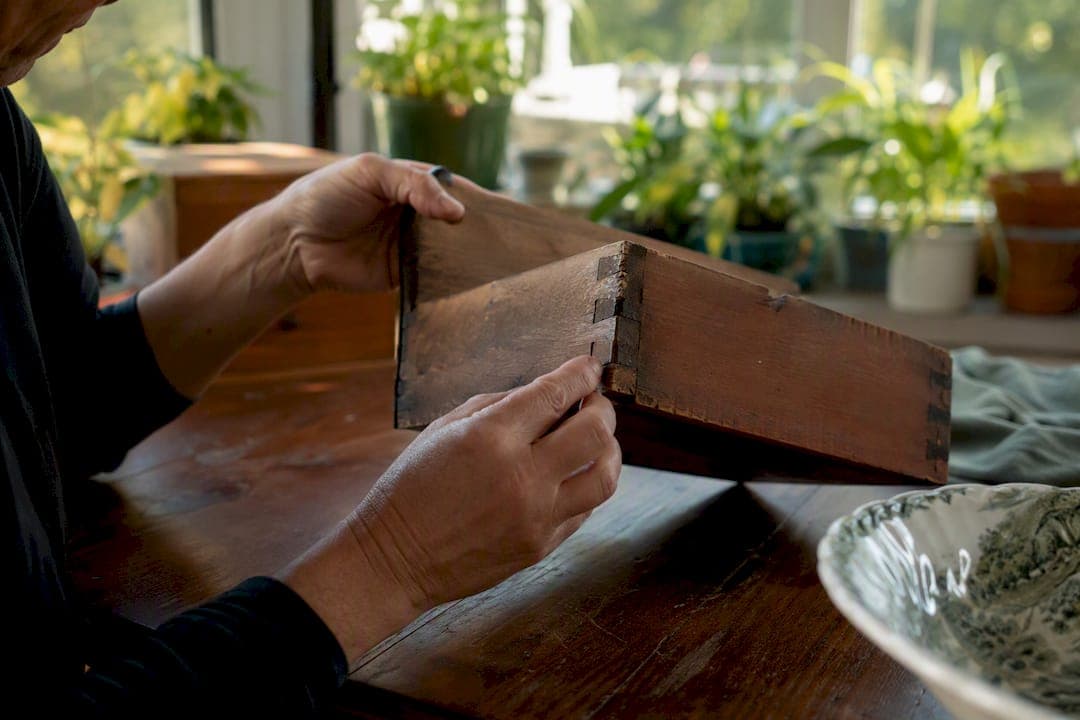
Four physical clues predict whether a piece of furniture might be valuable: authentic hand-work in the construction (hand-cut dovetails, mismatched secondary woods), an original, unstripped finish, a maker's mark or label, and a style currently in demand, like mid-century modern or high-quality Arts and Crafts. Check all four before you decide what to keep, sell, or donate.
Here's the three-minute field version. Pull a drawer all the way out. Look underneath the piece and behind it. Check the screws and the dovetail joints. Run a finger along any veneer edge to feel its thickness. Photograph any label or stamp you find, front and back, in good light.
- Hand-cut dovetails that are slightly irregular, paired with different wood species on the drawer bottoms versus the front
- An untouched finish with real patina, not a glossy, uniform refinish
- A maker's mark, paper label, or branded stamp somewhere hidden
- A recognizable, currently sought-after style
Walk away fast if you spot plywood or particle board where structure should be solid wood, perfectly uniform "hand-cut" dovetails, Phillips-head screws inside a piece someone claims predates 1936, or heavy stripping and repainting that's erased the original surface.
Key Takeaways
Authentic construction, original finish, a documented maker's mark, and current style demand together determine whether a piece of furniture is genuinely valuable.
| Point | Details |
|---|---|
| Check joinery first | Irregular hand-cut dovetails and mismatched secondary woods suggest pre-industrial construction. |
| Protect the original finish | Stripping can cut value by 30 to 50 percent, so avoid refinishing before research. |
| Document every mark | Photograph labels, stamps, and tags in hidden spots before cleaning or moving a piece. |
| Trust sold prices, not listings | Build a cluster of three or more completed sales before estimating value. |
| Bring in professionals for high stakes | Bereavement Cleanout Services documents and photographs valuable pieces during estate cleanouts so families have what a credentialed appraiser needs. |
Table of Contents
- How to Identify Valuable Furniture Through Construction and Joinery
- Matching Style and Period to Estimate Age and Demand
- What Wood and Finish Reveal About Authenticity
- Finding Maker's Marks and Building a Provenance File
- Reading Condition, Repairs, and Structural Soundness
- The Thrift-Store Checklist for High-Yield Finds
- Researching Market Value with Sold Comps and Auction Data
- When to Bring In a Professional Appraiser
- Common Counterfeits and How to Spot Them
- Identifying Valuable Furniture by Function and Rarity
- Regional and Cultural Significance in Furniture Valuation
- What Estate Work Teaches You About Spotting Value Fast
- How Bereavement Cleanout Services Handles Valuable Furniture During an Estate Cleanout
- Sources
How to Identify Valuable Furniture Through Construction and Joinery
Joinery tells you more than any label ever will, because it's the one thing nobody thinks to fake convincingly. Hand-cut dovetails are irregular. Machine-cut ones are uniform, tight, and mechanically perfect, and their presence usually points to production after the mid-1800s. Circular-saw marks (arced, evenly spaced) and band-saw marks (straight, parallel) both signal post-industrial manufacture; a hand-plane leaves faint, irregular ripples instead.
Secondary woods matter as much as the wood you can see. Drawer bottoms, backboards, and interior rails were historically made from cheaper, local species, so a mismatch between the show wood and the hidden wood is normal and expected, not a red flag. What is a red flag: plywood or particle board in those hidden areas on a piece claimed to be pre-1900.
Screws and nails carry their own timeline. Handmade screws have off-center, uneven slots. A Phillips-head screw tucked inside a drawer runner or hinge plate is a hard stop for any pre-1936 claim.
Before you go further, take these photos:
- The full piece, front and side, in natural light
- Every drawer bottom and the underside of the case
- Any label, stamp, or brand mark, close up
- A joint detail shot of at least one dovetail
- The hardware, including screw heads
Pro Tip: Photograph the underside of drawers even when nothing looks unusual. Reviewing that shot later, side by side with a comparable sold listing, is often how you catch a mismatch you missed on-site.
Matching Style and Period to Estimate Age and Demand
Once you've checked construction, style narrows the window fast. Queen Anne pieces show curved cabriole legs and shell carvings. Chippendale adds ornate claw-and-ball feet and heavier proportions. Federal favors straight, tapered legs with inlay rather than carving. Victorian pieces tend toward dark, heavily ornamented surfaces and machine-turned spindles. Arts and Crafts is blocky, quarter-sawn oak with exposed joinery as a design feature, not something hidden. Mid-century modern is clean-lined, tapered, and often teak or walnut.
A simple decision tree gets you close fast:
- Heavy and dark, ornate carving → likely Victorian or Chippendale
- Light and straight-legged, minimal ornament → likely Federal or mid-century
- Curved legs, shell or scroll motifs → likely Queen Anne
- Exposed joinery, flat panels, quarter-sawn oak grain → likely Arts and Crafts
Watch for style mismatches. A piece styled as 18th-century Chippendale with machine-cut dovetails and plywood drawer bottoms isn't Chippendale. It's a later reproduction wearing the right clothes.
What Wood and Finish Reveal About Authenticity
Mahogany, walnut, and quarter-sawn oak dominate the pieces collectors chase, and each was used in identifiable ways by era. Veneer thickness is a fast tell: pre-industrial veneers were hand-cut and tend to run noticeably thicker than the paper-thin veneers used after the 1900s, so run a fingernail along an exposed edge and compare.
Two simple finish tests help, applied carefully and only on an inconspicuous spot: a cotton swab with denatured alcohol will soften shellac (a common pre-1920s finish) but won't touch modern lacquer or polyurethane, and a swab with diluted ammonia reacts against old milk paint. Test on the underside or back, never on a visible surface, since even a small solvent mark can itself hurt value.
Original finish carries real weight. Stripped and refinished pieces commonly sell for 30 to 50 percent less than comparable pieces with intact original surfaces, because patina is one of the clearest authenticity markers a buyer can see without tools.
Finding Maker's Marks and Building a Provenance File
Marks hide in predictable places. Check the underside of drawers, the back panel, interior rails, and any area with a small brass plate or paper label still attached.
- Look for paper labels first, since they're the most fragile and the first thing lost to water damage or refinishing.
- Check for ivorine tags (thin, ivory-colored plastic or celluloid plaques), common on furniture made from the 1920s through the 1950s.
- Look for embossed or stamped metal tags, often screwed to the back rail.
- Run a hand along interior surfaces for a carved signature or incised mark.
Types of marks each carry their own dating cues: a specific label typeface, a company address that only existed for a narrow window of years, a patent date. Photograph every mark you find, then build a provenance file: receipts, family letters, estate inventories, even a dated photo of the piece in a relative's home. Present that file, not just the piece, to any appraiser or buyer.
Reading Condition, Repairs, and Structural Soundness
Stripping an original finish is one of the fastest ways to erase value, since it removes the tool marks, shellac layers, and oxidation that experts use to date and authenticate a piece. Refinished antiques regularly sell for a third to half less than unrestored comparables, for exactly that reason.
Watch for these repair red flags:
- Plywood or particle board patches inside a case claimed to be pre-1900
- Non-period hardware, like modern cam-lock fasteners or plastic knobs
- Replaced drawer bottoms that don't match the wood grain elsewhere in the piece
- Secondary woods that are inconsistent from drawer to drawer
Run a quick structural check before you commit time to anything else. Give the piece a gentle wobble test at the top. Check hinges for stripped screw holes and drawer runners for splits. Look for small exit holes or soft, crumbly wood, both signs of past insect damage or dry rot.
Pro Tip: A wobbly frame or a stuck drawer isn't automatically a deal-breaker. Structural conservation by a qualified restorer can preserve value on a genuinely rare piece, but it rarely makes financial sense on a common one. Get a value estimate before you pay for repair.
The Thrift-Store Checklist for High-Yield Finds
Certain categories reward a second look every time: signed mid-century case goods, anything in the Stickley or Arts and Crafts family, solid-wood dressers and secretaries with dovetailed drawers, pieces with unusually figured veneer, and anything still wearing its original hardware.
- Photograph the whole piece, any label, and a joint detail before you even ask the price.
- Ask the seller where the piece came from and how long they've had it. A clear answer helps; a vague one doesn't disqualify anything.
- Check for the deal-breakers covered earlier: plywood in hidden areas, Phillips screws where they shouldn't be, and heavy overpaint.
- If the price feels high, reference a comparable sold price and make your case calmly rather than walking away.
Solid, well-marked, structurally sound pieces in currently desirable styles like mid-century modern and Arts and Crafts tend to outperform generic "brown furniture" by a wide margin in today's market.
Researching Market Value with Sold Comps and Auction Data
Asking prices are noise. Sold listings are signal, and the goal is finding a cluster of three or more comparable completed sales, not one outlier. A single $4,000 hammer price on an unusual piece tells you almost nothing if nothing else has sold near that number in the last year or two.
When you're comparing, adjust for the differences that actually move price:
- Condition gaps (original finish vs. refinished, minor repair vs. major restoration)
- Documented provenance versus none at all
- Shipping difficulty, since large or fragile case pieces often sell for less locally than their auction-house comparables suggest, simply because buyers have to factor in freight
Pull comparables from auction house archives, completed and sold filters on general marketplaces, and specialist furniture auction databases. Treat any single extreme result as an outlier until you find company for it.
When to Bring In a Professional Appraiser
A written appraisal becomes necessary, not optional, in three situations: settling an estate, insuring a piece at replacement value, or claiming a donation tax deduction. Formal appraisals typically take one to three weeks from walkthrough to finished report.
Look for credentials from the ISA (International Society of Appraisers), ASA (American Society of Appraisers), or AAA (Appraisers Association of America). A defensible report includes a full description, condition notes, provenance, methodology, and comparable sales.
When a family is sorting through decades of belongings under time pressure, the difference between "we think this might be worth something" and a documented, photographed inventory is often the difference between a fair price and a rushed guess.
Bereavement Cleanout Services builds that documentation as part of every estate cleanout: photographed inventory, donation-first sorting that protects anything with resale or sentimental value, and organized records ready to hand to a credentialed appraiser.
Common Counterfeits and How to Spot Them
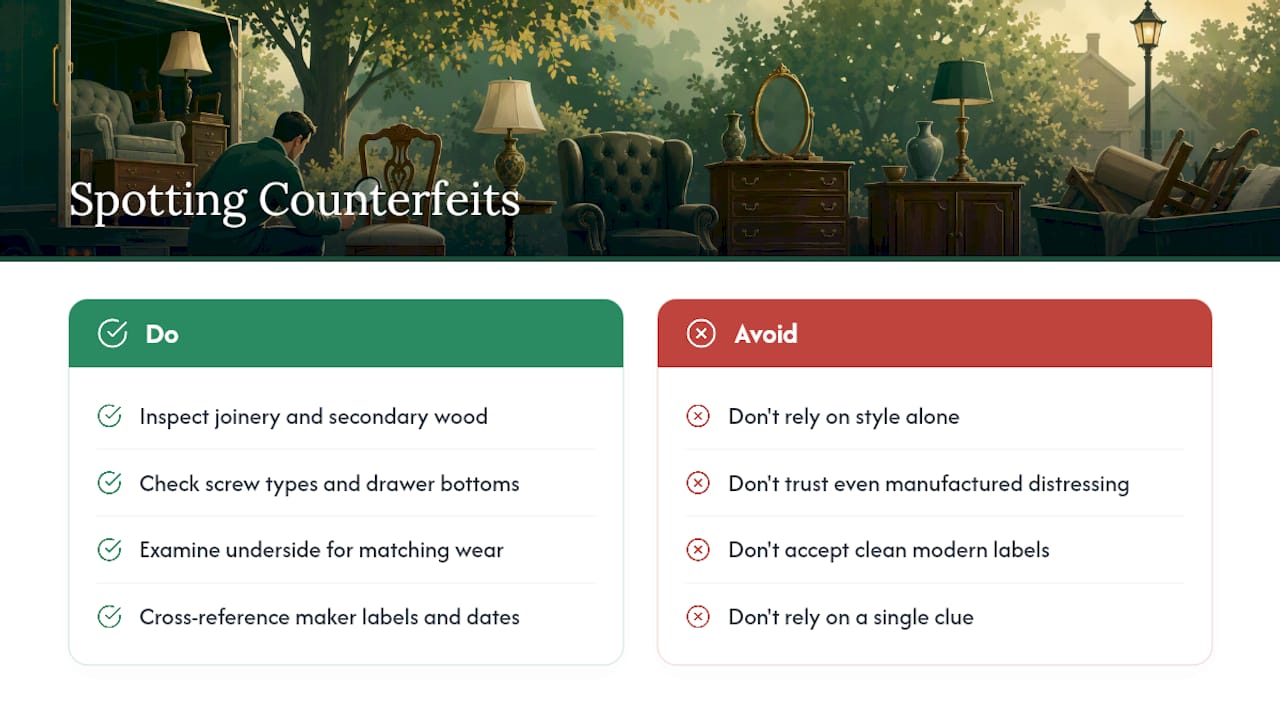
Reproduction furniture has gotten good enough that style alone won't save you. The most common counterfeit pattern is a piece built with modern methods but dressed in period styling: a "Queen Anne" table with machine-cut dovetails, a "Chippendale" chest with plywood drawer bottoms, a "Federal" sideboard with visible circular-saw marks under the finish.
Fake distressing is another common trick. Real wear accumulates in specific, logical places: chair arms where hands rested, stretchers where feet rubbed, drawer edges from decades of opening and closing. Manufactured "distressing" tends to be too even, applied with a chain or a rasp in patterns that don't match how a person would actually use the piece. Check the underside of a "worn" tabletop; if the wear doesn't continue there in a way that matches gravity and use, be suspicious.
Watch labels closely too. Some reproductions carry labels copied or loosely inspired by real historic manufacturers, printed in modern typefaces or on paper stock that looks too clean for its claimed age. Cross-reference any label's company name, address, and design against what you can find about that maker's actual production years.
The most reliable defense combines every method already covered: joinery, secondary wood, screw type, and finish, cross-checked against each other rather than relying on any single clue. A reproduction usually fails at least one of those checks even when it passes the others convincingly.
Identifying Valuable Furniture by Function and Rarity
Function drives demand as much as age does. Case pieces built for a purpose that still exists (dressers, sideboards, secretaries, bookcases) tend to hold value better than pieces built for obsolete functions, since modern buyers actually need somewhere to put clothes and dishes. A beautifully made 19th-century wash-stand, built for a function no modern home requires, often sells for far less than a plainer chest of drawers from the same era and maker.
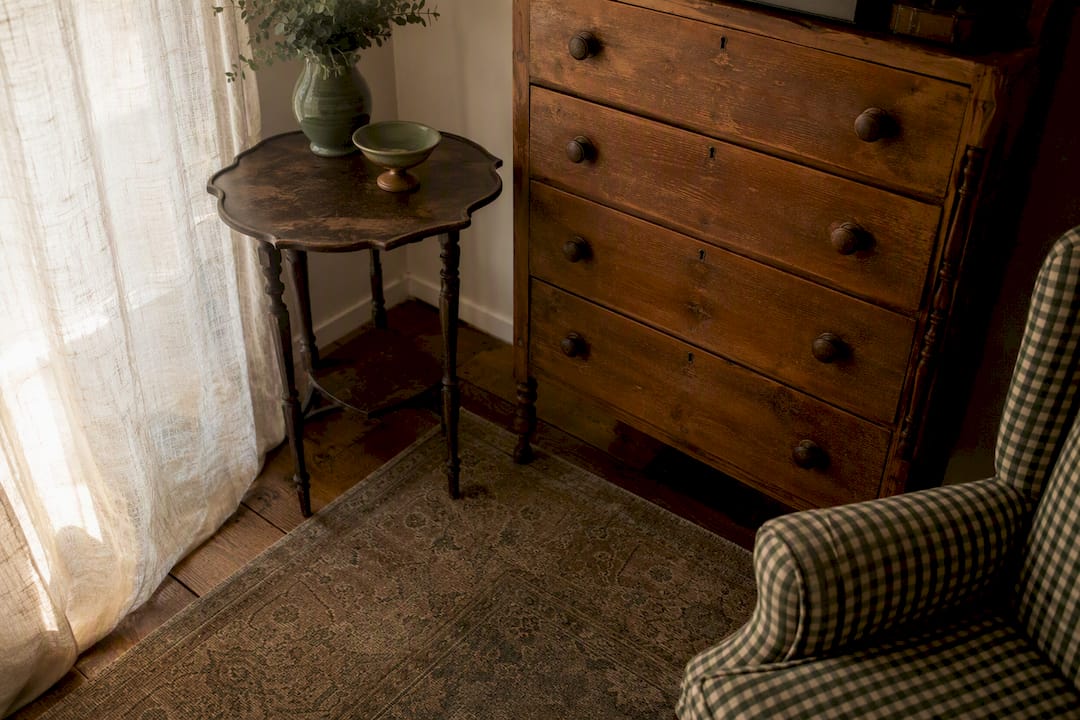
Rarity works differently than most people expect. A common form in an uncommon wood, an unusual size, or a documented limited production run can matter more than raw age. A set of matching dining chairs, especially six or more with no replacements, is consistently harder to find than a single chair, and prices scale up disproportionately for a complete, matched set versus individual pieces.
Specialty forms reward a closer look: game tables with hidden mechanisms, campaign furniture built to disassemble for travel, and transitional pieces that blend two style periods (a hint of Federal restraint on an otherwise Chippendale form, for instance) often carry premiums because they're genuinely uncommon rather than simply old.
Small case pieces and accent furniture, dressing tables, nightstands, small chests, sell more easily than large case pieces in today's market, mostly because they fit into modern homes and modern moving trucks without a specialty crew. That practical reality shapes realized prices as much as historical importance does.
Regional and Cultural Significance in Furniture Valuation
Where a piece was made, and where it's being sold, both shape its value. Furniture made in a recognized regional center, Grand Rapids case goods, Southern Appalachian folk furniture, New England Shaker pieces, tends to carry a premium among collectors who specifically seek out that region's output, even when a piece from elsewhere is otherwise comparable in quality.
Regional demand also shifts by geography. A piece that would sell quickly in a market with strong local collecting culture for that style might sit for months somewhere the local taste runs differently. Shipping cost and difficulty compound this: a large, regionally significant case piece is worth more to a buyer who can drive to pick it up than to one who has to arrange freight across the country.
Cultural context matters too, particularly with folk art furniture, painted pieces, and items tied to a specific immigrant community's craft tradition (Pennsylvania Dutch painted chests are a well-known example). These pieces are sometimes undervalued by general appraisers unfamiliar with the specific tradition, and overvalued by sellers who assume "folk" automatically means valuable. Research the specific tradition rather than treating "old and handmade" as its own category.
What Estate Work Teaches You About Spotting Value Fast
Going through a family's home under time pressure teaches you to trust the quick physical checks over guesswork. A drawer pulled to check the dovetails, a photo of a maker's mark before anything gets moved. Those few minutes of documentation, done early, are what let an appraiser or buyer make a fair call later. When the stakes are real, and they usually are during an estate cleanout, it's worth letting a professional handle the sale logistics while you focus on what actually needs a family's attention.
— Derek
How Bereavement Cleanout Services Handles Valuable Furniture During an Estate Cleanout
Finding a piece that might be worth real money in the middle of an estate cleanout changes the pace of everything, and that's exactly where a documented, donation-first process pays off. Bereavement Cleanout Services photographs and inventories notable pieces before anything moves, sorts usable items to local charities only after family members have had the chance to claim keepsakes, and hands over organized records that a credentialed appraiser can actually use for an estate settlement or insurance claim.

A consult starts with a walkthrough of the home, followed by a firm quote and a clear timeline, so there's no guessing about cost once work begins. Fees are transparent from that first quote, and when a piece looks like it could be genuinely valuable, that gets flagged before any donation or disposal decision gets made, giving the family time to pursue a professional appraisal if it's warranted. If you're facing an estate full of unknowns, request a consultation with Bereavement Cleanout Services and get a clear plan before anything leaves the house.
Sources
- To refinish or not to refinish: The great antique furniture debate | Antique Trader
- Antique furniture makers' marks — identification tips | Mumford Restoration
- Antique & vintage furniture value guide: What your pieces really fetch | InstAppraisal