
Bonds protect your clients. Insurance protects your business. That single sentence is the practical answer to the bonded vs. insured question, and everything else is detail. According to NFP, insurance shields your business assets from unexpected losses, while bonds guarantee that you will deliver on contractual promises to clients. Before you hire a contractor or bid on a contract, confirm three things:
- Request a Certificate of Insurance (COI) with policy limits and effective dates.
- Ask for the bond type, bond number, and the name of the surety company.
- Confirm the obligee name on the bond matches the client or project entity.
Forbes Advisor notes that carrying both is increasingly a prerequisite for larger clients, landlords, and government agencies, making "bonded and insured" a genuine contract-winning signal, not just marketing language.
Key Takeaways
Bonds protect clients from contractor failures; insurance protects the business from accidents and liability, and most professional service businesses need both to operate credibly and win contracts.
| Point | Details |
|---|---|
| Bonds protect clients | A surety bond guarantees performance to the obligee; the principal must reimburse the surety if a claim is paid. |
| Insurance protects the business | General liability, workers' comp, and related policies cover the business owner's losses from accidents and lawsuits. |
| Verify before you hire | Request a COI, bond number, surety name, and obligee confirmation before signing any service contract. |
| Reimbursement obligation matters | A bond claim is not free coverage; the surety will seek repayment from the principal. |
| Both are often required | Licensed trades, government contracts, and many client agreements require bonds and insurance simultaneously. |
Table of Contents
- How bonded vs. insured actually compares side by side
- What "bonded" actually means for your business
- What "insured" means in a business context
- How claims and payouts differ in practice
- Who actually needs bonds, who needs insurance, and when you need both
- How to verify that a contractor is bonded and insured
- How businesses get bonded and insured — steps, costs, and timelines
- Common misconceptions that can leave you exposed
- What bonded vs. insured means for an estate cleanout client
- Why showing proof of coverage changes everything for clients
- Sources
How bonded vs. insured actually compares side by side
The fastest way to see the difference is to look at who gets paid when something goes wrong.
| Factor | Surety Bond | Business Insurance |
|---|---|---|
| Who is protected | Client / obligee | Business owner / insured |
| Who pays the claim | Surety company (then seeks repayment) | Insurer (absorbs the loss) |
| Number of parties | Three: principal, obligee, surety | Two: insurer, insured |
| Underwriting focus | Credit history, performance record | Loss history, risk profile |
| Typical use case | Contract guarantee, license compliance | Accident, injury, property damage |
| Reimbursement obligation | Principal must repay the surety | None beyond the deductible |
A concrete example: a cleaning crew accidentally breaks a client's antique mirror. General liability insurance pays for that damage. But if that same crew abandons a job halfway through, a performance bond is what compensates the client for the incomplete work. BondsExpress confirms that small bonds can cost a few hundred to a few thousand dollars annually depending on type, while comprehensive business insurance premiums typically run higher because insurers price for expected loss rates rather than reimbursable guarantees.
What "bonded" actually means for your business
A surety bond is a three-party contract. The principal (the business) purchases the bond. The obligee (the client, government agency, or licensing board) is the protected party. The surety (the bonding company) guarantees the principal's performance and pays valid claims on the obligee's behalf.
Common bond types and their purposes:
- License and permit bonds: Required by state or local licensing boards to prove a business will comply with regulations. Common in contracting, notary work, and auto dealerships.
- Contract/performance bonds: Guarantee a contractor will complete a project per the contract terms. The SBA explains that government contracts frequently require these for bidding and project execution.
- Bid bonds: Assure the project owner that a contractor who wins a bid will actually sign the contract and provide performance and payment bonds.
- Fidelity bonds: Protect clients from employee dishonesty, including theft of money or property while on the client's premises.
Here is how a typical bond claim flows: the obligee files a claim with the surety, the surety investigates and pays the obligee if the claim is valid, and then the surety turns to the principal for reimbursement. That reimbursement obligation is what separates a bond from insurance.
What "insured" means in a business context
Business insurance is a two-party contract between the insurer and the insured. The business pays premiums, and the insurer agrees to cover specified losses up to the policy limit. Unlike a bond, the insurer absorbs the financial loss rather than seeking repayment.
Key policy types every business owner should understand:
- General liability: Covers third-party bodily injury, property damage, and advertising injury. This is the baseline policy most clients and landlords require.
- Professional liability (E&O): Covers claims that your professional advice or service caused a financial loss. Critical for consultants, designers, and service providers.
- Workers' compensation: Covers employee medical costs and lost wages from on-the-job injuries. Mandatory in most states.
- Commercial auto: Covers vehicles used for business purposes, including accidents and liability.
- Commercial property: Covers your owned or leased equipment, tools, and physical space from fire, theft, or vandalism.
- Cyber liability: Covers data breaches and related costs, increasingly relevant for businesses handling client records.
Insurance typically covers accidents, third-party injuries, and property damage. It generally does not cover deliberate fraud, contract nonperformance, or employee theft — those gaps are where bonds step in. NEXT Insurance clarifies that insurance and bonds are not interchangeable, and a standard general liability policy will not respond to a breach of contract claim the way a performance bond would.
How claims and payouts differ in practice
The operational gap between bonds and insurance becomes clearest when a claim actually happens.
With insurance, the process is relatively straightforward: you file a claim, the insurer investigates, and if the loss is covered, the insurer pays. Your only out-of-pocket cost is the deductible. The insurer absorbs the rest.
With a bond, the flow is different. The obligee files the claim directly with the surety. The surety pays the obligee if the claim is valid. Then the surety pursues the principal for full reimbursement. Insureon describes this as a contingent credit line: the surety acts as a guarantor, not a loss absorber. Surety underwriting reflects that distinction. Bond applications focus on your credit score, financial statements, and track record of completing contracts, not your claims history. Insurance underwriting, by contrast, examines your past losses, payroll size, revenue, and the nature of your work.
Bond amounts are set by the obligee or licensing authority, often as a fixed dollar figure. Insurance policy limits are chosen by the business, with higher limits costing more in premium. Neither product eliminates all risk on its own, which is why most professional service businesses carry both.
Who actually needs bonds, who needs insurance, and when you need both
Bonds are typically required when:
- You are bidding on federal or state construction contracts. The Miller Act requires performance and payment bonds on most federal construction projects above a certain threshold.
- Your state licensing board mandates a license bond as a condition of operating (common in contracting, home improvement, notary, and auto dealer work).
- A private client or property manager contractually requires a performance or fidelity bond before awarding a service contract.
Insurance is typically required when:
- You employ workers. Workers' compensation is mandatory in nearly every state.
- You sign a commercial lease. Most landlords require general liability coverage with the property owner listed as an additional insured.
- You operate vehicles for business. Commercial auto coverage is legally required in every state.
- A client contract specifies minimum liability limits before work begins.
You likely need both when you work in a licensed trade, handle client property, employ staff, and bid on contracts. For home service businesses, the combination of general liability insurance and a fidelity bond covers the two most common client concerns: accidental damage and employee dishonesty.
How to verify that a contractor is bonded and insured
Verification takes about ten minutes and protects you from significant financial exposure. Here is what to request and check:
- Certificate of Insurance (COI): Ask for a current COI showing policy type, coverage limits, policy number, and expiration date. Confirm the limits meet your contract requirements.
- Additional insured endorsement: Request that your name or entity be added as an additional insured on the contractor's general liability policy. This gives you direct rights under the policy.
- Bond details: Ask for the bond type (fidelity, performance, license), the bond number, and the name of the surety company.
- Obligee confirmation: Verify that the obligee name on the bond matches your project or entity, not a previous client.
- Direct verification: Call the insurer or surety company using the number on their official website, not the number the contractor provides. Insureon recommends contacting the issuer directly to confirm active coverage.
- State registry check: Many states maintain public license bond registries. Your state's Department of Insurance or contractor licensing board is the right starting point.
Red flags to watch for: an expired COI, a bond with a different obligee name, vague bond descriptions with no bond number, or a contractor who can only confirm coverage verbally.
How businesses get bonded and insured — steps, costs, and timelines
Getting bonded
- Identify the bond type and required amount (set by the licensing board, client contract, or project owner).
- Submit a bond application to a surety company or broker. Expect to provide financial statements, credit authorization, and business references.
- The surety underwrites your application based on creditworthiness and performance history. Small businesses with limited credit may face higher rates or collateral requirements.
- Once approved, the surety issues the bond. Simple license bonds can be issued within a day; larger contract bonds may take one to two weeks.
Getting insured
- Assess your exposures: number of employees, revenue, types of work, vehicles, and client contract requirements.
- Choose policy types and limits. General liability and workers' comp are the starting point for most service businesses.
- Submit an application to an insurer or broker. Underwriters review your claims history, payroll, and the nature of your services.
- Receive a binder (temporary coverage confirmation) within days; the formal policy follows within two to four weeks.
Pro Tip: Bundle general liability, commercial property, and business interruption into a Business Owner's Policy (BOP) when your insurer offers one. BOPs typically cost less than purchasing each policy separately and simplify renewal.
For home service contexts, understanding how insurance responds to physical damage during contracted work is worth reviewing before you set your coverage limits. Similarly, roofing bond examples illustrate how contract bonds function in practice for home service contractors.
Common misconceptions that can leave you exposed
Myth: "My insurance covers the client if I don't finish the job." Standard general liability insurance does not cover contract nonperformance. If you abandon a project, the client's remedy is a performance bond, not your insurance policy.
Myth: "Being bonded means I'm covered if my employee steals." A general surety bond does not cover employee theft. A fidelity bond does. They are different products, and conflating them leaves a real gap in client protection.
Myth: "Bonds and insurance protect the same party." They protect opposite parties. NFP states this plainly: insurance protects the business owner; bonds protect the client or public.
Myth: "If the surety pays, I'm done." The surety will pursue reimbursement from you. A bond claim is not a free pass. It functions like a credit line you are expected to repay.
Myth: "Small businesses don't need bonds." Many state licensing boards require bonds regardless of business size. Skipping a required license bond can result in fines, license suspension, or contract voidance.
What bonded vs. insured means for an estate cleanout client
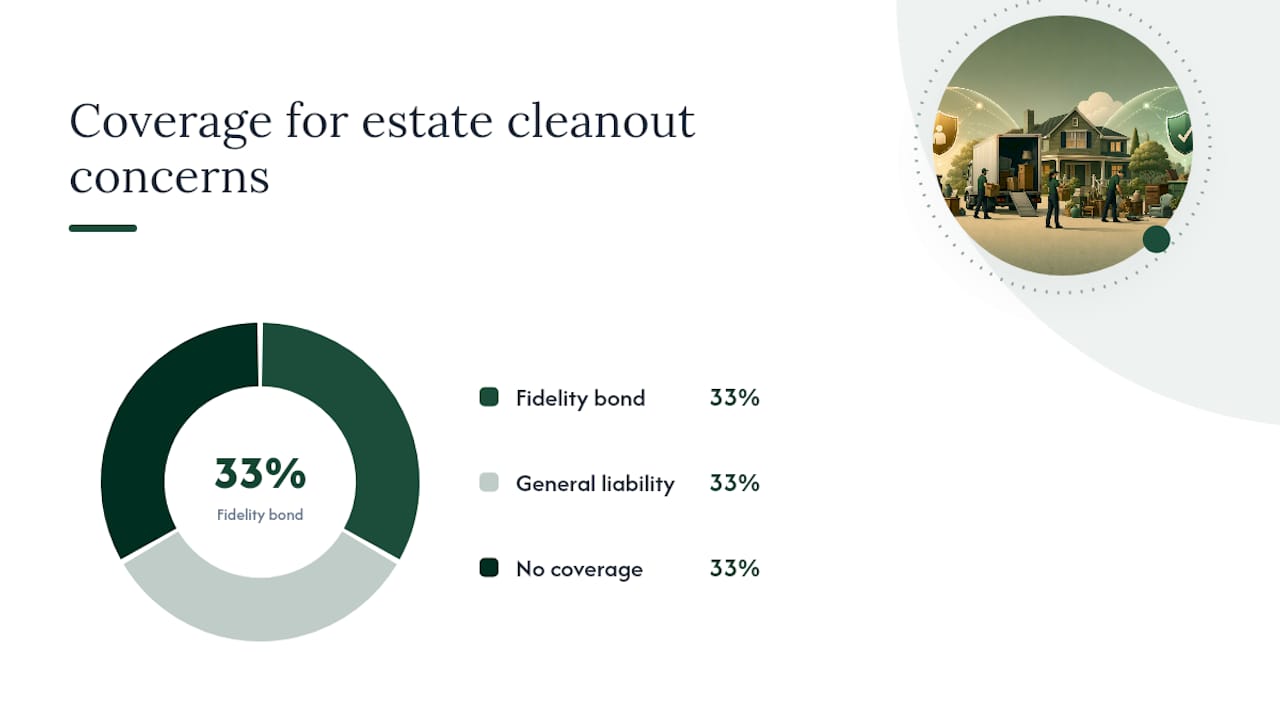
Consider a typical estate cleanout scenario. A family hires a service to clear a loved one's home. Three concerns arise: a piece of jewelry goes missing, a wall is scuffed during furniture removal, and the family worries about how donated items are handled.
Here is how coverage maps to each concern:
- Missing jewelry: A fidelity bond responds to employee theft. Without one, the client has limited financial recourse.
- Wall damage: General liability insurance covers accidental property damage caused during the job.
- Donation handling: Neither bond nor insurance governs this directly. It is a matter of documented process and service commitment.
Before hiring any estate cleanout service, request:
- A current COI showing general liability coverage with adequate limits.
- Confirmation of whether a fidelity bond is carried and the bond number.
- Written documentation of the sorting, donation, and disposal process.
- A signed inventory list of items removed, donated, or discarded.
Bereavementcleanoutservices operates with fully insured status across New Jersey and documents every cleanout with a donation-first sorting process, giving families a clear record of where each item went. For clients who want to understand how insurance responds to real service incidents, reviewing concrete examples from comparable cleaning and remediation contexts is a practical starting point.
Why showing proof of coverage changes everything for clients
Every cleanout we handle involves someone's most personal belongings, often during one of the hardest weeks of their life. Showing a COI at the first meeting is not a formality. It tells the family that if something goes wrong, there is a real financial backstop, not just a verbal promise.
The habit of documenting inventory before we touch a single item, and walking clients through what our insurance covers and what it does not, eliminates most disputes before they start. Clients who understand the coverage picture from day one are calmer, more trusting, and more likely to refer others. That transparency is worth more than any marketing claim.
Sources
These authoritative resources will help you confirm state-specific requirements, find licensed bond and insurance providers, and understand federal contracting rules:
- What Does It Mean to Be Bonded and Insured? | NFP
- Surety bonds - Small Business Administration - SBA
- Bonded and insured — Forbes Advisor
For state-specific bond rules, contact your state's Department of Insurance or contractor licensing board directly. For federal contracting requirements, the SBA's surety bond program page is the most reliable starting point.
This article is general information, not a substitute for advice from a qualified financial advisor. Consult a qualified financial professional about your own circumstances before acting on anything here.